Marcaine Injection, Solution
Product Images NDC 0404-9768

View Photos of Packaging, Regulatory Labels, and Product Appearance

Product Visual Gallery

This gallery contains 11 technical images submitted to the FDA as part of the official labeling for Marcaine (NDC 0404-9768). Unlike standard consumer photos, these assets often include clinical data figures, molecular chemical structures, and official manufacturer packaging layouts.

As provided by Henry Schein, Inc., these visuals offer a comprehensive scientific overview of the product's physical and chemical identity, aiding pharmacists and researchers in product verification and study.

FDA Label Image

Formula1.jpg (Formula1)

Formula1.jpg (Formula1)
Chemical structure of bupivacaine hydrochloride, the active ingredient in Marcaine injection solution. The diagram shows the molecular arrangement including the aromatic ring with methyl groups, a piperidine ring, and the associated hydrochloride and water molecules.*

FDA Label Image

Formula2.jpg (Formula2)

Formula2.jpg (Formula2)
Chemical structure diagram showing the molecular components related to the active ingredient in Marcaine (bupivacaine hydrochloride) injection solution, 5 mg/mL, from Henry Schein, Inc. The structure illustrates chemical groups and bonds relevant to bupivacaine.*
FDA Label Image

Image1.jpg (Image1)

Image1.jpg (Image1)
A data table titled 'Types of Block and Recommended Marcaine/Marcaine with Epinephrine Concentrations' showing recommended concentrations of Marcaine (bupivacaine hydrochloride) with and without epinephrine for various types of nerve blocks and anesthesia procedures. The table lists different blocks such as local infiltration, peripheral nerve block, retrobulbar block, sympathetic block, caudal block, lumbar epidural block, epidural test dose, and dental block, with check marks indicating recommended concentration strengths ranging from 0.25% (2.5 mg/mL) to 0.75% (7.5 mg/mL) for Marcaine alone and 0.25% to 0.5% for Marcaine with epinephrine.*
FDA Label Image

Image2.jpg (Image2)

Image2.jpg (Image2)
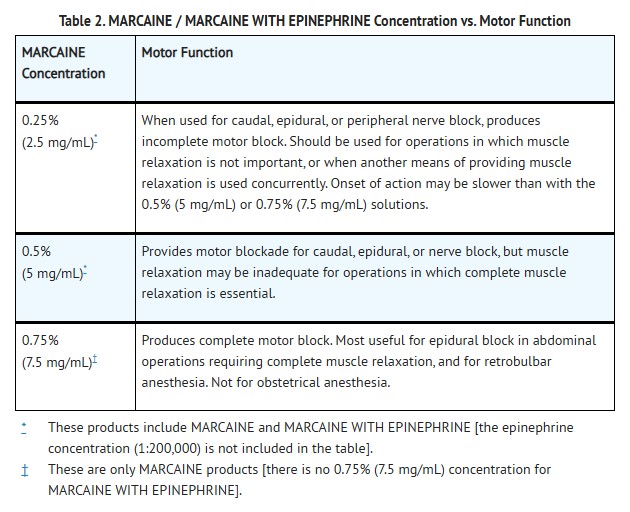
Table 2 comparing MARCAINE and MARCAINE WITH EPINEPHRINE concentration versus motor function. It details motor block effects at concentrations 0.25% (2.5 mg/mL), 0.5% (5 mg/mL), and 0.75% (7.5 mg/mL) of bupivacaine hydrochloride injection solution, noting differences in onset, completeness of motor block, and suitability for various nerve blocks and surgical uses.*
FDA Label Image

Image3.jpg (Image3)

Image3.jpg (Image3)
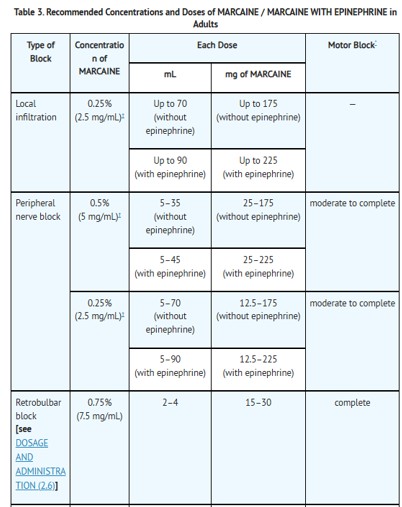
A table titled 'Recommended Concentrations and Doses of MARCAINE / MARCAINE WITH EPINEPHRINE in Adults' showing types of nerve blocks (Local infiltration, Peripheral nerve block, Retrobulbar block), corresponding concentrations of Marcaine (bupivacaine hydrochloride) in mg/mL, dosing volumes in mL, milligrams of Marcaine per dose, and motor block effects associated with each type of block.*
FDA Label Image

Image4.jpg (Image4)

Image4.jpg (Image4)
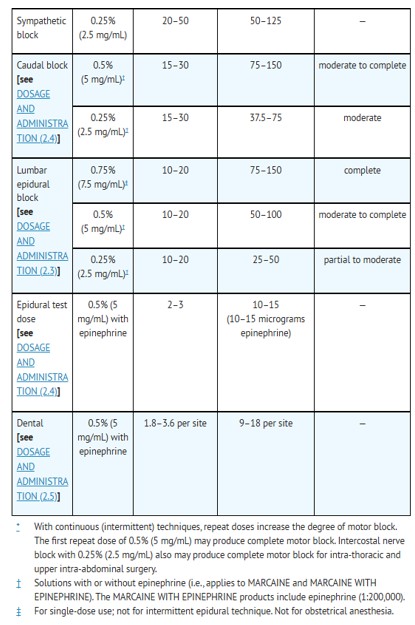
A dosing guideline table for Marcaine (bupivacaine hydrochloride) injection, solution 5 mg/mL by Henry Schein, Inc. The table lists block types (sympathetic, caudal, lumbar epidural, epidural test dose, dental) with corresponding concentrations, volume range (mL), dose range (mg or micrograms), and block characteristics such as completeness or motor block degree.*
FDA Label Image

Image5.jpg (Image5)

Image5.jpg (Image5)
A table titled 'Examples of Drugs Associated with Methemoglobinemia' listing drug classes and examples. Classes include Nitrates/Nitrites, Local anesthetics (including bupivacaine), Antineoplastic agents, Antibiotics, Antimalarials, Anticonvulsants, and Other drugs. The table links bupivacaine to the local anesthetics class.*
FDA Label Image

Image6.jpg (Image6)

Image6.jpg (Image6)
This table lists various NDC codes for Marcaine (bupivacaine hydrochloride) injection solutions with corresponding unit of sale descriptions and concentrations. It includes details on vial types (single-dose or multiple-dose), quantities per tray or carton, and specifies concentrations ranging from 0.25% to 0.5% with respective total milligrams per volume and mg/mL strengths.*
FDA Label Image

Image7.jpg (Image7)

Image7.jpg (Image7)
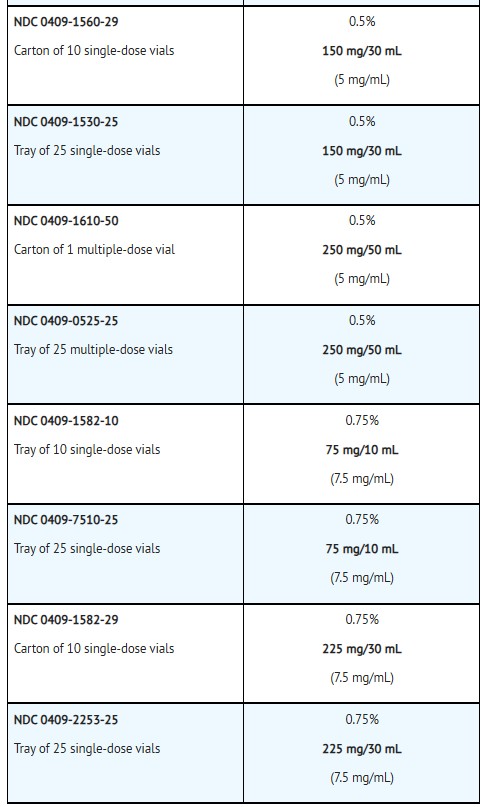
A data table listing multiple NDC codes, packaging types, and strengths for bupivacaine hydrochloride injection solutions. It details various vial formats (single-dose trays and cartons, multiple-dose vials) with concentrations of 0.5% (5 mg/mL) and 0.75% (7.5 mg/mL), including total amounts per package such as 150 mg/30 mL, 250 mg/50 mL, 75 mg/10 mL, and 225 mg/30 mL.*
FDA Label Image

Image8.jpg (Image8)

Image8.jpg (Image8)
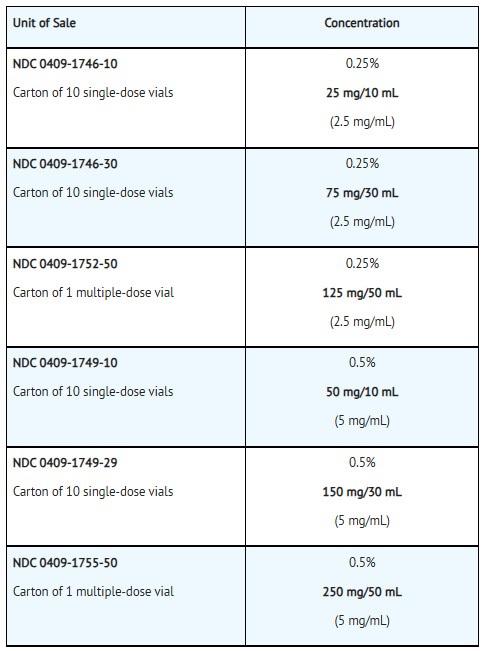
A data table listing various NDCs, unit sales, and concentrations for bupivacaine hydrochloride injection solutions. The table shows multiple packaging options including cartons of single-dose and multiple-dose vials with concentrations of 0.25% (2.5 mg/mL) and 0.5% (5 mg/mL) at different volumes, detailing specific NDC codes for each.*
FDA Label Image

Label1.jpg (Label1)

Label1.jpg (Label1)
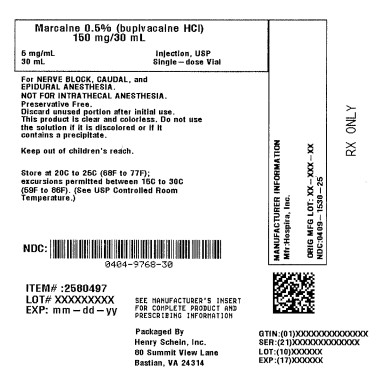
The label for Marcaine 0.5% (bupivacaine HCl) Injection, USP, shows a single-dose vial containing 150 mg/30 mL (5 mg/mL) solution. It specifies use for nerve block, caudal, and epidural anesthesia, not for intrathecal anesthesia. The label includes storage instructions (20-25°C, excursions 16-30°C allowed) and safety notes. Packaged by Henry Schein, Inc., Bastiaan, VA. NDC 0404-9768-30 is displayed with barcode and placeholders for lot and expiration dates.*

* About these descriptions: Image descriptions on this page are generated by automated AI analysis of the product label images from the manufacturer's FDA label submission (SPL). They are provided for reference only and may contain errors or omissions. Always rely on the printed label itself and the official FDA labeling, and consult a pharmacist or healthcare professional with any questions about this product.