Heparin Sodium Injection, Solution
Product Images NDC 0404-9979

View Photos of Packaging, Regulatory Labels, and Product Appearance

Product Visual Gallery

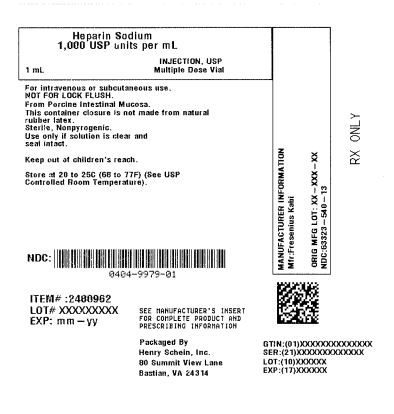
This gallery contains 7 technical images submitted to the FDA as part of the official labeling for Heparin Sodium (NDC 0404-9979). Unlike standard consumer photos, these assets often include clinical data figures, molecular chemical structures, and official manufacturer packaging layouts.

As provided by Henry Schein, Inc., these visuals offer a comprehensive scientific overview of the product's physical and chemical identity, aiding pharmacists and researchers in product verification and study.

FDA Label Image

Formula1.jpg (Formula1)

FDA Label Image

Image1.jpg (Image1)

Image1.jpg (Image1)
This text describes the method of frequency and recommended doses for administration of a medication through deep subcutaneous injection, intermittent intravenous injection, and continuous intravenous infusion. The initial dose and subsequent doses are provided for each method of administration. It is recommended to use a different site for each injection to prevent the development of hematoma or solution. The medication is not named.*
FDA Label Image

Image2.jpg (Image2)

Image2.jpg (Image2)
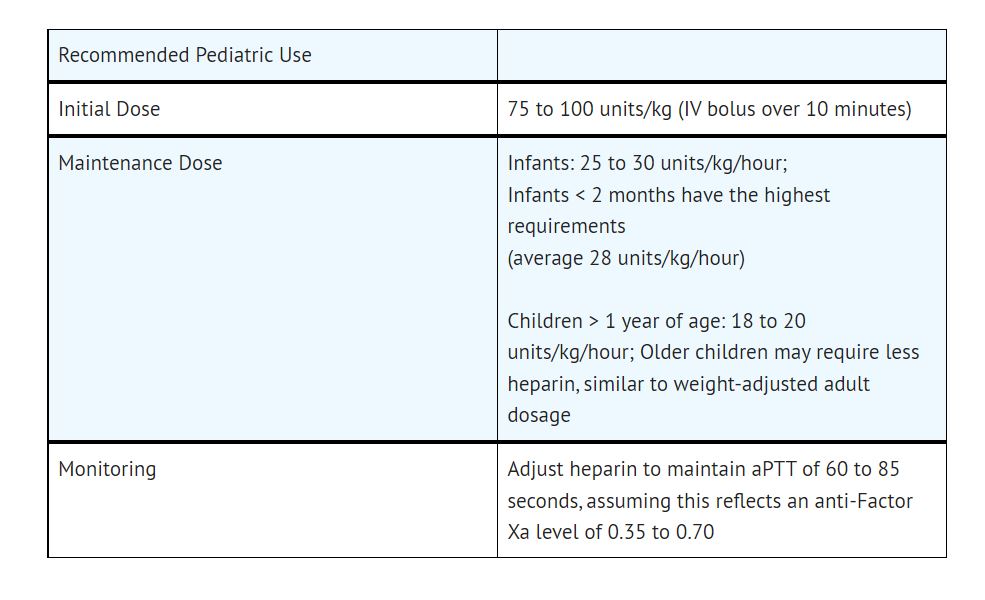
This text provides recommended pediatric dosages for the anticoagulant heparin. The initial dose is recommended to be between 75 to 100 units/kg, administered via IV bolus over ten minutes. Infants under 2 months old may require higher doses than infants older than 2 months or children over 1 year of age. The maintenance dose for infants is recommended to be 25 to 30 units/kg/hour, while the maintenance dose for children over 1 year old is recommended to be 18 to 20 units/kg/hour. Heparin dosage should be adjusted to maintain a specific aPTT level between 60 to 85 seconds.*
FDA Label Image

Image3.jpg (Image3)

Image3.jpg (Image3)
This text describes two pharmaceutical products with their respective codes, unit of sales, strengths, and quantities. The first product has a code of 27602 and is sold in units of 25 per box. Each unit has 2 mL of medication and a strength of 1,000 USP units per mL. The second product has a code of 504313 and is sold in units of 25 per box as well. Each unit has 0.5 mL of medication and a strength of 5,000 USP units per 0.5 mL. Both products are contained in single-dose, flip-top vials.*
FDA Label Image

Image4.jpg (Image4)

Image4.jpg (Image4)
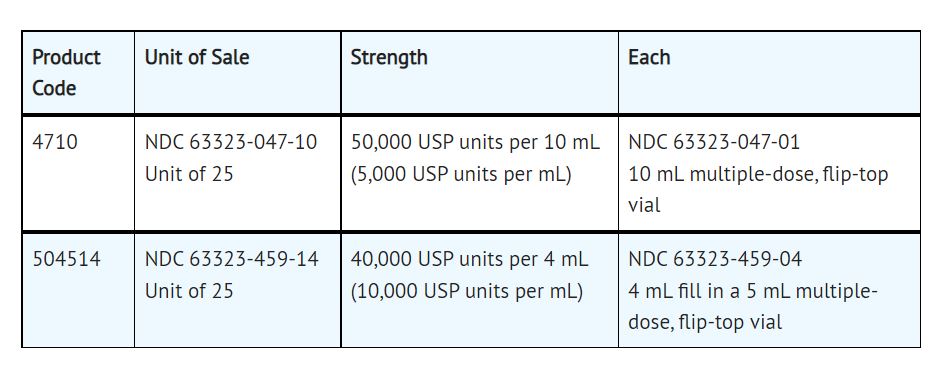
Product code 4710 or 504514 is available in units of sale as NDC 63323-047-10 or NDC 63323-459-14 respectively, with each unit containing 25 vials. The strength of the product is either 50,000 USP units per 10 mL (5,000 USP units per mL) or 40,000 USP units per 4 mL (10,000 USP units per mL) depending on the unit of sale. Each individual vial is either a 10 mL multiple-dose, flip-top vial (NDC 63323-047-01) or a 4 mL fill in a 5 mL multiple-dose, flip-top vial (NDC 63323-459-04).*
FDA Label Image

Image5.jpg (Image5)

Image5.jpg (Image5)
This is a list of pharmaceutical products with their corresponding NDC codes and unit of sale. The products are presented in different strengths and quantities per vial, ranging from 1,000 to 50,000 USP units per ml. Some products are available in a 2 mL multiple-dose flip-top vial, others are in a 10 mL or 30 mL flip-top vial. One product on the list contains an RFID technology. The unit of sale for all products is 25.*
FDA Label Image

Label1.jpg (Label1)

* These product label images have been analyzed using experimental machine learning. Please verify findings with the primary label text.