- (270 mg Iodine/mL) CT imaging of the head and body.
- (270 mg Iodine/mL) excretory urography.
Intra-arterial Dosage and Administration
Angiocardiography, cerebral arteriography, or visceral arteriography (320 mg Iodine/mL):
The recommended dosage is 1 to 2 mL/kg. The maximum dose should not exceed 4 mL/kg.
Intravenous Dosage and Administration
Computerized Tomography or Excretory Urography (270 mg Iodine/mL):
The recommended dosage is 1 to 2 mL/kg. The maximum dose should not exceed 2 mL/kg.
Angiocardiography
Serious, rarely fatal, thromboembolic events causing myocardial infarction and stroke can occur during angiocardiography procedures with both ionic and nonionic contrast media. During these procedures, increased thrombosis and activation of the complement system occurs. Risk factors for thromboembolic events include: length of procedure, catheter and syringe material, underlying disease state, and concomitant medications.
To minimize thromboembolic events, use meticulous angiographic techniques, and minimize the length of the procedure. Avoid blood remaining in contact with syringes containing iodinated contrast agents, which increases the risk of clotting. Avoid angiocardiography in patients with homocystinuria because of the risk of inducing thrombosis and embolism.
Metformin
In patients with renal impairment, metformin can cause lactic acidosis. Iodinated contrast agents appear to increase the risk of metformin-induced lactic acidosis, possibly as a result of worsening renal function. Stop metformin at the time of, or prior to, VISIPAQUE administration in patients with an eGFR between 30 and 60 mL/min/1.73 m2; in patients with a history of hepatic impairment, alcoholism or heart failure; or in patients who will be administered intra-arterial iodinated contrast. Re-evaluate eGFR 48 hours after the imaging procedure, and reinstitute metformin only after renal function is stable.
Radioactive Iodine
Administration of iodinated contrast agents may interfere with thyroid uptake of radioactive iodine (I-131 and I-123) and decrease therapeutic and diagnostic efficacy in patients with carcinoma of the thyroid. The decrease in efficacy lasts for 6 to 8 weeks.
Beta-adrenergic Blocking Agents
The use of beta-adrenergic blocking agents lowers the threshold for and increases the severity of contrast reactions, and reduces the responsiveness of treatment of hypersensitivity reactions with epinephrine. Because of the risk of hypersensitivity reactions, use caution when administering VISIPAQUE to patients taking beta-blockers.
Oral Cholecystographic Contrast Agents
Renal toxicity has been reported in patients with liver dysfunction who were given an oral cholecystographic agent followed by intravascular iodinated contrast agents. Postpone the administration of VISIPAQUE in patients who have recently received an oral cholecystographic contrast agent.
Effect on Thyroid Tests
The results of protein bound iodine and radioactive iodine uptake studies, which depend on iodine estimation, will not accurately reflect thyroid function for at least 16 days following administration of iodinated contrast agents. However, thyroid function tests which do not depend on iodine estimations (e.g., T3 resin uptake and total or free thyroxine T4 assays) are not affected.
Effect on Urine Tests
As reported with other contrast agents, VISIPAQUE may produce a false-positive result for protein in the urine using urine dip tests. However, the Coomassie blue method has been shown to give accurate results for the measurement of urine protein in the presence of VISIPAQUE. In addition, care should be used in interpreting the results of urine specific gravity measurements in the presence of high levels of VISIPAQUE and other contrast agents in the urine. Refractometry or urine osmolality may be substituted.
Risk Summary
There are no data with iodixanol use in pregnant women to inform any drug-associated risks. In animal reproduction studies, no developmental toxicity occurred with intravenous iodixanol administration to rats and rabbits at doses up to 0.24 (rat) or 0.48 (rabbit) times the maximum recommended human intravenous dose (see Data).
All pregnancies have a background risk of birth defect, loss or other adverse outcomes. In the U.S. general population, the estimated background risk of major birth defects and miscarriage in clinically recognized pregnancies is 2 to 4% and 15 to 20%, respectively.
Data
Animal Data
Reproduction studies were performed in rats and rabbits with intravenous administration of iodixanol at doses up to 2 g Iodine/kg, daily, from implantation of the embryo (gestation day 7 in rat; 6 in rabbit) through closure of the hard palate (gestation day 17 in rats; 18 in rabbits). No maternal toxicity occurred, and no adverse effects occurred on fetal survival, embryo-fetal development, or the ability of dams to rear a litter.
Risk Summary
There are no data on the presence of iodixanol in human milk, the effects on the breastfed infant or the effects on milk production. Iodinated contrast agents are poorly excreted into human milk and are poorly absorbed by the gastrointestinal tract of a breastfed infant. The developmental and health benefits of breastfeeding should be considered along with the mother's clinical need for VISIPAQUE and any potential adverse effects on the breastfed infant from VISIPAQUE or from the underlying maternal condition.
Clinical Considerations
Interruption of breastfeeding after exposure to iodinated contrast agents is not necessary because the potential exposure of the breastfed infant to iodine is small. However, a lactating woman may consider interrupting breastfeeding and pumping and discarding breast milk for 10 hours (approximately 5 elimination half-lives) after VISIPAQUE administration in order to minimize drug exposure to a breast fed infant.
Distribution
In an in vitro human plasma study, iodixanol did not bind to protein. The volume of distribution in adults was 0.26 L/kg body weight, consistent with distribution to extracellular space.
Elimination
In 40 healthy, young male volunteers receiving a single intravenous administration of VISIPAQUE in doses of 0.3 to 1.2 gram Iodine/kg body weight, the elimination half-life was 2.1 hr. (± 0.1). Renal clearance was 110 ± 14 mL/min, equivalent to glomerular filtration (108 mL/min). These values were independent of the dose administered.
Metabolism
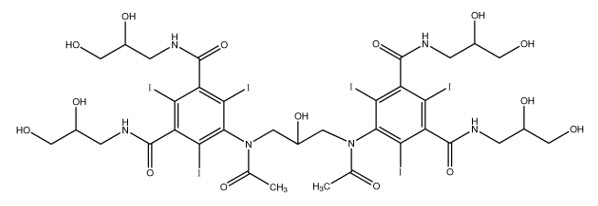
Iodixanol does not undergo metabolism.
Excretion
In adults, approximately 97% of the injected dose of iodixanol is excreted unchanged in urine within 24 hours, with less than 2% excreted in feces within five days post-injection.
Specific Populations
Pediatric: Forty pediatric patients ≤12 years old, with renal function that is normal for their age, received multiple intra-arterial administrations of VISIPAQUE in doses of 0.32 to 3.2 gram Iodine/kg body weight. The elimination half-lives for these patients are shown in Table 5.
Dose adjustments to account for differences in elimination half-life in pediatric patients less than 6 months of age have not been studied.
TABLE 5 MEAN ELIMINATION HALF-LIFE* IN PEDIATRIC PATIENTS| Age Range | Number of Patients | Elimination half-life |
|---|
| | (hr. ± SD) |
|---|
| Newborn to < 2 months | 8 | 4.1 ± 1.4 |
| 2 to 6 months | 8 | 2.8 ± 0.6 |
| 6 to 12 months | 9 | 2.4 ± 0.4 |
| 1 to 2 years | 5 | 2.3 ± 0.6 |
| 2 to 12 years | 10 | 2.3 ± 0.5 |
| Adults | 40 | 2.1 ± 0.1 |
Renal Impairment: In patients with significantly impaired renal function, the total clearance of iodixanol is reduced and the half-life is increased. In a study of 16 adult patients who were scheduled for renal transplant, the mean creatinine clearance was 13.6 ± 4.7 mL/min). In these patients, plasma half-life was 23 hours (t1/2 for typical patients = 2.1 hours). Contrast enhancement time in kidneys increased from 6 hours to at least 24 hours. Dose adjustments in patients with renal impairment have not been studied. In patients with normal blood brain barriers and severe renal impairment, iodinated contrast agents have been associated with blood-brain barrier disruption and accumulation of contrast in the brain.
VISIPAQUE has been shown to be dialyzable. In an in vitro hemodialysis study, after 4 hours of dialysis with a cellulose membrane, approximately 36% of iodixanol was removed from the plasma. After 4 hours of dialysis with polysulfone membranes, approximately 49% of iodixanol was removed.
Hypersensitivity Reactions
Advise the patient concerning the risk of hypersensitivity reactions that can occur both during and after VISIPAQUE administration. Advise the patient to report any signs or symptoms of hypersensitivity reactions during the procedure and to seek immediate medical attention for any signs or symptoms experienced after discharge [see Warnings and Precautions (5.2)].
Advise patients to inform their physician if they develop a rash after receiving VISIPAQUE [see Warnings and Precautions (5.11)].
Contrast-Induced Acute Kidney Injury
Advise the patient concerning appropriate hydration to decrease the risk of contrast-induced acute kidney injury [see Warnings and Precautions (5.3)].
Extravasation
If extravasation occurs during injection, advise patients to seek medical care for progression of symptoms [see Warnings and Precautions (5.6)].
Thyroid Dysfunction
Advise parents/caregivers about the risk of developing thyroid dysfunction after VISIPAQUE administration. Advise parents/caregivers about when to seek medical care for their child to monitor for thyroid dysfunction [see Warnings and Precautions (5.8)].
Distributed by GE Healthcare Inc., Marlborough, MA 01752 U.S.A.
Product of Norwegian Origin.
VISIPAQUE is a trademark of General Electric Company or one of its subsidiaries.
GE and the GE Monogram are trademarks of General Electric Company.
© 2022 General Electric Company - All rights reserved.
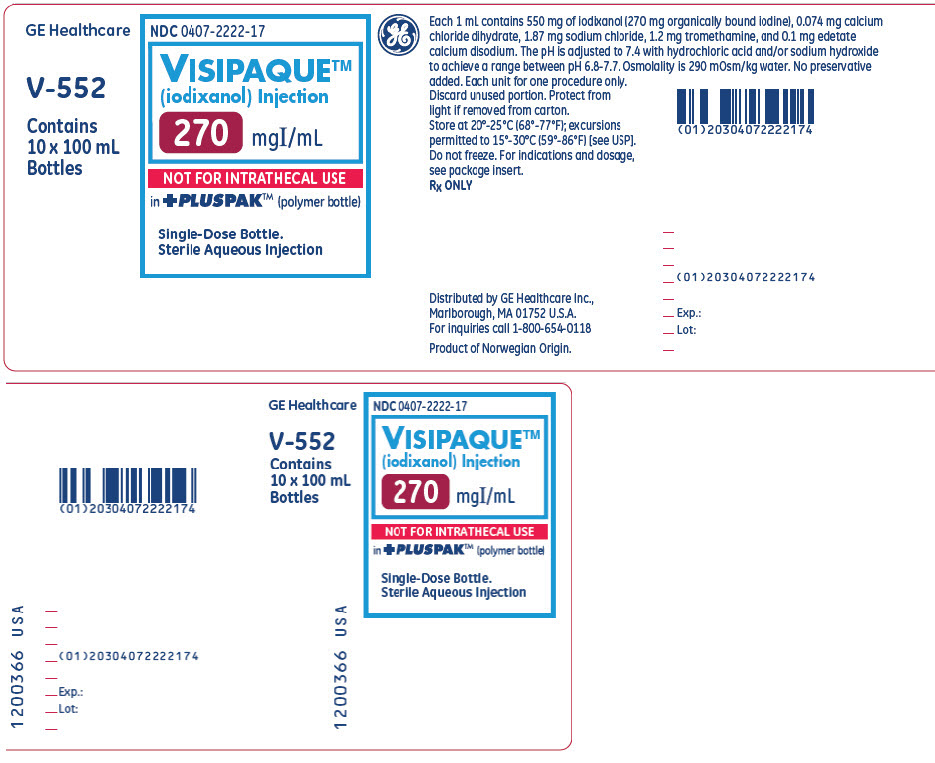
GE Healthcare
V-552
Contains
10 x 100 mL
Bottles