Risk Summary
There are no data with Optison use in pregnant women to inform any drug-associated risks. No adverse developmental outcomes were observed in animal reproduction studies with intravenous administration of Optison to pregnant rats and rabbits during organogenesis at doses up to at least 5 and 10 times the recommended human dose based on body surface area (see Data).
In the U.S. general population, the estimated background risk of major birth defects and miscarriage in clinically recognized pregnancies is 2-4% and 15-20%, respectively.
Data
Animal Data
Optison was administered intravenously to rats at doses of 0.25, 5 and 10 mL/kg/day (approximately 0.2, 5 and 10 times the recommended maximum human dose of 8.7 mL, respectively, based on body surface area) and to rabbits at 0.25, 2.5 and 5 mL/kg/day (approximately 0.5, 5 and 10 times the recommended maximum human dose, respectively, based on body surface area) during organogenesis. No significant findings attributable solely to a direct effect on the fetus were detected in the studies.
Distribution
The binding of perflutren to plasma proteins and its partitioning into blood cells are unknown. However, perflutren protein binding is expected to be minimal due to the low partition coefficient of the gas in blood.
Elimination
Following intravenous injection, perflutren is cleared with a pulmonary elimination half-life of 1.3 ± 0.69 minutes (mean ± SD).
Metabolism
Perflutren is a stable gas that is not metabolized. The human albumin component of the microsphere is expected to be handled by the normal metabolic routes.
Excretion
Perflutren is eliminated through the lungs within 10 minutes. The mean ± SD recovery was 96% ± 23%. The perflutren concentration in expired air peaked approximately 30-40 seconds after administration.
Carcinogenesis
Animal studies were not carried out to determine the carcinogenic potential of Optison.
Mutagenesis
The result of the following genotoxicity studies with Optison were negative: 1) Salmonella/Escherichia coli reverse mutation assay, 2) in vitro mammalian chromosome aberration assay using Chinese hamster ovary cells (CHO) with and without metabolic activation, 3) CHO/HGPRT forward mutation assay, and 4) in vivo mammalian micronucleus assay.
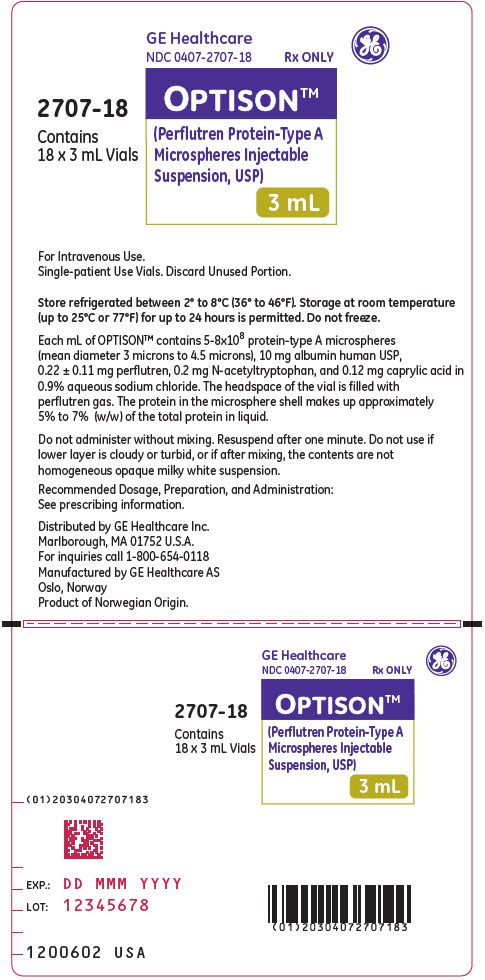
Distributed by GE Healthcare Inc., Marlborough, MA 01752 U.S.A.
Manufactured by GE Healthcare AS, Oslo, Norway
OPTISON™ is a trademark of GE Healthcare or one of its subsidiaries
GE and the GE Monogram are trademarks of General Electric Company.
© 2016 General Electric Company - All rights reserved.
OPT-1H-OSLO
Revised September 2016