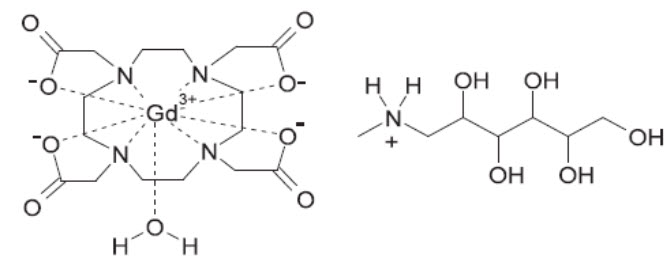
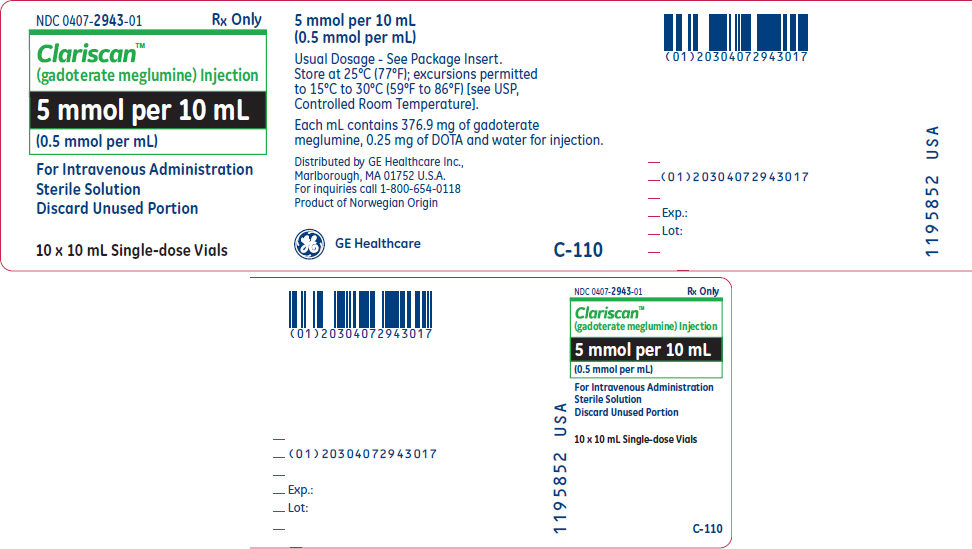
Directions for Use of Clariscan (gadoterate meglumine) Injection
Glass vial:
Aseptically draw up the contrast medium into a disposable syringe and use immediately.
Adverse Reactions in Pediatric Patients
During clinical trials, 140 pediatric patients (7 aged < 24 months, 33 aged 2 - 5 years, 57 aged 6 - 11 years and 43 aged 12 – 17 years) received gadoterate meglumine. Overall, 6 pediatric patients (4.3%) reported at least one adverse reaction following gadoterate meglumine administration. The most frequently reported adverse reaction was headache (1.1%). Most adverse events were mild in intensity and transient in nature.
Additional pediatric use information is approved for Guerbet, LLC's Dotarem (gadoterate meglumine injection). However, due to Guerbet LLC's marketing exclusivity, this drug product is not labeled with that pediatric information.
Risk Summary
GBCAs cross the human placenta and result in fetal exposure and gadolinium retention. The human data on the association between GBCAs and adverse fetal outcomes are limited and inconclusive (see Data). In animal reproduction studies, there were no adverse developmental effects observed in rats or rabbits with intravenous administration of gadoterate meglumine during organogenesis at doses up to 16 and 10 times, respectively, the recommended human dose (see Data). Because of the potential risks of gadolinium to the fetus, use Clariscan only if imaging is essential during pregnancy and cannot be delayed.
The estimated background risk of major birth defects and miscarriage for the indicated population(s) are unknown. All pregnancies have a background risk of birth defect, loss, or other adverse outcomes. In the U.S. general population, the estimated background risk of major birth defects and miscarriage in clinically recognized pregnancies is 2-4% and 15-20%, respectively.
Data
Human Data
Contrast enhancement is visualized in the placenta and fetal tissues after maternal GBCA administration.
Cohort studies and case reports on exposure to GBCAs during pregnancy have not reported a clear association between GBCAs and adverse effects in the exposed neonates. However, a retrospective cohort study, comparing pregnant women who had a GBCA MRI to pregnant women who did not have an MRI, reported a higher occurrence of stillbirths and neonatal deaths in the group receiving GBCA MRI. Limitations of this study include a lack of comparison with non-contrast MRI and lack of information about the material indication for MRI. Overall, these data preclude a reliable evaluation of the potential risk of adverse fetal outcomes with the use of GBCAs in pregnancy.
Animal Data
Gadolinium Retention
GBCAs administered to pregnant non-human primates (0.1 mmol/kg on gestational days 85 and 135) result in measurable gadolinium concentration in the offspring in bone, brain, skin, liver, kidney, and spleen for at least 7 months. GBCAs administered to pregnant mice (2 mmol/kg daily on gestational days 16 through 19) result in measurable gadolinium concentrations in the pups in bone, brain, kidney, liver, blood, muscle, and spleen at one-month postnatal age.
Reproductive Toxicology
Gadoterate meglumine was administered in intravenous doses of 0, 2, 4 and 10 mmol/kg/day [3, 7 and 16 times the recommended human dose (RHD) based on body surface area (BSA)] to female rats for 14 days before mating, throughout the mating period and until gestation day (GD) 17. Pregnant rabbits were administered gadoterate meglumine in intravenous doses levels of 0, 1, 3 and 7 mmol/kg/day (3, 10 and 23 times the RHD based on BSA) from GD6 to GD19. No effects on embryo-fetal development were observed at doses up to 10 mmol/kg/day in rats or 3 mmol/kg/day in rabbits. Maternal toxicity was observed in rats at 10 mmol/kg/day and in rabbits at 7 mmol/kg/day. This maternal toxicity was characterized in rats by a slightly lower litter size and gravid uterus weight compared to the control group, and in rabbits by a reduction in body weight and food consumption.
Risk Summary
There are no data on the presence of gadoterate in human milk, the effects on the breastfed infant, or the effects on milk production. However, published lactation data on other GBCAs indicate that 0.01 to 0.04% of the maternal gadolinium dose is present in breast milk. Additionally, there is limited GBCA gastrointestinal absorption in the breastfed infant. Gadoterate is present in goat milk (see Data). The developmental and health benefits of breastfeeding should be considered along with the mother's clinical need for Clariscan and any potential adverse effects on the breastfed infant from Clariscan or from the underlying maternal condition.
Data
Nonclinical data demonstrate that gadoterate is detected in goat milk in amounts < 0.1% of the dose intravenously administered. Furthermore, in rats, absorption of gadoterate via the gastrointestinal tract is poor (1.2% of the administered dose was absorbed and eliminated in urine).
Juvenile Animal Data
Single and repeat-dose toxicity studies in neonatal and juvenile rats did not reveal findings suggestive of a specific risk for use in pediatric patients.
Additional pediatric use information is approved for Guerbet, LLC's Dotarem (gadoterate meglumine injection). However, due to Guerbet LLC's marketing exclusivity, this drug product is not labeled with that pediatric information.
Distribution
The volume of distribution at steady state of total gadolinium in normal subjects is 179 ± 26 and 211 ± 35 mL/kg in female and male subjects respectively, roughly equivalent to that of extracellular water. Gadoterate does not undergo protein binding in vitro. The extent of blood cell partitioning of gadoterate is not known.
Following GBCA administration, gadolinium is present for months or years in brain, bone, skin, and other organs [see Warnings and Precautions (5.3)].
Metabolism
Gadoterate is not known to be metabolized.
Elimination
Following a 0.1 mmol/kg dose of gadoterate meglumine, total gadolinium is excreted primarily in the urine with 72.9 ± 17.0% and 85.4 ± 9.7% (mean ± SD) eliminated within 48 hours, in female and male subjects, respectively. Similar values were achieved after a cumulative dose of 0.3 mmol/kg (0.1 + 0.2 mmol/kg, 20 minutes later), with 85.5 ± 13.2% and 92.0 ± 12.0% recovered in urine within 48 hours in female and male subjects, respectively.
In healthy subjects, the renal and total clearance rates of total gadolinium are comparable (1.27 ± 0.32 and 1.74 ± 0.12 mL/min/kg in females; and 1.40 ± 0.31 and 1.64 ± 0.35 mL/min/kg in males, respectively) indicating that the drug is primarily cleared through the kidneys. Within the studied dose range (0.1 to 0.3 mmol/kg), the kinetics of total gadolinium appear to be linear.
Special Populations
Renal Impairment
A single intravenous dose of 0.1 mmol/kg of gadoterate meglumine was administered to 8 patients (5 men and 3 women) with impaired renal function (mean serum creatinine of 498 ± 98 µmol/L in the 10-30 mL/min creatinine clearance group and 192 ± 62 µmol/L in the 30-60 mL/min creatinine clearance group). Renal impairment delayed the elimination of total gadolinium. Total clearance decreased as a function of the degree of renal impairment. The distribution volume was unaffected by the severity of renal impairment (Table 5). No changes in renal function test parameters were observed after gadoterate meglumine injection. The mean cumulative urinary excretion of total gadolinium was approximately 76.9 ± 4.5% in 48 hours in patients with moderate renal impairment, 68.4 ± 3.5% in 72 hours in patients with severe renal impairment and 93.3 ± 4.7% in 24 hours for subjects with normal renal function.
Table 5: Pharmacokinetic Profile of Total Gadolinium in Normal and Renally Impaired Patients| Population | Elimination Half-life
(hr) | Plasma Clearance
(L/h/kg) | Distribution Volume
(L/kg) |
|---|
| Healthy volunteers | 1.6 ± 0.2 | 0.10 ± 0.01 | 0.246 ± 0.03 |
| Patients with moderate renal impairment | 5.1 ± 1.0 | 0.036 ± 0.007 | 0.236 ± 0.01 |
| Patients with severe renal impairment | 13.9 ± 1.2 | 0.012 ± 0.001 | 0.234 ± 0.01 |
Gadoterate was shown to be dialyzable after an IV injection of gadoterate meglumine in 10 patients with end-stage renal failure who required hemodialysis treatment. Gd serum concentration decreased over time by 88%, 93% and 97% at 0.5 hours, 1.5 hours, and 4 hours after start of dialysis, respectively. A second and third hemodialysis session further removed Gd. After the third dialysis, Gd serum concentration decreased by 99.7%.
Pediatric Population
Additional pediatric use information is approved for Guerbet, LLC's Dotarem (gadoterate meglumine injection). However, due to Guerbet LLC's marketing exclusivity, this drug product is not labeled with that pediatric information.
CNS Imaging
Efficacy and safety of gadoterate meglumine were evaluated in a multi-center clinical trial (Study A) that enrolled 364 adult and 38 pediatric patients (aged ≥ 2 years) with known or suspected CNS lesions. Adults were randomized 2 to 1 to receive either gadoterate meglumine or gadopentetate dimeglumine, each administered at a dose of 0.1 mmol/kg. All pediatric patients received gadoterate meglumine, also at a dose of 0.1 mmol/kg. In the trial, patients first underwent a baseline (pre-contrast) MRI examination followed by the assigned GBCA administration and a post-contrast MR examination. The images (pre-contrast, post-contrast and "paired pre- and post-contrast") were interpreted by three independent off-site readers blinded to clinical information. The primary efficacy analysis compared three patient-level visualization scores (paired images) to baseline MRI (pre-contrast images) for adults who received gadoterate meglumine. The three primary visualization components were: contrast enhancement, border delineation and internal morphology. For each of these components there was a pre-defined scoring scale. Lesion counting (up to five per patient) was also reflected within each component's patient-level visualization score.
Among the adult patients, 245 received gadoterate meglumine and their data comprised the primary efficacy population. There were 114 (47%) men and 131 (53%) women with a mean age of 53 years (range 18 to 85 years), the racial and ethnic representations were 84% Caucasian, 11% Asian, 4% Black, and 1% other.
Table 6 displays a comparison of paired images (pre-and post-contrast) to pre-contrast images with respect to the proportion of patients who had paired image scores that were greater "better", or same/worse "not better" than the pre- contrast scores and with respect to the difference in the mean patient level visualization score. Across the three readers 56% to 94% of patients had improved lesion visualization for paired images compared to pre-contrast images. Gadoterate meglumine provided a statistically significant improvement for all three primary visualization components. More lesions were seen on the paired images than the pre-contrast images.
Table 6: Study A. Improvement in Patient-level Lesion Visualization Scores, Paired versus Pre-contrast ImagesBetter: number of patients with paired (pre-and post-contrast) score greater than the pre-contrast score
Not better: number of patients with paired score same as or worse than the pre-contrast score
Missing: number of patients with missing score
| Lesion Scores | Reader 1 | Reader 2 | Reader 3 |
|---|
| n = 231 | n = 232 | n = 237 |
|---|
| Border Delineation |
| Better | 195 (84%) | 215 (93%) | 132 (56%) |
| Not Better | 28 (12%) | 7 (3%) | 88 (37%) |
| Missing | 8 (4%) | 10 (4%) | 17 (7%) |
| Difference in Mean Score Difference = paired mean score minus pre-contrast mean score | 2.26 Statistically significant improvement by paired t-test | 2.89 | 1.17 |
| Internal Morphology |
| Better | 218 (94%) | 214 (93%) | 187 (79%) |
| Not Better | 5 (2%) | 8 (3%) | 33 (14%) |
| Missing | 8 (4%) | 10 (4%) | 17 (7%) |
| Difference in Mean Score | 2.74 | 2.75 | 1.54 |
| Contrast Enhancement |
| Better | 208 (90%) | 216 (93%) | 208 (88%) |
| Not Better | 15 (6%) | 6 (3%) | 12 (5%) |
| Missing | 8 (4%) | 10 (4%) | 17 (7%) |
| Difference in Mean Score | 3.09 | 3.69 | 2.92 |
In secondary analyses, post-contrast images were improved in comparison to pre-contrast images. Gadoterate meglumine lesion visualization scores were similar to those for gadopentetate dimeglumine. Gadoterate meglumine imaging results in the pediatric patients were also similar to those seen in adults.
In a second clinical trial (Study B), MR images were reread from 150 adult patients with known CNS lesions who had participated in a previously conducted clinical trial. Gadoterate meglumine administration and image interpretation was performed in the same manner as in Study A. Similar to Study A, this trial also demonstrated improved lesion visualization with gadoterate meglumine.
Additional pediatric use information is approved for Guerbet, LLC's Dotarem (gadoterate meglumine injection). However, due to Guerbet LLC's marketing exclusivity, this drug product is not labeled with that pediatric information.
Distributed by GE Healthcare Inc.
Marlborough, MA 01752 U.S.A.
Product of Norwegian Origin.
GE and the GE Monogram are trademarks of General Electric Company.
1197884 BK