- Administer FLYRCADO via intravenous injection as a bolus lasting less than 10 seconds and immediately follow with a flush of 0.9% Sodium Chloride Injection, USP.
- The minimum time between rest and stress dose administration is:
- 30 minutes when using pharmacologic stress
- 60 minutes when using exercise stress
- When using pharmacologic stress, administer FLYRCADO at the time of peak vasodilation according to the prescribing information for the stress agent, using an intravenous port different from the one used for the stress agent.
- When using exercise stress, administer FLYRCADO after the patient reaches at least 85% of their age-predicted maximum heart rate or exhibits ischemic signs or symptoms. The patient should then continue to exercise for approximately 1 minute to 2 minutes after the injection. If the patient cannot achieve the target heart rate, the examination may be converted to pharmacologic stress.
Rest Imaging
Begin the PET acquisition 5 minutes after FLYRCADO administration and acquire images for 10 minutes using a scanner in 3D mode.
Pharmacologic Stress Imaging
Begin the PET acquisition 5 minutes after FLYRCADO administration and acquire images for 10 minutes using a scanner in 3D mode.
Optionally, dynamic imaging may be performed, starting immediately prior to the injection of FLYRCADO.
Exercise Stress Imaging
Once the patient has been positioned on the scanner and respiration has begun to return to normal, begin image acquisition (about 15 minutes to 25 minutes after administration of FLYRCADO). Acquire images for 10 minutes using a scanner in 3D mode.
Risk Summary
There are no data on use of flurpiridaz F 18 in pregnant women to evaluate for a drug-associated risk of major birth defects, miscarriage, or other adverse maternal or fetal outcomes.
All radiopharmaceuticals, including FLYRCADO, have the potential to cause fetal harm depending on the fetal stage of development and the magnitude of the radiation dose. If considering FLYRCADO administration to a pregnant woman, inform the patient about the potential for adverse pregnancy outcomes based on the radiation dose from flurpiridaz F 18 and the gestational timing of exposure.
FLYRCADO contains ethanol (a maximum daily dose of 337 mg anhydrous ethanol). The lower limit of safety for ethanol use during pregnancy has not been established. Published studies have demonstrated that ethanol is associated with fetal harm including central nervous system abnormalities, behavioral disorders, and impaired intellectual development. If considering FLYRCADO administration to a pregnant woman, inform the patient about the potential for adverse pregnancy outcomes associated with ethanol exposure during pregnancy.
The background risk of major birth defects and miscarriage for the indicated population is unknown. All pregnancies have a background risk of birth defect, loss, or other adverse outcomes. In the U.S. general population, the estimated background risk of major birth defects and miscarriage in clinically recognized pregnancies is 2% to 4% and 15% to 20%, respectively.
Risk Summary
There are no data on the presence of flurpiridaz F 18 or its metabolites in human milk or animal milk, the effects on the breastfed infant, or the effects on milk production. Based on clinical guidelines, exposure of FLYRCADO to a breastfed infant can be minimized by advising a lactating woman to temporarily discontinue breastfeeding and to pump and discard breast milk for a minimum of 8 hours after administration of FLYRCADO. The developmental and health benefits of breastfeeding should be considered along with the mother's clinical need for FLYRCADO and any potential adverse effects on the breastfed child from FLYRCADO or from the underlying maternal condition.
Distribution
Flurpiridaz F 18 distributes to the liver (19% of injected activity), kidneys (9%), brain (8%), and heart wall (3%) about 10 minutes post-dose. The heart wall radioactivity was retained for 1 hour after administration.
Elimination
Flurpiridaz F 18 and its metabolites were cleared from blood within 48 hours.
Metabolism
Flurpiridaz F 18 was shown to undergo biotransformation to numerous polar metabolites.
Excretion
Following intravenous administration of a single dose of 3H-radiolabeled flurpiridaz, 63% of the administered dose was recovered in urine (0% unchanged flurpiridaz) and 30% in feces (0% unchanged flurpiridaz).
Specific Populations
No clinically significant differences in the pharmacokinetics of flurpiridaz F 18 were observed for age, sex, body mass index, diabetic status, mild hepatic impairment (Child Pugh A), or renal impairment (eGFR ≥19 to 89 mL/min). The effect of moderate to severe hepatic impairment (Child Pugh B and C) or end stage renal disease on flurpiridaz F 18 pharmacokinetics has not been evaluated.
Carcinogenesis
No carcinogenicity studies of flurpiridaz have been conducted.
Mutagenesis
Flurpiridaz did not demonstrate mutagenic potential in an in vitro bacterial reverse mutation assay (Ames test), in an in vitro chromosome aberration assay in Chinese hamster ovary cells, or in an in vivo rat micronucleus assay.
How Supplied
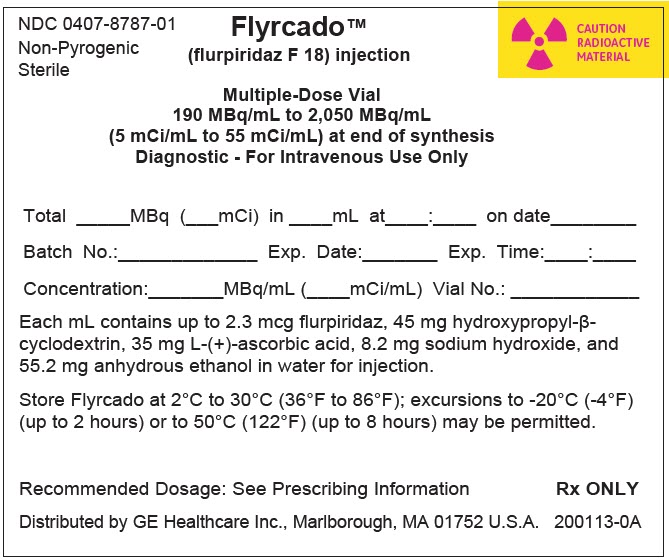
FLYRCADO (flurpiridaz F 18) injection is a clear, colorless to yellow solution containing 190 MBq/mL to 2,050 MBq/mL (5 mCi/mL to 55 mCi/mL) of flurpiridaz F 18 at end of synthesis, supplied in a shielded multiple-dose vial (NDC 0407-8787-01) with up to 30 mL fill volume.
Adequate Hydration
Instruct patients to drink water to ensure adequate hydration prior to administration of FLYRCADO and to continue drinking and voiding frequently during the first hours following administration to reduce radiation exposure [see Warnings and Precautions (5.2)].
Pregnancy
Inform pregnant women of the risks of fetal exposure to radiation dose if they undergo a radionuclide procedure and the potential risk of exposure to ethanol which is present in FLYRCADO [see Use in Specific Populations (8.1)].
Lactation
Advise a lactating woman to temporarily discontinue breastfeeding and to pump and discard breast milk for at least 8 hours after FLYRCADO administration to minimize radiation exposure to a breastfed infant [see Use in Specific Populations (8.2)].
Distributed by
GE Healthcare Inc.
Marlborough, MA 01752
USA
FLYRCADO™ is a trademark of GE HealthCare.
GE is a trademark of General Electric Company used under trademark license.
© 2024 GE HealthCare