- Avoid administration of ibuprofen for 2 days before, the day of, and 2 days following administration of Pemetrexed Injection [see Dosage and Administration (2.5)].
- Monitor patients more frequently for myelosuppression, renal, and gastrointestinal toxicity, if concomitant administration of ibuprofen cannot be avoided.
Risk Summary
Based on findings from animal studies and its mechanism of action, Pemetrexed Injection can cause fetal harm when administered to a pregnant woman [see Clinical Pharmacology (12.1)]. There are no available data on Pemetrexed Injection use in pregnant women. In animal reproduction studies, intravenous administration of pemetrexed to pregnant mice during the period of organogenesis was teratogenic, resulting in developmental delays and malformations at doses lower than the recommended human dose of 500 mg/m2 [see Data]. Advise pregnant women of the potential risk to a fetus [see Use in Special Populations (8.3)].
In the U.S. general population, the estimated background risk of major birth defects and miscarriage in clinically recognized pregnancies is 2 to 4% and 15 to 20%, respectively.
Data
Animal Data
Pemetrexed was teratogenic in mice. Daily dosing of pemetrexed by intravenous injection to pregnant mice during the period of organogenesis increased the incidence of fetal malformations (cleft palate; protruding tongue; enlarged or misshaped kidney; and fused lumbar vertebra) at doses (based on BSA) 0.03 times the human dose of 500 mg/m2. At doses, based on BSA, greater than or equal to 0.0012 times the 500 mg/m2 human dose, pemetrexed administration resulted in dose-dependent increases in developmental delays (incomplete ossification of talus and skull bone; and decreased fetal weight).
Risk Summary
There is no information regarding the presence of pemetrexed or its metabolites in human milk, the effects on the breastfed infant, or the effects on milk production. Because of the potential for serious adverse reactions in breastfed infants from Pemetrexed Injection, advise women not to breastfeed during treatment with Pemetrexed Injection and for one week after last dose.
Pregnancy Testing
Verify pregnancy status of females of reproductive potential prior to initiating Pemetrexed Injection [see Use in Specific Populations (8.1)].
Contraception
Females
Because of the potential for genotoxicity, advise females of reproductive potential to use effective contraception during treatment with Pemetrexed Injection and for 6 months after the last dose of Pemetrexed Injection.
Males
Because of the potential for genotoxicity, advise males with female partners of reproductive potential to use effective contraception during treatment with Pemetrexed Injection and for 3 months after the last dose [see Nonclinical Toxicology (13.1)].
Infertility
Males
Pemetrexed Injection may impair fertility in males of reproductive potential. It is not known whether these effects on fertility are reversible [see Nonclinical Toxicology (13.1)].
Absorption
The pharmacokinetics of pemetrexed when pemetrexed was administered as a single agent in doses ranging from 0.2 to 838 mg/m2 infused over a 10-minute period have been evaluated in 426 cancer patients with a variety of solid tumors. Pemetrexed total systemic exposure (AUC) and maximum plasma concentration (Cmax) increased proportionally with increase of dose. The pharmacokinetics of pemetrexed did not change over multiple treatment cycles.
Distribution
Pemetrexed has a steady-state volume of distribution of 16.1 liters. In vitro studies indicated that pemetrexed is 81% bound to plasma proteins.
Elimination
The total systemic clearance of pemetrexed is 91.8 mL/min and the elimination half-life of pemetrexed is 3.5 hours in patients with normal renal function (creatinine clearance of 90 mL/min). As renal function decreases, the clearance of pemetrexed decreases and exposure (AUC) of pemetrexed increases.
Metabolism
Pemetrexed is not metabolized to an appreciable extent.
Excretion
Pemetrexed is primarily eliminated in the urine, with 70% to 90% of the dose recovered unchanged within the first 24 hours following administration. In vitro studies indicated that pemetrexed is a substrate of OAT3 (organic anion transporter 3), a transporter that is involved in the active secretion of pemetrexed.
Specific Populations
Age (26 to 80 years) and sex had no clinically meaningful effect on the systemic exposure of pemetrexed based on population pharmacokinetic analyses.
Racial Groups
The pharmacokinetics of pemetrexed were similar in Whites and Blacks or African Americans. Insufficient data are available for other ethnic groups.
Patients with Hepatic Impairment
Pemetrexed has not been formally studied in patients with hepatic impairment. No effect of elevated AST, ALT, or total bilirubin on the PK of pemetrexed was observed in clinical studies.
Patients with Renal Impairment
Pharmacokinetic analyses of pemetrexed included 127 patients with impaired renal function. Plasma clearance of pemetrexed decreases as renal function decreases, with a resultant increase in systemic exposure. Patients with creatinine clearances of 45, 50, and 80 mL/min had 65%, 54%, and 13% increases, respectively in systemic exposure (AUC) compared to patients with creatinine clearance of 100 mL/min [see Dosage and Administration (2.3) and Warnings and Precautions (5.2)].
Third-Space Fluid
The pemetrexed plasma concentrations in patients with various solid tumors with stable, mild to moderate third-space fluid were comparable to those observed in patients without third-space fluid collections. The effect of severe third-space fluid on pharmacokinetics is not known.
Drug Interaction Studies
Drugs Inhibiting OAT3 Transporter
Ibuprofen, an OAT3 inhibitor, administered at 400 mg four times a day decreased the clearance of pemetrexed and increased its exposure (AUC) by approximately 20% in patients with normal renal function (creatinine clearance >80 mL/min).
In Vitro Studies
Pemetrexed is a substrate for OAT3. Ibuprofen, an OAT3 inhibitor inhibited the uptake of pemetrexed in OAT3-expressing cell cultures with an average [Iu]/IC50 ratio of 0.38. In vitro data predict that at clinically relevant concentrations, other NSAIDs (naproxen, diclofenac, celecoxib) would not inhibit the uptake of pemetrexed by OAT3 and would not increase the AUC of pemetrexed to a clinically significant extent [see Drug Interactions (7)].
Pemetrexed is a substrate for OAT4. In vitro, ibuprofen and other NSAIDs (naproxen, diclofenac, celecoxib) are not inhibitors of OAT4 at clinically relevant concentrations.
Aspirin
Aspirin, administered in low to moderate doses (325 mg every 6 hours), does not affect the pharmacokinetics of pemetrexed.
Cisplatin
Cisplatin does not affect the pharmacokinetics of pemetrexed and the pharmacokinetics of total platinum are unaltered by pemetrexed.
Vitamins
Neither folic acid nor vitamin B12 affect the pharmacokinetics of pemetrexed.
Drugs Metabolized by Cytochrome P450 Enzymes
In vitro studies suggest that pemetrexed does not inhibit the clearance of drugs metabolized by CYP3A, CYP2D6, CYP2C9, and CYP1A2.
Initial Treatment in Combination with Cisplatin
The efficacy of pemetrexed was evaluated in Study JMDB (NCT00087711), a multi-center, randomized (1:1), open-label study conducted in 1725 chemotherapy-naive patients with Stage IIIb/IV NSCLC. Patients were randomized to receive pemetrexed with cisplatin or gemcitabine with cisplatin. Randomization was stratified by Eastern Cooperative Oncology Group Performance Status (ECOG PS 0 versus 1), gender, disease stage, basis for pathological diagnosis (histopathological/cytopathological), history of brain metastases, and investigative center. Pemetrexed was administered intravenously over 10 minutes at a dose of 500 mg/m2 on Day 1 of each 21-day cycle. Cisplatin was administered intravenously at a dose of 75 mg/m2 approximately 30 minutes after pemetrexed administration on Day 1 of each cycle, gemcitabine was administered at a dose of 1250 mg/m2 on Day 1 and Day 8, and cisplatin was administered intravenously at a dose of 75 mg/m2 approximately 30 minutes after administration of gemcitabine, on Day 1 of each 21-day cycle. Treatment was administered up to a total of 6 cycles; patients in both arms received folic acid, vitamin B12, and dexamethasone [see Dosage and Administration (2.4)]. The primary efficacy outcome measure was overall survival.
A total of 1725 patients were enrolled with 862 patients randomized to pemetrexed in combination with cisplatin and 863 patients to gemcitabine in combination with cisplatin. The median age was 61 years (range 26–83 years), 70% were male, 78% were White, 17% were Asian, 2.9% were Hispanic or Latino, and 2.1% were Black or African American, and <1% were other ethnicities. Among patients for whom ECOG PS (n=1722) and smoking history (n=1516) were collected, 65% had an ECOG PS of 1, 36% had an ECOG PS of 0, and 84% were smokers. For tumor characteristics, 73% had non-squamous NSCLC and 27% had squamous NSCLC; 76% had Stage IV disease. Among 1252 patients with non-squamous NSCLC histology, 68% had a diagnosis of adenocarcinoma, 12% had large cell histology and 20% had other histologic subtypes.
Efficacy results in Study JMDB are presented in Table 8 and Figure 1.
Table 8: Efficacy Results in Study JMDB| Efficacy Parameter | Pemetrexed plus Cisplatin
(N=862) | Gemcitabine plus Cisplatin
(N=863) |
|---|
Overall Survival |
Median (months) | 10.3 | 10.3 |
(95% CI) | (9.8–11.2) | (9.6–10.9) |
Hazard ratio (HR) Unadjusted for multiple comparisons. ,Adjusted for gender, stage, basis of diagnosis, and performance status. | 0.94 |
(95% CI) | (0.84–1.05) |
Progression-Free Survival |
Median (months) | 4.8 | 5.1 |
(95% CI) | (4.6–5.3) | (4.6–5.5) |
Hazard ratio (HR), | 1.04 |
(95% CI) | (0.94–1.15) |
Overall Response Rate | 27.1% | 24.7% |
(95% CI) | (24.2–30.1) | (21.8–27.6) |
Figure 1: Kaplan-Meier Curves for Overall Survival in Study JMDB
In pre-specified analyses assessing the impact of NSCLC histology on overall survival, clinically relevant differences in survival according to histology were observed. These subgroup analyses are shown in Table 9 and Figures 2 and 3. This difference in treatment effect for pemetrexed based on histology demonstrating a lack of efficacy in squamous cell histology was also observed in Studies JMEN and JMEI.
Table 9: Overall Survival in NSCLC Histologic Subgroups in Study JMDB| Histologic Subgroups | Pemetrexed plus Cisplatin
(N=862) | Gemcitabine plus Cisplatin
(N=863) |
|---|
Non-squamous NSCLC (N=1252) |
Median (months) | 11.0 | 10.1 |
(95% CI) | (10.1–12.5) | (9.3–10.9) |
HR Unadjusted for multiple comparisons. ,Adjusted for ECOG PS, gender, disease stage, and basis for pathological diagnosis (histopathological/cytopathological). | 0.84 |
(95% CI) | (0.74–0.96) |
Adenocarcinoma (N=847) |
Median (months) | 12.6 | 10.9 |
(95% CI) | (10.7–13.6) | (10.2–11.9) |
HR, | 0.84 |
(95% CI) | (0.71–0.99) |
Large Cell (N=153) |
Median (months) | 10.4 | 6.7 |
(95% CI) | (8.6–14.1) | (5.5–9.0) |
HR, | 0.67 |
(95% CI) | (0.48–0.96) |
Non-squamous, not otherwise specified (N=252) |
Median (months) | 8.6 | 9.2 |
(95% CI) | (6.8–10.2) | (8.1–10.6) |
HR, | 1.08 |
(95% CI) | (0.81–1.45) |
Squamous Cell (N=473) |
Median (months) | 9.4 | 10.8 |
(95% CI) | (8.4–10.2) | (9.5–12.1) |
HR, | 1.23 |
(95% CI) | (1.00–1.51) |
Figure 2: Kaplan-Meier Curves for Overall Survival in Non-squamous NSCLC in Study JMDB
Figure 3: Kaplan-Meier Curves for Overall Survival in Squamous NSCLC in Study JMDB
Maintenance Treatment Following First-line Non-Pemetrexed Containing Platinum-Based Chemotherapy
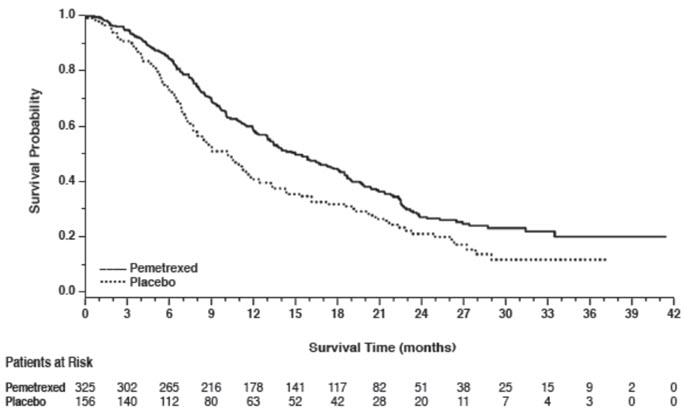
The efficacy of pemetrexed as maintenance therapy following first-line platinum-based chemotherapy was evaluated in Study JMEN (NCT00102804), a multicenter, randomized (2:1), double-blind, placebo-controlled study conducted in 663 patients with Stage IIIb/IV NSCLC who did not progress after four cycles of platinum-based chemotherapy. Patients were randomized to receive pemetrexed 500 mg/m2 intravenously every 21 days or placebo until disease progression or intolerable toxicity. Patients in both study arms received folic acid, vitamin B12, and dexamethasone [see Dosage and Administration (2.4)]. Randomization was carried out using a minimization approach [Pocock and Simon (1975)] using the following factors: gender, ECOG PS (0 versus 1), response to prior chemotherapy (complete or partial response versus stable disease), history of brain metastases (yes versus no), non-platinum component of induction therapy (docetaxel versus gemcitabine versus paclitaxel), and disease stage (IIIb versus IV). The major efficacy outcome measures were progression-free survival based on assessment by independent review and overall survival; both were measured from the date of randomization in Study JMEN.
A total of 663 patients were enrolled with 441 patients randomized to pemetrexed and 222 patients randomized to placebo. The median age was 61 years (range 26–83 years); 73% were male; 65% were White, 32% were Asian, 2.9% were Hispanic or Latino, and <2% were other ethnicities; 60% had an ECOG PS of 1; and 73% were current or former smokers. Median time from initiation of platinum-based chemotherapy to randomization was 3.3 months (range 1.6 to 5.1 months) and 49% of the population achieved a partial or complete response to first-line, platinum-based chemotherapy. With regard to tumor characteristics, 81% had Stage IV disease, 73% had non-squamous NSCLC and 27% had squamous NSCLC. Among the 481 patients with non-squamous NSCLC, 68% had adenocarcinoma, 4% had large cell, and 28% had other histologies.
Efficacy results are presented in Table 10 and Figure 4.
Table 10: Efficacy Results in Study JMEN| Efficacy Parameter | Pemetrexed | Placebo |
|---|
Overall survival | N=441 | N=222 |
Median (months) | 13.4 | 10.6 |
(95% CI) | (11.9–15.9) | (8.7–12.0) |
Hazard ratio Hazard ratios are adjusted for multiplicity but not for stratification variables. | 0.79 |
(95% CI) | (0.65–0.95) |
p-value | p=0.012 |
Progression-free survival per independent review | N=387 | N=194 |
Median (months) | 4.0 | 2.0 |
(95% CI) | (3.1–4.4) | (1.5–2.8) |
Hazard ratio | 0.60 |
(95% CI) | (0.49–0.73) |
p-value | p<0.00001 |
Figure 4: Kaplan-Meier Curves for Overall Survival in Study JMEN
The results of pre-specified subgroup analyses by NSCLC histology are presented in Table 11 and Figures 5 and 6.
Table 11: Efficacy Results in Study JMEN by Histologic Subgroup| Efficacy Parameter | Overall Survival | Progression-Free Survival Per Independent Review |
|---|
| Pemetrexed
(N=441) | Placebo
(N=222) | Pemetrexed
(N=387) | Placebo
(N=194) |
|---|
Non-squamous NSCLC (n=481) |
Median (months) | 15.5 | 10.3 | 4.4 | 1.8 |
HR Hazard ratios are not adjusted for multiplicity | 0.70 | 0.47 |
(95% CI) | (0.56–0.88) | (0.37–0.60) |
Adenocarcinoma (n=328) |
Median (months) | 16.8 | 11.5 | 4.6 | 2.7 |
HR | 0.73 | 0.51 |
(95% CI) | (0.56–0.96) | (0.38–0.68) |
Large cell carcinoma (n=20) |
Median (months) | 8.4 | 7.9 | 4.5 | 1.5 |
HR | 0.98 | 0.40 |
(95% CI) | (0.36–2.65) | (0.12–1.29) |
Other Primary diagnosis of NSCLC not specified as adenocarcinoma, large cell carcinoma, or squamous cell carcinoma. (n=133) |
Median (months) | 11.3 | 7.7 | 4.1 | 1.6 |
HR | 0.61 | 0.44 |
(95% CI) | (0.40–0.94) | (0.28–0.68) |
Squamous cell NSCLC (n=182) |
Median (months) | 9.9 | 10.8 | 2.4 | 2.5 |
HR | 1.07 | 1.03 |
(95% CI) | (0.77–1.50) | (0.71–1.49) |
Figure 5: Kaplan-Meier Curves for Overall Survival in Non-squamous NSCLC in Study JMEN
Figure 6: Kaplan-Meier Curves for Overall Survival in Squamous NSCLC in Study JMEN
Maintenance Treatment Following First-line Pemetrexed Plus Platinum Chemotherapy
The efficacy of pemetrexed as maintenance therapy following first-line platinum-based chemotherapy was also evaluated in PARAMOUNT (NCT00789373), a multi-center, randomized (2:1), double-blind, placebo-controlled study conducted in patients with Stage IIIb/IV non-squamous NSCLC who had completed four cycles of pemetrexed in combination with cisplatin and achieved a complete response (CR) or partial response (PR) or stable disease (SD). Patients were required to have an ECOG PS of 0 or 1. Patients were randomized to receive pemetrexed 500 mg/m2 intravenously every 21 days or placebo until disease progression. Randomization was stratified by response to pemetrexed in combination with cisplatin induction therapy (CR or PR versus SD), disease stage (IIIb versus IV), and ECOG PS (0 versus 1). Patients in both arms received folic acid, vitamin B12, and dexamethasone. The main efficacy outcome measure was investigator-assessed progression-free survival (PFS) and an additional efficacy outcome measure was overall survival (OS); PFS and OS were measured from the time of randomization.
A total of 539 patients were enrolled with 359 patients randomized to pemetrexed and 180 patients randomized to placebo. The median age was 61 years (range 32 to 83 years); 58% were male; 95% were White, 4.5% were Asian, and <1% were Black or African American; 67% had an ECOG PS of 1; 78% were current or former smokers; and 43% of the population achieved a partial or complete response to first-line, platinum-based chemotherapy. With regard to tumor characteristics, 91% had Stage IV disease, 87% had adenocarcinoma, 7% had large cell, and 6% had other histologies.
Efficacy results for PARAMOUNT are presented in Table 12 and Figure 7.
Table 12: Efficacy Results in PARAMOUNT| Efficacy Parameter | Pemetrexed
(N=359) | Placebo
(N=180) |
|---|
Overall survival |
Median (months) | 13.9 | 11.0 |
(95% CI) | (12.8–16.0) | (10.0–12.5) |
Hazard ratio (HR) Hazard ratios are adjusted for multiplicity but not for stratification variables. | 0.78 |
(95% CI) | (0.64–0.96) |
p-value | p=0.02 |
Progression-free survival Based on investigator's assessment. |
Median (months) | 4.1 | 2.8 |
(95% CI) | (3.2–4.6) | (2.6–3.1) |
Hazard ratio (HR) | 0.62 |
(95% CI) | (0.49–0.79) |
p-value | p<0.0001 |
Figure 7: Kaplan-Meier Curves for Overall Survival in PARAMOUNT
How Supplied
Pemetrexed Injection is a clear, colorless to pale yellow ready-to-dilute solution in a single-dose vial for intravenous infusion.
NDC 0409-0020-02: Carton containing one (1) single-dose vial, 100 mg/4 mL (25 mg/mL).
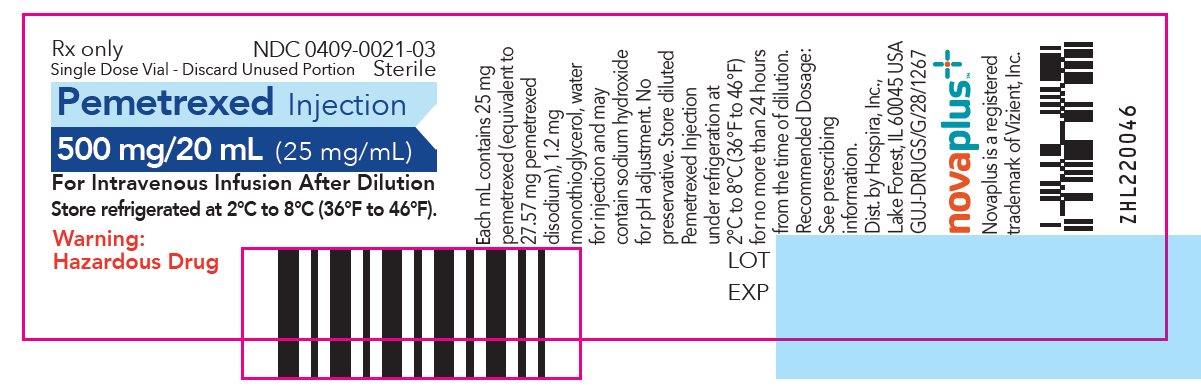
NDC 0409-0021-03: Carton containing one (1) single-dose vial, 500 mg/20 mL (25 mg/mL).
NDC 0409-0004-04: Carton containing one (1) single-dose vial, 1 g/40 mL (25 mg/mL).
Premedication and Concomitant Medication: Instruct patients to take folic acid as directed and to keep appointments for vitamin B12 injections to reduce the risk of treatment-related toxicity. Instruct patients of the requirement to take corticosteroids to reduce the risks of treatment-related toxicity [see Dosage and Administration (2.4) and Warnings and Precautions (5.1)].
Myelosuppression: Inform patients of the risk of low blood cell counts and instruct them to immediately contact their physician for signs of infection, fever, bleeding, or symptoms of anemia [see Warnings and Precautions (5.1)].
Renal Failure: Inform patients of the risks of renal failure, which may be exacerbated in patients with dehydration arising from severe vomiting or diarrhea. Instruct patients to immediately contact their healthcare provider for a decrease in urine output [see Warnings and Precautions (5.2)].
Bullous and Exfoliative Skin Disorders: Inform patients of the risks of severe and exfoliative skin disorders. Instruct patients to immediately contact their healthcare provider for development of bullous lesions or exfoliation in the skin or mucous membranes [see Warnings and Precautions (5.3)].
Interstitial Pneumonitis: Inform patients of the risks of pneumonitis. Instruct patients to immediately contact their healthcare provider for development of dyspnea or persistent cough [see Warnings and Precautions (5.4)].
Radiation Recall: Inform patients who have received prior radiation of the risks of radiation recall. Instruct patients to immediately contact their healthcare provider for development of inflammation or blisters in an area that was previously irradiated [see Warnings and Precautions (5.5)].
Increased Risk of Toxicity with Ibuprofen in Patients with Renal Impairment: Advise patients with mild to moderate renal impairment of the risks associated with concomitant ibuprofen use and instruct them to avoid use of all ibuprofen containing products for 2 days before, the day of, and 2 days following administration of Pemetrexed Injection [see Dosage and Administration (2.5), Warnings and Precautions (5.6), and Drug Interactions (7)].
Embryo-Fetal Toxicity: Advise females of reproductive potential and males with female partners of reproductive potential of the potential risk to a fetus [see Warnings and Precautions (5.7) and Use in Specific Populations (8.1)]. Advise females of reproductive potential to use effective contraception during treatment with Pemetrexed Injection and for 6 months after the last dose. Advise females to inform their prescriber of a known or suspected pregnancy. Advise males with female partners of reproductive potential to use effective contraception during treatment with Pemetrexed Injection and for 3 months after the last dose [see Warnings and Precautions (5.7) and Use in Specific Populations (8.3)].
Lactation: Advise women not to breastfeed during treatment with Pemetrexed Injection and for 1 week after the last dose [see Use in Specific Populations (8.2)].
This product's label may have been updated. For current full prescribing information, please visit www.pfizer.com.
Manufactured by: Zydus Hospira Oncology Private Ltd.
Ahmedabad 382-213, Gujarat, India.
Distributed by: Hospira, Inc., Lake Forest, IL 60045 USA
Novaplus is a registered trademark of Vizient, Inc.
LAB-1549-1.0