Levetiracetam Injection, Solution
Product Images NDC 0409-1886

View Photos of Packaging, Regulatory Labels, and Product Appearance

Product Visual Gallery

This gallery contains 10 technical images submitted to the FDA as part of the official labeling for Levetiracetam (NDC 0409-1886). Unlike standard consumer photos, these assets often include clinical data figures, molecular chemical structures, and official manufacturer packaging layouts.

As provided by Hospira, Inc., these visuals offer a comprehensive scientific overview of the product's physical and chemical identity, aiding pharmacists and researchers in product verification and study.

FDA Label Image

Chemical Structure (Levetiracetam 01)

Chemical Structure (Levetiracetam 01)
Chemical structure diagram depicting the active ingredient Levetiracetam. The structure features a pyrrolidone ring attached to an ethyl group and an amide functional group, illustrating the molecular arrangement of Levetiracetam.*
FDA Label Image

Figure 1 (Levetiracetam 02)

Figure 1 (Levetiracetam 02)
Bar chart depicting the percentage of patients for three groups: Placebo (7.4%), Levetiracetam 1000 mg/day (37.1%), and Levetiracetam 3000 mg/day (39.6%). The chart shows higher percentages of patients in both Levetiracetam dosage groups compared to placebo.*
FDA Label Image

Figure 2 (Levetiracetam 03)

Figure 2 (Levetiracetam 03)
A bar chart showing the percentage of patients by treatment group, including placebo (6.3% of 111 patients), Levetiracetam 1000 mg/day (20.8% of 106 patients), and Levetiracetam 2000 mg/day (35.2% of 105 patients). The y-axis represents the percentage of patients, ranging from 0% to 45%.*
FDA Label Image

Figure 3 (Levetiracetam 04)

Figure 3 (Levetiracetam 04)
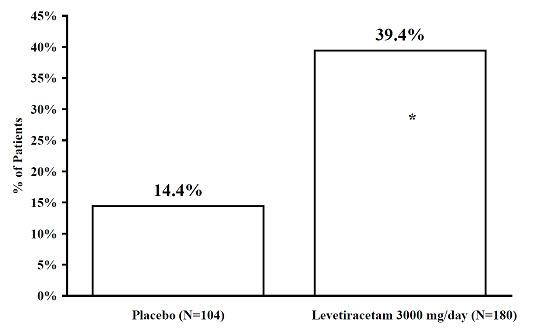
A bar chart comparing the percentage of patients between two groups: Placebo (104 patients) with 14.4%, and Levetiracetam 3000 mg/day (180 patients) with 39.4%, illustrating a higher percentage in the Levetiracetam group.*
FDA Label Image

Figure 4 (Levetiracetam 05)

Figure 4 (Levetiracetam 05)
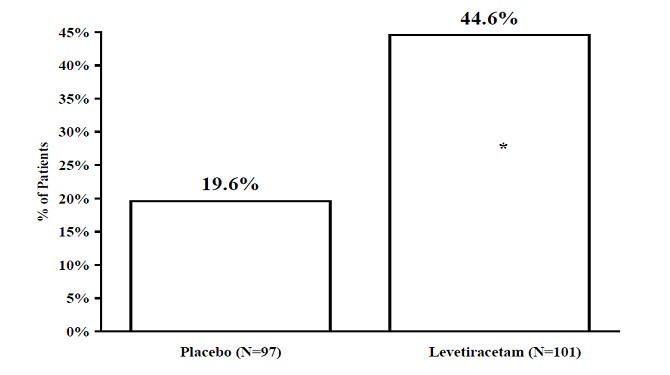
A bar graph comparing the percentage of patients between placebo and Levetiracetam groups. The y-axis shows the percentage of patients from 0% to 45%. The placebo group, with 97 patients, shows 19.6%, while the Levetiracetam group, with 101 patients, shows 44.6%. A significance mark is present on the Levetiracetam bar.*
FDA Label Image

Figure 5 (Levetiracetam 06)

Figure 5 (Levetiracetam 06)
A bar chart comparing the percentage of patients between placebo (N=51) and Levetiracetam (N=58). The placebo group shows 19.6% of patients, while the Levetiracetam group shows 43.1%, with an asterisk indicating statistical significance.*
FDA Label Image

Figure 6 (Levetiracetam 07)

Figure 6 (Levetiracetam 07)
A bar graph comparing the percentage of patients between two groups: Placebo (N=84) and Levetiracetam (N=79). The Placebo group shows 45.2% of patients, and the Levetiracetam group shows 72.2%, with an asterisk above the Levetiracetam bar indicating statistical significance or emphasis.*
FDA Label Image

Logo (Levetiracetam 08)

FDA Label Image

Principal Display Panel (5 mL Vial Label)

Principal Display Panel (5 mL Vial Label)
Levetiracetam Injection, USP 500 mg/5 mL (100 mg/mL) single-dose vial label from Hospira, Inc. The label states it is for intravenous use only and must be diluted prior to administration. It includes storage instructions and manufacturer information for Gland Pharma Limited, Hyderabad, India, and Hospira, Inc., Lake Forest, IL, USA.*
FDA Label Image

Principal Display Panel (5 mL Vial Carton)

Principal Display Panel (5 mL Vial Carton)
Levetiracetam Injection, USP 500 mg/5 mL (100 mg/mL) carton label for single-dose vials, containing 25 vials of 5 mL each. The label states it is for intravenous use only and must be diluted prior to administration. The product is manufactured for Hospira, Inc.*

* About these descriptions: Image descriptions on this page are generated by automated AI analysis of the product label images from the manufacturer's FDA label submission (SPL). They are provided for reference only and may contain errors or omissions. Always rely on the printed label itself and the official FDA labeling, and consult a pharmacist or healthcare professional with any questions about this product.