Because clinical trials are conducted under widely varying conditions, adverse reaction rates observed in the clinical trials of a drug cannot be directly compared to rates in the clinical trials of another drug and may not reflect the rates observed in practice.
The pooled safety population described in the WARNINGS AND PRECAUTIONS reflect exposure to VYLOY in 533 patients at an 800 mg/m2 initial dose followed by subsequent doses of 600 mg/m2 every 3 weeks in combination with fluoropyrimidine- and platinum-containing chemotherapy in the SPOTLIGHT (279) and GLOW (254) studies. Among 533 patients who received VYLOY in these studies, 47% were exposed for ≥6 months and 20% were exposed for ≥12 months.
In this pooled population, the most common (≥15%) adverse reactions, were nausea, vomiting, fatigue, decreased appetite, diarrhea, peripheral sensory neuropathy, abdominal pain, constipation, decreased weight, hypersensitivity reactions, and pyrexia. The most common (≥15%) laboratory abnormalities in the pooled population were decreased neutrophil count, decreased leucocyte count, decreased albumin, increased creatinine, decreased hemoglobin, increased glucose, decreased lymphocyte count, increased aspartate aminotransferase, decreased platelets, increased alkaline phosphatase, increased alanine aminotransferase, decreased glucose, decreased sodium, increased phosphate, decreased potassium, and decreased magnesium.
SPOTLIGHT
The safety of VYLOY was evaluated in SPOTLIGHT in patients with locally advanced unresectable or metastatic gastric or GEJ cancer who received at least one dose of VYLOY at an 800 mg/m2 initial dose followed by 600 mg/m2 subsequent doses every 3 weeks in combination with mFOLFOX6 [see Clinical Studies (14)]. The median duration of exposure to VYLOY in combination with mFOLFOX6 was 6.2 months (range: 1 day to 40.9 months).
Serious adverse reactions occurred in 45% of patients treated with VYLOY in combination with mFOLFOX6; the most common serious adverse reactions (≥2%) were vomiting (8%), nausea (7%), neutropenia (2.9%), febrile neutropenia (2.9%), diarrhea (2.9%), intestinal obstruction (3.2%), pyrexia (2.5%), pneumonia (2.5%), respiratory failure (2.2%), pulmonary embolism (2.2%), decreased appetite (2.1%) and sepsis (2.0%). Fatal adverse reactions occurred in 5% of patients who received VYLOY in combination with mFOLFOX6 including sepsis (1.4%), pneumonia (1.1%), respiratory failure (1.1%), intestinal obstruction (0.7%), acute hepatic failure (0.4%), acute myocardial infarction (0.4%), death (0.4%), disseminated intravascular coagulation (0.4%), encephalopathy (0.4%), and upper gastrointestinal hemorrhage (0.4%).
Permanent discontinuation of VYLOY due to an adverse reaction occurred in 20% of patients; the most common adverse reactions leading to discontinuation (≥2%) were nausea and vomiting.
Dosage interruptions of VYLOY due to an adverse reaction occurred in 75% of patients; the most common adverse reactions leading to dose interruption (≥5%) were nausea, vomiting, neutropenia, abdominal pain, fatigue, and hypertension.
Tables 3 and 4 summarize the most common (≥15%) adverse reactions and laboratory abnormalities with a difference between arms of ≥5%, respectively, compared to placebo in SPOTLIGHT.
Table 3. Adverse Reactions (≥15%) in Patients Treated with VYLOY in SPOTLIGHT with a Difference Between Arms of ≥5% Compared to Placebo
Adverse Reaction
| VYLOY with mFOLFOX6 n=279 | Placebo with mFOLFOX6 n=278 |
All Grades % | Grade 3 or 4 % | All Grades % | Grade 3 or 4 % |
Gastrointestinal disorders |
Nausea | 82 | 16 | 61 | 7 |
Vomiting | 67 | 16 | 36 | 6 |
Metabolism and nutrition disorders |
Decreased appetite | 47 | 6 | 34 | 3.2 |
General disorders and administration site conditions |
Peripheral edema | 18 | 0.7 | 9 | 0 |
Table 4. Laboratory Abnormalities (≥ 15%) in SPOTLIGHT with a Difference Between Arms of ≥ 5% Compared to PlaceboLaboratory Abnormality | VYLOY with mFOLFOX6 The denominator used to calculate the rate varied from 271 to 272 based on the number of patients with a baseline value and at least one post-treatment value. | Placebo with mFOLFOX6 |
All Grades % | Grade 3 or 4 % | All Grades % | Grade 3 or 4 % |
Albumin decreased | 78 | 4.4 | 47 | 1.1 |
Potassium decreased | 28 | 11 | 21 | 6 |
Glucose decreased | 45 | 0.4 | 35 | 0.4 |
Sodium decreased | 29 | 5 | 21 | 2.9 |
GLOW
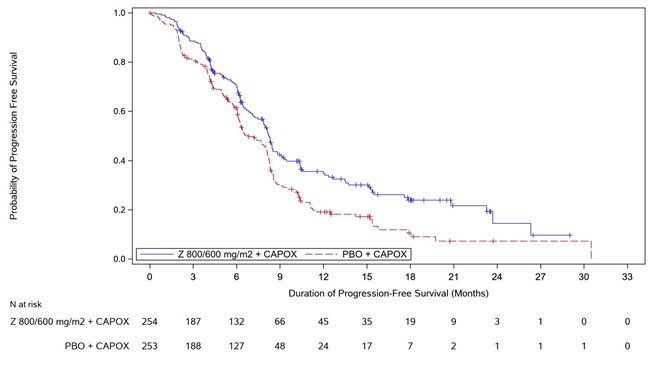
The safety of VYLOY was evaluated in GLOW in patients with locally advanced unresectable or metastatic gastric/GEJ cancer who received at least one dose of VYLOY at an 800 mg/m2 initial dose followed by 600 mg/m2 subsequent doses every 3 weeks in combination with CAPOX [see Clinical Studies (14)]. The median duration of exposure to VYLOY in combination with CAPOX was 4.4 months (range: 0.03 to 30.7 months).
Serious adverse reactions occurred in 47% of patients treated with VYLOY in combination with CAPOX; the most common serious adverse reactions (≥2%) were vomiting (6%), nausea (4.3%), decreased appetite (3.9%), decreased platelet count (3.1%), upper gastrointestinal hemorrhage (2.8%), diarrhea (2.8%), pneumonia (2.4%), pulmonary embolism (2.3%), and pyrexia (2.0%). Fatal adverse reactions occurred in 8% of patients who received VYLOY in combination with CAPOX including sepsis (1.2%), pneumonia (0.4%), death (0.8%), upper gastrointestinal hemorrhage (0.8%), cerebral hemorrhage (0.8%), abdominal infection (0.4%), acute respiratory distress syndrome (0.4%), cardio‑respiratory arrest (0.4%), decreased platelet count (0.4%), disseminated intravascular coagulation (0.4%), dyspnea (0.4%), gastric perforation (0.4%), hemorrhagic ascites (0.4%), procedural complication (0.4%), sudden death (0.4%), and syncope (0.4%).
Permanent discontinuation of VYLOY due to an adverse reaction occurred in 19% of patients; the most common adverse reaction leading to discontinuation (≥2%) was vomiting.
Dosage interruption of VYLOY due to an adverse reaction occurred in 55% of patients; the most common adverse reactions leading to dose interruption (≥2%) were nausea, vomiting, neutropenia, thrombocytopenia, anemia, fatigue, infusion-related reaction, and abdominal pain.
Tables 5 and 6 summarize the most common (≥15%) adverse reactions and laboratory abnormalities with a difference between arms of ≥5%, respectively compared to placebo in GLOW.
Table 5. Adverse Reactions (≥15%) in Patients Treated with VYLOY in GLOW with a Difference Between Arms of ≥5% Compared to PlaceboAdverse Reaction | VYLOY with CAPOX n=254 | Placebo with CAPOX n=249 |
All Grades % | Grade 3 or 4 % | All Grades % | Grade 3 or 4 % |
Gastrointestinal disorders |
Nausea | 69 | 9 | 50 | 2.4 |
Vomiting | 66 | 12 | 31 | 3.6 |
Metabolism and nutrition disorders |
Decreased appetite | 41 | 7 | 34 | 1.6 |
Blood and lymphatic system disorders |
Neutropenia | 20 | 7 | 14 | 2.8 |
Investigations |
Weight decreased | 20 | 0.4 | 10 | 0.4 |
Other clinically relevant adverse reactions (<15%) in GLOW with a difference between arms of 5% compared to placebo included peripheral edema.
Table 6. Laboratory Abnormalities (≥15%) in Patients Treated with VYLOY in GLOW with a Difference Between Arms of ≥5% Compared to PlaceboLaboratory Abnormality | VYLOY with CAPOX The denominator used to calculate the rate varied from 237 to 238 based on the number of patients with a baseline value and at least one post-treatment value. | Placebo with CAPOX |
All Grades % | Grade 3 or 4 % | All Grades % | Grade 3 or 4 % |
Albumin decreased | 66 | 3.8 | 47 | 1.7 |
Leukocytes decreased | 66 | 6 | 60 | 8 |
Neutrophils decreased | 76 | 21 | 70 | 14 |
Glucose decreased | 24 | 0 | 18 | 0 |