Patients with asthma 12 years of age and older
In two clinical studies comparing budesonide and formoterol fumarate dihydrate inhalation aerosol with the individual components, improvements in most efficacy end points were greater with budesonide and formoterol fumarate dihydrate inhalation aerosol than with the use of either budesonide or formoterol alone. In addition, one clinical study showed similar results between budesonide and formoterol fumarate dihydrate inhalation aerosol and the concurrent use of budesonide and formoterol at corresponding doses from separate inhalers.
The safety and efficacy of budesonide and formoterol fumarate dihydrate inhalation aerosol were demonstrated in two randomized, double-blind, placebo-controlled US clinical studies involving 1076 patients 12 years of age and older. Fixed budesonide and formoterol fumarate dihydrate inhalation aerosol dosages of 160/9 mcg, and 320/9 mcg twice daily (each dose administered as 2 inhalations of the 80/4.5 and 160/4.5 mcg strengths, respectively) were compared with the monocomponents (budesonide and formoterol) and placebo to provide information about appropriate dosing to cover a range of asthma severity.
Study 1: Clinical Study with Budesonide and Formoterol Fumarate Dihydrate Inhalation Aerosol 160/4.5 mcg
This 12-week study evaluated 596 patients 12 years of age and older by comparing budesonide and formoterol fumarate dihydrate inhalation aerosol 160/4.5, the free combination of budesonide 160 mcg plus formoterol 4.5 mcg in separate inhalers, budesonide 160 mcg, formoterol 4.5 mcg, and placebo; each administered as 2 inhalations twice daily. The study included a 2-week run-in period with budesonide 80 mcg, 2 inhalations twice daily. Most patients had moderate to severe asthma and were using moderate to high doses of inhaled corticosteroids prior to study entry. Randomization was stratified by previous inhaled corticosteroid treatment (71.6% on moderate- and 28.4% on high-dose inhaled corticosteroid). Mean percent predicted FEV1 at baseline was 68.1% and was similar across treatment groups. The co-primary efficacy end points were 12-hour-average post-dose FEV1 at week 2, and pre-dose FEV1 averaged over the course of the study. The study also required that patients who satisfied a predefined asthma-worsening criterion be withdrawn. The predefined asthma-worsening criteria were a clinically important decrease in FEV1 or PEF, increase in rescue albuterol use, nighttime awakening due to asthma, emergency intervention or hospitalization due to asthma, or requirement for asthma medication not allowed by the protocol. For the criterion of nighttime awakening due to asthma, patients were allowed to remain in the study at the discretion of the investigator if none of the other asthma-worsening criteria were met. The percentage of patients withdrawing due to or meeting predefined criteria for worsening asthma is shown in Table 4.
Table 4: The number and percentage of patients withdrawing due to or meeting predefined criteria for worsening asthma (Study 1) | Budesonide and Formoterol Fumarate Dihydrate Inhalation Aerosol
160/4.5 mcg
n = 124 | Budesonide
160 mcg plus
Formoterol
4.5 mcg
n = 115 |
Budesonide
160 mcg
n = 109
|
Formoterol
4.5 mcg
n = 123
|
Placebo
n = 125
|
Patients withdrawn due to predefined asthma event1 | 13 (10.5) | 13 (11.3) | 22 (20.2) | 44 (35.8) | 62 (49.6) |
Patients with a predefined asthma event1,2 | 37 (29.8) | 24 (20.9) | 48 (44.0) | 68 (55.3) | 84 (67.2) |
Decrease in FEV1 | 4 (3.2) | 8 (7.0) | 7 (6.4) | 15 (12.2) | 14 (11.2) |
Rescue medication use | 2 (1.6) | 0 | 3 (2.8) | 3 (2.4) | 7 (5.6) |
Decrease in AM PEF | 2 (1.6) | 5 (4.3) | 5 (4.6) | 17 (13.8) | 15 (12.0) |
Nighttime awakenings3 | 24 (19.4) | 11 (9.6) | 29 (26.6) | 32 (26.0) | 49 (39.2) |
Clinical exacerbation | 7 (5.6) | 6 (5.2) | 5 (4.6) | 17 (13.8) | 16 (12.8) |
1. These criteria were assessed on a daily basis irrespective of the timing of the clinic visit, with the exception of FEV1, which was assessed at each clinic visit. |
2. Individual criteria are shown for patients meeting any predefined asthma event, regardless of withdrawal status. |
3. For the criterion of nighttime awakening due to asthma, patients were allowed to remain in the study at the discretion of the investigator if none of the other criteria were met. |
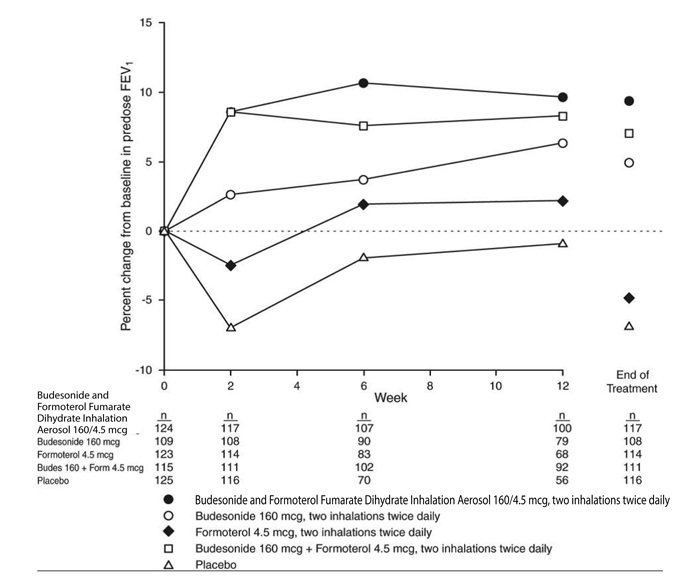
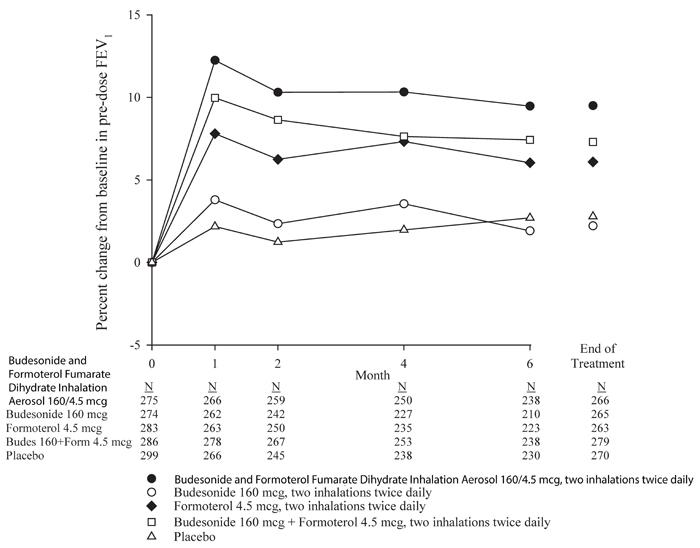
Mean percent change from baseline in FEV1 measured immediately prior to dosing (pre-dose) over 12 weeks is displayed in Figure 1. Because this study used predefined withdrawal criteria for worsening asthma, which caused a differential withdrawal rate in the treatment groups, pre-dose FEV1 results at the last available study visit (end of treatment, EOT) are also provided. Patients receiving budesonide and formoterol fumarate dihydrate inhalation aerosol 160/4.5 had significantly greater mean improvements from baseline in pre-dose FEV1 at the end of treatment (0.19 L, 9.4%), compared with budesonide 160 mcg (0.10 L, 4.9%), formoterol 4.5 mcg (-0.12 L, -4.8%), and placebo (-0.17 L, -6.9%).
Figure 1 Mean Percent Change from Baseline in Pre-dose FEV1 Over 12 Weeks (Study 1)
The effect of budesonide and formoterol fumarate dihydrate inhalation aerosol 160/4.5 two inhalations twice daily on selected secondary efficacy variables, including morning and evening PEF, albuterol rescue use, and asthma symptoms over 24 hours on a 0 to 3 scale is shown in Table 5.
Table 5: Mean values for selected secondary efficacy variables (Study 1)Efficacy Variable | Budesonide and Formoterol Fumarate Dihydrate Inhalation Aerosol
160/4.5 mcg
(n1=124) | Budesonide
160 mcg plus Formoterol 4.5 mcg
(n1=115) |
Budesonide
160 mcg
(n1=109)
|
Formoterol
4.5 mcg
(n1=123)
|
Placebo
(n1=125) |
AM PEF (L/min) Baseline | 341 | 338 | 342 | 339 | 355 |
Change from Baseline | 35 | 28 | 9 | -9 | -18 |
PM PEF (L/min) Baseline | 351 | 348 | 357 | 354 | 369 |
Change from Baseline | 34 | 26 | 7 | -7 | -18 |
Albuterol rescue use | 2.1 | 2.3 | 2.7 | .5 | 2.4 |
Baseline | | | | | |
Change from Baseline | -1.0 | -1.5 | -0.8 | -0.3 | 0.8 |
Average symptom score/day (0 to 3 scale) | 0.99 | 1.03 | 1.04 | 1.04 | 1.08 |
Baseline | | | | | |
Change from Baseline | -0.28 | -0.32 | -0.14 | -0.05 | 0.10 |
1. Number of patients (n) varies slightly due to the number of patients for whom data were available for each variable. Results shown are based on last available data for each variable. |
The subjective impact of asthma on patients’ health-related quality of life was evaluated through the use of the standardized Asthma Quality of Life Questionnaire (AQLQ(S)) (based on a 7-point scale where 1 = maximum impairment and 7 = no impairment). Patients receiving budesonide and formoterol fumarate dihydrate inhalation aerosol 160/4.5 had clinically meaningful improvement in overall asthma-specific quality of life, as defined by a mean difference between treatment groups of >0.5 points in change from baseline in overall AQLQ score (difference in AQLQ score of 0.70 [95% CI 0.47, 0.93], compared to placebo).
Study 2: Clinical Study with Budesonide and Formoterol Fumarate Dihydrate Inhalation Aerosol 80/4.5 mcg
This 12-week study was similar in design to Study 1, and included 480 patients 12 years of age and older. This study compared budesonide and formoterol fumarate dihydrate inhalation aerosol 80/4.5, budesonide 80 mcg, formoterol 4.5 mcg, and placebo; each administered as 2 inhalations twice daily. The study included a 2-week placebo run-in period. Most patients had mild to moderate asthma and were using low to moderate doses of inhaled corticosteroids prior to study entry. Mean percent predicted FEV1 at baseline was 71.3% and was similar across treatment groups. Efficacy variables and end points were identical to those in Study 1.
The percentage of patients withdrawing due to or meeting predefined criteria for worsening asthma is shown in Table 6. The method of assessment and criteria used were identical to that in Study 1.
Table 6: The number and percentage of patients withdrawing due to or meeting predefined criteria for worsening asthma (Study 2) | Budesonide and Formoterol Fumarate Dihydrate Inhalation Aerosol
80/4.5 mcg
(n=123) | Budesonide
80 mcg
(n=121) |
Formoterol
4.5 mcg
(n=114)
|
Placebo
(n=122)
|
Patients withdrawn due to predefined asthma event1 | 9 (7.3) | 8 (6.6) | 21 (18.4) | 40 (32.8) |
Patients with a predefined asthma event1,2 | 23 (18.7) | 26 (21.5) | 48 (42.1) | 69 (56.6) |
Decrease in FEV1 | 3 (2.4) | 3 (2.5) | 11 (9.6) | 9 (7.4) |
Rescue medication use | 1 (0.8) | 3 (2.5) | 1 (0.9) | 3 (2.5) |
Decrease in AM PEF | 3 (2.4) | 1 (0.8) | 8 (7.0) | 14 (11.5) |
Nighttime awakening3 | 17 (13.8) | 20 (16.5) | 31 (27.2) | 52 (42.6) |
Clinical exacerbation | 1 (0.8) | 3 (2.5) | 5 (4.4) | 20 (16.4) |
1. These criteria were assessed on a daily basis irrespective of the timing of the clinic visit, with the exception of FEV1, which was assessed at each clinic visit. |
2. Individual criteria are shown for patients meeting any predefined asthma event, regardless of withdrawal status. |
3. For the criterion of nighttime awakening due to asthma, patients were allowed to remain in the study at the discretion of the investigator if none of the other criteria were met. |
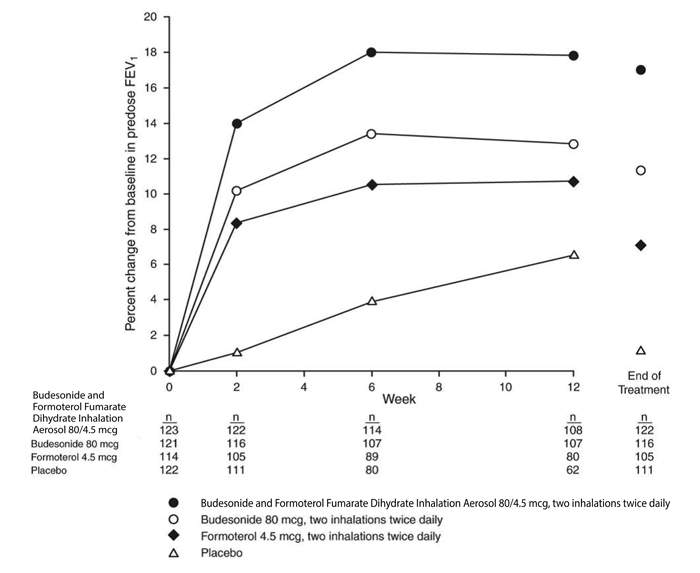
Mean percent change from baseline in pre-dose FEV1 over 12 weeks is displayed in Figure 2.
Figure 2 Mean Percent Change from Baseline in Pre-dose FEV1 Over 12 Weeks (Study 2)
Efficacy results for other secondary end points, including quality of life, were similar to those observed in Study 1.
Onset and Duration of Action and Progression of Improvement in Asthma Control
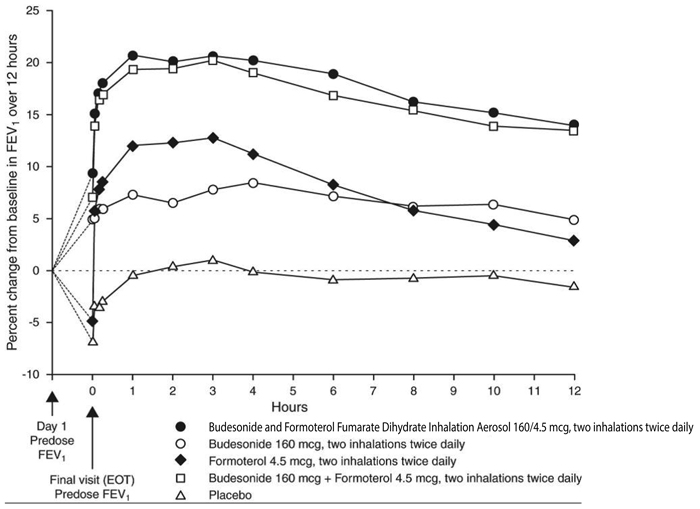
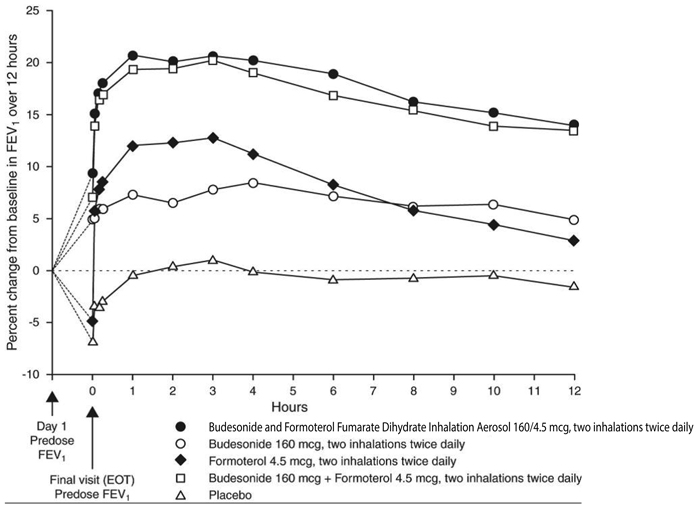
The onset of action and progression of improvement in asthma control were evaluated in the two pivotal clinical studies. The median time to onset of clinically significant bronchodilation (>15% improvement in FEV1) was seen within 15 minutes. Maximum improvement in FEV1 occurred within 3 hours, and clinically significant improvement was maintained over 12 hours. Figures 3 and 4 show the percent change from baseline in post-dose FEV1 over 12 hours on the day of randomization and on the last day of treatment for Study 1.
Reduction in asthma symptoms and in albuterol rescue use, as well as improvement in morning and evening PEF, occurred within 1 day of the first dose of budesonide and formoterol fumarate dihydrate inhalation aerosol; improvement in these variables was maintained over the 12 weeks of therapy.
Following the initial dose of budesonide and formoterol fumarate dihydrate inhalation aerosol, FEV1 improved markedly during the first 2 weeks of treatment, continued to show improvement at the Week 6 assessment, and was maintained through Week 12 for both studies.
No diminution in the 12-hour bronchodilator effect was observed with either budesonide and formoterol fumarate dihydrate inhalation aerosol 80/4.5 or budesonide and formoterol fumarate dihydrate inhalation aerosol 160/4.5, as assessed by FEV1, following 12 weeks of therapy or at the last available visit. FEV1 data from Study 1 evaluating budesonide and formoterol fumarate dihydrate inhalation aerosol 160/4.5 is displayed in Figures 3 and 4.
Figure 3 Mean Percent Change from Baseline in FEV1 on Day of Randomization (Study 1)
Figure 4 Mean Percent Change from Baseline in FEV1 at End of Treatment (Study 1)
Patients with asthma 6 to less than 12 years of age
The clinical program to support the efficacy of budesonide and formoterol fumarate dihydrate inhalation aerosol 80/4.5 in children 6 to less than 12 years of age included the following: 1) a budesonide dose confirmatory study, 2) a formoterol dose finding study, and 3) an efficacy and safety study of the budesonide and formoterol fumarate dihydrate inhalation aerosol combination product.
The selection of budesonide 80 mcg is supported by a 6-week, randomized, double-blind, placebo-controlled study in 304 pediatric patients (152 budesonide, 152 placebo) 6 to less than 12 years of age with asthma. Results showed that budesonide 80 mcg (2 inhalations twice daily) provided statistically significantly greater improvement compared to placebo for the primary endpoint of change from baseline to the treatment period average in pre-dose morning PEF and the key secondary endpoint of change in pre-dose morning FEV1. The selection of the formoterol dose is supported by a randomized, single dose, placebo-controlled, active-controlled (Foradil Aerolizer 12 mcg), 5-way cross-over study in which doses of 2.25, 4.5 and 9 mcg formoterol were administered in combination with budesonide in 54 pediatric patients 6 to less than 12 years of age with asthma. Results showed a dose response of formoterol compared to placebo for the primary endpoint of FEV1 averaged over 12 hours post-dose and the 9 mcg group showed numerically similar results compared to the active control.
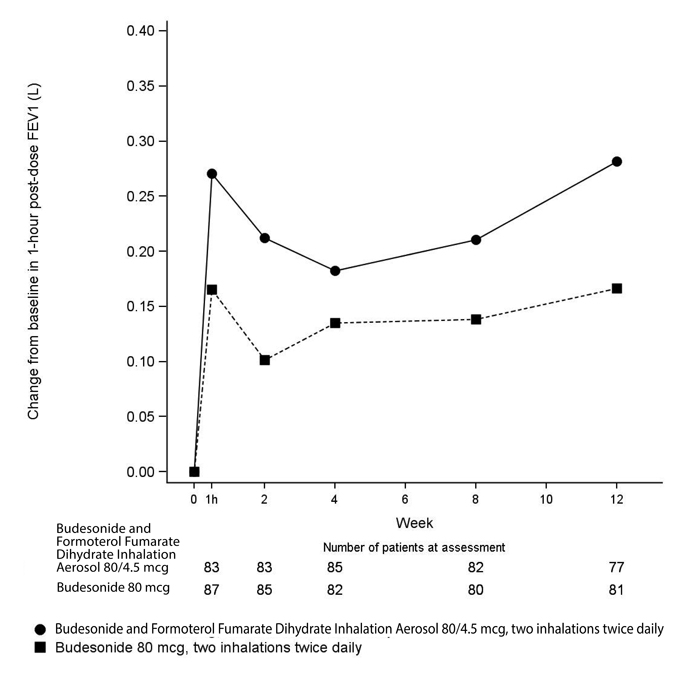
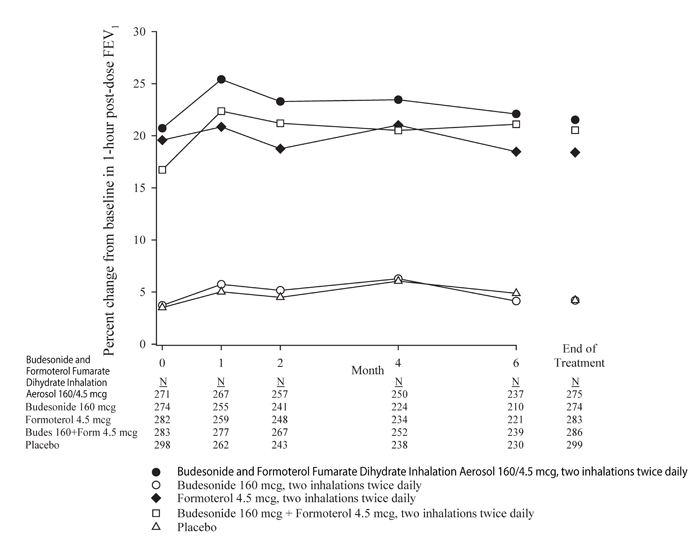
The confirmatory efficacy study was a 12-week, randomized, double-blind, multicenter study in which budesonide and formoterol fumarate dihydrate inhalation aerosol 80/4.5 was compared with budesonide pMDI 80 mcg, each administered as 2 inhalations twice daily, in 184 pediatric patients 6 to less than 12 years of age with a documented clinical diagnosis of asthma. At trial entry, the children had a requirement for daily medium-dose range inhaled corticosteroid therapy or fixed combination of inhaled corticosteroid and LABA therapy, and exhibited symptoms despite treatment with a low-dose inhaled corticosteroid during a 2 to 4 week run-in period. The primary efficacy variable was change from baseline to Week 12 in clinic-measured 1-hour post-dose FEV1. In patients receiving budesonide and formoterol fumarate dihydrate inhalation aerosol 80/4.5, there was a statistically significant change compared to budesonide in 1-hour post-dose FEV1 which improved by 0.28 L from baseline to Week 12, as compared with 0.17 L for those receiving budesonide 80 mcg (mean difference 0.12 L; 95% CI: 0.03, 0.20) (see Figure 5).
Figure 5 Change from Baseline in Clinic-Measured 1-hour Post-dose FEV1 over 12 Weeks (Efficacy and Safety Study in Patients 6 to less than 12 years of age).Similarly, improvement was noted in change from baseline to Week 12 for 1-hour post-dose clinic PEF (mean difference 25.5 L/min; 95% CI: 10.9, 40.0). Bronchodilatory effects were evident from the first assessment at 15 minutes on day 1 and were maintained at Week 12. The estimated mean difference between budesonide and formoterol fumarate dihydrate inhalation aerosol 80/4.5 and budesonide with respect to change from baseline to Week 12 in 15 minutes post-dose clinic FEV1 was 0.10 L (95% CI: 0.02, 0.18). No differences between budesonide and formoterol fumarate dihydrate inhalation aerosol and budesonide were noted in nighttime awakenings, rescue albuterol use, or Pediatric Asthma Quality of Life Questionnaire (PAQLQ) scores. The proportion of patients with at least 0.5 points improvement from baseline to Week 12 in PAQLQ was 42% on budesonide and formoterol fumarate dihydrate inhalation aerosol 80/4.5 and 46% on budesonide 80 mcg.
Postmarketing Safety and Efficacy Study
A randomized, double-blind, parallel-group, safety study compared budesonide and formoterol fumarate dihydrate inhalation aerosol with budesonide, each administered as 2 inhalations twice daily over 26 weeks (NCT01444430). The primary safety objective was to evaluate whether the addition of formoterol to budesonide therapy (budesonide and formoterol fumarate dihydrate inhalation aerosol) was non-inferior to budesonide in terms of the risk of serious asthma-related events (asthma-related hospitalization, endotracheal intubation, and death). The study was designed to rule out a pre-defined risk margin of serious asthma-related events of 2.0. A blinded adjudication committee determined whether events were asthma-related.
This study enrolled patients who were 12 years of age and older, had a clinical diagnosis of asthma for at least 1 year, and had at least 1 asthma exacerbation requiring treatment with systemic corticosteroids or an asthma-related hospitalization in the previous year. Patients were stratified to one of the two dose levels of budesonide and formoterol fumarate dihydrate inhalation aerosol or budesonide based on assessment of asthma control and ongoing asthma therapy. Patients with a history of life-threatening asthma were excluded. The study included 11,693 patients [5846 receiving budesonide and formoterol fumarate dihydrate inhalation aerosol (80/4.5 or 160/4.5) and 5847 receiving budesonide (80 or 160 mcg)], whose mean age was 44 years, and of whom 66% were female and 69% were Caucasian.
Budesonide and formoterol fumarate dihydrate inhalation aerosol was non-inferior to budesonide in terms of time to first serious asthma-related events based on the pre-specified risk margin, with an estimated hazard ratio of 1.07 [95% CI: 0.70, 1.65] (Table 7).
Table 7: Serious Asthma-Related Events (Postmarketing Safety and Efficacy study) | Budesonide and Formoterol Fumarate Dihydrate Inhalation Aerosol |
Budesonide
|
Budesonide and Formoterol Fumarate Dihydrate Inhalation Aerosol vs. Budesonide
|
| (N1 =5846) | (N1 =5847) | Hazard ratio (95% CI)3 |
| n2 (%) | n2 (%) | |
Serious asthma-related event4 | 43 (0.7) | 40 (0.7) | 1.07 (0.70, 1.65) |
Asthma-related death | 2 (<0.1) | 0 | |
Asthma-related endotracheal intubation | 1 (<0.1) | 0 | |
Asthma-related hospitalization | 42 (0.7) | 40 (0.7) | |
1. N = total number of patients |
2. n = number of patients with the event |
3. The hazard ratio for time to first event was based on a non-stratified Cox proportional hazard model with covariates of treatment (budesonide and formoterol fumarate dihydrate inhalation aerosol vs. budesonide) and inhaled corticosteroid dose level (160 mcg vs. 80 mcg), as randomized. If the resulting upper 95% CI estimate for the relative risk was <2.0, then non-inferiority was concluded. |
4. Asthma-related hospitalization, endotracheal intubation, or death that occurred within 6 months after the first use of study drug or 7 days after the last date of study drug, whichever date was later. Patients can have one or more events, but only the first event was counted for analysis. A single, blinded, independent adjudication committee determined whether events were asthma-related. |
The primary efficacy endpoint was asthma exacerbations, defined as a deterioration of asthma that led to use of systemic corticosteroids for at least 3 days, or a hospitalization, or an emergency room visit that required systemic corticosteroids. The estimated hazard ratio for time to first asthma exacerbation rate for budesonide and formoterol fumarate dihydrate inhalation aerosol relative to budesonide was 0.84 [95% CI: 0.75, 0.94]. This outcome was primarily driven by a reduction in systemic corticosteroid use.