Gabapentin Capsule
Product Images NDC 0480-3495

View Photos of Packaging, Regulatory Labels, and Product Appearance

Product Visual Gallery

This gallery contains 8 technical images submitted to the FDA as part of the official labeling for Gabapentin (NDC 0480-3495). Unlike standard consumer photos, these assets often include clinical data figures, molecular chemical structures, and official manufacturer packaging layouts.

As provided by Teva Pharmaceuticals, Inc., these visuals offer a comprehensive scientific overview of the product's physical and chemical identity, aiding pharmacists and researchers in product verification and study.

FDA Label Image

Equation Of Cockcroft And Gault (Image 1)

Equation Of Cockcroft And Gault (Image 1)
This text provides an equation to calculate creatinine clearance (CLCr) based on age, weight, gender, and serum creatinine level. It involves subtracting the individual's age (in years) from 140, then multiplying that by the individual's weight in kilograms. For female patients, the result is further multiplied by 0.85. Finally, the product is divided by 72 times the serum creatinine level in mg/dL. This formula is commonly used in healthcare settings to estimate renal function.*
FDA Label Image

1 (Image 2)

FDA Label Image

Figure 1 (Image 3)

Figure 1 (Image 3)
This is a graph showing the mean pain score over a 4-week dose titration period followed by a 4-week fixed dose period comparing a placebo to a dosage of 3600 mg/day of Gabapentin. The baseline and weeks 1 through 8 are displayed on the graph for reference.*
FDA Label Image

Figure 2 (Image 4)

Figure 2 (Image 4)
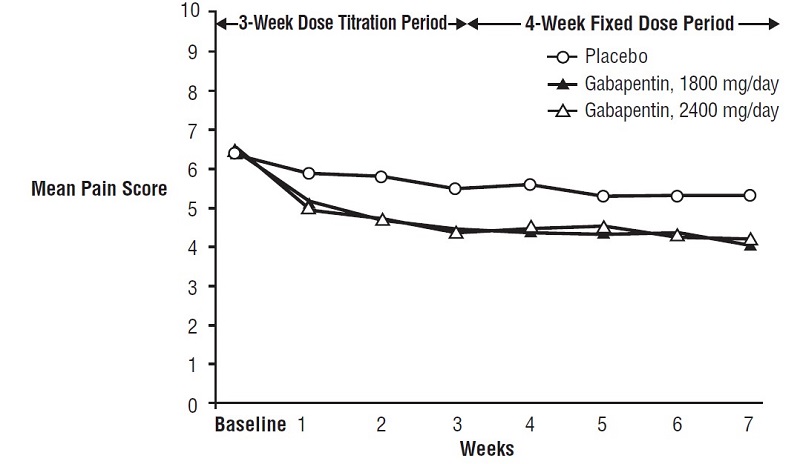
This is a chart showing the mean pain scores for different doses of Gabapentin compared to a placebo. The study involves a 3-week dose titration period followed by a 4-week fixed dose period. The doses being compared are a placebo, 1800 mg/day of Gabapentin, and 2400 mg/day of Gabapentin. The chart also indicates the baseline and weeks 1 to 7 for reference.*
FDA Label Image

Figure 3 (Image 5)

Figure 3 (Image 5)
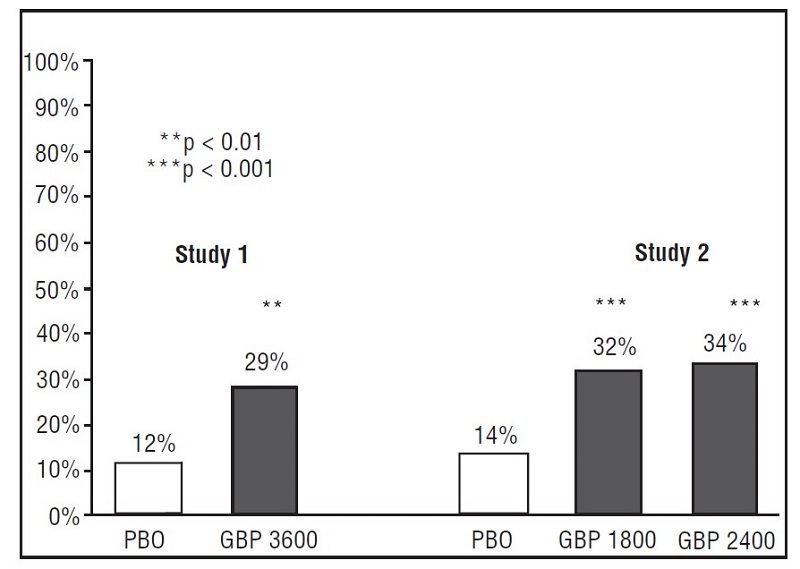
This text appears to be reporting statistical significance levels in a study. The symbols "**p < 0.01" and "***p < 0.001" suggest different levels of significance for the results presented. The study seems to involve two groups labeled as PBO and GBP, with corresponding percentages shown for each group. Additionally, there are values provided as "3600," "1800," and "2400" associated with the GBP group.*
FDA Label Image

Figure 4 (Image 6)

FDA Label Image

100 mg, 500s (Image 7)

100 mg, 500s (Image 7)
This text provides important information about a medication labeled as Gabapentin in capsule form, each containing 100 mg of the active ingredient. It includes details such as dosage instructions, storage conditions, manufacturer information, and a reminder for pharmacists to provide the accompanying Medication Guide to patients. The medication is dispensed in a container specified by USP guidelines. Additionally, it mentions the need to keep the medication out of reach of children and specifies the usual dosage information.*
FDA Label Image

300 mg, 500s (Image 8)

300 mg, 500s (Image 8)
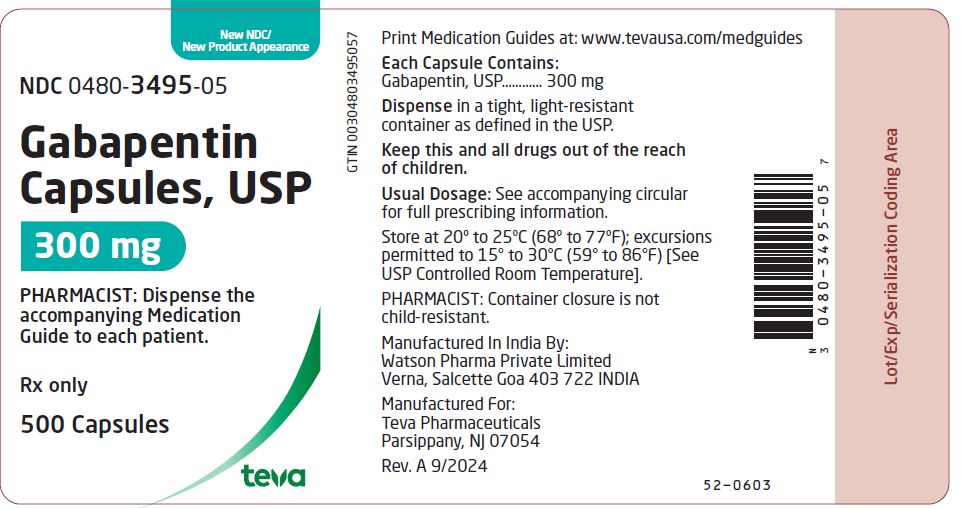
This is a description of a new product appearance for Gabapentin capsules, USP. The product comes in a pack of 500 capsules and each capsule contains 300 mg of Gabapentin, USP. The pharmacist is required to dispense the accompanying Medication Guide to each patient. The product should be stored in a tight, light-resistant container at 20° to 25°C; excursions are permitted to 15° to 30°C. The manufacturing details indicate that it is manufactured in India by Watson Pharma Private Limited and produced for Teva Pharmaceuticals. The label also mentions that the container closure is not child-resistant. Additionally, there is a lot/expiry/serialization coding area provided. For full prescribing information, the pharmacist is advised to refer to the accompanying circular.*

* These product label images have been analyzed using experimental machine learning. Please verify findings with the primary label text.