Absorption
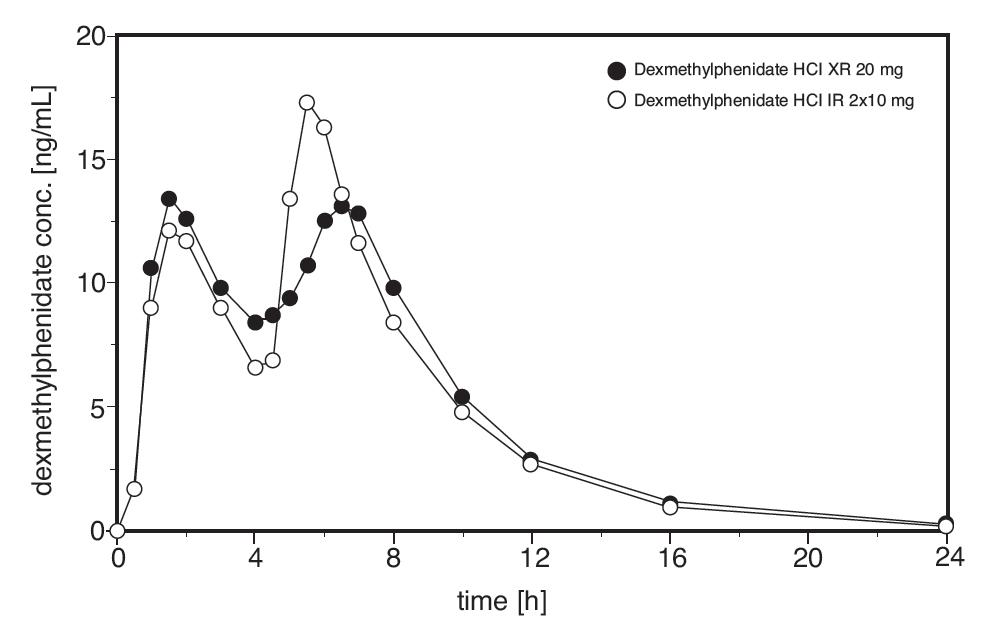
Dexmethylphenidate HCl extended-release capsules produces a bi-modal plasma concentration-time profile (i.e., 2 distinct peaks approximately 4 hours apart) when orally administered to healthy adults. The initial rate of absorption for dexmethylphenidate HCl extended-release capsules is similar to that of dexmethylphenidate HCl immediate release tablets as shown by the similar rate parameters between the 2 formulations, i.e., first peak concentration (Cmax1), and time to the first peak (tmax1), which is reached in 1.5 hours (typical range 1 to 4 hours). The mean time to the interpeak minimum (tminip) is slightly shorter, and time to the second peak (tmax2) is slightly longer for dexmethylphenidate HCl extended-release capsules given once daily (about 6.5 hours, range 4.5 to 7 hours) compared to dexmethylphenidate HCl immediate release tablets given in 2 doses 4 hours apart (see Figure 1), although the ranges observed are greater for dexmethylphenidate HCl extended-release capsules.
Dexmethylphenidate HCl extended-release capsules given once daily exhibits a lower second peak concentration (Cmax2), higher interpeak minimum concentrations (Cminip), and fewer peak and trough fluctuations than dexmethylphenidate immediate release tablets given in 2 doses given 4 hours apart. This is due to an earlier onset and more prolonged absorption from the delayed-release beads (see Figure 1).
The AUC (exposure) after administration of dexmethylphenidate HCl extended-release capsules given once daily is equivalent to the same total dose of dexmethylphenidate HCl immediate release tablets given in 2 doses 4 hours apart. The variability in Cmax, Cmin, and AUC is similar between dexmethylphenidate HCl extended-release capsules and dexmethylphenidate HCl immediate release tablets with approximately a 3-fold range in each.
Radiolabeled racemic methylphenidate is well absorbed after oral administration with approximately 90% of the radioactivity recovered in urine. However, due to first pass metabolism the mean absolute bioavailability of dexmethylphenidate when administered in various formulations was 22% to 25%.
Figure 1. Mean Dexmethylphenidate Plasma Concentration-Time Profiles After Administration of 1 x 20 mg Dexmethylphenidate HCl Extended-Release Capsules (n=24) and 2 x 10 mg Dexmethylphenidate HCl Immediate-Release Tablets (n=25)

Figure 1 (Dexmethylphenidate HCl Extended Release Capsules 2)
Dose Proportionality
Dose proportionality of dexmethylphenidate HCl extended-release capsules was evaluated in a randomized, single-dose, 5-period, cross-over study with administration of single doses of 5, 10, 20, 30, and 40 mg to healthy adults. Results confirmed dose proportionality within this dose range.
Food Effects
Administration times relative to meals and meal composition may need to be individually titrated.
No food effect study was performed with dexmethylphenidate HCl extended-release capsules. However, the effect of food has been studied in adults with racemic methylphenidate in the same type of extended-release formulation. The findings of that study are considered applicable to dexmethylphenidate HCl extended-release capsules. After a high fat breakfast, there was a longer lag time until absorption began and variable delays in the time until the first peak concentration, the time until the interpeak minimum, and the time until the second peak. The first peak concentration and the extent of absorption were unchanged after food relative to the fasting state, although the second peak was approximately 25% lower. The effect of a high fat lunch was not examined. There is no evidence of dose dumping in the presence or absence of food. There were no differences in the plasma concentration-time profile, when administered with applesauce, compared to administration in the fasting condition. The results are expected not to differ for dexmethylphenidate HCl extended-release capsules.
For patients unable to swallow the capsule, the contents may be sprinkled on applesauce and administered [see Dosage and Administration (2)].
Distribution
The plasma protein binding of dexmethylphenidate is not known; racemic methylphenidate is bound to plasma proteins by 12%-15%, independent of concentration. Dexmethylphenidate shows a volume of distribution of 2.65±1.11 L/kg. Plasma dexmethylphenidate concentrations decline monophasically following oral administration of dexmethylphenidate HCl extended-release capsules.
Metabolism and Excretion
In humans, dexmethylphenidate is metabolized primarily to d-α-phenyl-piperidine acetic acid (also known as d-ritalinic acid) by de-esterification. This metabolite has little or no pharmacological activity. There is no in vivo interconversion to the l-threo-enantiomer, based on a finding of no levels of l-threo-methylphenidate being detectable after administration of up to 40 mg dexmethylphenidate in adults. After oral dosing of radiolabeled racemic methylphenidate in humans, about 90% of the radioactivity was recovered in urine. The main urinary metabolite of racemic (d,l-) methylphenidate was d,l-ritalinic acid, accountable for approximately 80% of the dose. Urinary excretion of parent compound accounted for 0.5% of an intravenous dose.
In vitro studies showed that dexmethylphenidate did not inhibit cytochrome P450 isoenzymes at concentrations observed after therapeutic doses.
Intravenous dexmethylphenidate was eliminated with a mean clearance of 0.40±0.12 L/kg.h-1 corresponding to 0.56±0.18 L/min. The mean terminal elimination half-life of dexmethylphenidate was just over 3 hours in healthy adults and typically varied between 2 and 4.5 hours with an occasional subject exhibiting a terminal half-life between 5 and 7 hours. Children tend to have slightly shorter half-lives with means of 2–3 hours.
Special Populations
Gender
After administration of dexmethylphenidate HCl extended-release capsules the first peak, (Cmax1), was on average 45% higher in women. The interpeak minimum and the second peak also tended to be slightly higher in women although the difference was not statistically significant, and these patterns remained even after weight normalization. Pharmacokinetic parameters for dexmethylphenidate after dexmethylphenidate immediate-release tablets were similar for boys and girls.
Race
There is insufficient experience with the use of dexmethylphenidate HCl extended-release capsules to detect ethnic variations in pharmacokinetics.
Age
The pharmacokinetics of dexmethylphenidate after dexmethylphenidate HCl extended-release capsules administration have not been studied in children less than 18 years of age. When a similar formulation of racemic methylphenidate was examined in 15 children between 10 and 12 years of age and 3 children with ADHD between 7 and 9 years of age, the time to the first peak was similar, although the time until the between peak minimum, and the time until the second peak were delayed and more variable in children compared to adults. After administration of the same dose to children and adults, concentrations in children were approximately twice the concentrations observed in adults. This higher exposure is almost completely due to smaller body size as no relevant age-related differences in dexmethylphenidate pharmacokinetic parameters (i.e., clearance and volume of distribution) are observed after normalization to dose and weight.
Renal Insufficiency
There is no experience with the use of dexmethylphenidate HCl extended-release capsules in patients with renal insufficiency. After oral administration of radiolabeled racemic methylphenidate in humans, methylphenidate was extensively metabolized and approximately 80% of the radioactivity was excreted in the urine in the form of racemic ritalinic acid which is pharmacologically inactive. Very little unchanged drug is excreted in the urine, thus renal insufficiency is expected to have little effect on the pharmacokinetics of dexmethylphenidate HCl extended-release capsules.
Hepatic Insufficiency
There is no experience with the use of dexmethylphenidate HCl extended-release capsules in patients with hepatic insufficiency [see Drug Interactions (7)].