Trospium Chloride Capsule, Extended Release
Product Images NDC 0574-0118

8 FDA label images from Padagis Us Llc · Packaging, Regulatory Labels, and Product Appearance

Product Visual Gallery

This gallery contains 8 technical images submitted to the FDA as part of the official labeling for Trospium Chloride (NDC 0574-0118). Unlike standard consumer photos, these assets often include clinical data figures, molecular chemical structures, and official manufacturer packaging layouts.

As provided by Padagis Us Llc, these visuals offer a comprehensive scientific overview of the product's physical and chemical identity, aiding pharmacists and researchers in product verification and study.

FDA Label Image

Chemical Structure (Image 01)

Chemical Structure (Image 01)
Chemical structure diagram of Trospium Chloride, showing the molecular arrangement including the chloride ion and distinct ring structures characteristic of this active ingredient.*
FDA Label Image

Figure 1 (Image 02)

Figure 1 (Image 02)
A line graph depicting plasma concentration (ng/mL) of Trospium Chloride Extended-Release Capsules 60 mg in the blood over time, measured in hours post-dose up to 24 hours. The graph shows an initial rise in concentration, peaking around 4-6 hours, followed by a gradual decline, including error bars indicating variability at each time point.*
FDA Label Image

Figure 2 (Image 03)

Figure 2 (Image 03)
A line graph comparing average change over time between placebo and Trospium Chloride Extended-Release Capsules (60 mg). The x-axis shows time points (0, 1, 4, 12), and the y-axis represents average change with standard error. Two lines display data for placebo (dashed) and Trospium Chloride extended-release capsules (solid), with statistical significance indicated at multiple time points.*
FDA Label Image

Figure 3 (Image 04)

Figure 3 (Image 04)
A line graph comparing average change over time between placebo and Trospium Chloride Extended-Release Capsules groups. The y-axis shows average change with standard error, and the x-axis indicates time points (0, 1, 4, and 12). The graph includes p-values showing statistical significance at multiple time points.*
FDA Label Image

Figure 4 (Image 05)

Figure 4 (Image 05)
A line graph comparing average change over time between placebo and Trospium Chloride Extended-Release Capsules groups. The x-axis represents time points (0, 1, 4, and 12), and the y-axis shows average change with standard error (SE). Data points show significant differences at days 4 and 12, with Trospium Chloride showing greater change than placebo.*
FDA Label Image

Figure 5 (Image 06)

Figure 5 (Image 06)
A line chart comparing the average change over time between a placebo group (N=276) and patients treated with Trospium Chloride Extended-Release Capsules (N=267). The x-axis represents time points at 0, 1, 4, and 12 (units not specified), and the y-axis shows average change with standard error bars. Trospium Chloride ER shows a greater negative average change than placebo at each time point, with p-values less than 0.001 at 1, 4, and 12.*
FDA Label Image

Label (Label Rev11 22)

Label (Label Rev11 22)
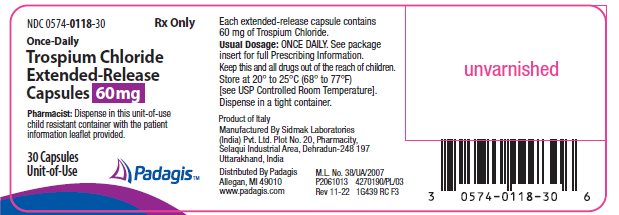
Packaging label of Trospium Chloride Extended-Release Capsules 60 mg, with 30 capsules per unit-of-use container. The label specifies once-daily dosage and includes storage instructions, manufacturer Padagis US LLC, and product NDC 0574-0118-30. The label also features a barcode and notes the product is Rx only.*
FDA Label Image

Serialization-template.jpg (Serialization Template)

Serialization-template.jpg (Serialization Template)
A text panel with placeholder lines for a product's serial number (S/N), lot number (Lot), and expiration date (Exp). This panel appears to be intended for batch tracking and expiration details but contains no specific information.*

* About these descriptions: Image descriptions on this page are generated by automated AI analysis of the product label images from the manufacturer's FDA label submission (SPL). They are provided for reference only and may contain errors or omissions. Always rely on the printed label itself and the official FDA labeling, and consult a pharmacist or healthcare professional with any questions about this product.