Randomized, Open-Label Clinical Trial in Patients with Newly Diagnosed MM:
A randomized multicenter, open-label, 3-arm trial of 1,623 patients, was conducted to compare the efficacy and safety of lenalidomide capsules and low-dose dexamethasone (Rd) given for 2 different durations of time to that of melphalan, prednisone and thalidomide (MPT) in newly diagnosed MM patients who were not a candidate for stem cell transplant. In the first arm of the study, Rd was given continuously until progressive disease [Arm Rd Continuous]. In the second arm, Rd was given for up to eighteen 28-day cycles [72 weeks, Arm Rd18]). In the third arm, melphalan, prednisone and thalidomide (MPT) was given for a maximum of twelve 42-day cycles (72 weeks). For the purposes of this study, a patient who was < 65 years of age was not a candidate for SCT if the patient refused to undergo SCT therapy or the patient did not have access to SCT due to cost or other reasons. Patients were stratified at randomization by age (≤75 versus >75 years), stage (ISS Stages I and II versus Stage III), and country.
Patients in the Rd Continuous and Rd18 arms received lenalidomide capsules 25 mg once daily on Days 1 to 21 of 28-day cycles. Dexamethasone was dosed 40 mg once daily on Days 1, 8, 15, and 22 of each 28-day cycle. For patients over > 75 years old, the starting dose of dexamethasone was 20 mg orally once daily on days 1,8,15, and 22 of repeated 28-day cycles. Initial dose and regimens for Rd Continuous and Rd18 were adjusted according to age and renal function. All patients received prophylactic anticoagulation with the most commonly used being aspirin.
The demographics and disease-related baseline characteristics of the patients were balanced among the 3 arms. In general, study subjects had advanced-stage disease. Of the total study population, the median age was 73 in the 3 arms with 35% of total patients > 75 years of age; 59% had ISS Stage I/II; 41% had ISS stage III; 9% had severe renal impairment (creatinine clearance [CLcr] < 30 mL/min); 23% had moderate renal impairment (CLcr > 30 to 50 mL/min; 44% had mild renal impairment (CLcr > 50 to 80 mL/min). For ECOG Performance Status, 29% were Grade 0, 49% Grade 1, 21% Grade 2, 0.4% ≥ Grade 3.
The primary efficacy endpoint, progression-free survival (PFS), was defined as the time from randomization to the first documentation of disease progression as determined by Independent Response Adjudication Committee (IRAC), based on International Myeloma Working Group [IMWG] criteria or death due to any cause, whichever occurred first during the study until the end of the PFS follow-up phase. For the efficacy analysis of all endpoints, the primary comparison was between Rd Continuous and MPT arms. The efficacy results are summarized in the table below. PFS was significantly longer with Rd Continuous than MPT: HR 0.72 (95% CI: 0.61-0.85 p <0.0001). A lower percentage of subjects in the Rd Continuous arm compared with the MPT arm had PFS events (52% versus 61%, respectively). The improvement in median PFS time in the Rd Continuous arm compared with the MPT arm was 4.3 months. The myeloma response rate was higher with Rd Continuous compared with MPT (75.1% versus 62.3%); with a complete response in 15.1% of Rd Continuous arm patients versus 9.3% in the MPT arm. The median time to first response was 1.8 months in the Rd Continuous arm versus 2.8 months in the MPT arm.
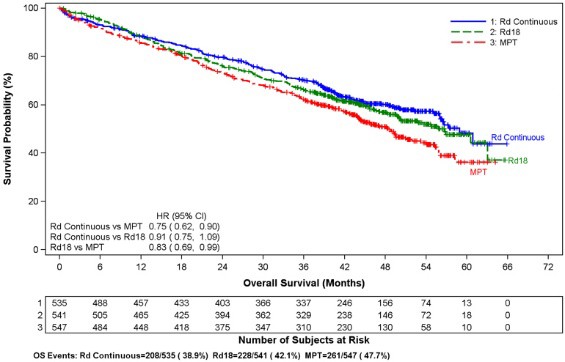
For the interim OS analysis with 03 March 2014 data cutoff, the median follow-up time for all surviving patients is 45.5 months, with 697 death events, representing 78% of prespecified events required for the planned final OS analysis (697/896 of the final OS events). The observed OS HR was 0.75 for Rd Continuous versus MPT (95% CI = 0.62, 0.90).
Table 13: Overview of Efficacy Results – Study MM-020 (Intent-to-treat Population)
| Rd Continuous
(N = 535) | Rd18
(N = 541) | MPT
(N = 547) |
|---|
PFS – IRAC (months)g | | | |
Number of PFS events | 278 (52) | 348 (64.3) | 334 (61.1) |
Mediana PFS time, months (95% CI)b | 25.5 (20.7, 29.4) | 20.7 (19.4, 22) | 21.2 (19.3, 23.2) |
HR [95% CI]c; p-valued | | | |
Rd Continuous vs MPT | 0.72 (0.61, 0.85); <0.0001 | | |
Rd Continuous vs Rd18 | 0.70 (0.60, 0.82) | 0.70 (0.60, 0.82) | 0.70 (0.60, 0.82) |
Rd18 vs MPT | 1.03 (0.89, 1.20) | | |
Overall Survival (months)h | | | |
Number of Death events | 208 (38.9) | 228 (42.1) | 261 (47.7) |
Mediana OS time, months (95% CI)b | 58.9 (56, NE)f | 56.7 (50.1, NE) | 48.5 (44.2, 52 ) |
HR [95% CI]c | | | |
Rd Continuous vs MPT | 0.75 (0.62, 0.90) | | |
Rd Continuous vs Rd18 | 0.91 (0.75, 1.09) | | |
Rd18 vs MPT | 0.83 (0.69, 0.99) | | |
Response Ratee – IRAC, n (%)g | | | |
CR | 81 (15.1) | 77 (14.2) | 51 (9.3) |
VGPR | 152 (28.4) | 154 (28.5) | 103 (18.8) |
PR | 169 (31.6) | 166 (30.7) | 187 (34.2) |
Overall response: CR, VGPR, or PR | 402 (75.1) | 397 (73.4) | 341 (62.3) |
CR = complete response; d = low-dose dexamethasone; HR = hazard ratio; IRAC = Independent Response Adjudication Committee; M = melphalan;
NE = not estimable; OS = overall survival; P = prednisone; PFS = progression-free survival; PR = partial response; R = lenalidomide; Rd Continuous = Rd given until documentation of progressive disease; Rd18 = Rd given for ≤ 18 cycles; T = thalidomide; VGPR = very good partial response; vs = versus.
a The median is based on the Kaplan-Meier estimate.
b The 95% Confidence Interval (CI) about the median.
c Based on Cox proportional hazards model comparing the hazard functions associated with the indicated treatment arms.
d The p-value is based on the unstratified log-rank test of Kaplan-Meier curve differences between the indicated treatment arms.
e Best assessment of response during the treatment phase of the study.
f Including patients with no response assessment data or whose only assessment was “response not evaluable.”
g Data cutoff date = 24 May 2013.
h Data cutoff date = 3 March 2014.
Kaplan-Meier Curves of Progression-free Survival Based on IRAC Assessment (ITT MM Population)
Between Arms Rd Continuous, Rd18 and MPT
Cutoff date: 24 May 2013
CI = confidence interval; d = low-dose dexamethasone; HR = hazard ratio; IRAC = Independent Response Adjudication Committee; M = melphalan; P = prednisone;
R = lenalidomide capsules; Rd Continuous = Rd given until documentation of progressive disease; Rd18 = Rd given for ≤ 18 cycles; T = thalidomide.
Kaplan-Meier Curves of Overall Survival (ITT MM Population)
Between Arms Rd Continuous, Rd18 and MPT
Cutoff date: 03 Mar 2014
CI = confidence interval; d = low-dose dexamethasone; HR = hazard ratio; M = melphalan; P = prednisone; R = lenalidomide; Rd Continuous = Rd given until documentation of progressive disease; Rd18 = Rd given for ≤18 cycles; T = thalidomide.
Randomized, Placebo-Controlled Clinical Trials - Maintenance Following Auto-HSCT:
Two multicenter, randomized, double-blind, parallel group, placebo-controlled studies were conducted to evaluate the efficacy and safety of lenalidomide capsules maintenance therapy in the treatment of MM patients after auto-HSCT. In Maintenance Study 1, patients between 18 and 70 years of age who had undergone induction therapy followed by auto-HSCT were eligible. Induction therapy must have occurred within 12 months. Within 90-100 days after auto-HSCT, patients with at least a stable disease response were randomized 1:1 to receive either lenalidomide capsules or placebo maintenance. In Maintenance Study 2, patients aged < 65 years at diagnosis who had undergone induction therapy followed by auto-HSCT and had achieved at least a stable disease response at the time of hematologic recovery were eligible. Within 6 months after auto-HSCT, patients were randomized 1:1 to receive either lenalidomide capsules or placebo maintenance. Patients eligible for both trials had to have CLcr ≥30 mL/minute.
In both studies, the lenalidomide capsules maintenance dose was 10 mg once daily on days 1-28 of repeated 28-day cycles, could be increased to 15 mg once daily after 3 months in the absence of dose-limiting toxicity, and treatment was to be continued until disease progression or patient withdrawal for another reason. The dose was reduced, or treatment was temporarily interrupted or stopped, as needed to manage toxicity. A dose increase to 15 mg once daily occurred in 135 patients (58%) in Maintenance Study 1, and in 185 patients (60%) in Maintenance Study 2.
The demographics and disease-related baseline characteristics of the patients were similar across the two studies and reflected a typical MM population after auto- HSCT (see Table 14).
Table 14: Baseline Demographic and Disease-Related Characteristics – MM Maintenance Studies 1 and 2
| Maintenance Study 1 | | Maintenance Study 2 | |
|---|
| Lenalidomidecapsules N = 231 | Placebo N = 229 | Lenalidomidecapsules N = 307 | Placebo N = 307 |
Age (years) | | | | |
Median | 58 | 58 | 57.5 | 58.1 |
(Min, max) | (29, 71) | (39, 71) | (22.7, 68.3) | (32.3, 67) |
Sex, n (%) | | | | |
Male | 121 (52) | 129 (56) | 169 (55) | 181 (59) |
Female | 110 (48) | 100 (44) | 138 (45) | 126 (41) |
ISS Stage at Diagnosis, n (%) | | | | |
Stage I or II | 120 (52) | 131 (57) | 232 (76) | 250 (81) |
Stage I | 62 (27) | 85 (37) | 128 (42) | 143 (47) |
Stage II | 58 (25) | 46 (20) | 104 (34) | 107 (35) |
Stage III | 39 (17) | 35 (15) | 66 (21) | 46 (15) |
Missing | 72 (31) | 63 (28) | 9 (3) | 11 (4) |
CrCl at Post- auto-HSCT, n (%) | | | | |
< 50 mL/min | 23 (10) | 16 (7) | 10 (3) | 9 (3) |
≥ 50 mL/min | 201 (87) | 204 (89) | 178 (58) | 200 (65) |
Missing | 7 (3) | 9 (4) | 119 (39) | 98 (32) |
Data cutoff date = 1 March 2015.
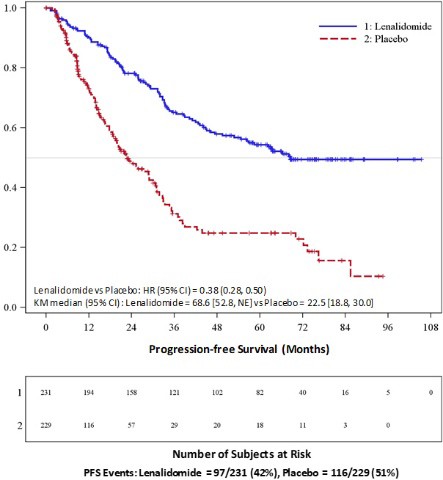
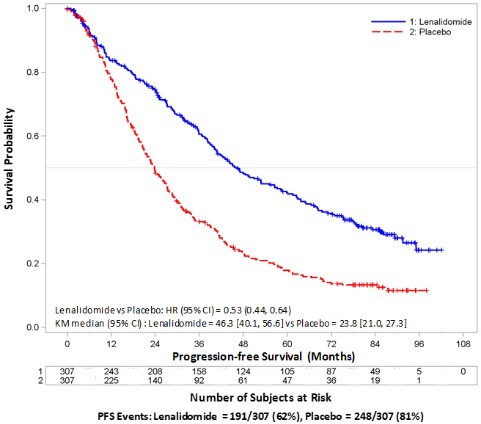
The major efficacy endpoint of both studies was PFS defined from randomization to the date of progression or death, whichever occurred first; the individual studies were not powered for an overall survival endpoint. Both studies were unblinded upon the recommendations of their respective data monitoring committees and after surpassing the respective thresholds for preplanned interim analyses of PFS. After unblinding, patients continued to be followed as before. Patients in the placebo arm of Maintenance Study 1 were allowed to cross over to receive lenalidomide capsules before disease progression (76 patients [33%] crossed over to lenalidomide); patients in Maintenance Study 2 were not recommended to cross over. The efficacy results are summarized in the following table. In both studies, the primary analysis of PFS at unblinding was significantly longer with lenalidomide capsules compared to placebo: Maintenance Study 1 HR 0.38 (95% CI: 0.27-0.54 p <0.001) and Maintenance Study 2 HR 0.50 (95% CI: 0.39-0.64 p <0.001). For both studies, PFS was updated with a cutoff date of 1 March 2015 as shown in the table and the following Kaplan Meier graphs. With longer follow-up (median 72.4 and 86.0 months, respectively), the updated PFS analyses for both studies continue to show a PFS advantage for lenalidomide capsules compared to placebo: Maintenance Study 1 HR 0.38 (95% CI: 0.28-0.50) with median PFS of 68.6 months and Maintenance Study 2 HR 0.53 (95% CI: 0.44-0.64) with median PFS of 46.3 months.
Descriptive analysis of OS data with a cutoff date of 1 February 2016 are provided in Table 15. Median follow-up time was 81.6 and 96.7 months for Maintenance Study 1 and Maintenance Study 2, respectively. Median OS was 111.0 and 84.2 months for lenalidomide capsules and placebo, respectively, for Maintenance Study 1, and 105.9 and 88.1 months, for lenalidomide capsules and placebo, respectively, for Maintenance Study 2.
Table 15: Progression-free Survival and Overall Survival from
Randomization in MM Maintenance Studies 1 and 2 (ITT Post-Auto-HSCT Population)
| Maintenance Study 1 | | Maintenance Study 2 | |
| Lenalidomidecapsules N = 231 | Placebo N = 229 | Lenalidomidecapsules N = 307 | Placebo N = 307 |
PFS at Unblinding | | | | |
PFS Events n (%) | 46 (20) | 98 (43) | 103 (34) | 160 (52) |
Median in months [95% CI] | 33.9 [NE, NE] | 19 [16.2, 25.6] | 41.2 [38.3, NE] | 23.0 [21.2, 28.0] |
Hazard Ratio [95% CI] | 0.38 [0.27, 0.54] | | 0.50 [0.39, 0.64] | |
Log-rank Test p- value | <0.001 | | <0.001 | |
PFS at Updated Analysis 1 March 2015 (Studies 1 and 2) | | | | |
PFS Events n (%) | 97 (42) | 116 (51) | 191 (62) | 248 (81) |
Median in months [95% CI] | 68.6 [52.8, NE] | 22.5 [18.8, 30.0] | 46.3 [40.1, 56.6] | 23.8 [21.0, 27.3] |
Hazard Ratio [95% CI] | 0.38 [0.28, 0.50] | | 0.53 [0.44, 0.64] | |
OS at Updated Analysis 1 Feb 2016 (Studies 1 and 2) | | | | |
OS Events n (%) | 82 (35) | 114 (50) | 143 (47) | 160 (52) |
Median in months [95% CI] | 111 [101.8, NE] | 84.2 [71.0, 102.7] | 105.9 [88.8, NE] | 88.1 [80.7, 108.4] |
Hazard Ratio [95% CI] | 0.59 [0.44, 0.78] | | 0.90 [0.72, 1.13] | |
Date of Unblinding in Maintenance Study 1 and 2 = 17 December 2009 and 7 July 2010, respectively.
Auto-HSCT = autologous hematopoietic stem cell transplantation; CI = confidence interval; ITT = intent to treat; NE = not estimable;
PFS = progression-free survival.
PFS at time of unblinding for Maintenance Study 2 was based on assessment by an Independent Review Committee. All other PFS analyses were based on assessment by investigator.
Note: The median is based on Kaplan-Meier estimate, with 95% CIs about the median overall PFS time. Hazard ratio is based on a proportional hazards model stratified by stratification factors comparing the hazard functions associated with treatment arms (Lenalidomide: placebo).
Kaplan-Meier Curves of Progression-free Survival from Randomization
(ITT Post-Auto-HSCT Population) in MM Maintenance Study 1 between Lenalidomide Capsules and
Placebo Arms (Updated Cutoff Date 1 March 2015)
Auto-HSCT = autologous hematopoietic stem cell transplantation; CI = confidence interval; HR = hazard ratio; ITT = intent to treat; KM = Kaplan-Meier; PFS = progression- free survival; vs = versus.
Kaplan-Meier Curves of Progression-free Survival from Randomization
(ITT Post-Auto-HSCT Population) in MM Maintenance Study 2 between
Lenalidomide Capsules and Placebo Arms (Updated Cutoff Date 1 March 2015)
Auto-HSCT = autologous hematopoietic stem cell transplantation; CI = confidence interval; HR = hazard ratio; ITT = intent to treat; KM = Kaplan-Meier; NE = not estimable; PFS = progression-free survival; vs = versus.
Randomized, Open-Label Clinical Studies in Patients with MM After At Least One PriorTherapy
Two randomized studies (Studies 1 and 2) were conducted to evaluate the efficacy and safety of lenalidomide. These multicenter, multinational, double-blind, placebo-controlled studies compared lenalidomide plus oral pulse high-dose dexamethasone therapy to dexamethasone therapy alone in patients with MM who had received at least one prior treatment. These studies enrolled patients with absolute neutrophil counts (ANC) ≥ 1000/mm3, platelet counts ≥ 75,000/mm3, serum creatinine ≤ 2.5 mg/dL, serum SGOT/AST or SGPT/ALT ≤ 3 × upper limit of normal (ULN), and serum direct bilirubin ≤ 2 mg/dL.
In both studies, patients in the lenalidomide/dexamethasone group took 25 mg of lenalidomide capsules orally once daily on Days 1 to 21 and a matching placebo capsule once daily on Days 22 to 28 of each 28-day cycle. Patients in the placebo/dexamethasone group took 1 placebo capsule on Days 1 to 28 of each 28-day cycle. Patients in both treatment groups took 40 mg of dexamethasone orally once daily on Days 1 to 4, 9 to 12, and 17 to 20 of each 28-day cycle for the first 4 cycles of therapy.
The dose of dexamethasone was reduced to 40 mg orally once daily on Days 1 to 4 of each 28-day cycle after the first 4 cycles of therapy. In both studies, treatment was to continue until disease progression.
In both studies, dose adjustments were allowed based on clinical and laboratory findings. Sequential dose reductions to 15 mg daily, 10 mg daily and 5 mg daily were allowed for toxicity [see Dosage and Administration (2.1)].
Table 16 summarizes the baseline patient and disease characteristics in the two studies. In both studies, baseline demographic and disease-related characteristics were comparable between the lenalidomide/dexamethasone and placebo/dexamethasone groups
Table 16: Baseline Demographic and Disease-Related Characteristics – MM Studies 1 and 2
| Study 1 | | Study 2 | |
|---|
| Lenalidomide/Dex
N=177 | Placebo/Dex
N=176 | Lenalidomide/Dex
N=176 | Placebo/Dex
N=175 |
|---|
Patient Characteristics | | | | |
Age (years) Median Min, Max | 64 36, 86 | 62 37, 85 | 63 33, 84 | 64 40, 82 |
Sex Male Female | 106 (60%) 71 (40%) | 104 (59%) 72 (41%) | 104 (59%) 72 (41%) | 103 (59%) 72 (41%) |
Race/Ethnicity White Other | 141(80%) 36 (20%) | 148 (84%) 28 (16%) | 172 (98%) 4 (2%) | 175 (100%) 0 (0%) |
ECOG Performance Status 0-1 | 157 (89%) | 168 (95%) | 150 (85%) | 144 (82%) |
Disease Characteristics | | | | |
Multiple Myeloma Stage (Durie- Salmon) I II III | 3% 32% 64% | 3% 31% 66% | 6% 28% 65% | 5% 33% 63% |
β2-microglobulin (mg/L) ≤ 2.5 mg/L > 2.5 mg/L | 52 (29%) 125 (71%) | 51 (29%) 125 (71%) | 51 (29%) 125 (71%) | 48 (27%) 127 (73%) |
Number of Prior Therapies | | | | |
1 ≥ 2 | 38% 62% | 38% 62% | 32% 68% | 33% 67% |
Types of Prior Therapies | | | | |
Stem Cell Transplantation | 62% | 61% | 55% | 54% |
Thalidomide | 42% | 46% | 30% | 38% |
Dexamethasone | 81% | 71% | 66% | 69% |
Bortezomib | 11% | 11% | 5% | 4% |
Melphalan Doxorubicin | 33% 55% | 31% 51% | 56% 56% | 52% 57% |
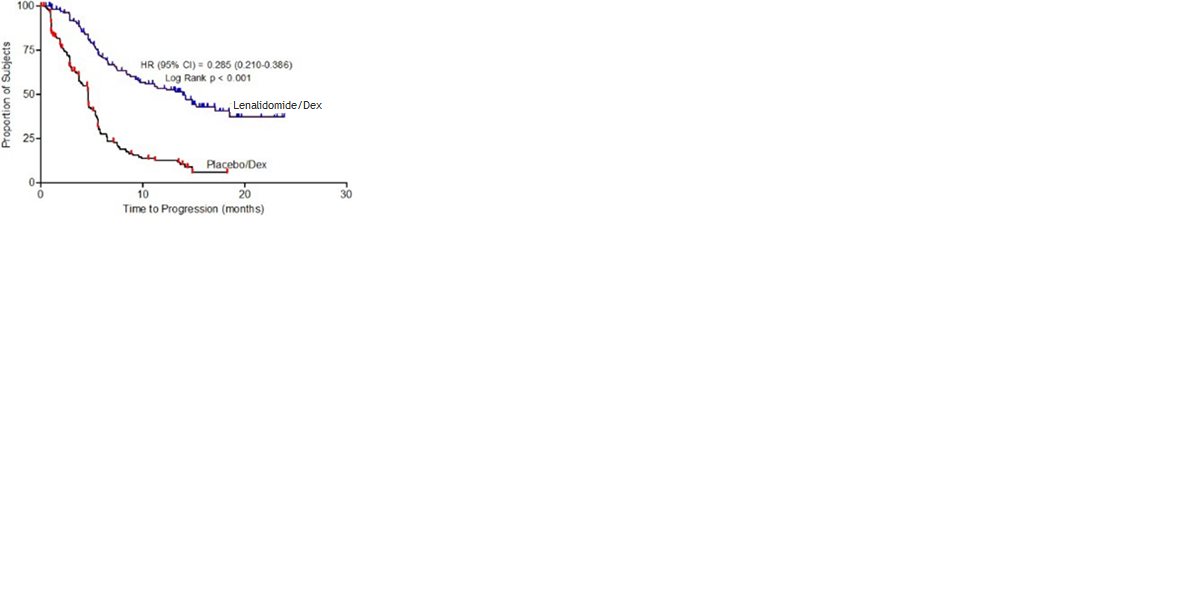
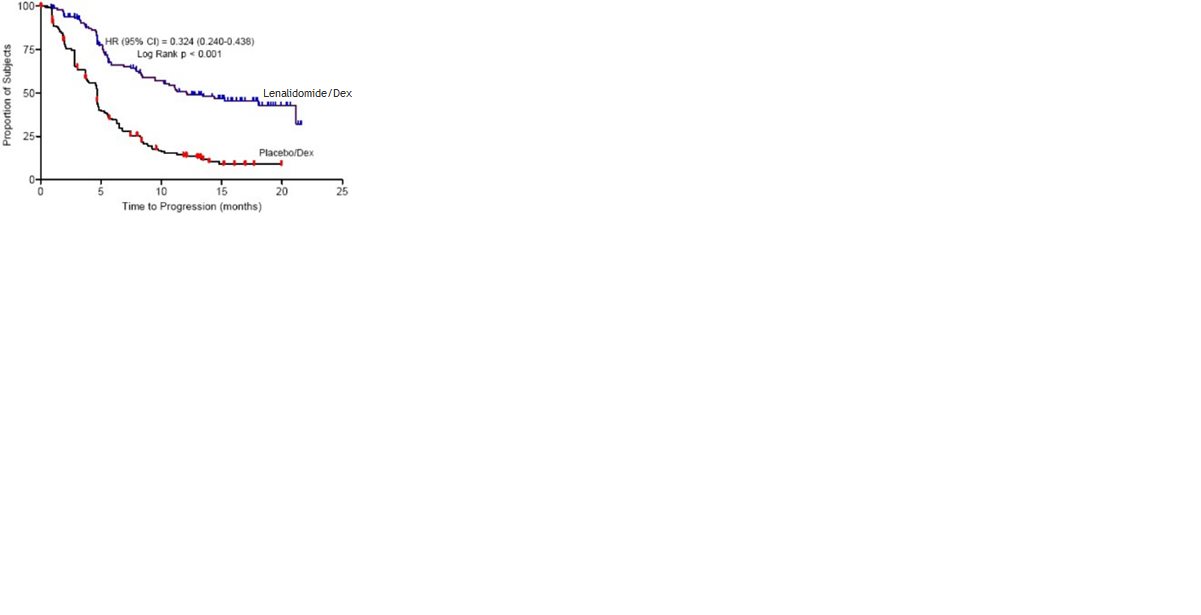
The primary efficacy endpoint in both studies was time to progression (TTP). TTP was defined as the time from randomization to the first occurrence of progressive disease.
Preplanned interim analyses of both studies showed that the combination of lenalidomide/dexamethasone was significantly superior to dexamethasone alone for TTP. The studies were unblinded to allow patients in the placebo/dexamethasone group to receive treatment with the lenalidomide/dexamethasone combination. For both studies, the extended follow-up survival data with crossovers were analyzed. In study 1, the median survival time was 39.4 months (95%CI: 32.9, 47.4) in lenalidomide/dexamethasone group and 31.6 months (95% CI: 24.1, 40.9) in placebo/dexamethasone group, with a hazard ratio of 0.79 (95% CI: 0.61-1.03). In study 2, the median survival time was 37.5 months (95%CI: 29.9, 46.6) in lenalidomide/dexamethasone group and 30.8 months (95%CI: 23.5, 40.3) in placebo/dexamethasone group, with a hazard ratio of 0.86 (95% CI: 0.65-1.14).
Table 17: TTP Results in MM Study 1 and Study 2
| Study 1 | | Study 2 | |
|---|
| Lenalidomide/Dex
N=177 | Placebo/Dex
N=176 | Lenalidomide/Dex
N=176 | Placebo/Dex
N=175 |
|---|
TTP | | | | |
Events n (%) | 73 (41) | 120 (68) | 68 (39) | 130 (74) |
Median TTP in months [95% CI] | 13.9 [9.5, 18.5] | 4.7 [3.7, 4.9] | 12.1 [9.5, NE] | 4.7 [3.8, 4.8] |
Hazard Ratio [95% CI] | 0.285 [0.210, 0.386] | | 0.324 [0.240, 0.438] | |
Log-rank Test p-value 3 | <0.001 | | <0.001 | |
Response | | | | |
Complete Response (CR) n (%) | 23 (13) | 1 (1) | 27 (15) | 7 (4) |
Partial Response (RR/PR) n (%) | 84 (48) | 33 (19) | 77 (44) | 34 (19) |
Overall Response n (%) | 107 (61) | 34 (19) | 104 (59) | 41 (23) |
p-value | <0.001 | | <0.001 | |
Odds Ratio [95% CI] | 6.38 [3.95, 10.32] | | 4.72 [2.98, 7.49] | |
Kaplan-Meier Estimate of Progression — MM Study 1
Kaplan-Meier Estimate of Progression — MM Study 2