Description
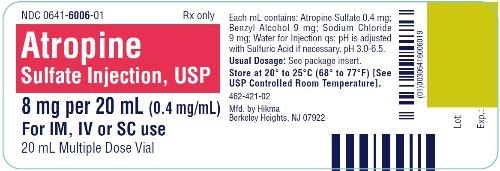
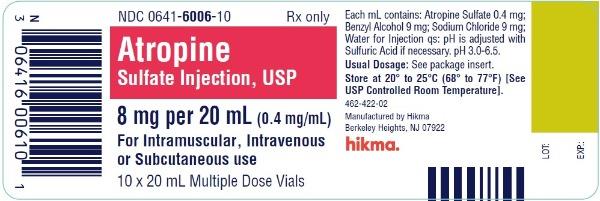
Atropine Sulfate Injection, USP is a sterile solution of atropine sulfate in Water for Injection. Each mL contains Atropine Sulfate 0.4 mg; Sodium Chloride 9 mg; Benzyl Alcohol 9 mg; Water for Injection qs; pH may be adjusted with Sulfuric Acid if necessary. pH 3.0-6.5.
Atropine Sulfate Injection, USP may be given intramuscularly, intravenously or subcutaneously. Atropine is a white crystalline alkaloid which may be extracted from belladonna root or may be produced synthetically. It is used as atropine sulfate because this compound has much greater solubility.
Atropine sulfate is an anticholinergic drug. The empirical formula of atropine sulfate is (C17H23NO3)2•H2SO4•H2O.
The structural formula is:
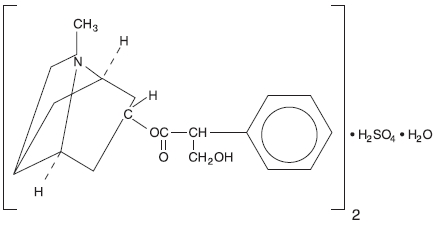
Structural Formula (Atropine Sulfate Injection Usp 1)