Arterial Events
CHCs increase the risk of cardiovascular events and cerebrovascular events, such as myocardial infarction and stroke. The risk is greater among older women (> 35 years of age), smokers, and females with hypertension, dyslipidemia, diabetes, or obesity.
LNG/EE Tablets is contraindicated in women over 35 years of age who smoke [see Contraindications (4)]. Cigarette smoking increases the risk of serious cardiovascular events from CHC use. This risk increases with age, particularly in women over 35 years of age, and with the number of cigarettes smoked.
Venous Events
Use of CHCs increases the risk of venous thromboembolic events (VTEs), such as deep vein thrombosis and pulmonary embolism. Risk factors for VTEs include smoking, obesity, and family history of VTE, in addition to other factors that contraindicate use of CHCs [see Contraindications (4)]. While the increased risk of VTE associated with use of CHCs is well-established, the rates of VTE are even greater during pregnancy, and especially during the postpartum period (see Figure 1). The rate of VTE in females using COCs has been estimated to be 3 to 9 cases per 10,000 woman-years.
The risk of VTE is highest during the first year of use of a CHC and when restarting hormonal contraception after a break of four weeks or longer. Based on results from a few studies, there is some evidence that this is true for non-oral products as well. The risk of thromboembolic disease due to CHCs gradually disappears after CHC use is discontinued.
Figure 1 shows the risk of developing a VTE for females who are not pregnant and do not use oral contraceptives, for females who use oral contraceptives, for pregnant females, and for females in the postpartum period. To put the risk of developing a VTE into perspective: If 10,000 females who are not pregnant and do not use oral contraceptives are followed for one year, between 1 and 5 of these females will develop a VTE.
| *Pregnancy data based on actual duration of pregnancy in the reference studies. Based on a model assumption that pregnancy duration is nine months, the rate is 7 to 27 per 10,000 WY. |
| Figure 1 Likelihood of Developing a VTE |
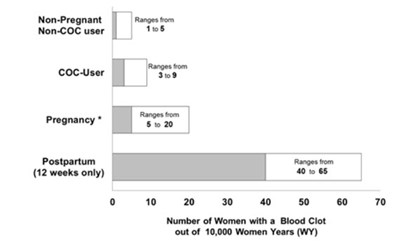 Figure 1 (Levonorgestrel 01) |
Elevated Liver Enzymes
LNG/EE Tablets is contraindicated in females with acute viral hepatitis or severe (decompensated) cirrhosis of the liver [see Contraindications (4)]. Discontinue LNG/EE Tablets if jaundice develops. Acute liver test abnormalities may necessitate the discontinuation of CHC use until the liver tests return to normal and CHC causation has been excluded.
Liver Tumors
LNG/EE Tablets is contraindicated in females with benign or malignant liver tumors [see Contraindications (4)]. CHCs increase the risk of hepatic adenomas. An estimate of the attributable risk is 3.3 cases/100,000 CHC users. Rupture of hepatic adenomas may cause death from abdominal hemorrhage.
Studies have shown an increased risk of developing hepatocellular carcinoma in long-term (> 8 years) CHC users. The attributable risk of liver cancers in CHC users is less than one case per million users.
Hyperglycemia
LNG/EE Tablets is contraindicated in diabetic women over age 35, or females who have diabetes with hypertension, nephropathy, retinopathy, neuropathy, other vascular disease, or females with diabetes of > 20 years duration [see Contraindications (4)]. LNG/EE Tablets may decrease glucose tolerance. Carefully monitor prediabetic and diabetic females who are using LNG/EE Tablets.
Dyslipidemia
Consider alternative contraception for females with uncontrolled dyslipidemia. LNG/EE Tablets may cause adverse lipid changes.
Females with hypertriglyceridemia, or a family history thereof, may have an increase in serum triglyceride concentrations when using LNG/EE Tablets, which may increase the risk of pancreatitis.
Unscheduled Bleeding and Spotting
Females using LNG/EE Tablets may experience unscheduled (breakthrough or intracyclic) bleeding and spotting, especially during the first three months of use. Bleeding irregularities may resolve over time or by changing to a different contraceptive product. If bleeding persists or occurs after previously regular cycles, evaluate for causes such as pregnancy or malignancy.
Amenorrhea and Oligomenorrhea
Females who use LNG/EE Tablets may experience absence of scheduled (withdrawal) bleeding, even if they are not pregnant.
If scheduled bleeding does not occur, consider the possibility of pregnancy. If the patient has not adhered to the prescribed dosing schedule (missed one or two active tablets or started taking them on a day later than she should have), consider the possibility of pregnancy at the time of the first missed period and perform appropriate diagnostic measures. If the patient has adhered to the prescribed dosing schedule and misses two consecutive periods, rule out pregnancy.
After discontinuation of a CHC, amenorrhea or oligomenorrhea may occur, especially if these conditions were pre-existent.
Substances decreasing the Plasma Concentration of CHCs and Potentially Diminishing the Efficacy of CHCs
Table 3 Significant Drug Interactions Involving Substances That Affect CHCs| a Induction potency of St. John's wort may vary widely based on preparation. |
| Metabolic Enzyme Inducers |
| Clinical effect | - Concomitant use of CHCs with metabolic enzyme inducers may decrease the plasma concentrations of the estrogen and/or progestin component of CHCs [see Clinical Pharmacology (12.3)].
- Decreased exposure of the estrogen and/or progestin component of CHCs may potentially diminish the effectiveness of CHCs and may lead to contraceptive failure or an increase in breakthrough bleeding.
|
| Prevention or management | - Counsel females to use an alternative method of contraception or a backup method when enzyme inducers are used with CHCs.
- Continue backup contraception for 28 days after discontinuing the enzyme inducer to maintain contraceptive reliability.
|
| Examples | Aprepitant, barbiturates, bosentan, carbamazepine, efavirenz, felbamate, griseofulvin, oxcarbazepine, phenytoin, rifampin, primidone, phenylbutazone, rifabutin, rufinamide, topiramate, products containing St. John's wort, and certain protease inhibitors (see separate section on protease inhibitors below). |
| Colesevelam |
| Clinical effect | - Concomitant use of CHCs with colesevelam significantly decreases systemic exposure of ethinyl estradiol [see Clinical Pharmacology (12.3)].
- Decreased exposure of the estrogen component of CHCs may potentially reduce contraceptive efficacy or result in an increase in breakthrough bleeding, depending on the strength of ethinyl estradiol in the CHC.
|
| Prevention or management | Administer 4 or more hours apart to attenuate this drug interaction. |
Substances increasing the systemic exposure of CHCs:
Co-administration of atorvastatin or rosuvastatin and CHCs containing ethinyl estradiol increase systemic exposure of ethinyl estradiol by approximately 20 to 25 percent. Ascorbic acid and acetaminophen may increase systemic exposure of ethinyl estradiol, possibly by inhibition of conjugation. CYP3A inhibitors such as itraconazole, voriconazole, fluconazole, grapefruit juice
The effect of grapefruit juice on CYP3A4 enzymes (e.g., strong vs. moderate inhibition) depends on its brand, concentration, and preparation.
, or ketoconazole may increase systemic exposure of the estrogen and/or progestin component of CHCs.
Human immunodeficiency virus (HIV)/hepatitis C virus (HCV) protease inhibitors and non-nucleoside reverse transcriptase inhibitors:
Significant decreases in systemic exposure of the estrogen and/or progestin have been noted when CHCs are co-administered with some HIV protease inhibitors (e.g., nelfinavir, ritonavir, darunavir/ritonavir, (fos)amprenavir/ritonavir, lopinavir/ritonavir, and tipranavir/ritonavir), some HCV protease inhibitors (e.g., boceprevir and telaprevir), and some non-nucleoside reverse transcriptase inhibitors (e.g., nevirapine).
In contrast, significant increases in systemic exposure of the estrogen and/or progestin have been noted when CHCs are co-administered with certain other HIV protease inhibitors (e.g., indinavir and atazanavir/ritonavir) and with other non-nucleoside reverse transcriptase inhibitors (e.g., etravirine).
Risk Summary
There is no use for contraception in pregnancy; therefore, LNG/EE Tablets should be discontinued during pregnancy. Epidemiologic studies and meta-analyses have not found an increased risk of genital or nongenital birth defects (including cardiac anomalies and limb-reduction defects) following exposure to CHCs before conception or during early pregnancy.
In the U.S. general population, the estimated background risk of major birth defects and miscarriage in clinically recognized pregnancies is 2 to 4 percent and 15 to 20 percent, respectively.
Risk Summary
Contraceptive hormones and/or metabolites are present in human milk. CHCs can reduce milk production in breast-feeding females. This reduction can occur at any time but is less likely to occur once breast-feeding is well established. When possible, advise the nursing female to use other methods of contraception until she discontinues breast-feeding [see Dosage and Administration (2.2)]. The developmental and health benefits of breast-feeding should be considered along with the mother's clinical need for LNG/EE Tablets and any potential adverse effects on the breast-fed child from LNG/EE Tablets or from the underlying maternal condition.
Data
Small amounts of oral-contraceptive steroids and/or metabolites have been identified in the milk of nursing mothers, and a few adverse effects on the child have been reported, including jaundice and breast enlargement. In addition, combination oral contraceptives given in the postpartum period may interfere with lactation by decreasing the quantity and quality of breast milk.
Absorption
No specific investigation of the absolute bioavailability of LNG/EE Tablets in humans has been conducted. However, literature indicates that levonorgestrel is rapidly and completely absorbed after oral administration (bioavailability about 100%) and is not subject to first-pass metabolism. Ethinyl estradiol is rapidly and almost completely absorbed from the gastrointestinal tract but, due to first-pass metabolism in gut mucosa and liver, the bioavailability of ethinyl estradiol is between 38% and 48%.
The kinetics of total levonorgestrel are non-linear due to an increase in binding of levonorgestrel to sex hormone binding globulin (SHBG), which is attributed to increased SHBG levels that are induced by the daily administration of ethinyl estradiol.
Table 5 provides a summary of pharmacokinetics of levonorgestrel and ethinyl estradiol after a single dose of LNG/EE Tablets in 32 female subjects only under fasting condition.
Table 5 Summary Mean (CV%) Pharmacokinetic Parameters from Single Dose Administration of LNG/EE Tablets| Analyte | Sample Size | Cmax
(pg/mL) | Tmax
(h)Median (min – max) | AUC0-T
(pg*h/mL) | AUC0-∞
(pg*h/mL) | T1/2
(h) |
|---|
| EE | n = 32 | 53.22 (33.9) | 1.50 (1.00-2.25) | 477.75 (32.5) | 515.51 (31.0) | 16.42 (25.0) |
| LNG | n = 32 n = 30 for AUC0-∞ and T1/2 | 3225.0 (33.1) | 0.75 (0.50-1.00) | 27586.0 (39.0) | 34099.0 (36.8) | 33.67 (31.8) |
Distribution
Levonorgestrel in serum is primarily bound to SHBG. Ethinyl estradiol is about 97% bound to plasma albumin. Ethinyl estradiol does not bind to SHBG, but induces SHBG synthesis.
Elimination
Metabolism
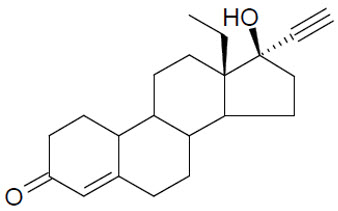
Levonorgestrel: The most important metabolic pathway occurs in the reduction of the Δ4-3-oxo group and hydroxylation at positions 2α, 1β, and 16β, followed by conjugation. Most of the metabolites that circulate in the blood are sulfates of 3α,5β-tetrahydro-levonorgestrel, while excretion occurs predominantly in the form of glucuronides. Some of the parent levonorgestrel also circulates as 17β-sulfate. Metabolic clearance rates may differ among individuals by several-fold, and this may account in part for the wide variation observed in levonorgestrel concentrations among users.
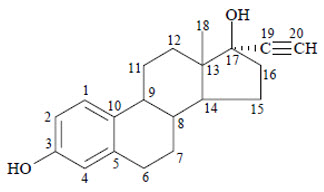
Ethinyl estradiol: Cytochrome P450 enzymes (CYP3A4) in the liver are responsible for the 2-hydroxylation that is the major oxidative reaction. The 2-hydroxy metabolite is further transformed by methylation and glucuronidation prior to urinary and fecal excretion. Levels of Cytochrome P450 (CYP3A) vary widely among individuals and can explain the variation in rates of ethinyl estradiol 2-hydroxylation. Ethinyl estradiol is excreted in the urine and feces as glucuronide and sulfate conjugates, and undergoes enterohepatic circulation.
Excretion
The elimination half-life for levonorgestrel is approximately 36 ± 13 hours at steady state. Levonorgestrel and its metabolites are primarily excreted in the urine (40% to 68%) and about 16% to 48% are excreted in feces. The elimination half-life of ethinyl estradiol is 18 ± 4.7 hours at steady state.
Cigarette Smoking
Advise women that cigarette smoking increases the risk of serious cardiovascular events from CHC use, and that women who are over 35 years old and smoke should not use LNG/EE Tablets [see Boxed Warning and Warning and Precautions (5.1)].
Venous Thromboembolism
Advise women that the increased risk of VTE compared to non-users of CHCs is greatest after initially starting a CHC or restarting (following a 4-week or greater tablet-free interval) the same or a different CHC [see Warnings and Precautions (5.1)].
Use During Pregnancy
Advise women that there is no reason to use LNG/EE Tablets during pregnancy. Instruct the woman to stop LNG/EE Tablets if pregnancy is confirmed during treatment [see Use in Specific Populations (8.1)].
Sexually Transmitted Infections
Advise women that LNG/EE Tablets does not protect against HIV-infection (AIDS) and other sexually transmitted infections.
Dosing, Administration and Missed Dose Instructions
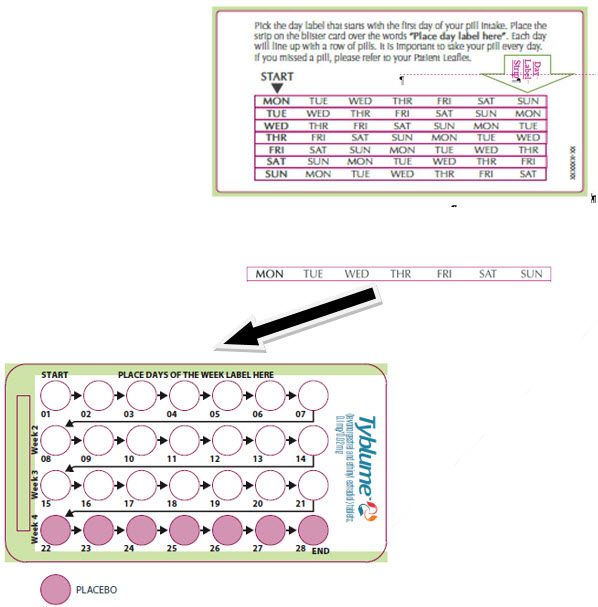
Advise women to take LNG/EE Tablets in one of two ways: (1) swallow whole on an empty stomach or (2) chew and then immediately swallow with a full glass of 240 mL water on an empty stomach. Advise women to take one tablet daily by mouth at the same time every day [see Dosage and Administration (2.1)].
Advise women about what to do in the event tablets are missed. See "What should I do if I miss any LNG/EE Tablets" section in FDA-approved patient labeling [see Dosage and Administration (2.3)].
Need for Additional Contraception
- Advise women to use a back-up or alternative method of contraception when enzyme inducers are used with LNG/EE Tablets [see Drug Interactions (7.1)].
- Advise a woman who starts CHCs postpartum and has not yet had a period that she should use an additional method of contraception until she has taken a white tablet for 7 consecutive days.
Lactation
CHCs may reduce breast milk production; this is less likely to occur if breastfeeding is well established [see Use in Specific Populations (8.2)].
Amenorrhea and Possible Symptoms of Pregnancy
Advise women that amenorrhea may occur. Advise women to contact their health care provider in the event of amenorrhea in two or more consecutive cycles or in case of symptoms of pregnancy such as morning sickness or unusual breast tenderness [see Warnings and Precautions (5.8)].
Bleeding Irregularities
Advise women that irregular bleeding and/or spotting may occur. Bleeding irregularities typically resolve after the first few months of use. Advise women to consult their healthcare provider if bleeding irregularities persist for more than three to four months [see Warnings and Precautions (5.8)].
Manufactured for: Exeltis USA, Inc., 180 Park Avenue, Suite 101, Florham Park, NJ 07932
Manufactured by: Laboratorios León Farma, S.A., León, Poligono Industrial Navatejera
C/ La Vallina, s/n 24008 Navatejera, Leon, Spain 24008