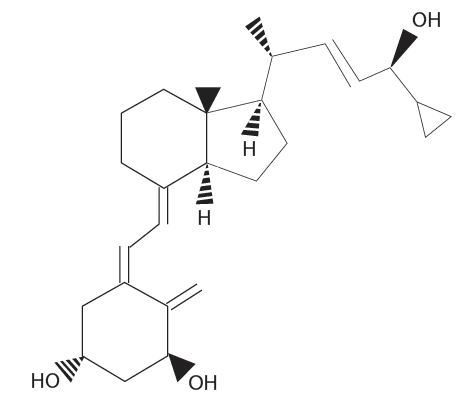
In humans, the natural supply of vitamin D depends mainly on exposure to the ultraviolet rays of the sun for conversion of 7-dehydrocholesterol to vitamin D3 (cholecalciferol) in the skin. Calcipotriene is a synthetic analog of vitamin D3.
Although the precise mechanism of calcipotriene’s antipsoriatic action is not fully understood, in vitro evidence suggests that calcipotriene is roughly equipotent to the natural vitamin in its effects on proliferation and differentiation of a variety of cell types. Calcipotriene has also been shown, in animal studies, to be 100-200 times less potent in its effects on calcium utilization than the natural hormone.
Clinical studies with radiolabelled calcipotriene solution indicate that less than 1% of the applied dose of calcipotriene is absorbed through the scalp when the solution (2.0 mL) is applied topically to normal skin or psoriasis plaques (160 cm2) for 12 hours, and that much of the absorbed calcipotriene is converted to inactive metabolites within 24 hours of application.
Vitamin D and its metabolites are transported in the blood, bound to specific plasma proteins. The active form of the vitamin, 1,25-dihydroxy vitamin D3 (calcitriol), is known to be recycled via the liver and excreted in the bile. Calcipotriene metabolism following systemic uptake is rapid, and occurs via a similar pathway to the natural hormone. The primary metabolites are much less potent than the parent compound.
There is evidence that maternal 1,25-dihydroxy vitamin D3 (calcitriol) may enter the fetal circulation, but it is not known whether it is excreted in human milk. The systemic disposition of calcipotriene is expected to be similar to that of the naturally occurring vitamin.