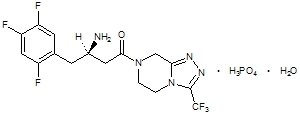
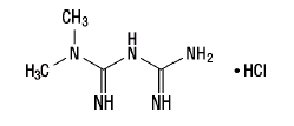
Sitagliptin
The pharmacokinetics of sitagliptin have been extensively characterized in healthy subjects and patients with type 2 diabetes mellitus. Following a single oral 100-mg dose to healthy volunteers, mean plasma AUC of sitagliptin was 8.52 μM•hr, Cmax was 950 nM, and apparent terminal half-life (t1/2) was 12.4 hours. Plasma AUC of sitagliptin increased in a dose-proportional manner and increased approximately 14% following 100 mg doses at steady-state compared to the first dose. The intra-subject and inter-subject coefficients of variation for sitagliptin AUC were small (5.8% and 15.1%). The pharmacokinetics of sitagliptin was generally similar in healthy subjects and in patients with type 2 diabetes mellitus.
Absorption
Sitagliptin
After oral administration of a 100 mg dose to healthy subjects, sitagliptin was rapidly absorbed with peak plasma concentrations (median Tmax) occurring 1 to 4 hours postdose. The absolute bioavailability of sitagliptin is approximately 87%.
Effect of Food
Coadministration of a high-fat meal with sitagliptin had no effect on the pharmacokinetics of sitagliptin.
Metformin
The absolute bioavailability of a metformin HCl 500-mg tablet given under fasting conditions is approximately 50 to 60%. Studies using single oral doses of metformin HCl tablets 500 mg to 1,500 mg, and 850 mg to 2,550 mg (approximately 1.3 times the maximum recommended daily dosage), indicate that there is a lack of dose proportionality with increasing doses, which is due to decreased absorption rather than an alteration in elimination.
Effect of Food
Food decreases the extent of and slightly delays the absorption of metformin, as shown by approximately a 40% lower mean peak plasma concentration (Cmax), a 25% lower area under the plasma concentration versus time curve (AUC), and a 35-minute prolongation of time to peak plasma concentration (Tmax) following administration of a single 850-mg tablet of metformin HCl with food, compared to the same tablet strength administered fasting. The clinical relevance of these decreases is unknown.
Distribution
Sitagliptin
The mean volume of distribution at steady state following a single 100-mg intravenous dose of sitagliptin to healthy subjects is approximately 198 liters. The fraction of sitagliptin reversibly bound to plasma proteins is low (38%).
Metformin
The apparent volume of distribution (V/F) of metformin following single oral doses of metformin HCl tablets 850 mg averaged 654 ± 358 L. Metformin is negligibly bound to plasma proteins, in contrast to sulfonylureas, which are more than 90% protein bound. Metformin partitions into erythrocytes, most likely as a function of time. At usual clinical doses and dosing schedules of metformin HCl tablets, steady-state plasma concentrations of metformin are reached within 24 to 48 hours and are generally <1 mcg/mL.
Elimination
Sitagliptin
Approximately 79% of sitagliptin is excreted unchanged in the urine with metabolism being a minor pathway of elimination. The apparent terminal t1/2 following a 100 mg oral dose of sitagliptin was approximately 12.4 hours and renal clearance was approximately 350 mL/min.
Metformin
Following oral administration, approximately 90% of the absorbed drug is eliminated via the renal route within the first 24 hours, with a plasma elimination half-life of approximately 6.2 hours. In blood, the elimination half-life is approximately 17.6 hours, suggesting that the erythrocyte mass may be a compartment of distribution.
Metabolism
Sitagliptin
Following a [14C]sitagliptin oral dose, approximately 16% of the radioactivity was excreted as metabolites of sitagliptin. Six metabolites were detected at trace levels and are not expected to contribute to the plasma DPP-4 inhibitory activity of sitagliptin. In vitro studies indicated that the primary enzyme responsible for the limited metabolism of sitagliptin was CYP3A4, with contribution from CYP2C8.
Metformin
Intravenous single-dose studies in normal subjects demonstrate that metformin is excreted unchanged in the urine and does not undergo hepatic metabolism (no metabolites have been identified in humans) nor biliary excretion.
Excretion
Sitagliptin
Following administration of an oral [14C]sitagliptin dose to healthy subjects, approximately 100% of the administered radioactivity was eliminated in feces (13%) or urine (87%) within one week of dosing.
Elimination of sitagliptin occurs primarily via renal excretion and involves active tubular secretion. Sitagliptin is a substrate for human organic anion transporter-3 (hOAT-3), which may be involved in the renal elimination of sitagliptin. The clinical relevance of hOAT-3 in sitagliptin transport has not been established. Sitagliptin is also a substrate of p-glycoprotein (P-gp), which may also be involved in mediating the renal elimination of sitagliptin. However, cyclosporine, a P-gp inhibitor, did not reduce the renal clearance of sitagliptin.
Metformin
Elimination of metformin occurs primarily via renal excretion. Renal clearance is approximately 3.5 times greater than creatinine clearance, which indicates that tubular secretion is the major route of metformin elimination.
Specific Populations
Patients with Renal Impairment
Sitagliptin and metformin hydrochloride
Studies characterizing the pharmacokinetics of sitagliptin and metformin after administration of sitagliptin and metformin hydrochloride in renally impaired patients have not been performed [see Dosage and Administration (2.2)].
Sitagliptin
An approximately 2-fold increase in the plasma AUC of sitagliptin was observed in patients with moderate renal impairment with eGFR of 30 to less than 45 mL/min/1.73 m2, and an approximately 4-fold increase was observed in patients with severe renal impairment including patients with end-stage renal disease (ESRD) on hemodialysis, as compared to normal healthy control subjects. [see Dosage and Administration (2.2).]
Metformin
In patients with decreased renal function, the plasma and blood half-life of metformin is prolonged and the renal clearance is decreased [see Contraindications (4); Warnings and Precautions (5.1)].
Patients with Hepatic Impairment
Sitagliptin and metformin hydrochloride
Studies characterizing the pharmacokinetics of sitagliptin and metformin after administration of sitagliptin and metformin hydrochloride in patients with hepatic impairment have not been performed.
Sitagliptin
In patients with moderate hepatic impairment (Child-Pugh score 7 to 9), mean AUC and Cmax of sitagliptin increased approximately 21% and 13%, respectively, compared to healthy matched controls following administration of a single 100-mg dose of sitagliptin. These differences are not considered to be clinically meaningful. There is no clinical experience in patients with severe hepatic impairment (Child-Pugh score >9) [see Use in Specific Populations (8.7)].
Metformin
No pharmacokinetic studies of metformin have been conducted in patients with hepatic impairment.
Effects of Age, Body Mass Index (BMI), Gender, and Race
Sitagliptin
Based on a population pharmacokinetic analysis or a composite analysis of available pharmacokinetic data, BMI, gender, and race do not have a clinically meaningful effect on the pharmacokinetics of sitagliptin. When the effects of age on renal function are taken into account, age alone did not have a clinically meaningful impact on the pharmacokinetics of sitagliptin based on a population pharmacokinetic analysis. Elderly subjects (65 to 80 years) had approximately 19% higher plasma concentrations of sitagliptin compared to younger subjects.
Metformin
Limited data from controlled pharmacokinetic studies of metformin in healthy elderly subjects suggest that total plasma clearance of metformin is decreased, the half-life is prolonged, and Cmax is increased, compared to healthy young subjects. From these data, it appears that the change in metformin pharmacokinetics with aging is primarily accounted for by a change in renal function.
Metformin pharmacokinetic parameters did not differ significantly between normal subjects and patients with type 2 diabetes mellitus when analyzed according to gender. Similarly, in controlled clinical studies in patients with type 2 diabetes mellitus, the antihyperglycemic effect of metformin was comparable in males and females.
No studies of metformin pharmacokinetic parameters according to race have been performed. In controlled clinical studies of metformin in patients with type 2 diabetes mellitus, the antihyperglycemic effect was comparable in Whites (n=249), Blacks (n=51), and Hispanics (n=24).
Drug Interaction Studies
Sitagliptin and Metformin hydrochloride
Coadministration of multiple doses of sitagliptin (50 mg) and metformin HCl (1,000 mg) given twice daily did not meaningfully alter the pharmacokinetics of either sitagliptin or metformin in patients with type 2 diabetes.
Pharmacokinetic drug interaction studies with sitagliptin and metformin hydrochloride have not been performed; however, such studies have been conducted with the individual components of sitagliptin and metformin hydrochloride.
Sitagliptin
In Vitro Assessment of Drug Interactions
Sitagliptin is not an inhibitor of CYP isozymes CYP3A4, 2C8, 2C9, 2D6, 1A2, 2C19 or 2B6, and is not an inducer of CYP3A4. Sitagliptin is a P-gp substrate but does not inhibit P-gp mediated transport of digoxin. Based on these results, sitagliptin is considered unlikely to cause interactions with other drugs that utilize these pathways.
Sitagliptin is not extensively bound to plasma proteins. Therefore, the propensity of sitagliptin to be involved in clinically meaningful drug-drug interactions mediated by plasma protein binding displacement is very low.
In Vivo Assessment of Drug Interactions
Effects of Sitagliptin on Other Drugs
In clinical studies, sitagliptin did not meaningfully alter the pharmacokinetics of metformin, glyburide, simvastatin, rosiglitazone, digoxin, warfarin, or an oral contraception (ethinyl estradiol and norethindrone) (Table 5), providing in vivo evidence of a low propensity for causing drug interactions with substrates of CYP3A4, CYP2C8, CYP2C9, P-gp, and organic cationic transporter (OCT).
Table 5: Effect of Sitagliptin on Systemic Exposure of Coadministered Drugs
Coadministered Drug | Dose of Coadministered Drug* | Dose of Sitagliptin* | Geometric Mean Ratio (ratio with/without sitagliptin) No Effect = 1.00 |
| AUC† | Cmax |
Digoxin | 0.25 mg‡ once daily for 10 days | 100 mg‡ once daily for 10 days | Digoxin | 1.11§ | 1.18 |
Glyburide | 1.25 mg | 200 mg‡ once daily for 6 days | Glyburide | 1.09 | 1.01 |
Simvastatin | 20 mg | 200 mg‡ once daily for 5 days | Simvastatin | 0.85¶ | 0.80 |
Simvastatin Acid | 1.12¶ | 1.06 |
Rosiglitazone | 4 mg | 200 mg‡ once daily for 5 days | Rosiglitazone | 0.98 | 0.99 |
Warfarin | 30 mg single dose on day 5 | 200 mg‡ once daily for 11 days | S(-) Warfarin | 0.95 | 0.89 |
R(+) Warfarin | 0.99 | 0.89 |
Ethinyl estradiol and norethindrone | 21 days once daily of 35 mcg ethinyl estradiol with norethindrone 0.5 mg x 7 days, 0.75 mg x 7 days, 1.0 mg x 7 days | 200 mg‡ once daily for 21 days | Ethinyl estradiol | 0.99 | 0.97 |
Norethindrone | 1.03 | 0.98 |
Metformin HCl | 1,000 mg‡ twice daily for 14 days | 50 mg‡ twice daily for 7 days | Metformin | 1.02# | 0.97 |
- * All doses administered as single dose unless otherwise specified.
†AUC is reported as AUC0- ∞ unless otherwise specified.
‡Multiple dose.
§AUC0-24hr.
¶AUC0-last.
#AUC0-12hr.
Effects of Other Drugs on Sitagliptin
Clinical data described below suggest that sitagliptin is not susceptible to clinically meaningful interactions by coadministered medications (Table 6).
Table 6: Effect of Coadministered Drugs on Systemic Exposure of Sitagliptin
Coadministered Drug | Dose of Coadministered Drug | Dose of Sitagliptin | Geometric Mean Ratio (ratio with/without coadministered drug) No Effect = 1.00 |
| AUC† | Cmax |
Cyclosporine | 600 mg once daily | 100 mg once daily | Sitagliptin | 1.29 | 1.68 |
Metformin HCl | 1,000 mg‡ twice daily for 14 days | 50 mg‡ twice daily for 7 days | Sitagliptin | 1.02§ | 1.05 |
- * All doses administered as single dose unless otherwise specified.
†AUC is reported as AUC0- ∞ unless otherwise specified.
‡Multiple dose.
§AUC0-12hr.
Metformin HCl
Table 7: Effect of Metformin HCl on Systemic Exposure of Coadministered Drugs
Coadministered Drug | Dose of Coadministered Drug* | Dose of Metformin HCl* | Geometric Mean Ratio (ratio with/without metformin) No Effect = 1.00 |
| AUC† | Cmax |
Cimetidine | 400 mg | 850 mg | Cimetidine | 0.95‡ | 1.01 |
Glyburide | 5 mg | 500 mg§ | Glyburide | 0.78¶ | 0.63¶ |
Furosemide | 40 mg | 850 mg | Furosemide | 0.87¶ | 0.69¶ |
Nifedipine | 10 mg | 850 mg | Nifedipine | 1.10‡ | 1.08 |
Propranolol | 40 mg | 850 mg | Propranolol | 1.01‡ | 0.94 |
Ibuprofen | 400 mg | 850 mg | Ibuprofen | 0.97# | 1.01# |
- * All doses administered as single dose unless otherwise specified.
†AUC is reported as AUC0- ∞ unless otherwise specified.
‡AUC0-24hr.
§GLUMETZA (metformin HCl extended-release tablets) 500 mg.
¶Ratio of arithmetic means, p value of difference <0.05
#Ratio of arithmetic means.
Table 8: Effect of Coadministered Drugs on Systemic Exposure of Metformin HCl
Coadministered Drug | Dose of Coadministered Drug* | Dose of Metformin HCl* | Geometric Mean Ratio (ratio with/without coadministered drug) No Effect = 1.00 |
| AUC† | Cmax |
Glyburide | 5 mg | 500 mg‡ | Metformin‡ | 0.98§ | 0.99§ |
Furosemide | 40 mg | 850 mg | Metformin | 1.09§ | 1.22§ |
Nifedipine | 10 mg | 850 mg | Metformin | 1.16 | 1.21 |
Propranolol | 40 mg | 850 mg | Metformin | 0.90 | 0.94 |
Ibuprofen | 400 mg | 850 mg | Metformin | 1.05§ | 1.07§ |
Drugs that are eliminated by renal tubular secretion may increase the accumulation of metformin. [see Warnings and Precautions (5.1) and Drug Interactions (7).] |
Cimetidine | 400 mg | 850 mg | Metformin | 1.40 | 1.61 |
Carbonic anhydrase inhibitors may cause metabolic acidosis. [see Warnings and Precautions (5.1) and Drug Interactions (7).] |
Topiramate | 100 mg¶ | 500 mg¶ | Metformin | 1.25¶ | 1.17 |
- * All doses administered as single dose unless otherwise specified.
- †AUC is reported as AUC0- ∞ unless otherwise specified.
- ‡GLUMETZA (metformin HCl extended-release tablets) 500 mg.
- §Ratio of arithmetic means.
- #Steady state 100 mg Topiramate every 12 hr + metformin HCl 500 mg every 12 hr AUC = AUC0-12hr.