Dose Modification Guidelines: The 300 mg/m2/day dose level of bexarotene may be adjusted to 200 mg/m2/day then to 100 mg/m2/day, or temporarily suspended, if necessitated by toxicity. When toxicity is controlled, doses may be carefully readjusted upward. If there is no tumor response after eight weeks of treatment and if the initial dose of 300 mg/m2/day is well tolerated, the dose may be escalated to 400 mg/m2/day with careful monitoring.
Duration of Therapy: In clinical trials in CTCL, bexarotene was administered for up to 97 weeks.
Bexarotene capsules should be continued as long as the patient is deriving benefit.
Effect of Other Drugs on Bexarotene
Gemfibrozil: Concomitant administration of bexarotene and gemfibrozil resulted in increases in plasma concentrations of bexarotene. Concomitant administration of gemfibrozil with bexarotene is not recommended.
Effect of Bexarotene on Other Drugs
Bexarotene may be an inducer for the CYP3A4 enzymes, and may reduce plasma concentrations of other substrates metabolized by CYP3A4. Drug products which may be affected include oral or other systemic hormonal contraceptives. Thus, if treatment with bexarotene is intended for a female with reproductive potential, it is strongly recommended that a non-hormonal contraception be considered [see Use in Specific Populations (8.3), Clinical Pharmacology (12.3)].
Laboratory Test Interference
CA125 assay values in patients with ovarian cancer may be increased by bexarotene therapy.
Risk Summary
Bexarotene, a retinoid, can cause fetal harm based on findings from animal studies when administered to a pregnant female and is contraindicated during pregnancy. Bexarotene was teratogenic and caused developmental mortality in rats following oral administration during organogenesis [see Data]. Bexarotene must not be given to a pregnant female or a female who intends to become pregnant. If pregnancy does occur during treatment with bexarotene, immediately discontinue the drug and advise the pregnant female of the potential risk to a fetus.
The background risk of major birth defects and miscarriage for the indicated populations are unknown. However, the background risk in the U.S. general population of major birth defects is 2 to 4% and of miscarriage is 15 to 20% of clinically recognized pregnancies.
Data
Animal Data
Bexarotene caused malformations when administered orally to pregnant rats during days 7 to 17 of gestation. Developmental abnormalities included incomplete ossification at 4 mg/kg/day and cleft palate, depressed eye bulge/microphthalmia, and small ears at 16 mg/kg/day. The plasma AUC of bexarotene in rats at 4 mg/kg/day is approximately one third the AUC in humans at the recommended daily dose. At doses greater than 10 mg/kg/day, bexarotene caused developmental mortality. The no effect dose for fetal effects in rats was 1 mg/kg/day (producing an AUC approximately one sixth of the AUC at the recommended human daily dose).
Risk Summary
There is no information regarding the presence of bexarotene in human milk, the effects on the breast fed infant, or the effects on milk production. Because many drugs are excreted in human milk and because of the potential for serious adverse reactions in nursing infants from bexarotene, discontinue breastfeeding during treatment with bexarotene.
Pregnancy Testing
Obtain a negative serum pregnancy test (e.g., serum beta-human chorionic gonadotropin [beta-HCG]) with a sensitivity of at least 50 mlU/L within one week prior to bexarotene therapy. Obtain another pregnancy test at monthly intervals while the patient remains on bexarotene.
Contraception
Females
Bexarotene can cause fetal harm when administered to a pregnant female [see Use in Specific Populations (8.1)]. Females of reproductive potential should be advised to avoid becoming pregnant when bexarotene is used. Effective contraception must be used for one month prior to the initiation of therapy, during therapy and for at least one month following discontinuation of therapy; it is recommended that two reliable forms of contraception be used simultaneously unless abstinence is the chosen method. Bexarotene can potentially induce metabolic enzymes and thereby theoretically reduce the plasma concentrations of oral or other systemic hormonal contraceptives [see Drug Interactions (7)].
Thus, if treatment with bexarotene is intended in a female with reproductive potential, it is strongly recommended that one of the two reliable forms of contraception should be non-hormonal.
Bexarotene therapy should be initiated on the second or third day of a normal menstrual period. No more than a one month supply of bexarotene should be given to the patient so that the results of pregnancy testing can be assessed and counseling regarding avoidance of pregnancy and birth defects can be reinforced.
Males
Male patients with sexual partners who are pregnant, possibly pregnant, or who could become pregnant must use condoms during sexual intercourse while taking bexarotene and for at least one month after the last dose of drug.
Absorption
After oral administration of bexarotene capsules, bexarotene is absorbed with a Tmax of about two hours. Plasma bexarotene AUC and Cmax values resulting from a 75 to 300 mg dose were 35% and 48% higher, respectively, after a fat-containing meal than after a glucose solution.
Distribution
Bexarotene is highly bound (>99%) to plasma proteins. The plasma proteins to which bexarotene binds have not been elucidated, and the ability of bexarotene to displace drugs bound to plasma proteins and the ability of drugs to displace bexarotene binding have not been studied.
Elimination
Metabolism
Four bexarotene metabolites have been identified in plasma: 6- and 7-hydroxy-bexarotene and 6- and 7-oxo-bexarotene. In vitro studies suggest that cytochrome P450 3A4 is the major cytochrome P450 responsible for formation of the oxidative metabolites and that the oxidative metabolites may be glucuronidated. The oxidative metabolites are active in in vitro assays of retinoid receptor activation, but the relative contribution of the parent and any metabolites to the efficacy and safety of bexarotene is unknown.
Excretion
The renal elimination of bexarotene and its metabolites was examined in patients with Type 2 diabetes mellitus. Urinary elimination of bexarotene and its known metabolites is a minor excretory pathway (<1% of administered dose).
Pharmacokinetics in Specific Populations
Age: Based on the population pharmacokinetic analysis of data for 232 patients aged ≥65 years and 343 patients aged <65 years, age has no statistically significant effect on bexarotene pharmacokinetics.
Body Weight and Gender: Based on the population pharmacokinetics analysis of data for 614 patients with a weight range of 26 to 145 kg, the bexarotene apparent clearance increases with increasing body weight. Gender has no statistically significant effect on bexarotene pharmacokinetics.
Race: Based on the population pharmacokinetic analysis of data for 540 Caucasian and 44 Black patients, bexarotene pharmacokinetics are similar in Blacks and Caucasians. There are insufficient data to evaluate potential differences in the pharmacokinetics of bexarotene for other races.
Renal Impairment: No formal studies have been conducted with bexarotene in patients with renal impairment. Urinary elimination of bexarotene and its known metabolites is a minor excretory pathway (<1% of administered dose), but because renal impairment can result in significant protein binding changes, pharmacokinetics may be altered in patients with renal impairment.
Hepatic Impairment: No specific studies have been conducted with bexarotene in patients with hepatic impairment. Because less than 1% of the dose is excreted in the urine unchanged and there is in vitro evidence of extensive hepatic contribution to bexarotene elimination, hepatic impairment would be expected to lead to greatly decreased clearance.
Drug Interactions
Effect of Other Drugs on Bexarotene
CYP3A4 Inhibitors/Inducers: In a clinical study, concomitant administration of multiple doses of ketoconazole with bexarotene did not alter bexarotene plasma concentrations. This suggests that bexarotene elimination is not dependent on CYP3A4 metabolism.
Paclitaxel plus Carboplatin: The coadministration of paclitaxel (200 mg/m2 IV dose over 3 hours) plus carboplatin (at a dose expected to achieve an AUC of 6 mg∙min/mL) with bexarotene (400 mg/m2 orally once daily) increased the exposure to bexarotene (AUC0–24 and Cmax) by 2-fold compared to bexarotene alone.
Atorvastatin: Bexarotene concentrations were not affected by concomitant atorvastatin administration.
Effect of Bexarotene on Other Drugs
Bexarotene did not significantly inhibit the following enzymes in human liver microsomes: CYP1A2, CYP2A6, CYP2C9, CYP2C19, CYP2D6, CYP2E1 and CYP3A4. In vitro data suggested a potential for bexarotene to inhibit CYP2C8 and induce CYP3A4.
Atorvastatin: The exposure (AUC) to atorvastatin (a substrate for CYP3A4) decreased by half when atorvastatin was coadministered with bexarotene (400 mg/m2 orally once daily).
Tamoxifen: Based on interim data, concomitant administration of bexarotene and tamoxifen resulted in approximately a 35% decrease in plasma concentrations of tamoxifen, possibly through induction of CYP3A4 by bexarotene.
Paclitaxel: The exposure (AUC) to paclitaxel (a substrate for CYP3A4 and CYP2C8) decreased by 19% when paclitaxel (200 mg/m2 IV dose over 3 hours) was coadministered with bexarotene (400 mg/m2 orally once daily).
Carboplatin: The coadministration of bexarotene (400 mg/m2 orally once daily) had no effect on the exposure to free or total carboplatin.
Birth Defects
Advise patients that bexarotene is contraindicated in pregnancy [see Contraindications (4.1)]. Bexarotene is a member of the retinoid class of drugs that is associated with birth defects in humans [see Use in Specific Populations (8.1)].
- Advise females of reproductive potential that they must avoid pregnancy while taking bexarotene and for at least one month following discontinuation of therapy.
- Advise females of reproductive potential of the importance of monthly pregnancy testing while taking bexarotene.
- Advise females of reproductive potential to use effective contraception for one month prior to the initiation of therapy, during therapy, and for at least one month following discontinuation of therapy and that two reliable forms of contraception should be used simultaneously, one of which should be non-hormonal.
- Advise females of reproductive potential that bexarotene therapy should be initiated on the second or third day of a normal menstrual period.
- Instruct patient to immediately stop taking bexarotene if she becomes pregnant while taking this drug.
- Advise male patients with sexual partners who are pregnant, possibly pregnant, or who could become pregnant that they must use condoms during sexual intercourse while taking bexarotene and for at least one month after the last dose of the drug.
Pancreatitis
Advise patients of the risk of developing pancreatitis, which may be accompanied by nausea, vomiting, and abdominal or back pain and to immediately contact their healthcare provider if these symptoms occur [see Warnings and Precautions (5.2)].
Hepatotoxicity
Inform patients of the possibility of developing liver function abnormalities and serious hepatic toxicity. Advise patients to immediately contact their healthcare provider if signs of liver failure occur, including jaundice, anorexia, bleeding, or bruising [see Warnings and Precautions (5.3)].
Neutropenia
Advise patients of the possibility of developing neutropenia and to immediately contact their healthcare provider should they develop a fever, particularly in association with any suggestion of infection [see Warnings and Precautions (5.5)].
Cataracts
Advise patients of the possibility of developing new or worsening cataracts and to inform their healthcare provider about any changes in their vision during treatment with bexarotene [see Warnings and Precautions (5.6)].
Vitamin A Supplementation Hazard
Advise patients to limit vitamin A intake to ≤15,000 IU/day to avoid potential additive toxic effects.
Hypoglycemia and Diabetes Mellitus
Advise patients of the possibility of developing hypoglycemia when using insulin, agents enhancing insulin secretion, or insulin-sensitizers while on bexarotene therapy. Instruct patients on these medications to check their blood sugar frequently and to notify their physicians of any changes in blood sugar level [see Warnings and Precautions (5.8)].
Photosensitivity
Advise patients of potential increased skin sensitivity to sunlight while taking bexarotene and to minimize exposure to sunlight and artificial ultraviolet light [see Warnings and Precautions (5.9)].
Laboratory Tests
Advise patients of laboratory testing which will occur during therapy to monitor lipids, liver function, thyroid function, and white blood cell counts [see Warnings and Precautions (5.10)]. If applicable, advise patients of monthly pregnancy testing [see Use In Specific Populations (8.3)].
Administration Instructions
Advise patients to take bexarotene with a meal [see DOSAGE AND ADMINISTRATION].
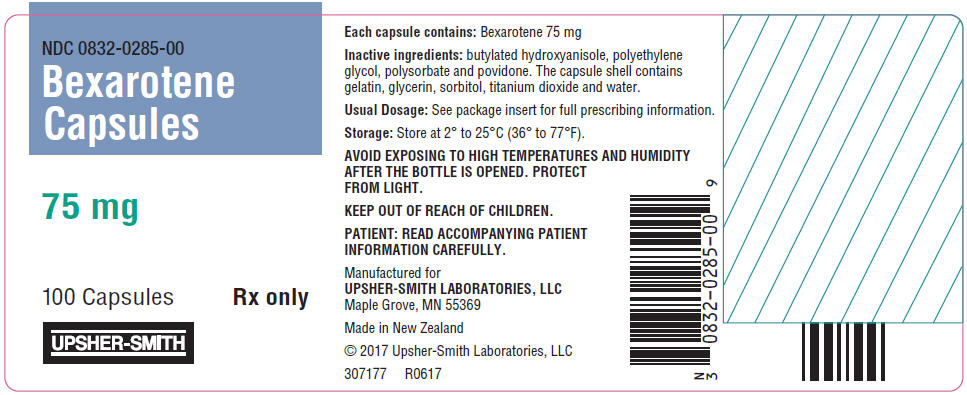
Manufactured for
UPSHER-SMITH LABORATORIES, LLC
Maple Grove, MN 55369
Made in New Zealand
Revised 0617