To ensure proper dosing, serum testosterone concentrations should be measured. Morning, pre-dose serum testosterone concentrations should be measured approximately 14 days after initiation of therapy to ensure proper serum testosterone concentrations are achieved. If the serum testosterone concentration is below the normal range (300 ng/dL to 1,000 ng/dL), the daily testosterone gel dose may be increased from 50 mg testosterone (one tube, one packet, or 4 pump actuations) to 100 mg of testosterone (two tubes, two packets, or 8 pump actuations) once daily.
The maximum recommended dose of testosterone gel is 100 mg once daily.
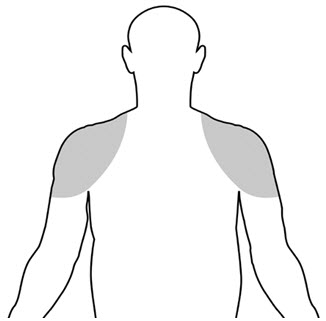
Upon opening the tube or packet the entire contents should be squeezed into the palm of the hand and immediately applied to the shoulders and/or upper arms (area of application should be limited to the area that will be covered by the patient's short sleeve t-shirt [see figure below]).
Table 1 has specific dosing guidelines for when the unit-dose tubes or packets are used.
Patients should be instructed to prime the pump before using it for the first time by fully depressing the pump mechanism (actuation) 3 times and discard this portion of the product to assure precise dose delivery. After the priming procedure, patients should completely depress the pump one time (actuation) for every 12.5 mg of testosterone required to achieve the daily prescribed dosage. Table 2 has specific dosing guidelines for when the metered pump is used.
The prescribed amount of product should be delivered directly into the palm of the hand and immediately applied to the shoulders and/or upper arms (area of application should be limited to the area that will be covered by the patient's short sleeve t-shirt [see figure below]).
Do not apply testosterone gel to the genitals or to the abdomen.
Application sites should be allowed to dry completely prior to dressing.
Hands should be washed thoroughly with soap and water after testosterone gel has been applied.
Avoid fire, flame or smoking during the application of testosterone gel until the gel has dried [see Warnings and Precautions (5.2, 5.16)].
In order to prevent transfer to another person, clothing should be worn to cover the application sites. If direct skin-to-skin contact of the application site(s) with another person is anticipated, the application sites must be washed thoroughly with soap and water [see Warnings and Precautions (5.2) and Clinical Pharmacology (12.3)].
The patient should avoid swimming or showering or washing the administration site for a minimum of 2 hours after application [see Clinical Pharmacology (12.3)].
- Children and women should avoid contact with unwashed or unclothed application site(s) of men using testosterone gel.
- Testosterone gel should only be applied to the upper arms and shoulders. The area of application should be limited to the area that will be covered by a short sleeve t-shirt.
- Patients should wash their hands with soap and water immediately after applying testosterone gel.
- Patients should cover the application site(s) with clothing (e.g., a t-shirt) after the gel has dried.
- Prior to any situation in which direct skin-to-skin contact of the application site(s) with another person is anticipated, patients should wash the application site(s) thoroughly with soap and water to remove any testosterone residue.
- In the event that unwashed or unclothed skin to which testosterone gel has been applied comes in direct contact with the skin of another person, the general area of contact on the other person should be washed with soap and water as soon as possible.
Secondary Exposure to Testosterone in Children
Cases of secondary exposure to testosterone resulting in virilization of children have been reported in postmarketing surveillance of testosterone gel products. Signs and symptoms of these reported cases have included enlargement of the clitoris (with surgical intervention) or of the penis, development of pubic hair, increased erections and libido, aggressive behavior, and advanced bone age. In most cases with a reported outcome, these signs and symptoms were reported to have regressed with removal of the testosterone gel exposure. In a few cases, however, enlarged genitalia did not fully return to age-appropriate normal size, and bone age remained modestly greater than chronological age. In some of the cases, direct contact with the sites of application on the skin of men using testosterone gel was reported. In at least one reported case, the reporter considered the possibility of secondary exposure from items such as the testosterone gel user's shirts and/or other fabrics, such as towels and sheets [see Warnings and Precautions (5.2)].
Cardiovascular Disorders:
Myocardial infarction, stroke [see Warnings and Precautions (5.5)]
Vascular Disorders:
Venous thromboembolism [see Warnings and Precautions (5.4)].
Abuse-Related Adverse Reactions
Serious adverse reactions have been reported in individuals who abuse anabolic androgenic steroids and include cardiac arrest, myocardial infarction, hypertrophic cardiomyopathy, congestive heart failure, cerebrovascular accident, hepatotoxicity, and serious psychiatric manifestations, including major depression, mania, paranoia, psychosis, delusions, hallucinations, hostility and aggression.
The following adverse reactions have also been reported in men: transient ischemic attacks, convulsions, hypomania, irritability, dyslipidemias, testicular atrophy, subfertility, and infertility.
The following additional adverse reactions have been reported in women: hirsutism, virilization, deepening of voice, clitoral enlargement, breast atrophy, male-pattern baldness, and menstrual irregularities.
The following adverse reactions have been reported in male and female adolescents: premature closure of bony epiphyses with termination of growth, and precocious puberty.
Because these reactions are reported voluntarily from a population of uncertain size and may include abuse of other agents, it is not always possible to reliably estimate their frequency or establish a causal relationship to drug exposure.
Behaviors Associated with Addiction
Continued abuse of testosterone and other anabolic steroids, leading to addiction is characterized by the following behaviors:
- Taking greater dosages than prescribed
- Continued drug use despite medical and social problems due to drug use
- Spending significant time to obtain the drug when supplies of the drug are interrupted
- Giving a higher priority to drug use than other obligations
- Having difficulty in discontinuing the drug despite desires and attempts to do so
- Experiencing withdrawal symptoms upon abrupt discontinuation of use
Physical dependence is characterized by withdrawal symptoms after abrupt drug discontinuation or a significant dose reduction of a drug. Individuals taking supratherapeutic doses of testosterone may experience withdrawal symptoms lasting for weeks or months which include depressed mood, major depression, fatigue, craving, restlessness, irritability, anorexia, insomnia, decreased libido and hypogonadotropic hypogonadism.
Drug dependence in individuals using approved doses of testosterone for approved indications has not been documented.
Absorption
Testosterone gel delivers physiologic amounts of testosterone, producing circulating testosterone concentrations that approximate normal levels (e.g., 300 – 1000 ng/dL) seen in healthy men.
The skin serves as a reservoir for the sustained release of testosterone into the systemic circulation. Approximately 10% of the testosterone applied on the skin surface is absorbed into the systemic circulation during a 24-hour period.
Single Dose
In a single dose, replicate crossover study, when testosterone gel 100 mg was applied, absorption of testosterone into the blood continued for the entire 24 hour dosing period. The average (± SD) AUC0-24 and AUC0-t and Cmax were 6625 (±3671) ng∙hr/dL, 10425 (±5521) ng∙hr/dL, and 573 (±284) ng/dL, respectively.
Multiple Dose
With single daily applications of testosterone gel 50 mg and 100 mg, follow-up measurements at 30 and 90 days after starting treatment have confirmed that serum testosterone and DHT concentrations are generally maintained within the normal range.
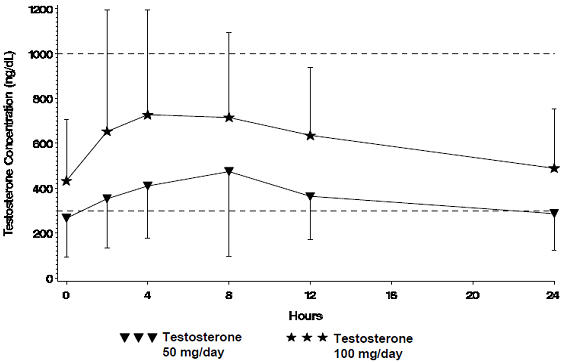
Figure 1 summarizes the 24-hour pharmacokinetic profile of testosterone for patients maintained on testosterone gel 50 mg or testosterone gel 100 mg for 30 days.
| Figure 1 Mean Steady-State Serum Testosterone (±SD) (ng/dL) Concentrations on Day 30 in Patients Applying Testosterone Once Daily |
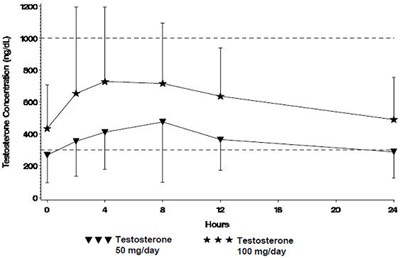 Figure 1 (Testosterone 03) |
The average daily testosterone concentration produced by testosterone gel 100 mg at Day 30 was 612 (± 286) ng/dL and by testosterone gel 50 mg at Day 30 was 365 (± 187) ng/dL.
Distribution
Circulating testosterone is primarily bound in the serum to sex hormone-binding globulin (SHBG) and albumin. Approximately 40% of testosterone in plasma is bound to SHBG, 2% remains unbound (free) and the rest is loosely bound to albumin and other proteins.
Metabolism
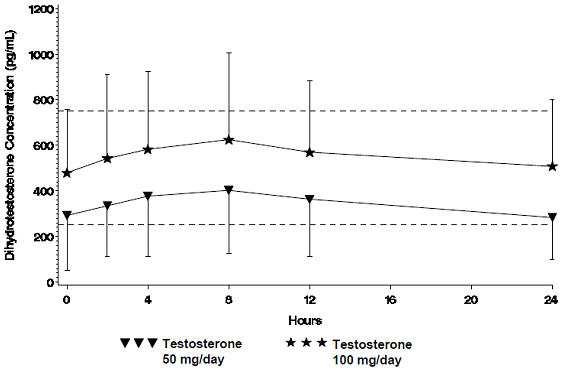
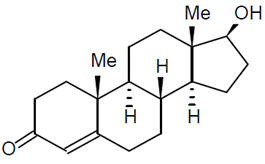
Testosterone is metabolized to various 17-keto steroids through two different pathways. The major active metabolites of testosterone are estradiol and DHT. The average daily DHT concentration produced by testosterone gel 100 mg at Day 30 was 555 (± 293) pg/mL and by testosterone gel 50 mg at Day 30 was 346 (± 212) pg/mL.
Figure 2 summarizes the 24-hour pharmacokinetic profile of DHT for patients maintained on testosterone gel 50 mg or testosterone gel 100 mg for 30 days.
| Figure 2 Mean Steady-State Serum Dihydrotestosterone (±SD) (pg/mL) Concentrations on Day 30 in Patients Applying Testosterone Once Daily |
 Figure 2 (Testosterone 04) |
Excretion
There is considerable variation in the half-life of testosterone concentration as reported in the literature, ranging from 10 to 100 minutes. About 90% of a dose of testosterone given intramuscularly is excreted in the urine as glucuronic acid and sulfuric acid conjugates of testosterone and its metabolites. About 6% of a dose is excreted in the feces, mostly in the unconjugated form. Inactivation of testosterone occurs primarily in the liver.
Potential for Transfer from Male Patients to Female Partners
The potential for dermal testosterone transfer following testosterone gel use was evaluated in a clinical study between males dosed with testosterone gel and their untreated female partners. Two (2) hours after application of 50 mg of testosterone from 5 g of testosterone gel to upper arm and shoulder of one side by the male subjects, the couples (N = 48 couples) engaged in a 15 minute session of skin-to-skin contact. Serum concentrations of testosterone were monitored in the female subjects for 24 hours after the transfer procedure. Under these study conditions, unprotected female partners had a mean testosterone AUC0-24 and Cmax that were 2.8 and 4 times greater than their mean baseline values, respectively. When a shirt covered the application site or the application site was washed, study results showed less than 10% increase in testosterone AUC0-24 and Cmax, compared to baseline in these females.
Effect of Hand Washing
In a clinical study conducted to evaluate the effect of hand washing on the residual amount of testosterone, 36 healthy male subjects received 50 mg of testosterone from 5 g of testosterone gel on a hand and applied testosterone gel to the upper arm and shoulder of one side. Subjects washed their hands with liquid soap and warm water immediately after drug application. Then the hand was allowed to air dry or patted dry with a cloth towel. A skin swab sample was collected and analyzed for testosterone content. A mean (SD) of 0.16 (0.46) to 0.65(1.03) µg of residual testosterone (i.e., 99% reduction compared to when hands were not washed) was recovered after washing hands with liquid soap and warm water.
Effect of Showering
The effect of showering (with mild soap) at 1, 2 and 6 hours post application of testosterone gel 100 mg was evaluated in a clinical trial in 12 men. The study demonstrated that the overall effect of washing was to decrease testosterone concentrations; however, when washing occurred two or more hours post drug application, serum testosterone concentrations remained within the normal range.
Carcinogenicity
Testosterone has been tested by subcutaneous injection and implantation in mice and rats. In mice, the implant induced cervical-uterine tumors, which metastasized in some cases. There is suggestive evidence that injection of testosterone into some strains of female mice increases their susceptibility to hepatoma. Testosterone is also known to increase the number of tumors and decrease the degree of differentiation of chemically induced carcinomas of the liver in rats.
Mutagenesis
Testosterone was negative in the in vitro Ames and in the in vivo mouse micronucleus assays.
Impairment of Fertility
The administration of exogenous testosterone has been reported to suppress spermatogenesis in the rat, dog and non-human primates, which was reversible on cessation of the treatment.
Men with Known or Suspected Carcinoma of the Breast or Prostate
Men with known or suspected prostate or breast cancer should not use testosterone gel [see Contraindications (4) and Warnings and Precautions (5.1)].
Potential for Secondary Exposure to Testosterone and Steps to Prevent Secondary Exposure
Secondary exposure to testosterone in children and women can occur with the use of testosterone gel products in men. Cases of secondary exposure to testosterone have been reported in children.
Physicians should advise patients of the reported signs and symptoms of secondary exposure which may include the following:
- In children; unexpected sexual development including inappropriate enlargement of the penis or clitoris, premature development of pubic hair, increased erections, and aggressive behavior
- In women; changes in hair distribution, increase in acne, or other signs of testosterone effects
- The possibility of secondary exposure to testosterone gel should be brought to the attention of a healthcare provider
- Testosterone gel should be promptly discontinued until the cause of virilization is identified
Strict adherence to the following precautions is advised to minimize the potential for secondary exposure to testosterone from testosterone gel in men [see Medication Guide]
- Children and women should avoid contact with unwashed or unclothed application site(s) of men using testosterone gel
- Patients using testosterone gel should apply the product as directed and strictly adhere to the following:
- Wash hands with soap and water immediately after application
- Cover the application site(s) with clothing after the gel has dried
- Wash the application site(s) thoroughly with soap and water prior to any situation where skin-to-skin contact of the application site with another person is anticipated
- In the event that unwashed or unclothed skin to which testosterone gel has been applied comes in contact with the skin of another person, the general area of contact on the other person should be washed with soap and water as soon as possible [see Dosage and Administration (2.2), Warnings and Precautions (5.2) and Clinical Pharmacology (12.3)].
Potential Adverse Reactions with Androgens
Patients should be informed that treatment with androgens may lead to adverse reactions which include:
- Changes in urinary habits, such as increased urination at night, trouble starting the urine stream, passing urine many times during the day, having an urge to go the bathroom right away, having a urine accident, or being unable to pass urine or weak urine flow
- Breathing disturbances, including those associated with sleep or excessive daytime sleepiness.
- Too frequent or persistent erections of the penis
- Nausea, vomiting, changes in skin color, or ankle swelling
Patients Should Be Advised of the Following Instructions for Use
- Read the Medication Guide before starting testosterone gel therapy and reread it each time the prescription is renewed.
- Testosterone gel should be applied and used appropriately to maximize the benefits and to minimize the risk of secondary exposure in children and women.
- Keep testosterone gel out of the reach of children. The package is not child resistant.
- Testosterone gel is an alcohol-based product and is flammable; therefore avoid fire, flame or smoking until the gel has dried.
- It is important to adhere to all recommended monitoring.
- Report any changes in their state of health, such as changes in urinary habits, breathing, sleep, and mood.
- Testosterone gel is prescribed to meet the patient's specific needs; therefore, the patient should never share testosterone gel with anyone.
- Testosterone gel should be applied topically once daily at approximately the same time each day to clean dry skin of the shoulders and/or upper arms.
- Testosterone gel should not be applied to the scrotum, penis, or abdomen.
- Wait 2 hours before washing or swimming following application of testosterone gel. This will ensure that the greatest amount of testosterone gel is absorbed.
Manufactured for
USL PHARMA, INC.
Denver, CO 80223
MADE IN CANADA
Revised 1016