- Calculate the difference between the patient's serum IgG trough level during HYQVIA treatment and the IgG trough level during the previous intravenous treatment.
- Find this difference (in mg/dL) in the columns of Table 2 and the corresponding amount (in mL) by which to increase or decrease the dose based on the patient's body weight and desired change in IgG trough level.
Table 2 Individualization in Volume Administered per Dosing Interval for Intended Change in IgG Trough LevelDerived using a slope of 3.3 kg/dL
(Difference in IgG Trough Levels)| Body Weight | 100 mg/dL | 200 mg/dL | 300 mg/dL | 400 mg/dL |
|---|
| 10 kg | 3 mL | 6 mL | 9 mL | 12 mL |
| 20 kg | 6 mL | 12 mL | 18 mL | 24 mL |
| 30 kg | 9 mL | 18 mL | 27 mL | 36 mL |
| 40 kg | 12 mL | 24 mL | 36 mL | 48 mL |
| 50 kg | 15 mL | 30 mL | 45 mL | 61 mL |
| 60 kg | 18 mL | 36 mL | 55 mL | 73 mL |
| 70 kg | 21 mL | 42 mL | 64 mL | 85 mL |
| 80 kg | 24 mL | 48 mL | 73 mL | 97 mL |
| 90 kg | 27 mL | 55 mL | 82 mL | 109 mL |
| 100 kg | 30 mL | 61 mL | 91 mL | 121 mL |
| 110 kg | 33 mL | 67 mL | 100 mL | 133 mL |
| 120 kg | 36 mL | 73 mL | 109 mL | 145 mL |
| 130 kg | 39 mL | 79 mL | 118 mL | 158 mL |
| 140 kg | 42 mL | 85 mL | 127 mL | 170 mL |
Example 1: A patient with a body weight of 80 kg has a measured IgG trough level of 800 mg/dL and the reference trough level is 1000 mg/dL. The trough level difference is 200 mg/dL (1000 mg/dL minus 800 mg/dL). The dose of HYQVIA would be increased by 48 mL (4.8 grams) per dosing interval.
Example 2: A patient with a body weight of 60 kg has a measured IgG trough level of 1000 mg/dL and the reference trough level is 900 mg/dL. The trough level difference is -100 mg/dL (900 mg/dL minus 1000 mg/dL). The dose of HYQVIA would be decreased by 18 mL (1.8 grams) per dosing interval.
HYQVIA can be used to administer a full therapeutic dose in one site up to every four weeks. Adjust the frequency and number of infusion sites taking into consideration volume, total infusion time, and tolerability. Adjust the frequency as needed so that the patient receives the same weekly equivalent dose.
Example 3: When adjusting a dose of 30 grams administered every 3 weeks, administer 40 grams of HYQVIA every 4 weeks. If a higher trough level is required relative to intravenous treatment at 3- or 4-week intervals, increase the dose or decrease the dosing interval. Evaluate the use of a second site or infusing at shorter intervals when the volume of HYQVIA is greater than 600 mL.
If a patient misses a dose, administer the missed dose as soon as possible and then resume scheduled treatments as applicable.
If HYQVIA is administered at a different interval than the previous treatment, either intravenously or subcutaneously, then Table 2 should not be used and the dose of HYQVIA should be adjusted, if necessary, based on clinical response.
Selection of Infusion Site(s)
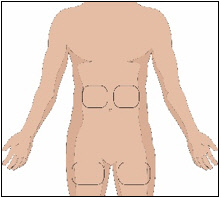
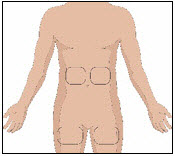
The suggested site(s) for the infusion of HYQVIA are the abdomen and thighs. If two sites are used, the two infusion sites should be on opposite sides of the body. Avoid bony prominences, or areas that are scarred, inflamed, or infected.
Volume per Site
Administer up to 600 mL per site for patients whose body weight is greater than or equal to 40 kg and up to 300 mL per site for patients whose body weight is less than 40 kg.
A second site can be used at the discretion of the physician and patient based on tolerability and total volume. If a second site is used, administer half the total volume of Recombinant Human Hyaluronidase of HYQVIA in each site.
Rate of Infusion
Administer the Recombinant Human Hyaluronidase of HYQVIA at an initial rate per site of approximately 1 to 2 mL per minute, or as tolerated.
Administer Immune Globulin Infusion 10% (Human) of HYQVIA at rates as shown in Table 3 for the initial infusions. If the patient tolerates these infusions at the full dose and maximum rate, adjust both the time intervals and number of rate changes of the ramp-up used for successive infusions at the discretion of the physician and patient.
Table 3 Immune Globulin Infusion 10% (Human) Infusion Rates | First 2 Infusions | Subsequent 2 or 3 Infusions |
|---|
| Subjects < 40 kg
(< 88lbs) | Subjects ≥ 40 kg
(≥ 88lbs) | Subjects < 40 kg
(< 88lbs) | Subjects ≥ 40 kg
(≥ 88lbs) |
|---|
| Intervals | Rate per site | Rate per site | Rate per site | Rate per site |
| Minutes | mL per hour | mL per hour | mL per hour | mL per hour |
| 5 - 15 | 5 | 10 | 10 | 10 |
| 5 - 15 | 10 | 30 | 20 | 30 |
| 5 - 15 | 20 | 60 | 40 | 120 |
| 5 - 15 | 40 | 120 | 80 | 240 |
| Remainder of infusion | 80 | 240 | 160 | 300 |
Postmarketing Experience of Immune Globulin Products
The following adverse reactions have been identified and reported during the postmarketing use of Immune Globulin products administered subcutaneously:
Anaphylactic reaction, Tremor, Tachycardia, Hypotension, Infusion related reaction, Dyspnea, Paresthesia oral, Dermatitis allergic, Injection site rash, and Alanine aminotransferase increased.
Risk Summary
No human data are available to indicate the presence or absence of drug-associated risk. Animal reproduction studies have not been conducted with Immune Globulin Infusion 10% (Human) component of HYQVIA. It is not known whether HYQVIA can cause fetal harm when administered to a pregnant woman or can affect reproduction capacity. Immune globulins cross the placenta from maternal circulation increasingly after 30 weeks of gestation.
Development and reproductive toxicology studies have been conducted with Recombinant Human Hyaluronidase in mice and rabbits [see Animal Toxicology and/or Pharmacology (13.2)]. No adverse effects on pregnancy were associated with anti-rHuPH20 antibodies. In these studies, maternal antibodies to Recombinant Human Hyaluronidase were transferred to offspring in utero. The effects of antibodies to the Recombinant Human Hyaluronidase component of HYQVIA on the human embryo or on human fetal development are unknown. HYQVIA should be given to a pregnant woman only if clearly indicated.
Risk Summary
No human data are available to indicate the presence or absence of drug-associated risk. In animal studies, maternal antibodies binding to Recombinant Human Hyaluronidase were transferred to offspring during lactation. No adverse effects on pregnancy or offspring development were associated with anti-rHuPH20 antibodies. The effects of antibodies that bind to Recombinant Human Hyaluronidase of HYQVIA transferred during human lactation are unknown. The developmental and health benefits of breastfeeding should be considered along with the mother's clinical need for HYQVIA and any potential adverse effects on the breastfed infant from HYQVIA or from the underlying maternal condition.
Risk Summary
Animal studies do not indicate direct or indirect harmful effects of Recombinant Human Hyaluronidase with respect to reproductive potential at the doses used for facilitating administration of IG 10% [see Carcinogenesis, Mutagenesis, Impairment of Fertility (13.1)].
Immune Globulin Infusion 10% (Human)
Long-term animal studies have not been conducted to evaluate the carcinogenic potential of Immune Globulin Infusion 10% (Human) or its effect on fertility.
An in vitro mutagenicity test was performed for Immune Globulin Infusion 10% (Human). No evidence of mutagenicity was observed.
Recombinant Human Hyaluronidase
Hyaluronidases are found in most tissues of the body. Long-term animal studies to evaluate the carcinogenic or mutagenic potential of Recombinant Human Hyaluronidase have not been conducted.
No adverse effects on fertility were observed in mice, rabbits and cynomolgus monkeys exposed to antibodies that bind to Recombinant Human Hyaluronidase and species-specific hyaluronidase. Reversible infertility has been observed in male and female guinea pigs immunized to produce antibodies to hyaluronidase. However, antibodies to hyaluronidase did not influence reproduction following immunization of mice, rabbits, sheep, or cynomolgus monkeys. The effects of antibodies that bind to Recombinant Human Hyaluronidase on human fertility are unknown.
Self-administration – If self-administration is deemed appropriate by the physician, give clear instructions and training on how to administer HYQVIA. Document their ability to independently administer HYQVIA.
- Ensure the patient understands the importance of following regularly scheduled infusions to maintain appropriate steady IgG levels.
- Instruct the patient to keep a treatment infusion log. This infusion log should include information about each infusion such as, the lot number(s), infusion site location, the time, date, dose, and any reactions.
- Inform the patient that due to the volume that can be infused, swelling is common with HYQVIA. Mild to moderate local infusion-site reactions (e.g., swelling and redness) are common side effects of facilitated subcutaneous treatment with HYQVIA. Instruct the patient to contact their healthcare professional if a local reaction increases in severity or persists for more than a few days.
- Instruct the patient on the importance of following the directions for the pump for infusion of the Immune Globulin Infusion 10% (Human) of HYQVIA.
BAXALTA® and HYQVIA® are trademarks of Baxalta Incorporated, a Takeda company.
TAKEDA and the TAKEDA logo are trademarks or registered trademarks of Takeda Pharmaceutical Company Limited.
Patented: Please see www.takeda.com/en-us/patents
Baxalta US Inc.
Lexington, MA 02421 USA
U.S. License No. 2020
Issue Date: 3/2021
HYQ353