To guide dose adjustment, calculate the difference between the patient's target serum IgG trough level and the IgG trough level during subcutaneous treatment. Find this difference in Table 1 and the corresponding amount (in mL) by which to increase (or decrease) the weekly/biweekly dose based on the patient's body weight. If the difference between measured and target trough levels is less than 100 milligram/dL, then no adjustment is necessary. However, the patient's clinical response should be the primary consideration in dose adjustment.
Example 1: A patient with a body weight of 70 kg who is on a weekly treatment has a measured IgG trough level of 600 milligrams/dL, and the target trough level is 800 milligrams/dL. The desired target trough level difference is 200 milligrams/dL (800 milligrams/dL minus 600 milligrams/dL). The weekly dose of CUVITRU should be increased by 13 mL.
Example 2: A patient with a body weight of 50 kg who is on a biweekly treatment has a measured IgG trough of 900 milligrams/dL, and the target trough level is 700 milligrams/dL. The desired target trough level difference is 200 milligrams/dL (900 milligrams/dL minus 700 milligrams/dL). The biweekly dose of CUVITRU should be decreased by 19 mL.
Use aseptic technique when preparing and administering CUVITRU for infusion.
- 1.Inspect the vials: Inspect for clarity, color, and expiration date(s) [see Dosage and Administration (2.1)].
- 2.Prepare for infusion:
- Gather supplies: CUVITRU vial(s), ancillary supplies, sharps container and infusion pump.
- Prepare a clean work area.
- Wash hands.
- 3.Prepare the CUVITRU:
- Wipe each stopper with a sterile alcohol wipe and allow to dry.
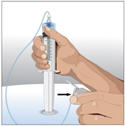
- Transfer into syringe(s), preferably using a vented spike.
- Start the infusion promptly after drawing CUVITRU into the syringe. It is suggested to complete the administration within 2 hours due to the potential formation of particles caused by siliconized syringes.
- 4.Prepare the infusion pump and tubing:
- Follow manufacturer directions for priming the tubing and pump usage.
- Attach the syringe filled with CUVITRU to the needle set.
- Prime the needle set up to the needle hub.
- 5.Prepare the infusion site(s):
- Potential sites for infusion include the abdomen, thighs, upper arms, or lateral hip.
- Avoid: bony areas, visible blood vessels, scars and any areas of inflammation (irritation) or infection.
- The number and location of infusion sites depends on the volume of the total dose.
- Infusion sites should be at least 4 inches apart.
- Rotate sites of the body between successive infusions.
- Cleanse the infusion site(s) with a sterile alcohol wipe beginning at the center of each infusion site and moving outward in a circular motion. Allow the infusion site(s) to dry.
- 6.Insert and secure the subcutaneous needle set:
- Pinch at least one inch of skin between two fingers. Insert the needle at a 90-degree angle into the subcutaneous tissue and secure the needle with sterile tape.
- If more than one site is used, repeat steps.
- Secure the needle in place with a sterile protective dressing.
- 7.Start the infusion of CUVITRU based on prescriber's order:
Follow the manufacturer's instructions to turn on the infusion pump. - 8.Remove subcutaneous needle(s) from the infusion site(s):
After the infusion is complete, remove the needle set and cover with a protective dressing. Discard any partially used vial(s) and disposable supplies in accordance with local requirements. - 9.Document the infusion:
Remove the peel-off label from each vial of CUVITRU used and affix to the patient's treatment record or infusion log. In addition, record the time, date, dose, infusion site location and any reactions after each infusion. For self-administration, provide the patient with instructions and training for infusion in the home or other appropriate setting.
North American Study
In a clinical study conducted in North America, 67 out of 74 subjects treated with CUVITRU completed the study including 20/21 subjects aged 2 to <16 years old. Of the 7 subjects that discontinued treatment with CUVITRU, one subject withdrew due to fatigue (assessed as not related), 1 subject withdrew because of non-compliance, and 5 subjects withdrew for personal reasons.
A total of 4,327 CUVITRU infusions were administered during the clinical study. No serious adverse reactions occurred during treatment with CUVITRU; 278 non-serious adverse reactions occurred at a rate per infusion of 0.06. Among the 4,327 CUVITRU infusions, 99.3% (276/278) of adverse reactions were mild or moderate and transient in nature. Of the 278 non-serious adverse reactions (excluding infections), 83% (231/278) were rated as mild, 16% (45/278) were rated as moderate, and 1% (2/278, hemoptysis and abdominal pain) were severe.
Adverse reactions occurring in ≥5% of subjects (defined as adverse events occurring during or within 72 hours of infusion or any causally related event occurring within the study period) are shown in Table 3. No subject discontinued treatment due to local adverse reactions.
Table 3 Adverse ReactionsExcluding infections
in ≥5% of Subjects Associated with Infusions of CUVITRU| Adverse Reactions | By Subject
N (%)Number and percentages of affected subjects
(N=74 Subjects) | By Infusion
N (Rate)Rate = Total number of adverse reactions divided by the total number of infusions under treatment
(N=4,327 infusions) |
|---|
| Local Adverse Reactions | 23 (31.1%) | 96 (0.022) |
| Systemic Adverse Reactions | 41 (55.4%) | 182 (0.042) |
| Headache | 10 (13.5%) | 50 (0.012) |
| Nausea | 9 (12.2%) | 16 (0.004) |
| Fatigue | 6 (8.1%) | 9 (0.002) |
| Diarrhea | 5 (6.8%) | 5 (0.001) |
| Vomiting | 4 (5.4%) | 5 (0.001) |
Systemic adverse reactions to immune globulin intravenous in part 1 of the study occurred at a rate of 0.302 relative to a rate of 0.042 during treatment with CUVITRU. The CUVITRU systemic adverse reaction rate was approximately 7-fold lower than the immune globulin intravenous rate.
Local Adverse Reactions: The most frequent local adverse reactions are listed by frequency in Table 4. Of the total 96 local adverse reactions, 100% were either mild (92.5%) or moderate (7.5%) in severity. No severe local adverse reactions were reported. During the clinical study, no local adverse reactions were observed in 68.9% (51/74) of subjects and in 98.2% (4,247/4,327) of infusions. The overall rate of local adverse reactions (excluding infections) during the clinical study was 0.022 (0.021 mild and 0.002 moderate). The rate of local adverse reactions was not associated with increased rate of infusion or volume per site.
Table 4 Most Frequent Local Adverse Reactions Reported in ≥5% of Subjects| Events | Total Number of Adverse Reactions | By Subject
N (%)Number and percentages of affected subjects
(N =74 Subjects) | By Infusion
N (Rate)Rate= Total number of adverse reactions divided by the total number of infusions under treatment
(N=4,327 infusions) |
|---|
| Mild | Moderate | | |
|---|
| Pain | 33 | 3 | 15 (20.3%) | 36 (0.008) |
| Erythema | 22 | 1 | 8 (10.8%) | 23 (0.005) |
| Pruritus | 7 | 1 | 4 (5.4%) | 8 (0.002) |
European Study
Efficacy and safety during treatment with CUVITRU were evaluated in 48 subjects in a clinical trial in Europe. CUVITRU was administered for a median treatment duration of 358 days (range: 127.0-399 days) and a mean (± SD) of 347.4 ± 47.9 days. CUVITRU treatment: 45/48 subjects treated with CUVITRU completed the study, including 23/25 subjects aged 2 to <18 years old.
A total of 2,349 CUVITRU infusions were administered during this clinical study. No serious adverse reactions occurred during treatment with CUVITRU. In total, 176 local adverse reactions and 205 systemic adverse reactions were reported (adverse reaction defined as adverse events occurring during or within 72 hours of infusion or any causally related event occurring within the study period), excluding infections. Of the 205 systemic reactions, the majority (134) were mild, 70 were moderate and one event was severe (headache, assessed as temporally associated, not causally related). The rate of systemic adverse reactions (excluding infections) during treatment with CUVITRU was 0.087, and the rate of related systemic AEs (excluding infections) per infusion was 0.032. During treatment with IGIV 10% in study part 1, the rate of related systemic AEs (excluding infections) was 0.173 events per infusion. The CUVITRU related systemic adverse event rate was approximately 5-fold lower than the immune globulin intravenous rate.
Table 5 EU Study: Adverse ReactionsCausally Related and/or Temporally Associated (Within 72 Hour) AEs (Excluding Infections)
in ≥5% of Subjects Associated with Infusions of CUVITRU| Adverse Reactions | By Subject
N (%)Total number of affected subjects divided by the total number of subjects under treatment
(N=48 Subjects) | By Infusion
N (Rate)Total number of AEs divided by the total number of infusions under treatment
(N=2,349 infusions) |
|---|
| Local Adverse Reactions | 18 (37.5%) | 176 (0.075) |
| Systemic Adverse Reactions | 33 (68.8%) | 205 (0.087) |
| Headache | 14 (29.2%) | 59 (0.025) |
| Diarrhea | 9 (18.8%) | 58 (0.025) |
| Cough | 5 (10.4%) | 7 (0.003) |
| Fatigue | 6 (12.5) | 8 (0.003) |
| Arthralgia | 3 (6.3%) | 5 (0.002) |
| Oropharyngeal pain | 3 (6.3%) | 3 (0.001) |
Local Adverse Reactions: Among the 176 local adverse reactions in total (adverse reaction defined as adverse events occurring during or within 72 hours of infusion or any causally related event occurring within the study period), none was severe. In total, 175 adverse reactions (99.4%) were mild, and 1 adverse reaction (0.6%) was moderate. The overall rate of local adverse reactions was 0.075 per infusion. The most common reactions (by subject) were infusion site pain, infusion site erythema and infusion site pruritus.
Table 6 EU Study: Most Frequent Local Adverse Reactions Reported in ≥5% of Subjects| Events | Total Number of Adverse Reactions | By Subject
N (%)Number and percentages of affected subjects
(N =48 Subjects) | By Infusion
N (Rate)Rate= Total number of adverse reactions divided by the total number of infusions under treatment
(N=2,349 infusions) |
|---|
| Mild | Moderate | | |
|---|
| Pain | 34 | 0 | 10 (20.8%) | 34 (0.014) |
| Erythema | 54 | 0 | 10 (20.8%) | 54 (0.023) |
| Pruritus | 30 | 0 | 7 (14.6%) | 30 (0.013) |
| Swelling | 46 | 0 | 4 (8.3%) | 46 (0.020) |
Postmarketing Experience of Immune Globulin Products
The following adverse reactions have been identified and reported during the postmarketing use of immune globulin products administered subcutaneously:
| Immune system disorders | Anaphylactic reaction |
| Cardiac disorders | Tachycardia |
| Nervous system disorders | Tremor and paresthesia |
| Respiratory, Thoracic and Mediastinal disorders | Dyspnea and laryngospasm |
| General disorders and administration site conditions | Injection site reaction (such as induration and warmth) and chest discomfort |
Risk Summary
No human data are available to indicate the presence or absence of drug-associated risk. Animal reproduction studies have not been conducted with CUVITRU. It is also not known whether CUVITRU can cause fetal harm when administered to a pregnant woman or can affect reproductive capacity. Immune globulins cross the placenta from maternal circulation increasingly after 30 weeks of gestation. CUVITRU should be given to a pregnant woman only if clearly indicated. In the U.S. general population, the estimated background risk of major birth defects and miscarriage in clinically recognized pregnancies is 2-4% and 15-20%, respectively.
Risk Summary
No human data are available to indicate the presence or absence of drug-associated risk. The developmental and health benefits of breastfeeding should be considered along with the mother's clinical need for CUVITRU and any potential adverse effects on the breastfed infant from CUVITRU or from the underlying maternal condition.
North America Study
A prospective, open-label, non-controlled, multicenter clinical study was conducted in North America to determine the efficacy, tolerability and PK of CUVITRU in 77 adult and pediatric subjects with PI. Efficacy was determined in 53 adults aged 16 years or older, 6 adolescents aged 12 to <16 years, and 15 children aged 2 to <12 years. CUVITRU was administered to 74 subjects with a mean dose of 222 mg/kg/week ± 71 mg/kg/week for a median treatment duration of 380.5 days (range: 30 - 629 days) and a mean (± SD) of 413.1 ± 116.5 days. The median duration of treatment did not vary significantly between age groups. The total exposure to CUVITRU was 83.70 subject-years and 4,327 infusions.
Initially subjects received immune globulin 10% intravenously (IGIV) every 3 or 4 weeks at a monthly dose equivalent to that received prior to the study for 13 weeks. The objective of part 1 of the study was to determine AUCIV of total IgG following IGIV administration. In part 2 of the study, subjects received CUVITRU subcutaneously at an adjusted dose of 145% of the IGIV dose. The objective of part 2 was to determine AUCSC of total IgG following weekly CUVITRU administration and to calculate an adjusted dose to be used in part 3. The dose adjustment factor was assessed to be 145% of the IGIV 10% dose by comparing the AUCSC with the AUCIV, 0-τ (standardized to 1 week) of part 1 for the first 15 subjects that completed part 2. Subjects who completed part 1 after this assessment was available, went directly into part 3. In part 3 of the study, subjects were treated weekly for 12 weeks at the adjusted dose. The ratio of serum IgG trough levels for part 1 and 3 were compared to the expected trough level determined in part 2 to establish the individually adapted dose for part 4 for each subject. In part 4 of the study, subjects were infused weekly with CUVITRU at the individually adapted dose for 40 weeks. During part 4, an additional pharmacokinetic assessment was performed. Follow-up with the subject either by diary system or by investigator occurred 3-5 days after every infusion in each study part to document adverse events. Adverse events were assessed using the subject's eDiary – all subjects received eDiary tablet to continuously record home treatments, adverse events, and additional information as they occurred.
One acute serious bacterial infection (ASBI) of pneumonia was reported in a 78-year old subject who had specific antibody deficiency and allergic bronchopulmonary aspergillosis while receiving CUVITRU. The point estimate of the annualized rate of ASBIs was 0.012 (upper limit of 99% CI: 0.024) during CUVITRU treatment. This annual rate of ASBIs was lower than 1.0 ASBIs /year (p<0.0001), the threshold specified as providing substantial evidence of efficacy.
The summary of infections and associated events for subjects during subcutaneous treatment with CUVITRU is summarized in Table 10.
Table 10 Summary of Infections and Associated Events| Parameters | Results |
|---|
Number of subjects
Total number of subject-years on treatment
Annual rate of any infections (per subject-year) | 74
83.70
2.41 (95% CI: 1.89 to 3.03) |
| Days on antibiotics (rate per subject-year) | 57.59 (95% CI: 40.71 to 78.59) |
| Days off work/school/unable to perform normal daily activities due to illness or infection (rate per subject-year) | 1.16 (95% CI: 0.70 to 1.79) |
| Number of hospitalizations due to infections (rate per subject-year) | 0.012 (95% CI: 0.006 to 0.022) |
| Number of days in hospital due to infections (rate per subject-year) | 0.06 (95% CI: 0.03 to 0.11) |
In the clinical study, across all age groups, the median maximum infusion rate was 60 mL/hr/site. This infusion rate was achieved in 57.3% (2,480/4,327) of completed CUVITRU infusions. CUVITRU infusion rate of 60 mL/h/site was achieved in 28.6% (6/21) of pediatric subjects (2 years to <16 years of age), in 88.7% (47/53) of adults (16 years of age and older) and in 71.6% (53/74) of all subject. For more than half of CUVITRU infusions (2,393/4,327), a volume of 30 to 39 mL (1,096/4,327 infusions) or 40 to 49 mL (1,297/4,327 infusions) was infused per site. For 320/4,327 of CUVITRU infusions, a volume of 60 mL/site or more was infused. Infusion parameters resulted in a median of 2 infusion sites (range: 1 to 4) per CUVITRU administration. During CUVITRU treatment, 84.9% (3,662/4,314) of infusions were administered using 1 infusion site (18.5%; 798/4,314) or 2 infusion sites (66.4%; 2,864/4,314) across all ages. The median duration of infusions was less than 1 hour (0.95 h; range: 0.2-6.4 hours). During all treatment periods, 99.8% of infusions were completed without a reduction, interruption, or discontinuation for tolerability reasons. Infusion characteristics did not significantly differ between adult and pediatric subjects.
Throughout the study, health-related quality of life was assessed using the Pediatric Quality of Life Inventory™ (PEDS-QL) questionnaire14 (pediatric subjects) or the self-administered SF-36 survey15(adult subjects). Quality of life was analyzed separately for the age groups 2 to 4 and 5 to 7 years (PEDS-QL, observer: parent), 8 to 12 and 13 years (PEDS-QL, observer: subject) and 14 years and older (SF-36, observer: subject). Treatment satisfaction was measured using the Life Quality Index questionnaire (LQI)16,17 and the Treatment Satisfaction Questionnaire for Medication (TSQM-9)18. The LQI was assessed for the age group 2 years to 12 years (observer: parent) and the age group 13 years and older (observer: subject) in three domains: Treatment Interference, Therapy-related Problems and Therapy Settings. The TSQM-9 was assessed in subjects aged 2 to 12 years (observer: parent) and 13 years and older (observer: subject) in 3 domains: Effectiveness, Convenience and Global Satisfaction. Differences between scores during the intravenous study part and subcutaneous 20% study part were calculated for selected domains of the instruments, see Table 11.
Table 11 Selected Patient Reported Outcomes: Differences Between the Intravenous and Subcutaneous Treatment| Scale | Difference | p-value |
|---|
| SF-36 Physical Component Score | 0.89 | 0.067 |
| SF-36 Mental Component Score | 1.31 | 0.976 |
| Total Score (PedsQL) | 1.09 | 0.449 |
| Treatment Interference (LQI) | 1.50 | 0.008 |
| Convenience (TSQM-9) | 11.11 | <0.001 |
European Study
A prospective, open-label, non-controlled, multicenter study conducted in 16 sites in Europe to evaluate the efficacy, safety, tolerability, and PK parameters of CUVITRU in subjects with PI aged 2 years and older at time of screening. The study consisted of 2 parts. In study part 1, subjects were treated with IGSC 16% for 12 weeks or with IGIV 10% for 13 weeks. Administration, dosage frequency, and dose were dependent on the pre-study treatment. However, the dose range had to be within 0.3-1.0 g/kg BW/4 weeks.
During study part 2, subjects received weekly CUVITRU infusions for 51 weeks at the dose used during study part 1, adjusted to a weekly equivalent dose if necessary. PK assessments were performed before the end of study part 1 and after approximately 5 months in study part 2 in subjects aged ≥12 years. For younger subjects (aged 2 to <12 years) only IgG trough levels were assessed to avoid multiple blood draws. The geometric mean of CUVITRU trough levels was 827 mg/dL [95% CI: 748-913]. Human and population PK parameters for CUVITRU were calculated from levels of Immunoglobulin G (IgG) measured during each part of the study.
CUVITRU was administered at the same weekly-equivalent dose as with the previously used IG product (mean (± SD) dose: 0.125 ± 0.042 g/kg/week). CUVITRU administered at this dose was shown to be effective in PI subjects aged ≥2 years.
One acute serious bacterial infection (ASBI) of pneumonia was reported in a 12-year old subject with a more severe form of hypogammaglobulinemia (XLA) while receiving CUVITRU. The point estimate of the annualized rate of ASBIs was 0.022 (upper limit of 99% CI: 0.049) during CUVITRU treatment. This annual rate of ASBIs was lower than 1.0 ASBIs /year, (p<0.0001), the threshold specified as providing substantial evidence of efficacy.
The summary of infections and associated events for subjects in the EU study during subcutaneous treatment with CUVITRU are summarized in Table 12.
Table 12 Summary of Infections and Associated Events| Parameters | Results |
|---|
Number of subjects
Annual rateRate = number of infections divided by the total number of subject-years under treatment of any infections (rate per subject-year) | 48
4.38 (95% CI: 3.38 to 5.56) |
| Days on antibiotics (rate per subject-year) | 18.11 (95% CI: 13.01 to 24.41) |
| Days off work/school/unable to perform normal daily activities due to illness or infection (rate per subject-year) | 15.55 (95% CI: 10.06 to 22.75) |
| Number of hospitalizations due to infections (rate per subject-year) | 0.04 (95% CI: 0.02 to 0.08) |
| Number of days in hospital due to infections (rate per subject-year) | 0.11 (95% CI: 0.05 to 0.21) |
How Supplied
CUVITRU is supplied in single-dose vials containing the labeled amount of functionally active IgG. The components used in the packaging for CUVITRU are not made with natural rubber latex.
The following presentations of CUVITRU are available:
| NDC Number | Volume | Grams Protein |
|---|
| 0944-2850-01 | 5 mL | 1.0 |
| 0944-2850-03 | 10 mL | 2.0 |
| 0944-2850-05 | 20 mL | 4.0 |
| 0944-2850-07 | 40 mL | 8.0 |
| 0944-2850-09 | 50 mL | 10.0 |
Self-administration – If self-administration is deemed to be appropriate by the physician, clear instructions and training on subcutaneous infusion should be given to the patient/caregiver, and the demonstration of their ability to independently administer subcutaneous infusions should be documented.
- Ensure the patient understands the importance of consistent subcutaneous infusions to maintain appropriate steady IgG levels.
- Inform the patient to start the infusion promptly after drawing CUVITRU into the syringe. Ensure the patient understands that it is suggested to complete the administration within 2 hours due to the potential formation of particles caused by siliconized syringes.
- Instruct the patient to keep a treatment diary/log book. This diary/log book should include information about each infusion such as, the time, date, dose, lot number(s), infusion sites, and any reactions.
- Inform the patient that mild to moderate local infusion-site reactions (e.g., pain, redness and itching) are a common side effect of subcutaneous treatment, but to contact their healthcare professional if a local reaction increases in severity or persists for more than a few days.
Takeda Pharmaceuticals U.S.A., Inc.
Cambridge, MA 02142
U.S. License No. 1898
CUVITRU is a registered trademark of Baxalta Incorporated.
Takeda and
are registered trademarks of Takeda Pharmaceutical Company Limited.©2025 Takeda Pharmaceutical Company Limited. All rights reserved.
CUV350