Patients Not Taking a Phosphate Binder. The recommended starting dose of sevelamer hydrochloride is 800 to 1600 mg, which can be administered as one or two 800 mg sevelamer hydrochloride tablets with meals based on serum phosphorus level. Table 1 provides recommended starting doses of sevelamer hydrochloride for patients not taking a phosphate binder.
Table 1: Starting Dose for Dialysis Patients Not Taking a Phosphate Binder| Serum Phosphorus | Sevelamer Hydrochloride 800 mg |
|---|
| >5.5 and <7.5 mg/dL | 1 tablet three times daily with meals |
| ≥7.5 and <9.0 mg/dL | 2 tablets three times daily with meals |
| ≥9.0 mg/dL | 2 tablets three times daily with meals |
Patients Switching from Calcium Acetate. In a study in 84 CKD patients on hemodialysis, a similar reduction in serum phosphorus was seen with equivalent doses (approximately mg for mg) of sevelamer hydrochloride and calcium acetate. Table 2 gives recommended starting doses of sevelamer hydrochloride based on a patient's current calcium acetate dose.
Table 2: Starting Dose for Dialysis Patients Switching from Calcium Acetate to Sevelamer HydrochlorideCalcium Acetate 667 mg
(Tablets per meal) | Sevelamer Hydrochloride 800 mg
(Tablets per meal) |
|---|
| 1 tablet | 1 tablet |
| 2 tablets | 2 tablets |
| 3 tablets | 3 tablets |
Dose Titration for All Patients Taking Sevelamer Hydrochloride. Adjust dosage based on the serum phosphorus concentration with a goal of lowering serum phosphorus to 5.5 mg/dL or less. Increase or decrease by one tablet per meal at two-week intervals as necessary. Table 3 gives a dose titration guideline. The average dose in a Phase 3 trial designed to lower serum phosphorus to 5.0 mg/dL or less was approximately three sevelamer hydrochloride 800 mg tablets per meal. The maximum average daily sevelamer hydrochloride dose studied was 13 g.
Table 3: Dose Titration Guideline| Serum Phosphorus | Sevelamer Hydrochloride Dose |
|---|
| >5.5 mg/dL | Increase 1 tablet per meal at 2-week intervals |
| 3.5-5.5 mg/dL | Maintain current dose |
| <3.5 mg/dL | Decrease 1 tablet per meal |
Risk Summary
Sevelamer hydrochloride is not absorbed systemically following oral administration and maternal use is not expected to result in fetal exposure to the drug.
Clinical Considerations
Sevelamer hydrochloride may decrease serum levels of fat-soluble vitamins and folic acid in pregnant women [see Clinical Pharmacology (12.2)]. Consider supplementing with these vitamins.
Data
Animal data
In pregnant rats given dietary doses of 0.5, 1.5, or 4.5 g/kg/day of sevelamer hydrochloride during organogenesis, reduced or irregular ossification of fetal bones, probably due to a reduced absorption of fat-soluble vitamin D, occurred at 7–21 times the maximum human equivalent dose of 13 g based on 60 kg body weight. In pregnant rabbits given oral doses of 100, 500, or 1000 mg/kg/day of sevelamer hydrochloride by gavage during organogenesis, an increase of early resorptions occurred in the high-dose group (human equivalent dose approximately 5 times the maximum clinical trial dose based on 60 kg body weight).
Risk Summary
Sevelamer hydrochloride is not absorbed systemically by the mother following oral administration and breastfeeding is not expected to result in exposure of the child to sevelamer hydrochloride.
Clinical Considerations
Sevelamer hydrochloride may decrease serum levels of fat-soluble vitamins and folic acid in lactating women [see Clinical Pharmacology (12.2)]. Consider supplementing with these vitamins.
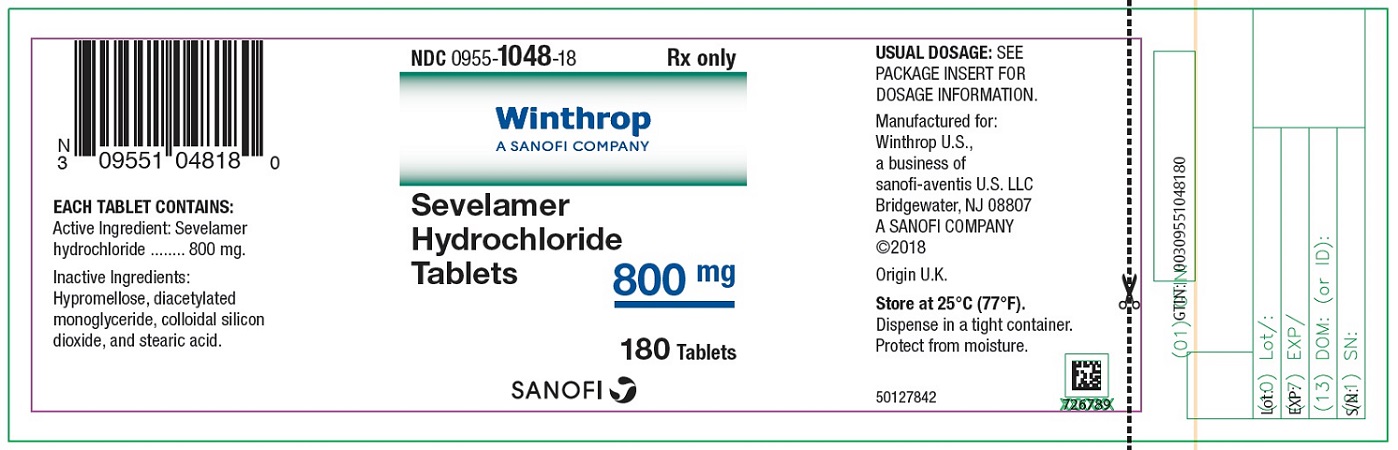
Sevelamer hydrochloride tablets: Each film-coated tablet of sevelamer hydrochloride contains 800 mg of sevelamer hydrochloride on an anhydrous basis. The inactive ingredients are hypromellose, diacetylated monoglyceride, colloidal silicon dioxide, and stearic acid. The tablet imprint contains iron oxide black ink.
Drug Interactions
In vivo
Sevelamer carbonate has been studied in human drug-drug interaction studies (9.6 g once daily with a meal) with warfarin and digoxin. Sevelamer hydrochloride, which contains the same active moiety as sevelamer carbonate, has been studied in human drug-drug interaction studies (2.4–2.8 g single dose or three times daily with meals or two times daily without meals) with ciprofloxacin, digoxin, enalapril, iron, metoprolol, mycophenolate mofetil and warfarin.
Coadministered single dose of 2.8 g of sevelamer hydrochloride in fasted state decreased the bioavailability of ciprofloxacin by approximately 50% in healthy subjects.
Concomitant administration of sevelamer and mycophenolate mofetil in adult and pediatric patients decreased the mean MPA Cmax and AUC0–12h by 36% and 26%, respectively.
Sevelamer carbonate or sevelamer hydrochloride did not alter the pharmacokinetics of a single dose of enalapril, digoxin, iron, metoprolol and warfarin when coadministered.
During postmarketing experience, cases of increased thyroid stimulating hormone (TSH) levels have been reported in patients coadministered sevelamer hydrochloride and levothyroxine. Reduction in concentrations of cyclosporine and tacrolimus leading to dose increases has also been reported in transplant patients when coadministered with sevelamer hydrochloride without any clinical consequences (e.g., graft rejection). The possibility of an interaction cannot be excluded with these drugs.
Manufactured for:
Winthrop U.S.,
a business of sanofi-aventis U.S. LLC
Bridgewater, NJ 08807
A SANOFI COMPANY
©2021 sanofi-aventis U.S. LLC