Ultracare Anesthetic Gel
Product Images NDC 10129-072
View Photos of Packaging, Regulatory Labels, and Product Appearance
Product Visual Gallery
This gallery contains 14 technical images submitted to the FDA as part of the official labeling for Ultracare Anesthetic Gel (NDC 10129-072). Unlike standard consumer photos, these assets often include clinical data figures, molecular chemical structures, and official manufacturer packaging layouts.
As provided by The Belport Company, Inc. Dba Gingi-pak, these visuals offer a comprehensive scientific overview of the product's physical and chemical identity, aiding pharmacists and researchers in product verification and study.
Product Images & Figures Index
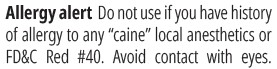
Alert (Allergy Alert)
Keep Out Of Reach Of Children (Children)
Consult (Consult)
This text appears to be a warning label advising users to consult a doctor or pharmacist before using the product if they have severe injuries, infections, or conditions in specific areas mentioned. It also instructs users to seek medical attention if they experience severe sore throat lasting more than 2 days, develop fever, headache, rash, nausea, or vomiting, have a mouth sore lasting more than 10 days, or if irritation, pain, or redness worsens.*
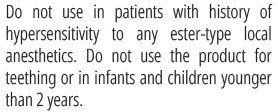
Do Not Use In Patients With History Of Ypersensitivity To Any Ester-type Local Anesthetics. Do Not Use The Product For Teething Or In Infants And Children Younger Than 2 Years (Dnu)
This text provides important safety information about the use of a specific product, cautioning against its use in patients with a history of hypersensitivity to certain types of local anesthetics. It also specifies that the product should not be used for teething or in infants and children younger than 2 years old.*
Dnu (Dnu2)
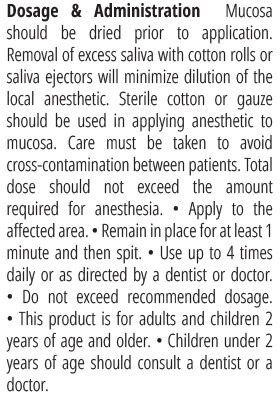
Dose Admin (Doseadmin)
This text provides instructions for the proper use of a local anesthetic on mucosa. It advises drying the area before application to enhance effectiveness, using cotton rolls or saliva ejectors to remove excess saliva, and avoiding cross-contamination between patients. The dosage should not exceed the amount needed for anesthesia, and the anesthetic should be applied to the affected area, remaining in place for at least 1 minute before spitting. The product is recommended for adults and children aged 2 years and older, with children under 2 years advised to consult a dentist or doctor before use. It can be used up to 4 times daily or as directed by a healthcare professional, and users should not exceed the recommended dosage.*
Facts (Drugfacts1)
Facts (Drugfacts2)
Inactive (Inactive)
Reduce Pain Or Discomfort Caused By Minor Dental Procedures • Minor Gum Injury • Canker Sores • Sore Throat • Minor Mouth Or Gum Irritations Caused By Dentures Or Orthodontic Appliances. (Intended Use)
This product is designed to reduce pain or discomfort caused by various dental procedures and minor oral irritations such as canker sores, sore throats, and gum injuries. It can also help with mouth or gum irritations from dentures or orthodontic appliances. The directions involve using this product to provide anesthesia to the mucous membranes of the oropharynx, minimizing pain during ulcers, needle punctures, scaling procedures, and other dental applications. It can also assist with patients who have an excessive gag reflex during impressions or intraoral radiographs.*
Lable (Label)
Storage (Storage)
Warnings (Warnings)
This text provides warnings and instructions for a specific product, advising on precautions and potential risks. It highlights contraindications for patients with hypersensitivity to local anesthetics, caution regarding usage in infants and children under 2 years, and recommendations for external use only. Additionally, it emphasizes the risks of allergic reactions, the importance of avoiding eye contact, keeping the product away from children, and the possibility of methemoglobinemia, a serious condition that can arise from its usage. Symptoms to watch for and immediate medical attention needed in case of such adverse reactions are also outlined.*
* These product label images have been analyzed using experimental machine learning. Please verify findings with the primary label text.