Risk Summary
There are no adequate and well controlled studies with miglustat in pregnant women. However, animal reproduction studies have been conducted for miglustat. In these animal studies, decreased live births and decreased fetal weight were observed in rats orally dosed with miglustat prior to mating and during organogenesis at doses with exposures at and greater than 2 times the human therapeutic systemic exposure. Maternal death and decreased body weight gain were observed in rabbits orally dosed with miglustat during organogenesis at doses with exposures less than the human therapeutic systemic exposure. Miglustat should be used during pregnancy only if the potential benefit justifies the potential risk to the fetus.
Clinical Considerations
Disease-associated maternal and embryo-fetal risk
Women with Type 1 Gaucher disease have an increased risk of spontaneous abortion, especially if disease symptoms are not treated and controlled pre-conception and during a pregnancy. Pregnancy may exacerbate existing Type 1 Gaucher disease symptoms or result in new disease manifestations. Type 1 Gaucher disease manifestations may lead to adverse pregnancy outcomes including, hepatosplenomegaly which can interfere with the normal growth of a pregnancy and thrombocytopenia which can lead to increased bleeding and possible hemorrhage.
Labor or delivery
Dystocia and delayed parturition were observed in rats dosed with miglustat gestation day 6 through lactation at systemic exposure ≥2 times the human therapeutic systemic exposure.
Data
Animal Data
In female rats given miglustat by oral gavage at doses of 20, 60, 180 mg/kg/day beginning 14 days before mating and continuing through gestation day 17 (organogenesis), decreased live births including complete litter loss and decreased fetal weight were observed in the mid-dose and high-dose groups (systemic exposures ≥2 times the human therapeutic systemic exposure, based on body surface area comparison). In pregnant rats given miglustat by oral gavage at doses of 20, 60, 180 mg/kg/day from gestation day 6 through lactation (postpartum day 20), dystocia and delayed parturition were observed in the mid- and high-dose groups (systemic exposure ≥2 times the human therapeutic systemic exposure, based on body surface comparison). In addition, decreased live births and pup body weights were observed at >20 mg/kg/day (systemic exposures less than the human therapeutic systemic exposure, based on body surface area comparison).
In pregnant rabbits given miglustat by oral gavage at doses of 15, 30, 45 mg/kg/day during gestation days 6-18 (organogenesis), maternal death and decreased body weight gain were observed at 15 mg/kg/day (systemic exposures less than the human therapeutic systemic exposure, based on body surface area comparisons).
A pre and postnatal development study in rats showed no evidence of any adverse effect on pre and postnatal development at oral doses up to 180 mg/kg/day (about 6 times the recommended daily human dose of 5 mg/kg based on body surface area).
Infertility
No effect on sperm concentration, motility, or morphology was seen in 7 healthy adult men who received miglustat 100 mg, orally, twice daily for 6 weeks. Decreased spermatogenesis with altered sperm morphology and motility and decreased fertility were observed in rats orally dosed with miglustat 14 days prior to mating with doses at exposures less than the human therapeutic systemic exposure based on body surface area comparisons (mg/m2). Decreased spermatogenesis was reversible in rats following 6 weeks of drug withdrawal [see Nonclinical Toxicology (13.1)].
Absorption: After a 100 mg oral dose, the time to maximum observed plasma concentration of miglustat (tmax) ranged from 2 to 2.5 hours in Gaucher patients. Plasma concentrations show a biexponential decline, characterized by a short distribution phase and a longer elimination phase. The effective half-life of miglustat is approximately 6 to 7 hours, which predicts that steady-state will be achieved by 1.5 to 2 days following the start of three times daily dosing.
Miglustat, dosed at 50 and 100 mg three times daily in Gaucher patients, exhibits dose-proportional pharmacokinetics. The pharmacokinetics of miglustat were not altered after repeated dosing three times daily for up to 12 months.
In healthy subjects, co-administration of miglustat with food results in a decrease in the rate of absorption of miglustat (maximum plasma concentration [Cmax] was decreased by 36% and tmax delayed 2 h) but had no statistically significant effect on the extent of absorption of miglustat (area-under-the-plasma-concentration time curve [AUC] was decreased by 14%). The mean oral bioavailability of a 100-mg miglustat capsule is about 97% relative to an oral solution administered under fasting conditions. The pharmacokinetics of miglustat were similar between adult type 1 Gaucher disease patients and healthy subjects after a single dose administration of miglustat 100 mg.
Distribution: Miglustat does not bind to plasma proteins. Mean apparent volume of distribution of miglustat is 83-105 liters in Gaucher patients. At steady state, the concentration of miglustat in cerebrospinal fluid of six non-Gaucher patients was 31.4-67.2% of that in plasma, indicating that miglustat crosses the blood brain barrier.
Metabolism and Excretion: The major route of excretion of miglustat is via kidney. Following administration of a single dose of 100 mg 14C-miglustat to healthy volunteers, 83% of the radioactivity was recovered in urine and 12% in feces. In healthy subjects, 67% of the administered dose was excreted unchanged in urine over 72 hours. The most abundant metabolite in urine was miglustat glucuronide accounting for 5% of the dose. The terminal half-life of radioactivity in plasma was 150 hours, suggesting the presence of one or more metabolites with a prolonged half-life. The metabolite accounting for this observation has not been identified, but may accumulate and reach concentrations exceeding those of miglustat at steady state.
Specific Populations
Gender: There was no statistically significant gender difference in miglustat pharmacokinetics, based on pooled data analysis.
Race: Ethnic differences in miglustat pharmacokinetics have not been evaluated in Gaucher patients. However, apparent oral clearance of miglustat in patients of Ashkenazi Jewish descent was not statistically different to that in others (1 Asian and 15 Caucasians), based on a cross-study analysis.
Hepatic Impairment: No studies have been performed to assess the pharmacokinetics of miglustat in patients with hepatic impairment.
Renal Impairment: Limited data in non-Gaucher patients with impaired renal function indicate that the apparent oral clearance (CL/F) of miglustat decreases with decreasing renal function. While the number of subjects with mild and moderate renal impairment was very small, the data suggest an approximate decrease in the apparent oral clearance of 40% and 60% respectively, in mild and moderate renal impairment, justifying the need to decrease the dosing of miglustat in such patients dependent upon creatinine clearance levels [see Dosage and Administration (2.2)].
Data in severe renal impairment are limited to two patients with creatinine clearances in the range 18-29 mL/min and cannot be extrapolated below this range. These data suggest a decrease in CL/F by at least 70% in patients with severe renal impairment [see Dosage and Administration (2.2) and Use in Specific Populations (8.6)].
Drug Interaction Studies
Miglustat does not inhibit the metabolism of various substrates of cytochrome P450 enzymes including, CYP1A2, CYP2A6, CYP2C9, CYP2C19, CYP2D6, CYP2E1, CYP3A4 and CYP4A11 in vitro; consequently significant interactions via inhibition of these enzymes are unlikely with drugs that are substrates of cytochrome P450 enzymes.
Drug interaction between miglustat 100 mg orally three times daily and imiglucerase 7.5 or 15 U/kg/day was assessed in imiglucerase-stabilized patients after one month of co-administration. There was no significant effect of imiglucerase on the pharmacokinetics of miglustat, with the co-administration of imiglucerase and miglustat resulting in a 22% reduction in Cmax and a 14% reduction in the AUC for miglustat. While miglustat appeared to increase the clearance of imiglucerase by 70%, these results are not conclusive because of the small number of subjects studied and because patients took variable doses of imiglucerase [see Drug Interactions (7)].
Concomitant therapy with loperamide during clinical trials did not appear to significantly alter the pharmacokinetics of miglustat.
Carcinogenesis: Two-year carcinogenicity studies have been conducted with miglustat in CD-1 mice at oral doses up to 500 mg/kg/day and in Sprague Dawley rats at oral doses up to 180 mg/kg/day. Oral administration of miglustat for 104 weeks produced mucinous adenocarcinomas of the large intestine at 210, 420 and 500 mg/kg/day (about 3, 6 and 7 times the recommended human dose, respectively, based on the body surface area) in male mice and at 420 and 500 mg/kg/day (about 6 and 7 times the recommended human dose, based on the body surface area) in female mice. The adenocarcinomas were considered rare in CD-1 mice and occurred in the presence of inflammatory and hyperplastic lesions in the large intestine of both males and females. In rats, oral administration of miglustat for 100 weeks produced increased incidences of interstitial cell adenomas of the testis at 30, 60 and 180 mg/kg/day (about 1, 2 and 5 times the recommended human dose, respectively, based on the body surface area).
Mutagenesis: Miglustat was not mutagenic or clastogenic in a battery of in vitro and in vivo assays including the bacterial reverse mutation (Ames), chromosomal aberration (in human lymphocytes), gene mutation in mammalian cells (Chinese hamster ovary), and mouse micronucleus assays.
Impairment of Fertility: Male rats, given 20 mg/kg/day miglustat by (systemic exposure less than the human therapeutic systemic exposure based on body surface area comparisons, mg/m2) oral gavage 14 days prior to mating, had decreased spermatogenesis with altered sperm morphology and motility and decreased fertility. Decreased spermatogenesis was reversible following 6 weeks of drug withdrawal. A higher dose of 60 mg/kg/day (2 times the human therapeutic systemic exposure, based on body surface area comparison, mg/m2) resulted in seminiferous tubule and testicular atrophy/degeneration.
Female rats were given oral gavage doses of 20, 60, 180 mg/kg/day beginning 14 days before mating and continuing through gestation. Effects observed at 20 mg/kg/day (systemic exposure less than the human therapeutic systemic exposure, based on body surface area comparisons) included decreased corpora lutea, increased postimplantation loss, and decreased live births.
Open-Label Uncontrolled Monotherapy Trials
In Study 1, miglustat was administered at a starting dose of 100 mg three times daily for 12 months (dose range of 100 once-daily to 200 mg three times daily) to 28 adult patients with type 1 Gaucher disease, who were unable to receive enzyme replacement therapy and who had not taken enzyme replacement therapy in the preceding 6 months. Twenty-two patients completed the trial. After 12 months of treatment, the results showed significant mean percent reductions from baseline in liver volume of 12% and spleen volume of 19%, a non-significant increase from baseline in mean absolute hemoglobin concentration of 0.26 g/dL and a mean absolute increase from baseline in platelet counts of 8 × 10⁹/L (See Tables 3-6).
In Study 2, miglustat was administered at a dose of 50 mg three times daily for 6 months to 18 adult patients with type 1 Gaucher disease who were unable to receive enzyme replacement therapy and who had not taken enzyme replacement therapy in the preceding 6 months. Seventeen patients completed the trial. After 6 months of treatment, the results showed significant mean percent reductions from baseline in liver volume of 6% and spleen volume of 5%. There was a non-significant mean absolute decrease from baseline in hemoglobin concentration of 0.13 g/dL and a non-significant mean absolute increase from baseline in platelet counts of 5 × 10⁹/L (See Tables 3-6).
Extension Period
Eighteen patients were enrolled in a 12-month extension to Study 1. A subset of patients continuing in the extension had larger mean baseline liver volumes, and lower mean baseline platelet counts and hemoglobin concentrations than the original study population (See Tables 3-6). After a total of 24 months of treatment, there were significant mean decreases from baseline in liver and spleen organ volumes of 15% and 27%, respectively, and significant mean absolute increases from baseline in hemoglobin concentration and platelet count of 0.9 g/dL and 14 × 109/L, respectively (See Tables 3-6).
Sixteen patients were enrolled in a 6-month extension to Study 2. After a total of 12 months of treatment, there was a mean decrease from baseline in spleen organ volume of 10%, whereas the mean percent decrease in liver organ volume remained at 6%. There were no significant changes in hemoglobin concentrations or platelet counts (See Tables 3-6).
Liver volume results from Studies 1 and 2 and their extensions are summarized in Table 3:
Table 3: Liver Volume Changes in Two Open-Label Uncontrolled Monotherapy Trials of miglustat with Extension Period | | Liver Volume |
|---|
| n | Absolute Mean (L)
(2-sided 95% CI) | Percent Mean (%)
(2-sided 95% CI) |
|---|
| Study 1 (starting dose miglustat 100 mg three times daily) | | | |
| Baseline (Month 0) | 21 | 2.39 | |
| Month 12 Change from baseline | | -0.28 (-0.38, -0.18) | -12.1% (-16.4, 7.9) |
| Study 1 Extension Phase | | | |
| Baseline (Month 0) | 12 | 2.54 | |
| Month 24 Change from baseline | | -0.36 (-0.48, -0.24) | -14.5% (-19.3, 9.7) |
| Study 2 (miglustat 50 mg three times daily) | | | |
| Baseline (Month 0) | 17 | 2.45 | |
| Month 6 Change from baseline | | -0.14 (-0.25, -0.03) | -5.9% (-9.9, -1.9) |
| Study 2 Extension Phase | | | |
| Baseline (Month 0) | 13 | 2.35 | |
| Month 12 Change from baseline | | -0.17 (-0.3, -0.0) | -6.2% (-12.0, -0.5) |
Spleen volume results from Studies 1 and 2 and their extensions are summarized in Table 4:
Table 4: Spleen Volume Changes in Two Open-Label Uncontrolled Monotherapy Trials of miglustat with Extension Period | | Spleen Volume |
|---|
| n | Absolute Mean (L)
(2-sided 95% CI) | Percent Mean (%)
(2-sided 95% CI) |
|---|
| Study 1 (starting dose miglustat 100 mg three times daily) | | | |
| Baseline (Month 0) | 18 | 1.64 | |
| Month 12 Change from baseline | | -0.32 (-0.42, -0.22) | -19.0% (-23.7, -14.3) |
| Study 1 Extension Phase | | | |
| Baseline (Month 0) | 10 | 1.56 | |
| Month 24 Change from baseline | | -0.42 (-0.53, -0.30) | -26.4% (-30.4, -22.4) |
| Study 2 (miglustat 50 mg three times daily) | | | |
| Baseline (Month 0) | 11 | 1.98 | |
| Month 6 Change from baseline | | -0.09 (-0.18, -0.01) | -4.5% (-8.2, -0.7) |
| Study 2 Extension Phase | | | |
| Baseline (Month 0) | 9 | 1.98 | |
| Month 12 Change from baseline | | -0.23 (-0.46, 0.00) | -10.1% (-20.1, -0.1) |
Hemoglobin concentration results from Studies 1 and 2 and their extensions are summarized in Table 5:
Table 5: Hemoglobin Concentration Changes in Two Open-Label Uncontrolled Monotherapy Trials of miglustat with Extension Period | | Hemoglobin Concentration |
|---|
| n | Absolute Mean (g/dL)
(2-sided 95% CI) | Percent Mean (%)
(2-sided 95% CI) |
|---|
| Study 1 (starting dose miglustat 100 mg three times daily) | | | |
| Baseline (Month 0) | 22 | 11.94 | |
| Month 12 Change from baseline | | 0.26 (-0.05, 0.57) | 2.6% (-0.5, 5.7) |
| Study 1 Extension Phase | | | |
| Baseline (Month 0) | 13 | 11.03 | |
| Month 24 Change from baseline | | 0.91 (0.30, 1.53) | 9.1% (2.9, 15.2) |
| Study 2 (miglustat 50 mg three times daily) | | | |
| Baseline (Month 0) | 17 | 11.60 | |
| Month 6 Change from baseline | | -0.13 (-0.51, 0.24) | -1.3% (-4.4, 1.8) |
| Study 2 Extension Phase | | | |
| Baseline (Month 0) | 13 | 11.94 | |
| Month 12 Change from baseline | | 0.06 (-0.73, 0.85) | 1.2% (-5.2, 7.7) |
Platelet count results from Studies 1 and 2 and their extensions are summarized in Table 6:
Table 6: Platelet Count Changes in Two Open-Label Uncontrolled Monotherapy Trials of miglustat with Extension Period | | Platelet Count |
|---|
| n | Absolute Mean (109/L)
(2-sided 95% CI) | Percent Mean (%)
(2-sided 95% CI) |
|---|
| Study 1 (starting dose miglustat 100 mg three times daily) | | | |
| Baseline (Month 0) | 22 | 76.58 | |
| Month 12 Change from baseline | | 8.28 (1.88, 14.69) | 16.0% (-0.8, 32.8) |
| Study 1 Extension Phase | | | |
| Baseline (Month 0) | 13 | 72.35 | |
| Month 24 Change from baseline | | 13.58 (7.72, 19.43) | 26.1% (14.7, 37.5) |
| Study 2 (miglustat 50 mg three times daily) | | | |
| Baseline (Month 0) | 17 | 116.47 | |
| Month 6 Change from baseline | | 5.35 (-6.31, 17.02) | 2.0% (-6.9, 10.8) |
| Study 2 Extension Phase | | | |
| Baseline (Month 0) | 13 | 122.15 | |
| Month 12 Change from baseline | | 14.0 (-3.4, 31.4) | 14.7% (-1.4, 30.7) |
Open-Label Active-Controlled Trial
Study 3 was an open-label, randomized, active-controlled study of 36 adult patients with type 1 Gaucher disease, who had been receiving enzyme replacement therapy with imiglucerase for a minimum of 2 years prior to study entry. Patients were randomized 1:1:1 to one of three treatment groups, as follows:
- miglustat 100 mg three times daily alone
- imiglucerase (patient's usual dose) alone
- miglustat 100 mg three times daily and imiglucerase (usual dose)
Patients were treated for 6 months, and 33 patients completed the study. Because miglustat is only indicated as monotherapy, the results for the monotherapy arms are described below. At Month 6, the results showed a decrease in mean percent change in liver volume in the miglustat treatment group compared to the imiglucerase alone group. There were no significant differences between the groups for mean absolute changes in liver and spleen volume and hemoglobin concentration. However, there was a significant difference between the miglustat alone and imiglucerase alone groups in platelet counts at Month 6, with the miglustat alone group having a mean absolute decrease in platelet count of 21.6 × 10⁹/L and the imiglucerase alone group having a mean absolute increase in platelet count of 10.1 × 10⁹/L (See Tables 7-10).
Extension period
Twenty-nine patients were enrolled in a 6-month extension to Study 3. In the extension phase, all 29 patients had withdrawn from imiglucerase and received open-label miglustat 100 mg three times daily monotherapy. At Month 12, the results showed non-significant decreases in platelet counts from baseline in all the treatment groups (by original randomization). There was a significant decrease in platelet counts from Month 6 to Month 12 in the group originally randomized to treatment with imiglucerase, and a continued decrease in platelet counts in the group originally randomized to miglustat alone. There were no significant changes in any treatment group for liver volume, spleen volume, or hemoglobin concentration (See Tables 7-10).
Liver volume results from Study 3 and extension are summarized in Table 7:
Table 7: Liver Volume Changes from Study 3 and Extension Phase | Imiglucerase alone | Miglustat alone |
|---|
| Study 3 | n=11 | n=10 |
| Month 0 | 1.81 | 1.58 |
| Month 6 Change (L) | 0.04 | -0.05 |
| Month 6 % Change | 3.6% | -2.9% |
| Adjusted mean Difference from Imiglucerase (95% CI) | | -4.5% (-13.2, 4.2) |
| Extension Phase All patients received miglustat 100 mg three times daily monotherapy from Month 6 to Month 12. | n=10 | n=8 |
| Month 0 | 1.94 | 1.60 |
| Month 12 Change (L) | -0.05 | -0.01 |
| Month 12 % Change | -0.7% | -0.8% |
Spleen volume results from Study 3 and extension are summarized in Table 8:
Table 8: Spleen Volume Changes from Study 3 and Extension Phase | Imiglucerase alone | Miglustat alone |
|---|
| Study 3 | n=8 | n=7 |
| Month 0 | 0.61 | 0.69 |
| Month 6 Change (L) | -0.02 | -0.03 |
| Month 6 % Change | -2.1% | -4.8% |
| Adjusted % Difference from Imiglucerase (95% CI) | | -5.8% (-22.1, 10.5) |
| Extension Phase All patients received miglustat 100 mg three times daily monotherapy from Month 6 to Month 12. | n=7 | n=6 |
| Month 0 | 0.83 | 0.57 |
| Month 12 Change (L) | 0.04 | -0.05 |
| Month 12 % Change | 1.5% | -6.1% |
Hemoglobin concentration results from Study 3 and extension are summarized in Table 9:
Table 9: Hemoglobin Concentration Changes from Study 3 and Extension Phase | Imiglucerase alone | Miglustat alone |
|---|
| Study 3 | n=12 | n=10 |
| Month 0 | 13.18 | 12.44 |
| Month 6 Change (g/dL) | -0.15 | -0.31 |
| Month 6 % Change | -1.2% | -2.4% |
| Adjusted % Difference from Imiglucerase (95% CI) | | -1.9% (-6.4, 2.6) |
| Extension Phase All patients received miglustat 100 mg three times daily monotherapy from Month 6 to Month 12 . | n=10 | n=9 |
| Month 0 | 13.39 | 12.46 |
| Month 12 Change (g/dL) | -0.48 | -0.13 |
| Month 12 % Change | -3.1% | -1.1% |
Platelet count results from Study 3 and extension are summarized in Table 10:
Table 10: Platelet Count Changes from Study 3 and Extension Phase | Imiglucerase alone | Miglustat alone |
|---|
| Study 3 | n=12 | n=10 |
| Month 0 | 165.75 | 170.55 |
| Month 6 Change (109/L) | 15.29 | -21.60 |
| Month 6 % Change | 10.1% | -9.6% |
| Adjusted % Difference from Imiglucerase (95% CI) | | -17.1% (-32.9, -1.3) |
| Extension Phase All patients received miglustat 100 mg three times daily monotherapy from Month 6 to Month 12. | n=10 | n=9 |
| Month 0 | 170.05 | 184.83 |
| Month 12 Change (109/L) | -3.75 | -27.39 |
| Month 12 % Change | -3.2% | -10.4% |
Patients with platelet counts above 150 × 109/L at baseline who were randomized to miglustat treatment had significant decreases in platelet counts at Month 12.
Information for Patients
- Advise patients that the most common serious adverse reactions reported with miglustat are peripheral neuropathy. Advise patients to promptly report any numbness, tingling, pain, or burning in the hands and feet [see Warnings and Precautions (5.1)].
- Advise patients that other adverse reactions include tremor and reductions in platelet counts. Advise patients to promptly report the development of tremor or worsening in an existing tremor. [see Warnings and Precautions (5.2 and 5.4)]
- Advise patients that other serious adverse reactions include diarrhea and weight loss. Advise patients to adhere to dietary instructions [see Warnings and Precautions (5.3)].
- Advise patients to take the next miglustat capsule at the next scheduled time if a dose is missed.
- Inform patients of the potential risks and benefits of miglustat and of alternative modes of therapy.
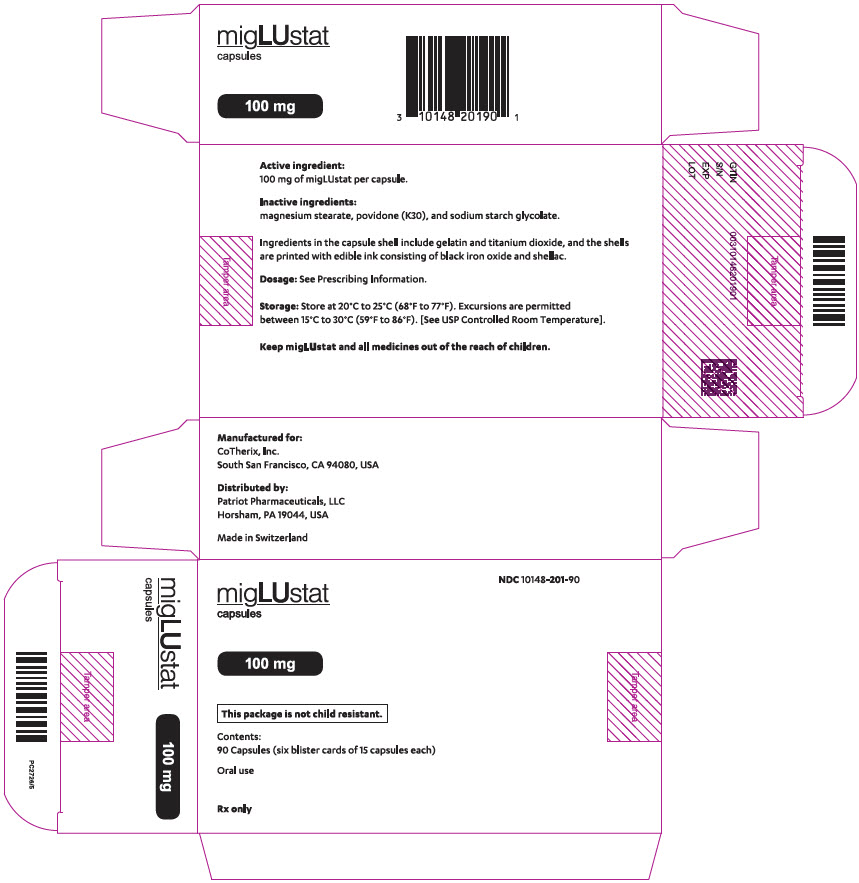
Made in Switzerland
Distributed by:
Patriot Pharmaceuticals, LLC
Horsham, PA 19044
Manufactured for:
CoTherix, Inc.
South San Francisco, CA 94080
©2017 CoTherix, Inc.
Issued: November 2017
ACT20171108