The coadministration of sitagliptin and metformin immediate-release has been studied in patients with type 2 diabetes inadequately controlled on diet and exercise and in combination with other antidiabetic medications.
There have been no clinical efficacy or safety studies conducted with sitagliptin and metformin hydrochloride extended-release tablets to characterize its effect on hemoglobin A1c (A1C) reduction. Bioequivalence of sitagliptin and metformin hydrochloride extended-release tablets with coadministered sitagliptin and extended-release metformin tablets has been demonstrated for all tablet strengths [see Clinical Pharmacology (12.3)].
Metformin Extended-Release Compared to Metformin Immediate-Release in Patients with Type 2 Diabetes
In a multicenter, randomized, double-blind, active-controlled, dose-ranging, parallel group trial extended-release metformin hydrochloride 1500 mg once daily, extended-release metformin hydrochloride 1500 mg per day in divided doses (500 mg in the morning and 1000 mg in the evening), and extended-release metformin hydrochloride 2000 mg once daily were compared to immediate-release metformin hydrochloride 1500 mg per day in divided doses (500 mg in the morning and 1000 mg in the evening). This trial enrolled patients (n = 338) who were newly diagnosed with diabetes, patients treated only with diet and exercise, patients treated with a single anti-diabetic medication (sulfonylureas, alpha-glucosidase inhibitors, thiazolidinediones, or meglitinides), and patients (n = 368) receiving metformin hydrochloride up to 1500 mg/day plus a sulfonylurea at a dose equal to or less than one-half the maximum dose. Patients who were enrolled on monotherapy or combination antidiabetic therapy underwent a 6-week washout. Patients randomized to extended-release metformin hydrochloride began titration from 1000 mg/day up to their assigned treatment dose over 3 weeks. Patients randomized to immediate-release metformin hydrochloride initiated 500 mg twice daily for 1 week followed by 500 mg with breakfast and 1000 mg with dinner for the second week. The 3-week treatment period was followed by an additional 21-week period at the randomized dose. For HbA1c and fasting plasma glucose, each of the extended-release metformin regimens was at least as effective as immediate-release metformin. Additionally, once daily dosing of extended-release metformin was as effective as twice daily dosing of the immediate-release metformin formulation.
Sitagliptin and Metformin Immediate-Release Coadministration in Patients with Type 2 Diabetes Inadequately Controlled on Diet and Exercise
A total of 1091 patients with type 2 diabetes and inadequate glycemic control on diet and exercise participated in a 24-week, randomized, double-blind, placebo-controlled factorial study designed to assess the efficacy of sitagliptin and metformin immediate-release coadministration. Patients on an antihyperglycemic agent (N=541) underwent a diet, exercise, and drug washout period of up to 12 weeks duration. After the washout period, patients with inadequate glycemic control (A1C 7.5% to 11%) were randomized after completing a 2-week single-blind placebo run-in period. Patients not on antihyperglycemic agents at study entry (N=550) with inadequate glycemic control (A1C 7.5% to 11%) immediately entered the 2-week single-blind placebo run-in period and then were randomized. Approximately equal numbers of patients were randomized to receive placebo, 100 mg of sitagliptin once daily, 500 mg or 1000 mg of metformin hydrochloride immediate-release twice daily, or 50 mg of sitagliptin twice daily in combination with 500 mg or 1000 mg of metformin hydrochloride immediate-release twice daily. Patients who failed to meet specific glycemic goals during the study were treated with glyburide (glibenclamide) rescue.
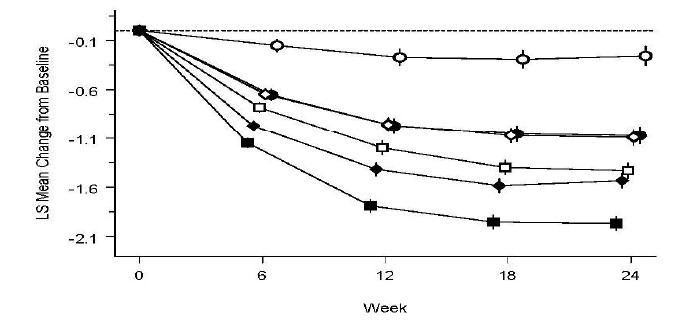
Sitagliptin and metformin immediate-release coadministration provided significant improvements in A1C, FPG, and 2-hour PPG compared to placebo, to metformin immediate-release alone, and to sitagliptin alone (Table 9, Figure 1). For patients not on an antihyperglycemic agent at study entry, mean reductions from baseline in A1C were: sitagliptin 100 mg once daily, -1.1%; metformin hydrochloride immediate-release 500 mg bid, -1.1%; metformin hydrochloride immediate-release 1000 mg bid, -1.2%; sitagliptin 50 mg bid with metformin hydrochloride immediate-release 500 mg bid, -1.6%; sitagliptin 50 mg bid with metformin hydrochloride immediate-release 1000 mg bid, -1.9%; and for patients receiving placebo, -0.2%. Lipid effects were generally neutral. The decrease in body weight in the groups given sitagliptin in combination with metformin immediate-release was similar to that in the groups given metformin alone or placebo.
Table 9: Glycemic Parameters at Final Visit (24-Week Study) for Sitagliptin and Metformin Immediate-Release, Alone and in Combination in Patients with Type 2 Diabetes Inadequately Controlled on Diet and Exercise*
| Placebo | Sitagliptin 100 mg once daily | Metformin hydrochloride Immediate- Release 500 mg twice daily | Metformin hydrochloride Immediate- Release 1000 mg twice daily | Sitagliptin 50 mg bid + Metformin hydrochloride Immediate- Release 500 mg twice daily | Sitagliptin 50 mg bid + Metformin hydrochloride Immediate- Release 1000 mg twice daily |
A1C (%) | N = 165 | N = 175 | N = 178 | N = 177 | N = 183 | N = 178 |
Baseline (mean) | 8.7 | 8.9 | 8.9 | 8.7 | 8.8 | 8.8 |
Change from baseline (adjusted mean†) | 0.2 | -0.7 | -0.8 | -1.1 | -1.4 | -1.9 |
Difference from placebo (adjusted mean†) (95% CI) | | -0.8‡ (-1.1, -0.6) | -1.0‡ (-1.2, -0.8) | -1.3‡ (-1.5, -1.1) | -1.6‡ (-1.8, -1.3) | -2.1‡ (-2.3, -1.8) |
Patients (%) achieving A1C <7% | 15 (9%) | 35 (20%) | 41 (23%) | 68 (38%) | 79 (43%) | 118 (66%) |
% Patients receiving rescue medication | 32 | 21 | 17 | 12 | 8 | 2 |
FPG (mg/dL) | N = 169 | N = 178 | N = 179 | N = 179 | N = 183 | N = 180 |
Baseline (mean) | 196 | 201 | 205 | 197 | 204 | 197 |
Change from baseline (adjusted mean†) | 6 | -17 | -27 | -29 | -47 | -64 |
Difference from placebo (adjusted mean†) (95% CI) | | -23‡ (-33, -14) | -33‡ (-43, -24) | -35‡ (-45, -26) | -53‡ (-62, -43) | -70‡ (-79, -60) |
2-hour PPG (mg/dL) | N = 129 | N = 136 | N = 141 | N = 138 | N = 147 | N = 152 |
Baseline (mean) | 277 | 285 | 293 | 283 | 292 | 287 |
Change from baseline (adjusted mean†) | 0 | -52 | -53 | -78 | -93 | -117 |
Difference from placebo (adjusted mean†) (95% CI) | | -52‡ (-67, -37) | -54‡ (-69, -39) | -78‡ (-93, -63) | -93‡ (-107, -78) | -117‡ (-131, -102) |
* Intent-to-treat population using last observation on study prior to glyburide (glibenclamide) rescue therapy.
† Least squares means adjusted for prior antihyperglycemic therapy status and baseline value.
‡ p<0.001 compared to placebo.
Figure 1: Mean Change from Baseline for A1C (%) over 24 Weeks with Sitagliptin and Metformin Immediate-Release, Alone and in Combination in Patients with Type 2 Diabetes Inadequately Controlled with Diet and Exercise*
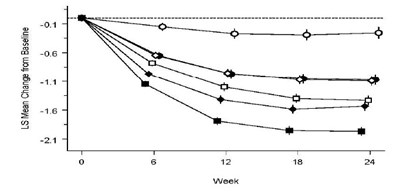
Figure1 (Sitagliptin And Metformin 3)
○ | Placebo (N=89) |
● | Sitagliptin 100 mg once daily (N=113) |
◊ | Metformin Immediate-Release 500 mg twice daily (N=128) |
□ | Metformin Immediate-Release 1000 mg twice daily (N=139) |
♦ | Sitagliptin 50 mg twice daily + Metformin Immediate-Release 500 mg twice daily (N=150) |
■ | Sitagliptin 50 mg twice daily + Metformin Immediate-Release 1000 mg twice daily (N=156) |
* The Completers Population: least squares means adjusted for prior antihyperglycemic therapy and baseline value.
Initial combination therapy or maintenance of combination therapy should be individualized and are left to the discretion of the health care provider.
Sitagliptin Add-on Therapy in Patients with Type 2 Diabetes Inadequately Controlled on Metformin Immediate-Release Alone
A total of 701 patients with type 2 diabetes participated in a 24-week, randomized, double-blind, placebo-controlled study designed to assess the efficacy of sitagliptin in combination with metformin immediate-release. Patients already on metformin hydrochloride immediate-release (N=431) at a dose of at least 1500 mg per day were randomized after completing a 2-week, single-blind placebo run-in period. Patients on metformin immediate-release and another antihyperglycemic agent (N=229) and patients not on any antihyperglycemic agents (off therapy for at least 8 weeks, N=41) were randomized after a run-in period of approximately 10 weeks on metformin hydrochloride immediate-release (at a dose of at least 1500 mg per day) in monotherapy. Patients were randomized to the addition of either 100 mg of sitagliptin or placebo, administered once daily. Patients who failed to meet specific glycemic goals during the studies were treated with pioglitazone rescue.
In combination with metformin immediate-release, sitagliptin provided significant improvements in A1C, FPG, and 2-hour PPG compared to placebo with metformin immediate-release (Table 10). Rescue glycemic therapy was used in 5% of patients treated with sitagliptin 100 mg and 14% of patients treated with placebo. A similar decrease in body weight was observed for both treatment groups.
Table 10: Glycemic Parameters at Final Visit (24-Week Study) of Sitagliptin as Add-on Combination Therapy with Metformin Immediate-Release*
| Sitagliptin 100 mg once daily + Metformin Immediate-Release | Placebo + Metformin Immediate-Release |
A1C (%) | N = 453 | N = 224 |
Baseline (mean) | 8.0 | 8.0 |
Change from baseline (adjusted mean†) | -0.7 | -0.0 |
Difference from placebo + metformin immediate-release (adjusted mean†) (95% CI) | -0.7‡ (-0.8, -0.5) | |
Patients (%) achieving A1C <7% | 213 (47%) | 41 (18%) |
FPG (mg/dL) | N = 454 | N = 226 |
Baseline (mean) | 170 | 174 |
Change from baseline (adjusted mean†) | -17 | 9 |
Difference from placebo + metformin immediate-release (adjusted mean†) (95% CI) | -25‡ (-31, -20) | |
2-hour PPG (mg/dL) | N = 387 | N = 182 |
Baseline (mean) | 275 | 272 |
Change from baseline (adjusted mean†) | -62 | -11 |
Difference from placebo + metformin immediate-release (adjusted mean†) (95% CI) | -51‡ (-61, -41) | |
* Intent-to-treat population using last observation on study prior to pioglitazone rescue therapy.
† Least squares means adjusted for prior antihyperglycemic therapy and baseline value.
‡ p<0.001 compared to placebo + metformin.
Sitagliptin Add-on Therapy in Patients with Type 2 Diabetes Inadequately Controlled on the Combination of Metformin Immediate-Release and Glimepiride
A total of 441 patients with type 2 diabetes participated in a 24-week, randomized, double-blind, placebo-controlled study designed to assess the efficacy of sitagliptin in combination with glimepiride, with or without metformin immediate-release. Patients entered a run-in treatment period on glimepiride (≥4 mg per day) alone or glimepiride in combination with metformin hydrochloride immediate-release (≥1500 mg per day). After a dose-titration and dose-stable run-in period of up to 16 weeks and a 2-week placebo run-in period, patients with inadequate glycemic control (A1C 7.5% to 10.5%) were randomized to the addition of either 100 mg of sitagliptin or placebo, administered once daily. Patients who failed to meet specific glycemic goals during the studies were treated with pioglitazone rescue.
Patients receiving sitagliptin with metformin immediate-release and glimepiride had significant improvements in A1C and FPG compared to patients receiving placebo with metformin immediate-release and glimepiride (Table 11), with mean reductions from baseline relative to placebo in A1C of -0.9% and in FPG of -21 mg/dL. Rescue therapy was used in 8% of patients treated with add-on sitagliptin 100 mg and 29% of patients treated with add-on placebo. The patients treated with add-on sitagliptin had a mean increase in body weight of 1.1 kg vs. add-on placebo (+0.4 kg vs. -0.7 kg). In addition, add-on sitagliptin resulted in an increased rate of hypoglycemia compared to add-on placebo [see Warnings and Precautions (5.6) and Adverse Reactions (6.1)].
Table 11: Glycemic Parameters at Final Visit (24-Week Study) for Sitagliptin in Combination with Metformin Immediate-Release and Glimepiride*
| Sitagliptin 100 mg + Metformin Immediate-Release and Glimepiride | Placebo + Metformin Immediate-Release and Glimepiride |
A1C (%) | N = 115 | N = 105 |
Baseline (mean) | 8.3 | 8.3 |
Change from baseline (adjusted mean†) | -0.6 | 0.3 |
Difference from placebo (adjusted mean†) (95% CI) | -0.9‡ (-1.1, -0.7) | |
Patients (%) achieving A1C <7% | 26 (23%) | 1 (1%) |
FPG (mg/dL) | N = 115 | N = 109 |
Baseline (mean) | 179 | 179 |
Change from baseline (adjusted mean†) | -8 | 13 |
Difference from placebo (adjusted mean†) (95% CI) | -21‡ (-32, -10) | |
* Intent-to-treat population using last observation on study prior to pioglitazone rescue therapy.
† Least squares means adjusted for prior antihyperglycemic therapy status and baseline value.
‡ p<0.001 compared to placebo.
Sitagliptin Add-on Therapy in Patients with Type 2 Diabetes Inadequately Controlled on the Combination of Metformin Immediate-Release and Rosiglitazone
A total of 278 patients with type 2 diabetes participated in a 54-week, randomized, double-blind, placebo-controlled study designed to assess the efficacy of sitagliptin in combination with metformin immediate-release and rosiglitazone. Patients on dual therapy with metformin hydrochloride immediate-release ≥1500 mg/day and rosiglitazone ≥4 mg/day or with metformin hydrochloride immediate-release ≥1500 mg/day and pioglitazone ≥30 mg/day (switched to rosiglitazone ≥4 mg/day) entered a dose-stable run-in period of 6 weeks. Patients on other dual therapy were switched to metformin hydrochloride immediate-release ≥1500 mg/day and rosiglitazone ≥4 mg/day in a dose titration/stabilization run-in period of up to 20 weeks in duration. After the run-in period, patients with inadequate glycemic control (A1C 7.5% to 11%) were randomized 2:1 to the addition of either 100 mg of sitagliptin or placebo, administered once daily. Patients who failed to meet specific glycemic goals during the studies were treated with glipizide (or other sulfonylurea) rescue. The primary time point for evaluation of glycemic parameters was Week 18.
In combination with metformin immediate-release and rosiglitazone, sitagliptin provided significant improvements in A1C, FPG, and 2-hour PPG compared to placebo with metformin immediate-release and rosiglitazone (Table 12) at Week 18. At Week 54, mean reduction in A1C was -1.0% for patients treated with sitagliptin and -0.3% for patients treated with placebo in an analysis based on the intent-to-treat population. Rescue therapy was used in 18% of patients treated with sitagliptin 100 mg and 40% of patients treated with placebo. There was no significant difference between sitagliptin and placebo in body weight change.
Table 12: Glycemic Parameters at Week 18 for Sitagliptin in Add-on Combination Therapy with Metformin Immediate-Release and Rosiglitazone*
| Week 18 |
| Sitagliptin 100 mg + Metformin Immediate-Release + Rosiglitazone | Placebo + Metformin Immediate-Release + Rosiglitazone |
A1C (%) | N = 176 | N = 93 |
Baseline (mean) | 8.8 | 8.7 |
Change from baseline (adjusted mean†) | -1.0 | -0.4 |
Difference from placebo + rosiglitazone + metformin immediate-release (adjusted mean†) (95% CI) | -0.7‡ (-0.9, -0.4) | |
Patients (%) achieving A1C <7% | 39 (22%) | 9 (10%) |
FPG (mg/dL) | N = 179 | N = 94 |
Baseline (mean) | 181 | 182 |
Change from baseline (adjusted mean†) | -30 | -11 |
Difference from placebo + rosiglitazone + metformin immediate-release (adjusted mean†) (95% CI) | -18‡ (-26, -10) | |
2-hour PPG (mg/dL) | N = 152 | N = 80 |
Baseline (mean) | 256 | 248 |
Change from baseline (adjusted mean†) | -59 | -21 |
Difference from placebo + rosiglitazone + metformin immediate-release (adjusted mean†) (95% CI) | -39‡ (-51, -26) | |
* Intent-to-treat population using last observation on study prior to glipizide (or other sulfonylurea) rescue therapy.
† Least squares means adjusted for prior antihyperglycemic therapy status and baseline value.
‡ p<0.001 compared to placebo + metformin + rosiglitazone.
Sitagliptin Add-on Therapy in Patients with Type 2 Diabetes Inadequately Controlled on the Combination of Metformin Immediate-Release and Insulin
A total of 641 patients with type 2 diabetes participated in a 24-week, randomized, double-blind, placebo-controlled study designed to assess the efficacy of sitagliptin as add-on to insulin therapy. Approximately 75% of patients were also taking metformin immediate-release. Patients entered a 2-week, single-blind run-in treatment period on pre-mixed, long-acting, or intermediate-acting insulin, with or without metformin hydrochloride immediate-release (≥1500 mg per day). Patients using short-acting insulins were excluded unless the short-acting insulin was administered as part of a pre-mixed insulin. After the run-in period, patients with inadequate glycemic control (A1C 7.5% to 11%) were randomized to the addition of either 100 mg of sitagliptin (N=229) or placebo (N=233), administered once daily. Patients were on a stable dose of insulin prior to enrollment with no changes in insulin dose permitted during the run-in period. Patients who failed to meet specific glycemic goals during the double-blind treatment period were to have uptitration of the background insulin dose as rescue therapy.
Among patients also receiving metformin immediate-release, the median daily insulin (pre-mixed, intermediate or long acting) dose at baseline was 40 units in the sitagliptin-treated patients and 42 units in the placebo-treated patients. The median change from baseline in daily dose of insulin was zero for both groups at the end of the study. Patients receiving sitagliptin with metformin immediate-release and insulin had significant improvements in A1C, FPG and 2-hour PPG compared to patients receiving placebo with metformin immediate-release and insulin (Table 13). The adjusted mean change from baseline in body weight was -0.3 kg in patients receiving sitagliptin with metformin immediate-release and insulin and -0.2 kg in patients receiving placebo with metformin immediate-release and insulin. There was an increased rate of hypoglycemia in patients treated with sitagliptin [see Warnings and Precautions (5.6) and Adverse Reactions (6.1)].
Table 13: Glycemic Parameters at Final Visit (24-Week Study) for Sitagliptin as Add-on Combination Therapy with Metformin Immediate-Release and Insulin*
| Sitagliptin 100 mg + Metformin Immediate-Release + Insulin | Placebo + Metformin Immediate- Release + Insulin |
A1C (%) | N = 223 | N = 229 |
Baseline (mean) | 8.7 | 8.6 |
Change from baseline (adjusted mean†,‡) | -0.7 | -0.1 |
Difference from placebo (adjusted mean†) (95% CI) | -0.5§ (-0.7, -0.4) | |
Patients (%) achieving A1C <7% | 32 (14%) | 12 (5%) |
FPG (mg/dL) | N = 225 | N = 229 |
Baseline (mean) | 173 | 176 |
Change from baseline (adjusted mean†) | -22 | -4 |
Difference from placebo (adjusted mean†) (95% CI) | -18§ (-28, -8.4) | |
2-hour PPG (mg/dL) | N = 182 | N = 189 |
Baseline (mean) | 281 | 281 |
Change from baseline (adjusted mean†) | -39 | 1 |
Difference from placebo (adjusted mean†) (95% CI) | -40§ (-53, -28) | |
* Intent-to-treat population using last observation on study prior to rescue therapy.
† Least squares means adjusted for insulin use at the screening visit, type of insulin used at the screening visit (pre-mixed vs. non pre-mixed [intermediate- or long-acting]), and baseline value.
‡ Treatment by insulin stratum interaction was not significant (p>0.10).
§ p<0.001 compared to placebo.
Maintenance of Sitagliptin During Initiation and Titration of Insulin Glargine
A total of 746 patients with type 2 diabetes (mean baseline HbA1C 8.8%, disease duration 10.8 years) participated in a 30-week, randomized, double-blind, placebo-controlled study to assess the efficacy and
safety of continuing sitagliptin during the initiation and uptitration of insulin glargine. Patients who were on a stable dose of metformin hydrochloride (≥1500 mg/day) in combination with a DPP-4 inhibitor and/or sulfonylurea but with inadequate glycemic control (A1C 7.5% to 11%) were enrolled in the study. Those on metformin and sitagliptin (100 mg/day) directly entered the double-blind treatment period; those on another DPP-4 inhibitor and/or on a sulfonylurea entered a 4 to 8 week run-in period in which they were maintained on metformin and switched to sitagliptin (100 mg); other DPP-4 inhibitors and sulfonylureas were discontinued. At randomization patients were randomized either to continue sitagliptin or to discontinue sitagliptin and switch to a matching placebo. On the day of randomization, insulin glargine was initiated at a dose of 10 units subcutaneously in the evening. Patients were instructed to uptitrate their insulin dose in the evening based on fasting blood glucose measurements to achieve a target of 72 to 100 mg/dL.
At 30 weeks, the mean reduction in A1C was greater in the sitagliptin group than in the placebo group (Table 14). At the end of the trial, 27.3% of patients in the sitagliptin group and 27.3% in the placebo group had a fasting plasma glucose (FPG) in the target range; there was no significant difference in insulin dose between arms.
Table 14: Change from Baseline in A1C and FPG at Week 30 in the Maintenance of Sitagliptin During Initiation and Titration of Insulin Glargine Study
| Sitagliptin 100 mg + Metformin + Insulin Glargine | Placebo +Metformin + Insulin Glargine |
A1C (%) | N = 373† | N = 370† |
Baseline (mean) | 8.8 | 8.8 |
Week 30 (mean) | 6.9 | 7.3 |
Change from baseline (adjusted mean)* | -1.9 | -1.4 |
Difference from placebo (adjusted mean) (95% CI)* | -0.4 (-0.6, -0.3)‡ | |
Patients (%) with A1C <7% | 202 (54.2%) | 131 (35.4%) |
FPG (mg/dL) | N = 373† | N = 370† |
Baseline (mean) | 199 | 201 |
Week 30 (mean) | 118 | 123 |
Change from baseline (adjusted mean)* | -81 | -76 |
* Analysis of Covariance including all post-baseline data regardless of rescue or treatment discontinuation. Model estimates calculated using multiple imputation to model washout of the treatment effect using placebo data for all subjects having missing Week 30 data.
† N is the number of randomized and treated patients.
‡ p<0.001 compared to placebo.
Sitagliptin Add-on Therapy vs. Glipizide Add-on Therapy in Patients with Type 2 Diabetes Inadequately Controlled on Metformin Immediate-Release
The efficacy of sitagliptin was evaluated in a 52-week, double-blind, glipizide-controlled noninferiority trial in patients with type 2 diabetes. Patients not on treatment or on other antihyperglycemic agents entered a run-in treatment period of up to 12 weeks duration with metformin hydrochloride immediate-release monotherapy (dose of ≥1500 mg per day) which included washout of medications other than metformin immediate-release, if applicable. After the run-in period, those with inadequate glycemic control (A1C 6.5% to 10%) were randomized 1:1 to the addition of sitagliptin 100 mg once daily or glipizide for 52 weeks. Patients receiving glipizide were given an initial dosage of 5 mg/day and then electively titrated over the next 18 weeks to a maximum dosage of 20 mg/day as needed to optimize glycemic control. Thereafter, the glipizide dose was to be kept constant, except for down-titration to prevent hypoglycemia. The mean dose of glipizide after the titration period was 10 mg.
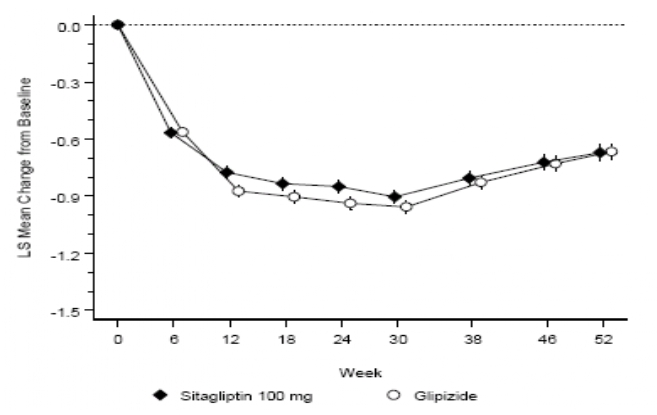
After 52 weeks, sitagliptin and glipizide had similar mean reductions from baseline in A1C in the intent-to-treat analysis (Table 15). These results were consistent with the per protocol analysis (Figure 2). A conclusion in favor of the non-inferiority of sitagliptin to glipizide may be limited to patients with baseline A1C comparable to those included in the study (over 70% of patients had baseline A1C <8% and over 90% had A1C <9%).
Table 15: Glycemic Parameters in a 52-Week Study Comparing Sitagliptin to Glipizide as Add-On Therapy in Patients Inadequately Controlled on Metformin Immediate-Release (Intent-to-Treat Population) *
| Sitagliptin 100 mg + Metformin Immediate-Release | Glipizide + Metformin Immediate- Release |
A1C (%) | N = 576 | N = 559 |
Baseline (mean) | 7.7 | 7.6 |
Change from baseline (adjusted mean†) | -0.5 | -0.6 |
FPG (mg/dL) | N = 583 | N = 568 |
Baseline (mean) | 166 | 164 |
Change from baseline (adjusted mean†) | -8 | -8 |
* The intent-to-treat analysis used the patients' last observation in the study prior to discontinuation.
† Least squares means adjusted for prior antihyperglycemic therapy status and baseline A1C value.
Figure 2: Mean Change from Baseline for A1C (%) Over 52 Weeks in a Study Comparing Sitagliptin to Glipizide as Add-On Therapy in Patients Inadequately Controlled on Metformin Immediate-Release (Per Protocol Population)*
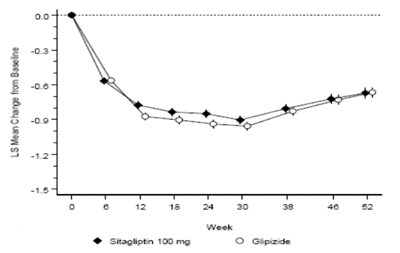
Figure2 (Sitagliptin And Metformin 4)
* The per protocol population (mean baseline A1C of 7.5%) included patients without major protocol violations who had observations at baseline and at Week 52.
The incidence of hypoglycemia in the sitagliptin group (4.9%) was significantly (p<0.001) lower than that in the glipizide group (32.0%). Patients treated with sitagliptin exhibited a significant mean decrease from baseline in body weight compared to a significant weight gain in patients administered glipizide (-1.5 kg vs. +1.1 kg).