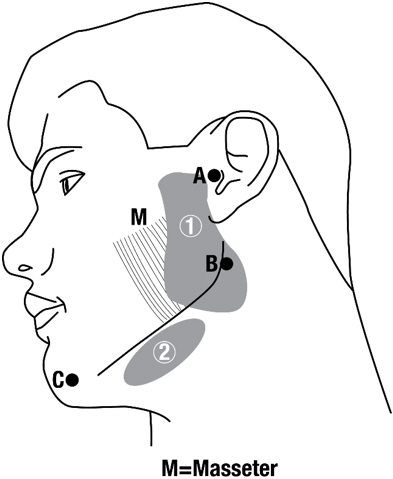
The recommended dosage of MYOBLOC for chronic sialorrhea is 1,500 Units to 3,500 Units, divided among the parotid and submandibular glands (Table 1). Patient response to treatment should be considered when determining subsequent MYOBLOC dosage
[see
Clinical Studies (14.2)]
. The typical duration of effect of each treatment is up to 3 months; however, the effect may vary in individual patients. The frequency of MYOBLOC repeat treatments should be determined by clinical response but should generally be no more frequent than every 12 weeks.
A suitable sterile needle (e.g., 30-gauge, 0.5 inch) should be used for intra-salivary gland administration.
- 1. To inject the parotid gland, bisect the distance between the tip of the tragus (Site A) and the angle of the mandible (Site B). Inject one finger breadth anterior to this site (Injection Site 1).
- 2. To inject the submandibular gland, bisect the distance between the angle of the mandible (Site B) and the tip of the chin (Site C). Inject one finger breadth medial to the inferior surface of the point of bisection (Injection Site 2).
In clinical studies, MYOBLOC was injected using anatomical landmarks to localize the salivary glands, or using ultrasound guidance for gland location. Both methods produced similar reduction in the unstimulated salivary flow rate.
Cervical Dystonia
In the treatment of cervical dystonia, MYOBLOC was studied in both placebo-controlled single treatment studies and open-label repeated treatment studies; most treatment sessions and patients were in the uncontrolled studies. The data described below reflect exposure to MYOBLOC at varying dosages in 570 subjects, including more than 300 patients with 4 or more treatment sessions. Most treatment sessions were at dosages of 12,500 Units or less.
Adverse reactions occurring in at least 5% of patients exposed to MYOBLOC treatment in pooled placebo-controlled clinical trials are shown in Table 2. The mean age of the population in these studies was 55 years, and approximately 66% were female. Most of the patients studied were Caucasian, and all had moderate to severe symptoms of cervical dystonia.
The most common adverse reactions (greater than 5% of MYOBLOC-treated patients at any dosage and at least 5% more common than placebo) in studies of cervical dystonia (Studies 1, 2, and 4) were dry mouth, dysphagia, injection site pain, and headache. Dry mouth and dysphagia were the adverse reactions most frequently resulting in discontinuation of treatment. There was an increased incidence of dysphagia with increased dose in the sternocleidomastoid muscle. The incidence of dry mouth showed some dose-related increase with doses injected into the splenius capitis, trapezius, and sternocleidomastoid muscles.
In the cervical dystonia program, only nine patients without a prior history of tolerating injections of type A botulinum toxin have been studied. Adverse reaction rates have not been adequately evaluated in these patients and may be higher than those described in Table 2.
Table 2: Adverse Reactions in at Least 5% of MYOBLOC-Treated Patients and Greater than Placebo, Following Single Treatment Session in Controlled Cervical Dystonia Studies (Studies 1, 2, and 4)| Adverse Reaction | MYOBLOC 2,500 Units
(N=31)
%
| MYOBLOC 5,000 Units
(N=67)
%
| MYOBLOC 10,000 Units
(N=106)
%
| Placebo
(N=104)
%
|
|---|
| Dry Mouth | 3 | 12 | 34 | 3 |
| Dysphagia | 16 | 10 | 25 | 3 |
| Injection Site Pain | 16 | 12 | 15 | 9 |
| Pain | 6 | 6 | 13 | 10 |
| Headache | 10 | 16 | 11 | 8 |
| Dyspepsia | 3 | 0 | 10 | 5 |
| Flu Syndrome | 6 | 9 | 8 | 4 |
| Arthralgia | 0 | 1 | 7 | 5 |
| Back Pain | 3 | 4 | 7 | 3 |
| Cough Increased | 3 | 6 | 7 | 3 |
| Asthenia | 3 | 0 | 6 | 4 |
| Dizziness | 3 | 3 | 6 | 2 |
In the overall clinical trial experience with MYOBLOC in cervical dystonia (570 patients, including the uncontrolled studies), most cases of dry mouth or dysphagia were reported as mild or moderate in severity. Severe dysphagia was reported by 3% of patients
[see
Warnings and Precautions (5.4)].
Severe dry mouth was reported by 6% of patients. Dysphagia and dry mouth were the most frequent adverse reactions reported as a reason for discontinuation from repeated treatment studies. These adverse reactions led to discontinuation from further treatments with MYOBLOC in some patients even when not reported as severe.
The following additional adverse events were reported in 2% or greater of patients participating in any of the clinical studies in cervical dystonia (by body system):
Body as a Whole: chest pain, chills, hernia, malaise, abscess, cyst, viral infection;
Respiratory: dyspnea, pneumonia;
Nervous System: migraine; anxiety, hyperesthesia, vertigo, vasodilation;
Digestive System: gastrointestinal disorder;
Skin and Appendages: pruritis;
Urogenital System: urinary tract infection, cystitis;
Special Senses: amblyopia, abnormal vision;
Metabolic and Nutritional Disorders: edema;
Hemic and Lymphatic System: ecchymosis.
Chronic Sialorrhea
In the double-blind placebo-controlled studies (Study 1 and Study 2), 166 patients were treated with a single treatment of MYOBLOC (1,500 Units; 2,500 Units; or 3,500 Units) and 75 patients received placebo. The mean age of patients treated with MYOBLOC in these studies was 65 years; 83% of the patients were male; and 95% were White. Four MYOBLOC-treated patients and three patients on placebo discontinued because of an adverse event. One patient discontinued because of dry mouth (3,500 Unit dose). The adverse reactions that occurred in at least 5% of MYOBLOC-treated patients and were more frequent than placebo are shown in Table 3.
Table 3: Adverse Reactions in At Least 5% of MYOBLOC-Treated Patients and Greater than Placebo in Pooled Chronic Sialorrhea Studies (Studies 1 and 2)| Adverse Reaction | MYOBLOC 1,500 Units
(N=14)
Adverse reactions for 1,500 Unit dose were only evaluated in Study 2
%
| MYOBLOC 2,500 Units
(N=75)
%
| MYOBLOC 3,500 Units
(N=77)
%
| Placebo
(N=75)
%
|
|---|
| Dry mouth | 14 | 36 | 39 | 7 |
| Dental caries | 0 | 7 | 5 | 3 |
| Dysphagia | 0 | 9 | 4 | 3 |
Cervical Dystonia
A two-stage assay was used to test for immunogenicity and neutralizing activity induced by treatment with MYOBLOC. In order to account for varying lengths of follow-up, life-table analysis methods were used to estimate the rates of development of immune responses and neutralizing activity. During the repeated treatment studies, 446 subjects were followed with periodic ELISA based evaluations for development of antibody responses against MYOBLOC. Only patients who showed a positive ELISA assay were subsequently tested for the presence of neutralizing activity against MYOBLOC in the mouse neutralization assay (MNA). 12% of patients had positive ELISA assays at baseline. Patients began to develop new ELISA responses after a single treatment session with MYOBLOC. By six months after initiating treatment, estimates for ELISA positive rate were 20%, which continued to rise to 36% at one year and 50% positive ELISA status at 18 months. Serum neutralizing activity was primarily not seen in patients until after 6 months. Estimated rates of development were 10% at one year and 18% at 18 months in the overall group of patients, based on analysis of samples from ELISA positive individuals. The effect of conversion to ELISA or MNA positive status on efficacy was not evaluated in these studies, and the clinical significance of development of antibodies has not been determined.
The data reflect the percentage of patients whose test results were considered positive for antibodies to MYOBLOC in both an
in vitro and
in vivo assay. The results of these antibody tests are highly dependent on the sensitivity and specificity of the assays. Additionally, the observed incidence of antibody positivity in an assay may be influenced by several factors including sample handling, concomitant medications, and underlying disease. For these reasons, comparison of the incidence of antibodies to MYOBLOC with the incidence of antibodies to other products may be misleading.
Chronic Sialorrhea
Immunogenicity potential was not further evaluated for MYOBLOC in the treatment of chronic sialorrhea.
Risk Summary
There are no adequate data on the developmental risks associated with the use of MYOBLOC in pregnant women. No developmental toxicity was observed in pregnant rats administered MYOBLOC by intramuscular injection during gestation and lactation, at doses producing maternal toxicity.
In the U.S. general population, the background risk of major birth defects and miscarriage in clinically recognized pregnancies is 2% to 4% and 15% to 20%, respectively. The background risk of major birth defects and miscarriage for the indicated population is unknown.
Data
Animal Data
When MYOBLOC was administered by intramuscular injection to pregnant rats (0, 300, 1000, or 3000 Units/kg/day) or rabbits (0, 0.03, 0.1, 0.3, or 1.0 Units/kg/day) throughout gestation, no adverse effects on embryofetal development were observed. The highest dose tested in rat, which was associated with maternal toxicity, was 36 times the maximum recommended human dose (MRHD) for cervical dystonia (5000 Units) on a body weight (Units/kg) basis. The highest dose tested in rabbit was substantially less than the MRHD for cervical dystonia on a Units/kg basis; maternal toxicity was observed at all but the lowest dose tested.
Risk Summary
There are no data on the presence of MYOBLOC in human milk, the effects on the breastfed infant, or the effects on milk production. The developmental and health benefits of breastfeeding should be considered along with the mother's clinical need for MYOBLOC and any potential adverse effects on the breastfed infant from MYOBLOC or from the underlying maternal condition.
Cervical Dystonia
In the controlled studies for MYOBLOC in patients with cervical dystonia, 152 (75%) were under the age of 65, and 52 (26%) were 65 years of age or older
[see
Clinical Studies (14.1)]
. For these age groups, the most frequently reported adverse reactions occurred at similar rates in both age groups. Efficacy results did not suggest any large differences between these age groups.
Very few patients age 75 or older were enrolled; therefore, no conclusions regarding the safety and efficacy of MYOBLOC within this age group can be determined.
Chronic Sialorrhea
Of the 166 MYOBLOC-treated patients in the placebo-controlled studies for treatment of chronic sialorrhea
[see
Clinical Studies (14.2)]
, 105 (63%) were 65 years of age or older, and 43 (26%) were 75 years of age or older. No overall differences in safety or effectiveness were observed between patients over 65 years of age and younger patients, but greater sensitivity of some older patients cannot be ruled out.
Carcinogenesis
No long-term carcinogenicity studies in animals have been conducted.
Mutagenesis
No genetic toxicology studies have been conducted.
Impairment of Fertility
Intramuscular administration of MYOBLOC (0, 300, 1000, or 3000 Units/kg/day) to male and female rats prior to and throughout the mating period and continuing in females to gestation day 6 resulted in decreases in implantation sites and viable fetuses at the high dose of 3000 Units/kg/day, which was associated with maternal toxicity. The no-effect dose for reproductive toxicity (1000 Units/kg/day) is 12 times the maximum recommended human dose for cervical dystonia (5000 Units) on a body weight (Units/kg) basis.
Study 1
Study 1 (NCT01994109) was a multicenter, randomized, double-blind, placebo-controlled study of a single treatment of chronic sialorrhea (with 13-week follow-up), followed by an open-label treatment period. 187 adult patients with chronic, troublesome sialorrhea for at least 3 months were randomized to receive treatment with MYOBLOC 2,500 Units, MYOBLOC 3,500 Units, or placebo. Patients had chronic sialorrhea associated with Parkinson's disease (n=122), amyotrophic lateral sclerosis(ALS) (n=12), stroke (n=13), and other causes (n=40). Patients with a history of aspiration or severe dysphagia in the last 6 months and ALS patients with a forced vital capacity of less than 20% of predicted were excluded from the study. A single treatment was administered, consisting of bilateral injections of MYOBLOC into the parotid (1,000 Units or 1,500 Units per gland) and submandibular (250 Units per gland) salivary glands or volume matched placebo. A total of 114 patients received 4 consecutive treatments with 3,500 Units of MYOBLOC every 11 to 15 weeks.
The co-primary efficacy endpoints for Study 1 were the change from baseline in Unstimulated Salivary Flow Rate (USFR) and the Clinical Global Impression of Change (CGI-C) assessed 4 weeks after treatment in the double-blind part of the study. The CGI-C is a seven-point Likert scale with scores ranging from "1=very much improved" to "7=very much worse". The change from baseline (i.e., decrease) in USFR at Week 4 was significantly greater for patients treated with MYOBLOC than in patients on placebo (Table 6). Similarly, CGI-C scores at Week 4 were significantly lower (i.e., better) in patients treated with MYOBLOC than in patients on placebo (Table 7). Chronic sialorrhea was 'much improved' or 'very much improved', according to CGI-C scores at Week 4 post injection, in patients treated with MYOBLOC 2,500 Units (60%) and MYOBLOC 3,500 Units (53%) than in patients on placebo (12%).
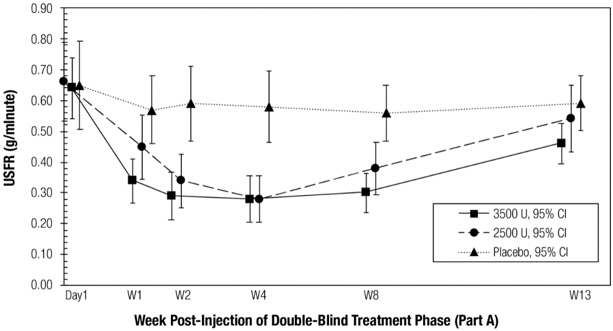
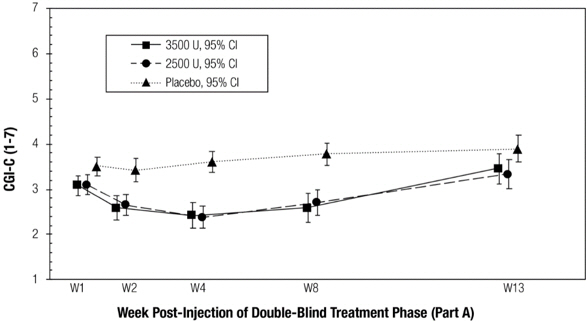
Figure 2 and Figure 3 show change in the USFR and CGI-C, respectively over the 13-week double-blind part of Study 1. The change from baseline to Week 4 on the USFR and the CGI-C was similar for MYOBLOC 2,500 Units and 3,500 Units, but there was a trend for more prolonged effect in patients treated with MYOBLOC 3,500 Units (Figure 2). CGI-C scores over the double-blind period were similar for both dose groups (Figure 3).
Table 6: Mean USFR Change from Baseline (g/min) at Week 4 in Study 1| Visit | MYOBLOC 2,500 Units
(N=63)
| MYOBLOC 3,500 Units
(N=64)
| Placebo
(N=57)
|
|---|
| Week 4 | -0.37
| -0.36
| -0.07 |
Table 7: CGI-C Score at Week 4 in Study 1| Visit | MYOBLOC 2,500 Units
(N=63)
| MYOBLOC 3,500 Units
(N=64)
| Placebo
(N=57)
|
|---|
| Week 4 | 2.38
| 2.45
| 3.59 |
Figure 2: Mean Unstimulated Salivary Flow Rate over Time in Study 1
Figure 3: Mean Clinical Global Impression of Change Score over Time in Study 1
Study 2
Study 2 (NCT00515437) was a multicenter, double-blind, placebo-controlled, sequential dose-escalation study of MYOBLOC 1,500 Units; 2,500 units; or 3,500 Units versus matching placebo for the treatment of troublesome chronic sialorrhea in patients with Parkinson's disease. Patients were randomized to receive a single treatment with MYOBLOC 1,500 Units (n=14); MYOBLOC 2,500 Units (n=12); or MYOBLOC 3,500 Units (n=13). Each group also included 5 patients who received placebo (n=15). Patients were followed for up to 20 weeks after injection. The mean age of patients in the study was 71 years. In the study, 89% of patients were male, and 96% White.
The change from baseline in the unstimulated salivary flow rate (USFR) and the Clinical Global Impression of Change (CGI-C) was assessed 4 weeks after treatment. There was a significant reduction in the USFR for all three dosage groups of MYOBLOC, compared with patients on placebo (Table 8). Similarly, the CGI-C scores were significantly lower in all three MYOBLOC dosage groups than in patients on placebo (Table 9). The mean change from baseline to Week 4 on the USFR was similar in all three MYOBLOC dosage groups.
Table 8: Mean USFR Change from Baseline (g/min) at Week 4 in Study 2| Visit | MYOBLOC 1,500 Units
(N=14)
| MYOBLOC 2,500 Units
(N=12)
| MYOBLOC 3,500 Units
(N=13)
| Placebo
(N=14)
|
|---|
| Week 4 | -0.44
| -0.38
| -0.30
Nominal p-value < 0.001 | 0.01 |
Table 9: CGI-C Score at Week 4 in Study 2| Visit | MYOBLOC 1,500 Units
(N=14)
| MYOBLOC 2,500 Units
(N=12)
| MYOBLOC 3,500 Units
(N=13)
| Placebo
(N= 14)
|
|---|
| Week 4 | 2.14
| 2.00
| 1.62
| 3.93 |
Swallowing, Speaking, or Breathing Difficulties or Other Unusual Symptoms
Advise patients to inform their healthcare provider if they develop any unusual symptoms, including difficulty with swallowing, speaking or breathing, or if any existing symptom worsens
[see
Box Warning and
Warnings and Precautions (5.1,
5.4)].
Inform patients of the risk of aspiration.
Ability to Operate Machinery or Vehicles
Counsel patients that if loss of strength, muscle weakness, or impaired vision occur, they should avoid driving a car or engaging in other potentially hazardous activities.
Manufactured By:
Solstice Neurosciences, LLC, Rockville, MD 20852
U.S. License No. 1718
"MYOBLOC" and the "MYOBLOC Logo" are registered trademarks of Solstice Neurosciences, Inc.
Protected by U.S. Patent No.
6,290,961; 6,632,433; 6,872,397; 6,887,476
© 2019 Solstice Neurosciences, LLC
64183
RA-MYO-V5