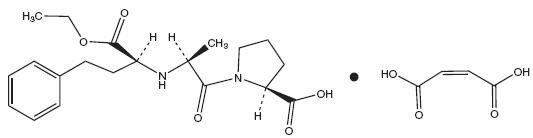
Administration of enalapril maleate to patients with hypertension of severity ranging from mild to severe results in a reduction of both supine and standing blood pressure usually with no orthostatic component. Symptomatic postural hypotension is therefore infrequent, although it might be anticipated in volume-depleted patients (see
WARNINGS).
In most patients studied, after oral administration of a single dose of enalapril, onset of antihypertensive activity was seen at one hour with peak reduction of blood pressure achieved by four to six hours.
At recommended doses, antihypertensive effects have been maintained for at least 24 hours. In some patients the effects may diminish toward the end of the dosing interval (see
DOSAGE AND ADMINISTRATION).
In some patients achievement of optimal blood pressure reduction may require several weeks of therapy.
The antihypertensive effects of enalapril maleate have continued during long term therapy. Abrupt withdrawal of enalapril maleate has not been associated with a rapid increase in blood pressure.
In hemodynamic studies in patients with essential hypertension, blood pressure reduction was accompanied by a reduction in peripheral arterial resistance with an increase in cardiac output and little or no change in heart rate. Following administration of enalapril maleate, there is an increase in renal blood flow; glomerular filtration rate is usually unchanged. The effects appear to be similar in patients with renovascular hypertension.
When given together with thiazide-type diuretics, the blood pressure lowering effects of enalapril maleate are approximately additive.
In a clinical pharmacology study, indomethacin or sulindac was administered to hypertensive patients receiving enalapril maleate. In this study there was no evidence of a blunting of the antihypertensive action of enalapril maleate (see
PRECAUTIONS, Drug Interactions).
Enalapril maleate is indicated for the treatment of hypertension.
Enalapril maleate is effective alone or in combination with other antihypertensive agents, especially thiazide-type diuretics. The blood pressure lowering effects of enalapril maleate and thiazides are approximately additive.
Adverse experiences occurring in greater than one percent of patients with hypertension treated with enalapril maleate in controlled clinical trials are shown below. In patients treated with enalapril maleate, the maximum duration of therapy was three years; in placebo treated patients the maximum duration of therapy was 12 weeks.
| Enalapril
Maleate
(n = 2314)
Incidence
(discontinuation)
| Placebo
(n = 230)
Incidence
|
|---|
| Body As A Whole | | |
| Fatigue | 3.0 (<0.1) | 2.6 |
| Orthostatic Effects | 1.2 (<0.1) | 0.0 |
| Asthenia | 1.1 (0.1) | 0.9 |
| Digestive | | |
| Diarrhea | 1.4 (<0.1) | 1.7 |
| Nausea | 1.4 (0.2) | 1.7 |
| Nervous/Psychiatric | | |
| Headache | 5.2 (0.3) | 9.1 |
| Dizziness | 4.3 (0.4) | 4.3 |
| Respiratory | | |
| Cough | 1.3 (0.1) | 0.9 |
| Skin | | |
| Rash | 1.4 (0.4) | 0.4 |
In patients who are currently being treated with a diuretic, symptomatic hypotension occasionally may occur following the initial dose of enalapril maleate. The diuretic should, if possible, be discontinued for two to three days before beginning therapy with enalapril maleate to reduce the likelihood of hypotension (see
WARNINGS). If the patient's blood pressure is not controlled with enalapril maleate alone, diuretic therapy may be resumed.
If the diuretic cannot be discontinued an initial dose of 2.5 mg should be used under medical supervision for at least two hours and until blood pressure has stabilized for at least an additional hour (see
WARNINGS and
PRECAUTIONS, Drug Interactions).
The recommended initial dose in patients not on diuretics is 5 mg once a day. Dosage should be adjusted according to blood pressure response. The usual dosage range is 10 to 40 mg per day administered in a single dose or two divided doses. In some patients treated once daily, the antihypertensive effect may diminish toward the end of the dosing interval. In such patients, an increase in dosage or twice daily administration should be considered. If blood pressure is not controlled with enalapril maleate alone, a diuretic may be added. Concomitant administration of enalapril maleate with potassium supplements, potassium salt substitutes, or potassium-sparing diuretics may lead to increases of serum potassium (see
PRECAUTIONS).