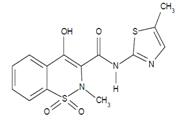
Other
Cardiovascular Risk
- Nonsteroidal anti-inflammatory drugs (NSAIDs) may cause an increased risk of serious cardiovascular (CV) thrombotic events, myocardial infarction, and stroke, which can be fatal. This risk may increase with duration of use. Patients with cardiovascular disease or risk factors for cardiovascular disease may be at greater risk [see Warnings and Precautions (5.1)].
- Meloxicam tablets are contraindicated for the treatment of perioperative pain in the setting of coronary artery bypass graft (CABG) surgery [see Contraindications (4.2) and Warnings and Precautions (5.1)].
- NSAIDs cause an increased risk of serious gastrointestinal (GI) adverse reactions including bleeding, ulceration, and perforation of the stomach or intestines, which can be fatal. These events can occur at any time during use and without warning symptoms. Elderly patients are at greater risk for serious gastrointestinal events [see Warnings and Precautions (5.2)].
- 7.5 mg: Light yellow, round flat beveled edged tablet with UL debossed on one side and 7.5 debossed centrally on the other side.
- 15 mg: Light yellow, capsule shaped, biconvex, tablet with UL debossed on one side and 15 debossed centrally on the other side.
- Cardiovascular thrombotic events [ see Boxed Warning and Warnings and Precautions (5.1)]
- Gastrointestinal effects – risk of GI ulceration, bleeding, and perforation [see Boxed Warning and Warnings and Precautions (5.2)]
- Hepatic effects [see Warnings and Precautions (5.3)]
- Hypertension [see Warnings and Precautions (5.4)]
- Congestive heart failure and edema [see Warnings and Precautions (5.5)]
- Renal effects [see Warnings and Precautions (5.6)]
- Anaphylactoid reactions [see Warnings and Precautions (5.7)]
- Adverse skin reactions [see Warnings and Precautions (5.8)]
Gastrointestinal Risk
Tablets:
Because clinical trials are conducted under widely varying conditions, adverse reaction rates observed in the clinical trials of a drug cannot be directly compared to rates in the clinical trials of another drug and may not reflect the rates observed in practice.
The following serious adverse reactions are discussed elsewhere in the labeling:
See also Clinical Pharmacology (12.3).
Please address medical inquiries to 1-866-562-4616
Manufactured by:
UNICHEM LABORATORIES LTD.
Pilerne Ind. Estate,
Pilerne, Bardez, Goa 403511, India
Marketed by:

Company Logo (Meloxicamtablets Figure 02)
Rochelle Park, NJ 07662
13003755
R-03-03/2011
This Medication Guide has been approved by the U.S. Food and Drug Administration.
Manufactured By:
UNICHEM LABORATORIES LTD.
Pilerne Ind. Estate,
Pilerne, Bardez, Goa 403511, India
Marketed by:

Company Logo (Meloxicamtablets Figure 03)
Rochelle Park, NJ 07662
13002550
R-02-09/2010