Leflunomide Tablet
Product Images NDC 10702-277

View Photos of Packaging, Regulatory Labels, and Product Appearance

Product Visual Gallery

This gallery contains 14 technical images submitted to the FDA as part of the official labeling for Leflunomide (NDC 10702-277). Unlike standard consumer photos, these assets often include clinical data figures, molecular chemical structures, and official manufacturer packaging layouts.

As provided by Kvk-tech, Inc., these visuals offer a comprehensive scientific overview of the product's physical and chemical identity, aiding pharmacists and researchers in product verification and study.

FDA Label Image

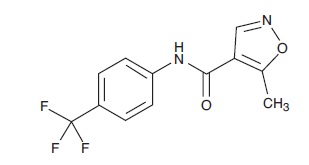
Chemical-structure-description (Chemical Structure Description)
FDA Label Image

Chemical-structure-pharmacokinetics (Chemical Structure Pharmacoki)

FDA Label Image
FDA Label Image

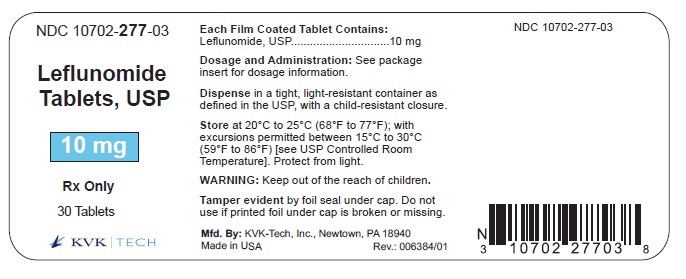
Container Label (10 mg)

Container Label (10 mg)
This is a medication called Leflunomide in tablet form with an NDC number of 10702-277-03. It is available with a prescription and each tablet contains 10mg of Lefunomide, USP. Dosage and administration instructions are available in the package insert. The medication should be stored in a tight, light-resistant container and protected from light, with a child-resistant closure. It must be kept away from children, and if the printed foil under the cap is broken or missing, it should not be used. It is manufactured by KVK-Toch, Inc. in Newlown, PA.*
FDA Label Image

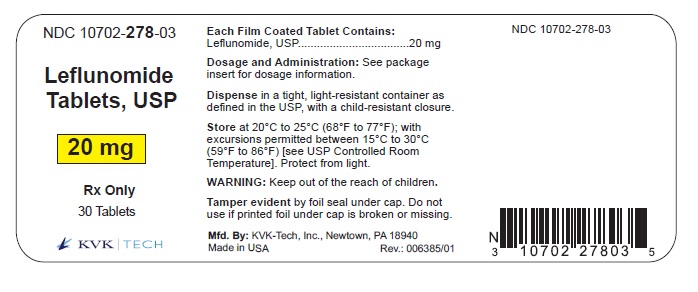
Container Label (20 mg)

Container Label (20 mg)
Description: Leflunomide is a prescription drug available in the form of film-coated tablets. Each tablet contains 20 mg of Lefunomide, USP. The package insert provides dosage information. Dispense in a tight, light-resistant container as defined in the USP, with a child-resistant closure. The drug should be stored at temperatures between 20°C to 25°C (68°F to 77°F), with permissible excursions between 15°C to 30°C (59°F to 86°F). The drug may cause harm if swallowed by children, hence, keep it out of their reach. The drug is manufactured by KVK-Tech Inc, Nowlown, PA.*
FDA Label Image

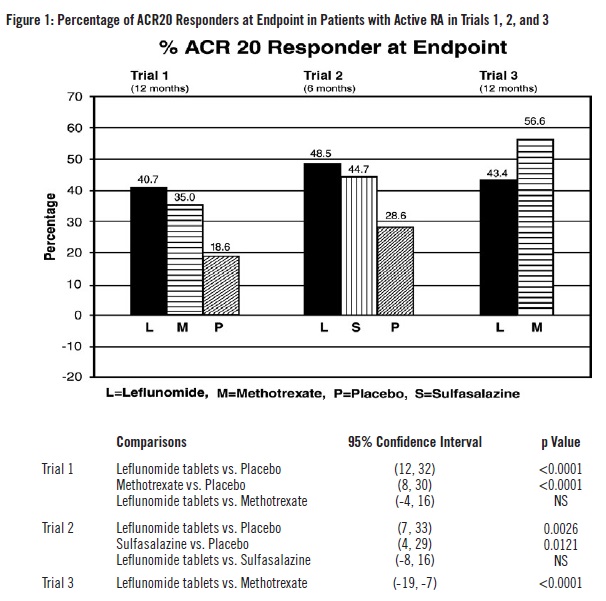
Figure 1 (Figure 1)

Figure 1 (Figure 1)
This is a table describing the percentage of ACR20 responders in patients with active rheumatoid arthritis in three clinical trials. The table provides information on the comparison between different drugs, such as Leflunomide, Methotrexate, and sulfasalazine, and placebo. The comparison is based on the percentage of responders, with trial durations ranging from 12 to 24 months. The table also includes 95% confidence intervals and p-values for each drug comparison.*
FDA Label Image

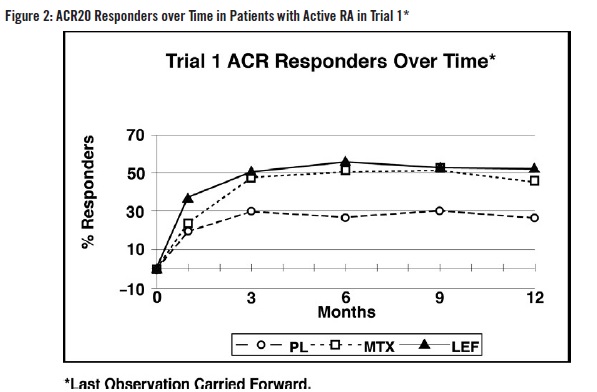
Figure 2 (Figure 2)

Figure 2 (Figure 2)
The text is a part of a chart in a medical study related to the response of patients with active rheumatoid arthritis over a period of 12 months. The chart displays the percentage of patients who showed ACR20 response over 6 months of treatment with a combination of MTX and LEF. The data is based on trial 1 and the last observation was carried forward.*
FDA Label Image

Figure 3 (Figure 3)

Figure 3 (Figure 3)
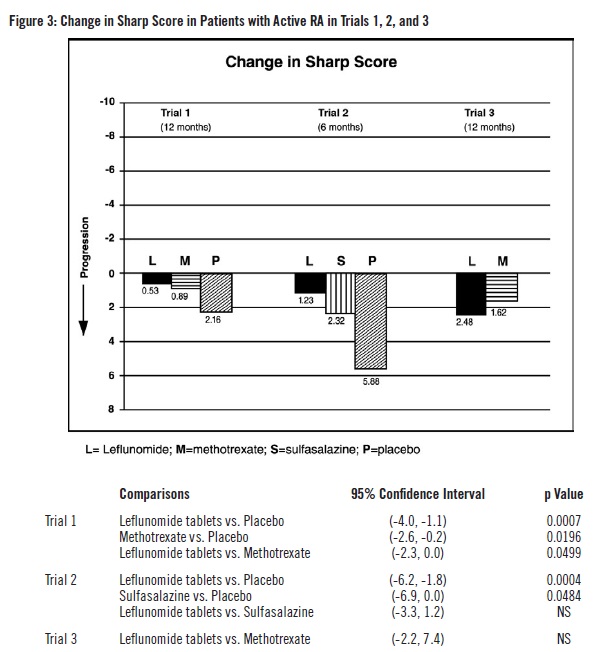
This is a graphical representation of the change in Sharp Score in patients with active RA in Trials 1, 2, and 3. The trials include patients who were given Leflunomide, Methotrexate, Sulfasalazine, or placebo. The text also shows comparisons and 95% confidence intervals between the different treatments.*
FDA Label Image

Figure 4 (Figure 4)

Figure 4 (Figure 4)
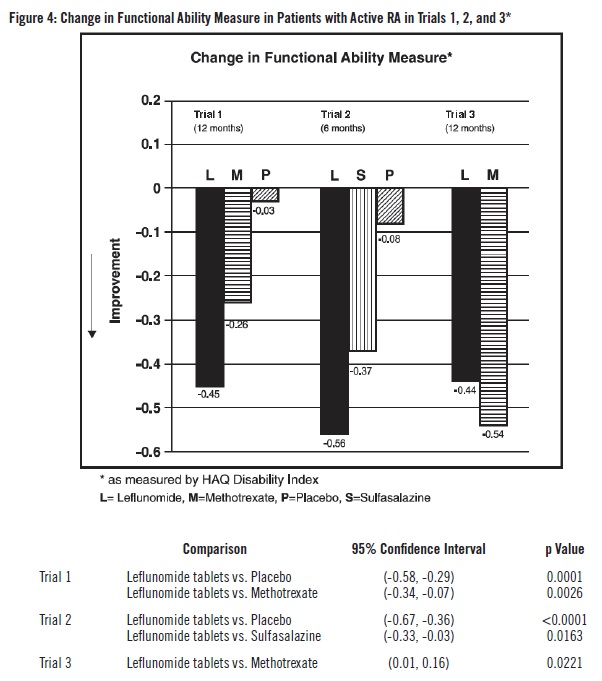
This is a graph with three lines representing the change in functional ability measure in patients with active rheumatoid arthritis in three different trials. The change is measured by the HAQ Disability Index. The graph also includes a comparison chart showing the 95% confidence interval and p-value of each trial comparing Leflunomide tablets to Placebo, Methotrexate, or Sulfasalazine.*
FDA Label Image

How Supplied (How Supplied)

How Supplied (How Supplied)
This is a product description of two strength variations of a medication. The first strength is 10mg and is available in a 30 count bottle with NDC number 10702-277-03. The tablet is white, round, film-coated, biconvex, and debossed with "V55" on one side and plain on the other side. The second strength is 20mg and is available in a 30 count bottle with NDC number 10702-278:03. The tablet is yellow, triangular, film-coated, biconvex, and debossed with "V56" on one side and plain on the other side.*
FDA Label Image

Table 1 (Table 1)

Table 1 (Table 1)
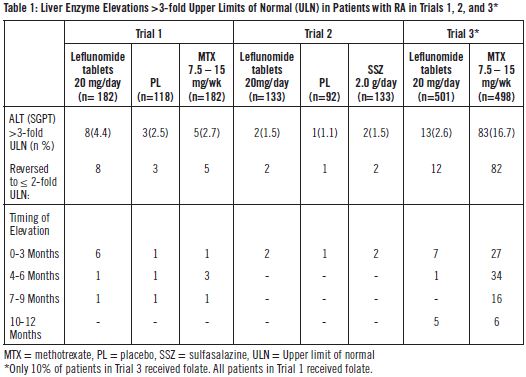
This is a table showing liver enzyme elevations in patients with rheumatoid arthritis in clinical trials 1, 2, and 3. The table compares the effects of Lefunomide and Placebo in the trials. The table lists the dosage, number of patients with enzyme elevations, and timing of the elevations. The table also notes that only 10% of patients in Trial 3 received folate supplementation.*
FDA Label Image

Table 2 (Table 2)

Table 2 (Table 2)
This is a table that shows the percentage of patients who experienced adverse events when taking leflunomide tablets in trials for rheumatoid arthritis. The table includes the placebo-controlled and active-controlled trials. Adverse events include diarrhea, headache, nausea, rash, abnormal liver enzymes, alopecia, hypertension, asthenia, back pain, abdominal pain, allergic reaction, bronchitis, dizziness, mouth ulcer, pruritus, rhinitis, vomiting, and tenosynovitis. The text also includes additional information about the trials and patient demographics.*
FDA Label Image

Table 3 (Table 3)

Table 3 (Table 3)
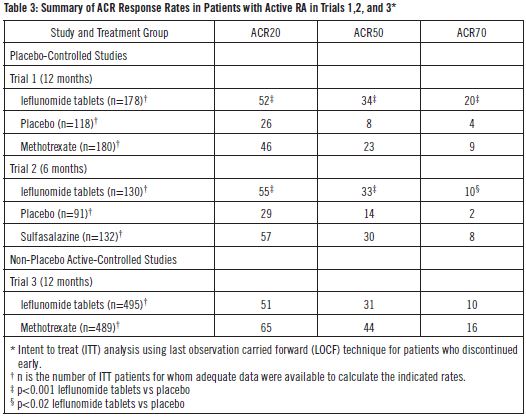
This is a summary table showing the response rates of patients with active RA in three different trials. The response rates were measured using the ACR20, ACR50, and ACR70 criteria. The first two studies were placebo-controlled and the third one was an active-controlled study. The intention-to-treat analysis was used, and the LOCF technique was applied for patients who discontinued early. The table also shows the number of patients for whom adequate data were available to calculate the indicated rates. There were significant differences between the response rates of patients taking leflunomide tablets vs placebo.*
FDA Label Image

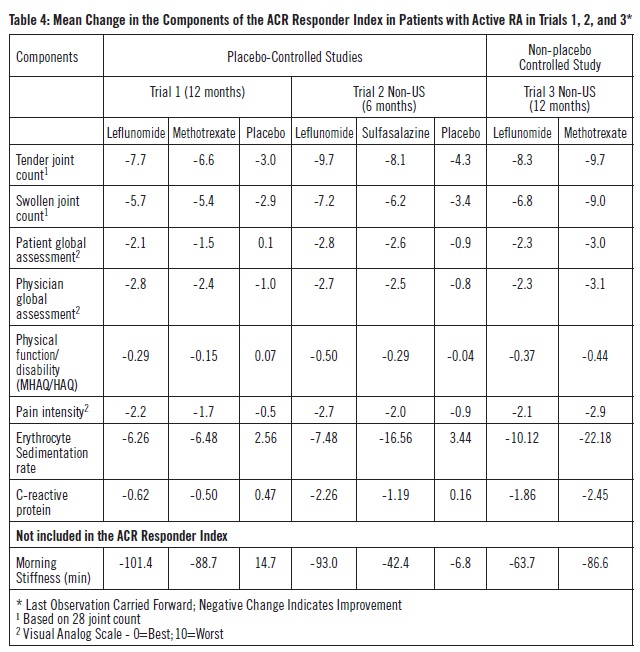
Table 4 (Table 4)

Table 4 (Table 4)
The text describes the mean change in components of the ACR Responder Index in patients with active Rheumatoid Arthritis (RA) in different trials based on observation carried forward. The table shows the results of the placebo-controlled studies with different medications and the difference in tender joint count, swollen joint count, patient and physician global assessment, physical function/disability, pain intensity, erythrocyte sedimentation rate, and C-reactive protein. The table also indicates that negative change indicates improvement, and the scale used was based on 28 joint counts and visual analog scale where 0 is best, and 10 is worst.*

* These product label images have been analyzed using experimental machine learning. Please verify findings with the primary label text.