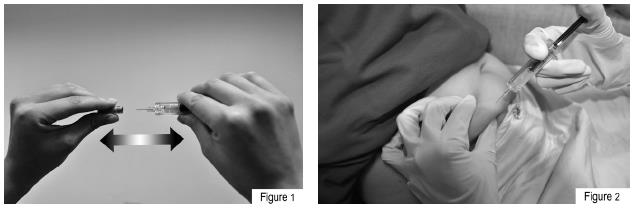
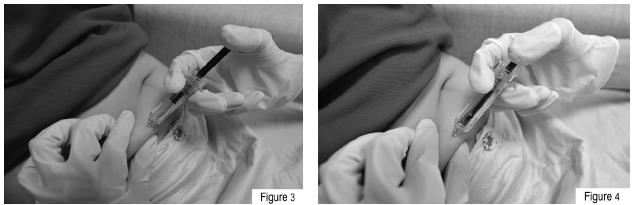
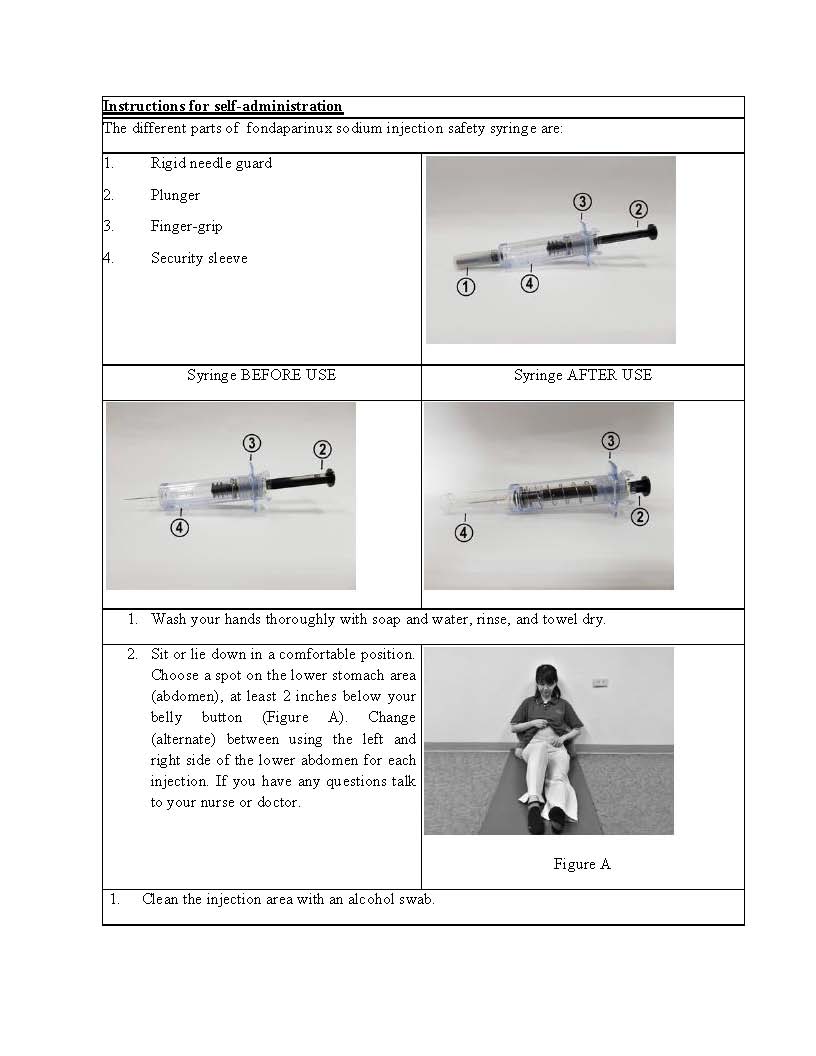
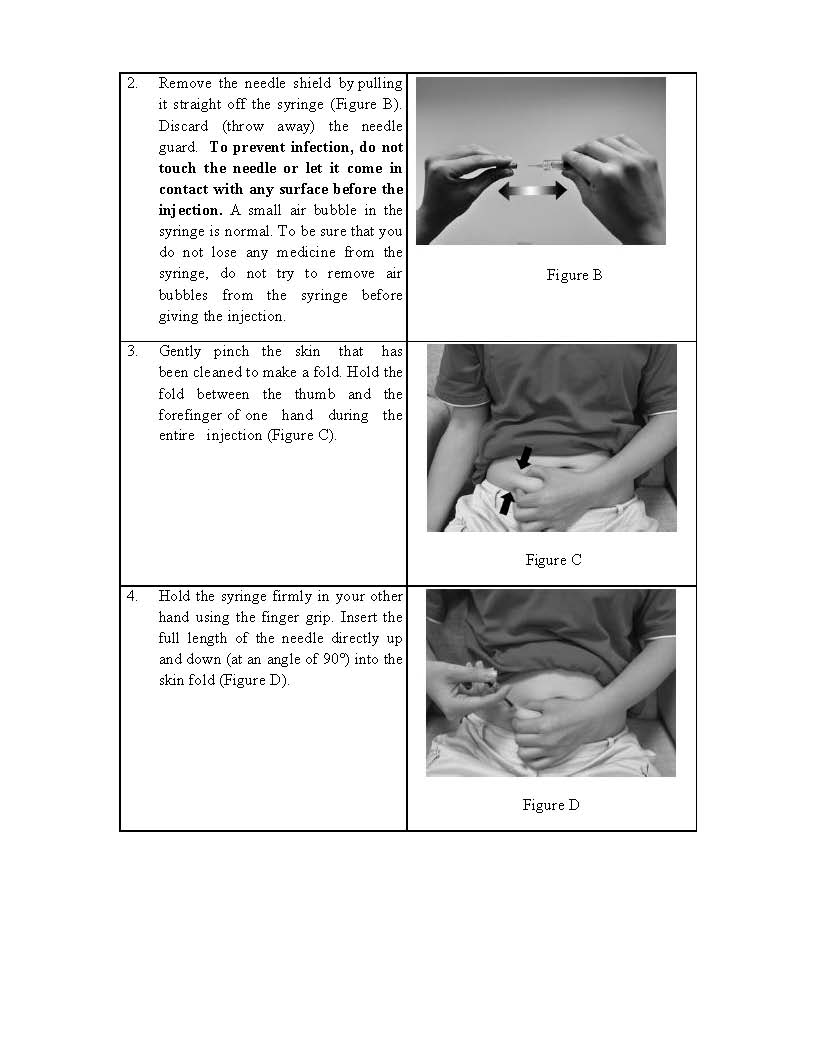
- Wipe the surface of the injection site with an alcohol swab.
- Remove the needle shield by pulling it straight off the syringe (Figure 1). Discard the needle guard.
- Do not try to remove the air bubbles from the syringe before giving the injection.
- Pinch a fold of skin at the injection site between your thumb and forefinger and hold it throught the injection.
- Hold the syringe with your thumb on the top pad of the plunger rod and your next 2 fingers on the finger grips on the syringe barrel. Pay attention to avoid sticking yourself with the exposed needle (Figure 2).
- Insert the full length of the syringe needle perpendicularly into the skin fold held between the thumb and forefinger (Figure 3).
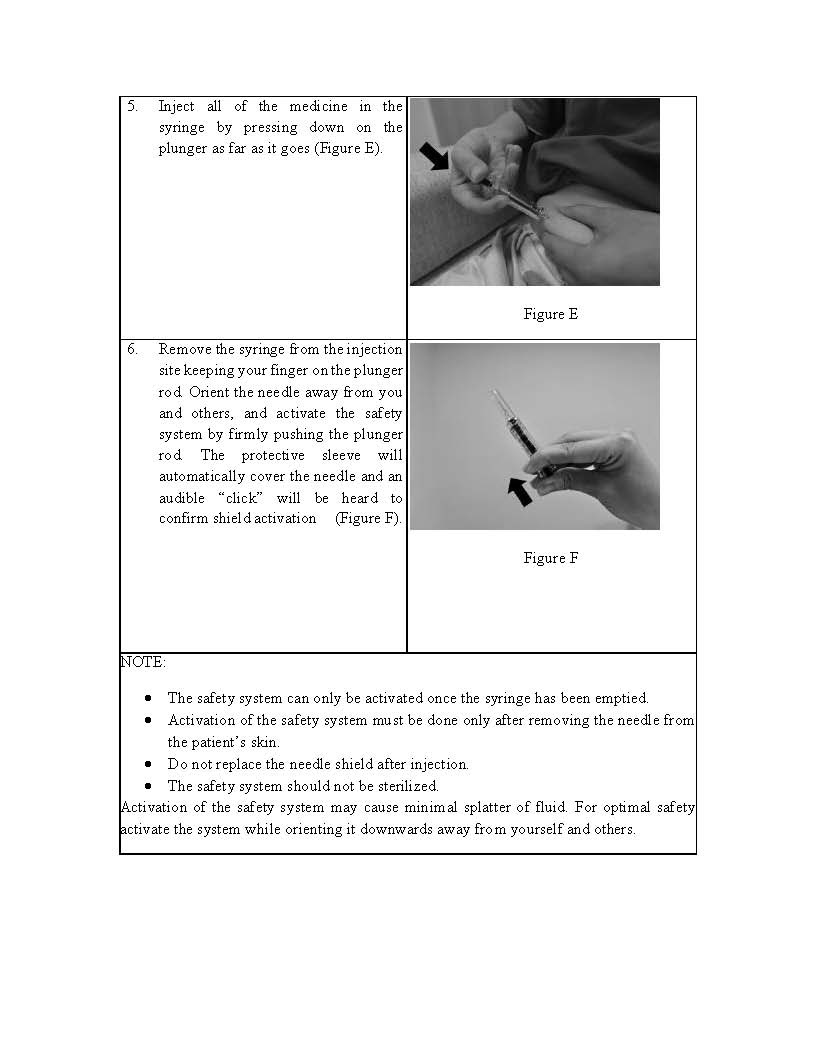
- Push the plunger rod firmly with your thumb as far as it will go. This will ensure you have injected all the contents of the syringe (Figure 4).
- Remove the syringe from the injection site keeping your finger on the plunger rod . Orient the needle away from you and others, and activate the safety system by firmly pushing the plunger rod (Figure 5). The protective sleeve will automatically cover the needle and an audible click will be heard to confirm shield activation. Immediately dispose of the syringe in the nearest sharps container.
NOTE: The safety system can only be activated once the syringe has been emptied. Activation of the safety system must be done only after removing the needle from the patient's skin. Do not replace the needle shield after injection. The safety system should not be sterilized. Activation of the safety system may cause minimal splatter of fluid. For optimal safety activate the system while orienting it downwards away from yourself and others.
Hip Fracture, Hip Replacement, and Knee Replacement Surgery: The rates of major bleeding events reported during the hip fracture, hip replacement, or knee replacement surgery clinical trials with fondaparinux sodium 2.5 mg are provided in Table 2.
Table 2. Bleeding Across Randomized, Controlled Hip Fracture, Hip Replacement, and Knee Replacement Surgery Studies | Peri-Operative
(Day 1 to Day 7 ± | Prophylaxis
1 post-surgery) | Extended
(Day 8 to Day 28 | Prophylaxis
± 2 post-surgery) |
| Fondaparinux Sodium
2.5 mg SC
once daily
N = 3,616 | Enoxaparin Sodiuma, b
N = 3,956 | Fondaparinux Sodium
2.5 mg SC
once daily
N = 327 | Placebo
SC once daily
N = 329 |
| Major bleedingc | 96 (2.7%) | 75 (1.9%) | 8 (2.4%) | 2 (0.6%) |
| Hip fracture | 18/831 (2.2%) | 19/842 (2.3%) | 8/327 (2.4%) | 2/329 (0.6%) |
| Hip replacement | 67/2,268 (3.0%) | 55/2,597 (2.1%) | — | — |
| Knee replacement | 11/517 (2.1%) | 1/517 (0.2%) | — | — |
| Fatal bleeding | 0 (0.0%) | 1 (<0.1%) | 0 (0.0%) | 0 (0.0%) |
| Non-fatal bleeding at critical site | 0 (0.0%) | 1 (<0.1%) | 0 (0.0%) | 0 (0.0%) |
| Re-operation due to bleeding | 12 (0.3%) | 10 (0.3%) | 2 (0.6%) | 2 (0.6%) |
| BI ≥2d | 84 (2.3%) | 63 (1.6%) | 6 (1.8%) | 0 (0.0%) |
| Minor bleedinge | 109 (3.0%) | 116 (2.9%) | 5 (1.5%) | 2 (0.6%) |
A separate analysis of major bleeding across all randomized, controlled, peri-operative, prophylaxis clinical studies of hip fracture, hip replacement, or knee replacement surgery according to the time of the first injection of fondaparinux sodium after surgical closure was performed in patients who received fondaparinux sodium only post-operatively. In this analysis, the incidences of major bleeding were as follows: <4 hours was 4.8% (5/104), 4 to 6 hours was 2.3% (28/1,196), 6 to 8 hours was 1.9% (38/1,965). In all studies, the majority (75%) of the major bleeding events occurred during the first 4 days after surgery.
Abdominal Surgery
In a randomized study of patients undergoing abdominal surgery, fondaparinux sodium 2.5 mg once daily (n = 1,433) was compared with dalteparin 5,000 IU once daily (n = 1,425). Bleeding rates are shown in Table 3.
Table 3. Bleeding in the Abdominal Surgery Study | Fondaparinux Sodium
2.5 mg SC once daily | Dalteparin Sodium
5,000 IU SC once daily |
| N = 1,433 | N = 1,425 |
| Major bleedinga | 49 (3.4%) | 34 (2.4%) |
| Fatal bleeding | 2 (0.1%) | 2 (0.1%) |
| Non-fatal bleeding at critical site | 0 (0.0%) | 0 (0.0%) |
| Other non-fatal major bleeding | | |
| Surgical site | 38 (2.7%) | 26 (1.8%) |
| Non-surgical site | 9 (0.6%) | 6 (0.4%) |
| Minor bleedingb | 31 (2.2%) | 23 (1.6%) |
The rates of major bleeding according to the time interval following the first fondaparinux sodium injection were as follows: <6 hours was 3.4% (9/263) and 6 to 8 hours was 2.9% (32/1112).
Treatment of Deep Vein Thrombosis and Pulmonary Embolism
The rates of bleeding events reported during a dose-response trial (n = 111) and an active-controlled trial with enoxaparin sodium in DVT treatment (n = 1,091) and an active-controlled trial with heparin in PE treatment (n = 1,091) with fondaparinux sodium are provided in Table 4.
Table 4. Bleedinga in Deep Vein Thrombosis and Pulmonary Embolism Treatment Studies | Fondaparinux Sodium
N = 2,294 | Enoxaparin Sodium
N = 1,101 | Heparin
aPTT adjusted IV
N = 1,092 |
| Major bleedingb | 28 (1.2%) | 13 (1.2%) | 12 (1.1%) |
| Fatal bleeding | 3 (0.1%) | 0 (0.0%) | 1 (0.1%) |
| Non-fatal bleeding at a critical site | 3 (0.1%) | 0 (0.0%) | 2 (0.2%) |
| Intracranial bleeding | 3 (0.1%) | 0 (0.0%) | 1 (0.1%) |
| Retro-peritoneal bleeding | 0 (0.0%) | 0 (0.0%) | 1 (0.1%) |
| Other clinically overt bleedingc | 22 (1.0%) | 13 (1.2%) | 10 (0.9%) |
| Minor bleedingd | 70 (3.1%) | 33 (3.0%) | 57 (5.2%) |
Distribution: In healthy adults, intravenously or subcutaneously administered fondaparinux sodium distributes mainly in blood and only to a minor extent in extravascular fluid as evidenced by steady state and non-steady state apparent volume of distribution of 7 to 11 L. Similar fondaparinux distribution occurs in patients undergoing elective hip surgery or hip fracture surgery. In vitro, fondaparinux sodium is highly (at least 94%) and specifically bound to antithrombin III (ATIII) and does not bind significantly to other plasma proteins (including platelet Factor 4 [PF4]) or red blood cells.
Metabolism: In vivo metabolism of fondaparinux has not been investigated since the majority of the administered dose is eliminated unchanged in urine in individuals with normal kidney function.
Elimination: In individuals with normal kidney function, fondaparinux is eliminated in urine mainly as unchanged drug. In healthy individuals up to 75 years of age, up to 77% of a single subcutaneous or intravenous fondaparinux dose is eliminated in urine as unchanged drug in 72 hours. The elimination half-life is 17 to 21 hours.
Hepatic Impairment: Following a single, subcutaneous dose of 7.5 mg of fondaparinux sodium in patients with moderate hepatic impairment (Child-Pugh Category B), Cmax and AUC were decreased by 22% and 39%, respectively, compared to subjects with normal liver function. The changes from baseline in pharmacodynamic parameters, such as aPTT, PT/INR, and antithrombin III, were similar in normal subjects and in patients with moderate hepatic impairment. Based on these data, no dosage adjustment is recommended in these patients. However, a higher incidence of hemorrhage was observed in subjects with moderate hepatic impairment than in normal subjects [see Use in Specific Populations (8.7)]. The pharmacokinetics of fondaparinux have not been studied in patients with severe hepatic impairment. [See Dosage and Administration (2.4).]
Pediatric: The pharmacokinetics of fondaparinux have not been investigated in pediatric patients. [See Contraindications (4), Warnings and Precautions (5.4), and Pediatric Use (8.4).]
Geriatric: Fondaparinux elimination is prolonged in patients older than 75 years. In studies evaluating fondaparinux sodium 2.5 mg prophylaxis in hip fracture surgery or elective hip surgery, the total clearance of fondaparinux was approximately 25% lower in patients older than 75 years as compared to patients younger than 65 years. A similar relationship between fondaparinux clearance and age was observed in DVT treatment patients. [See Use in Specific Populations (8.5).]
Patients Weighing Less Than 50 kg: Total clearance of fondaparinux sodium is decreased by approximately 30% in patients weighing less than 50 kg [see Dosage and Administration (2.3) and Contraindications (4)].
Gender: The pharmacokinetic properties of fondaparinux sodium are not significantly affected by gender.
Race: Pharmacokinetic differences due to race have not been studied prospectively. However, studies performed in Asian (Japanese) healthy subjects did not reveal a different pharmacokinetic profile compared to Caucasian healthy subjects. Similarly, no plasma clearance differences were observed between black and Caucasian patients undergoing orthopedic surgery.
Table 7. Efficacy of Fondaparinux Sodium in the Peri-operative Prophylaxis of Thromboembolic Events Following Hip Fracture Surgery | | Peri-operative
(Day 1 to Day 7 ± | Prophylaxis
2 post- surgery) |
| Endpoint | Fondapa
2.5 mg | rinux Sodium
SC once daily | Enoxa
40 mg | parin Sodium
SC once daily |
| n/Na | % (95% CI) | n/Na | % (95% CI) |
| VTE | 52/626 | 8.3%b (6.3, 10.8) | 119/624 | 19.1% (16.1, 22.4) |
| All DVT | 49/624 | 7.9%b (5.9, 10.2) | 117/623 | 18.8% (15.8, 22.1) |
| Proximal DVT | 6/650 | 0.9%b (0.3, 2.0) | 28/646 | 4.3% (2.9, 6.2) |
| Symptomatic PE | 3/831 | 0.4%c (0.1, 1.1) | 3/840 | 0.4% (0.1, 1.0) |
Table 8. Efficacy of Fondaparinux Sodium Injection in the Extended Prophylaxis of Thromboembolic Events Following Hip Fracture Surgery | | Extended
(Day 8 to Day 28± | Prophylaxis
2 post-surgery) | |
| Endpoint | Fonda
2.5 mg | parinux Sodium
SC once daily |
SC | Placebo
once daily |
| n/Na | % (95% CI) | n/Na | % (95% CI) |
| VTE | 3/208 | 1.4%b (0.3, 4.2) | 77/220 | 35.0% (28.7, 41.7) |
| All DVT | 3/208 | 1.4%b (0.3, 4.2) | 74/218 | 33.9% (27.7, 40.6) |
| Proximal DVT | 2/221 | 0.9%b (0.1, 3.2) | 35/222 | 15.8% (11.2, 21.2) |
| Symptomatic VTE (all) | 1/326 | 0.3%c (0.0, 1.7) | 9/330 | 2.7% (1.3, 5.1) |
| Symptomatic PE | 0/326 | 0.0%d (0.0, 1.1) | 3/330 | 0.9% (0.2, 2.6) |
Table 9. Efficacy of Fondaparinux Sodium in the Prophylaxis of Thromboembolic Events Following Hip Replacement Surgery | Study
n/N
% (95% | 1
a
CI) | Study
n/N
% (95% | 2
a
CI) |
| Endpoint | Fondaparinux
Sodium
2.5 mg SC
once daily | Enoxaparin
Sodium
30 mg SC
every 12 hr | Fondaparinux
Sodium
2.5 mg SC
once daily | Enoxaparin
Sodium
40 mg SC
once daily |
| VTEb | 48/787
6.1%c (4.5, 8.0) | 66/797
8.3% (6.5, 10.4) | 37/908
4.1%e (2.9, 5.6) | 85/919
9.2% (7.5, 11.3) |
| All DVT | 44/784
5.6%d (4.1, 7.5) | 65/796
8.2% (6.4, 10.3) | 36/908
4.0%e (2.8, 5.4) | 83/918
9.0% (7.3, 11.1) |
| Proximal DVT | 14/816
1.7%c (0.9, 2.9) | 10/830
1.2% (0.6, 2.2) | 6/922
0.7%f (0.2, 1.4) | 23/927
2.5% (1.6, 3.7) |
| Symptomatic PE | 5/1,126
0.4%c (0.1, 1.0) | 1/1,128
0.1% (0.0, 0.5) | 2/1,129
0.2%c (0.0, 0.6) | 2/1,123
0.2% (0.0, 0.6) |
Table 10. Efficacy of Fondaparinux Sodium in the Prophylaxis of Thromboembolic Events Following Knee Replacement Surgery | Endpoint | Fon
2.5 | daparinux Sodium
mg SC once daily |
30 | Enoxaparin Sodium
mg SC every 12 hours |
| n/Na | % (95% CI) | n/Na | % (95% CI) |
| VTEb | 45/361 | 12.5%c (9.2, 16.3) | 101/363 | 27.8% (23.3, 32.7) |
| All DVT | 45/361 | 12.5%c (9.2, 16.3) | 98/361 | 27.1% (22.6, 32.0) |
| Proximal DVT | 9/368 | 2.4%d (1.1, 4.6) | 20/372 | 5.4% (3.3, 8.2) |
| Symptomatic PE | 1/517 | 0.2%d (0.0, 1.1) | 4/517 | 0.8% (0.2, 2.0) |
Table 11. Efficacy of Fondaparinux Sodium In Prophylaxis of Thromboembolic Events Following Abdominal Surgery | Endpoint | Fondapari
2.5 mg SC | nux Sodium
once daily | Dalteparin
5,000 IU SC | Sodium
once daily |
| n/Na | % (95% CI) | n/Na | % (95% CI) |
| VTEb | 47/1,027 | 4.6%c (3.4, 6.0) | 62/1,021 | 6.1% (4.7, 7.7) |
| All DVT | 43/1,024 | 4.2% (3.1, 5.6) | 59/1,018 | 5.8% (4.4, 7.4) |
| Proximal DVT | 5/1,076 | 0.5% (0.2, 1.1) | 5/1,077 | 0.5% (0.2, 1.1) |
| Symptomatic VTE | 6/1,465 | 0.4% (0.2, 0.9) | 5/1,462 | 0.3% (0.1, 0.8) |
Table 12. Efficacy of Fondaparinux Sodium in the Treatment of Deep Vein Thrombosis (All Randomized) | Endpoint | Fond
5, 7.5, or
N | aparinux Sodium
10 mg SC once daily
= 1,098 | Enox
1 mg/kg
N | aparin Sodium
SC every 12 hours
= 1,107 |
| n | % (95% CI) | n | % (95% CI) |
| Total VTEa | 43 | 3.9% (2.8, 5.2) | 45 | 4.1% (3.0, 5.4) |
| DVT only | 18 | 1.6% (1.0, 2.6) | 28 | 2.5% (1.7, 3.6) |
| Non-fatal PE | 20 | 1.8% (1.1, 2.8) | 12 | 1.1% (0.6, 1.9) |
| Fatal PE | 5 | 0.5% (0.1, 1.1) | 5 | 0.5% (0.1, 1.1) |
During the initial treatment period, 18 (1.6%) of patients treated with fondaparinux sodium and 10 (0.9%) of patients treated with enoxaparin sodium had a VTE endpoint (95% CI for the treatment difference [fondaparinux sodium-enoxaparin sodium] for VTE rates: -0.2%; 1.7%).
Table 13. Efficacy of Fondaparinux Sodium in the Treatment of Pulmonary Embolism (All Randomized) | Endpoint | Fond
5, 7.5, or
N | aparinux Sodium
10 mg SC once daily
= 1,103 | | Heparin
aPTT adjusted IV
N = 1,110 |
| n | % (95% CI) | n | % (95% CI) |
| Total VTEa | 42 | 3.8% (2.8, 5.1) | 56 | 5.0% (3.8, 6.5) |
| DVT only | 12 | 1.1% (0.6, 1.9) | 17 | 1.5% (0.9, 2.4) |
| Non-fatal PE | 14 | 1.3% (0.7, 2.1) | 24 | 2.2% (1.4, 3.2) |
| Fatal PE | 16 | 1.5% (0.8, 2.3) | 15 | 1.4% (0.8, 2.2) |
During the initial treatment period, 12 (1.1%) of patients treated with fondaparinux sodium and 19 (1.7%) of patients treated with heparin had a VTE endpoint (95% CI for the treatment difference [fondaparinux sodium-heparin] for VTE rates: -1.6%; 0.4%).