Because clinical studies are conducted under widely varying conditions, adverse reaction rates observed cannot be directly compared to rates in other clinical trials and may not reflect the rates observed in practice.
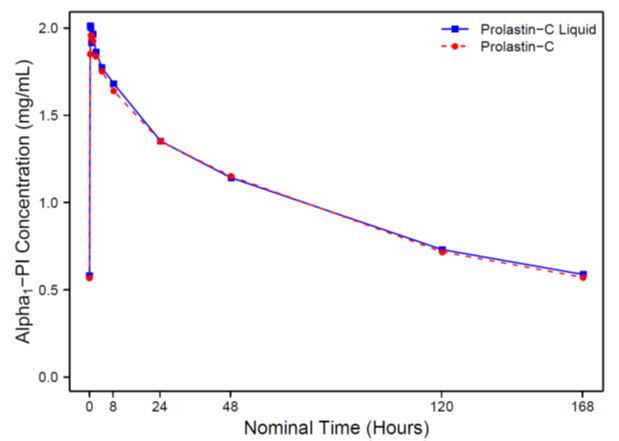
One clinical trial was conducted with PROLASTIN-C LIQUID: a 16 week, multicenter, randomized, double-blind crossover study to assess the safety, immunogenicity, and pharmacokinetic comparability of PROLASTIN-C LIQUID to PROLASTIN-C in 32 subjects.
Adverse reactions (as defined in the footnote to Table 1) occurring in >5% of subjects during the 16 week double-blind crossover treatment period are shown in Table 1.
Table 1: Adverse Reactions Occurring in >5% of Subjects during the Double-Blinded Crossover Treatment| | PROLASTIN®-C LIQUID
(N=32) | PROLASTIN®-C
(N=31) |
| Adverse Reaction An adverse reaction is defined as any adverse event that occurred where either a) the event was not considered “unrelated” to administration of the product, or b) the occurrence was during or within 72 hours of the end of the previous infusion of the product, or c) the investigator's causality assessment of the event was missing or indeterminate, or d) the incidence during treatment with 1 investigational product was 130% or more of the incidence during treatment with the other investigational product. ,Source: the randomized double-blinded comparator trial of PROLASTIN-C LIQUID vs PROLASTIN-C. | No. of Subjects with Adverse Reaction
(percentage of all subjects) | No. of Subjects with Adverse Reaction
(percentage of all subjects) |
| Diarrhea | 2 (6) | 0 |
| Fatigue | 2 (6) | 0 |
Table 2 below displays the adverse reaction (defined as per Table 1) rate as a percentage of infusions received during the 16 week double-blinded treatment period.
Table 2: Adverse Reaction Frequency as a Percent of All Infusions and Occurring More than Once in the PROLASTIN®-C LIQUID Group during the 16 Week Double Blinded Treatment Period| | PROLASTIN®-C LIQUID
No. of infusions: 252 | PROLASTIN®-C
No. of infusions: 245 |
| Adverse Reaction Source: the randomized double-blinded comparator trial of PROLASTIN-C LIQUID vs PROLASTIN-C. | No. of Adverse Reactions
(percentage of all infusions) | No. of Adverse Reactions
(percentage of all infusions) |
| Diarrhea | 3 (1.2) | 0 |
| Fatigue | 2 (0.8) | 0 |
A total of 23 COPD exacerbations were reported for a total of 18 individual subjects. Twelve subjects (12/32, 38%) during PROLASTIN-C LIQUID treatment experienced 13 COPD exacerbations, and 9 subjects (9/31, 29%) during PROLASTIN-C treatment had 10 COPD exacerbations. Three COPD exacerbations occurred during the Follow-Up Period after PROLASTIN-C LIQUID treatment and 1 COPD exacerbation occurred in the Follow-up period after PROLASTIN-C treatment. The overall rate of pulmonary exacerbations during treatment with either product was 1.9 exacerbations per subject-year. No exacerbation was considered to be serious, except for one event after PROLASTIN-C treatment during the Follow-Up period (due to hospitalization).
Two separate prior clinical trials were conducted with PROLASTIN-C: 1.) a 20 week, open-label, single arm safety study in 38 subjects (single-arm open-label trial), and 2.) a 16 week, randomized, double-blind, crossover pharmacokinetic comparability study vs. PROLASTIN in 24 subjects, followed by an 8 week open-label treatment with PROLASTIN-C (randomized double-blinded comparator trial). Thus, a total of 93 subjects were exposed to PROLASTIN-C in clinical trials.
The most serious adverse reaction observed during clinical trials with PROLASTIN-C was an abdominal and extremity rash in one subject. The rash resolved subsequent to outpatient treatment with antihistamines and steroids. Two instances of a less severe, pruritic abdominal rash were observed upon rechallenge despite continued antihistamine and steroid treatment, which led to withdrawal of the subject from the trial.
Grifols assessed the randomized double-blinded comparator trial of PROLASTIN and PROLASTIN-C for adverse reactions (as defined in the footnote to Table 3) occurring during each 8 week double-blind crossover treatment period, as shown in Table 3.
Table 3: Adverse Reactions Occurring during the First 8 Weeks of Each Double-Blinded Treatment| | PROLASTIN®-C
No. of subjects: 24 | PROLASTIN®
No. of subjects: 24 |
| Adverse Reaction An adverse reaction is defined as any adverse event where either a) the incidence with PROLASTIN-C was greater than with PROLASTIN, or b) the occurrence was within 72 hours of treatment, or c) the event was otherwise considered related or possibly related to the drug. ,Source: the randomized double-blinded comparator trial. | No. of Subjects with Adverse Reaction
(percentage of all subjects) | No. of Subjects with Adverse Reaction
(percentage of all subjects) |
| Upper respiratory tract infection | 3 (12.5%) | 1 (4.2%) |
| Headache | 1 (4.2%) | 2 (8.3%) |
| Pruritus | 1 (4.2%) | 0 |
| Urticaria | 1 (4.2%) | 0 |
| Nausea | 1 (4.2%) | 0 |
| Peripheral edema | 1 (4.2%) | 0 |
| Pyrexia | 1 (4.2%) | 0 |
Table 4 below displays the adverse reaction (defined as per Table 3) rate as a percentage of infusions received during the 8 weeks of each double-blinded treatment.
Table 4: Adverse Reaction Frequency as a Percent of All Infusions during the First 8 Weeks of Each Double-Blinded Infusion Treatment| | PROLASTIN®-C
No. of infusions: 188 | PROLASTIN®
No. of infusions: 192 |
| Adverse Reaction Source: the randomized double-blinded comparator trial. | No. of Adverse Reactions
(percentage of all infusions) | No. of Adverse Reactions
(percentage of all infusions) |
| Upper respiratory tract infection | 3 (1.6%) | 1 (0.5%) |
| Headache | 1 (0.5%) | 3 (1.6%) |
| Pruritus | 1 (0.5%) | 0 |
| Urticaria | 1 (0.5%) | 0 |
| Nausea | 1 (0.5%) | 0 |
| Peripheral edema | 1 (0.5%) | 0 |
| Pyrexia | 1 (0.5%) | 0 |
Table 5 below displays the adverse reactions occurring in two or more subjects during the single-arm open-label trial.
Table 5: Adverse Reactions Occurring in Two or More Subjects (>5%) during the 20 Week Single-Arm Open-Label Trial| | PROLASTIN®-C
No. of subjects: 38 |
| Adverse Reaction An adverse reaction is defined as any adverse event that occurred where either a) the occurrence was within 72 hours of treatment, or b) the event was otherwise considered related or possibly related to the drug. ,Source: the single-arm, open-label trial. | No. of Subjects with Adverse Reaction
(percentage of all subjects) |
| Upper respiratory tract infection | 6 (15.8%) |
| Urinary tract infection | 5 (13.2%) |
| Nausea | 4 (10.5%) |
| Chest pain | 3 (7.9%) |
| Back pain | 2 (5.3%) |
| Chills | 2 (5.3%) |
| Cough | 2 (5.3%) |
| Dizziness | 2 (5.3%) |
| Dyspnea | 2 (5.3%) |
| Headache | 2 (5.3%) |
| Hot flush | 2 (5.3%) |
| Oral candidiasis | 2 (5.3%) |
Ten exacerbations of chronic obstructive pulmonary disease were reported by 8 subjects in the 24 week crossover pharmacokinetic study. During the 16 week double-blind crossover phase, 4 subjects (17%) had a total of 4 exacerbations during PROLASTIN-C treatment and 4 subjects (17%) had a total of 4 exacerbations during PROLASTIN treatment. Two additional exacerbations in 2 subjects (8%) occurred during the 8 week open-label treatment period with PROLASTIN-C. The overall rate of pulmonary exacerbations during treatment with either product was 0.9 exacerbations per subject-year.
Immunogenicity
The detection of antibody formation is highly dependent on the sensitivity and specificity of the assay. Additionally, the observed incidence of antibody (including neutralizing antibody) positivity in an assay may be influenced by several factors including assay methodology, sample handling, timing of sample collection, concomitant medications, and underlying disease. For these reasons, comparison of the incidence of antibodies to PROLASTIN-C LIQUID with the incidence of antibodies to other products may be misleading.
In the randomized, crossover pharmacokinetic clinical trial, no immunogenicity response was observed in subjects dosed with PROLASTIN-C LIQUID or PROLASTIN-C.
In the single-arm, open-label safety clinical trial, three treatment naïve subjects out of 36 subjects evaluated developed antibody to Alpha1-PI at week 24 after receiving PROLASTIN-C. A fourth subject (non-naïve) was positive prior to and after receiving PROLASTIN-C, but levels were unchanged during the study. None of the four antibody specimens was able to neutralize the protease inhibitor capacity of PROLASTIN-C. In the randomized, crossover pharmacokinetic clinical trial comparing PROLASTIN-C and PROLASTIN, none of 24 subjects developed antibodies to PROLASTIN-C.