Other
Rx Only
Prescribing Information
Before prescribing carbamazepine, the physician should be thoroughly familiar with the details of this prescribing information, particularly regarding use with other drugs, especially those which accentuate toxicity potential.
SJS/TEN and HLA-B*1502 Allele
Retrospective case-control studies have found that in patients of Chinese ancestry there is a strong association between the risk of developing SJS/TEN with carbamazepine treatment and the presence of an inherited variant of the HLA-B gene, HLA-B*1502. The occurrence of higher rates of these reactions in countries with higher frequencies of this allele suggests that the risk may be increased in allele-positive individuals of any ethnicity.
Across Asian populations, notable variation exists in the prevalence of HLA-B*1502. Greater than 15% of the population is reported positive in Hong Kong, Thailand, Malaysia, and parts of the Philippines, compared to about 10% in Taiwan and 4% in North China. South Asians, including Indians, appear to have intermediate prevalence of HLA-B*1502, averaging 2% to 4%, but higher in some groups. HLA-B*1502 is pres ent in less than 1% of the population in Japan and Korea.
HLA-B*1502 is largely absent in individuals not of Asian origin (e.g., Caucasians, African-Americans, Hispanics, and Native Americans).
Prior to initiating carbamazepine therapy, testing for HLA-B*1502 should be performed in patients with ancestry in populations in which HLA-B*1502 may be present. In deciding which patients to screen, the rates provided above for the prevalence of HLA-B*1502 may offer a rough guide, keeping in mind the limitations of these figures due to wide variability in rates even within ethnic groups, the difficulty in ascertaining ethnic ancestry, and the likelihood of mixed ancestry. Carbamazepine should not be used in patients positive for HLA-B*1502 unless the benefits clearly outweigh the risks. Tested patients who are found to be negative for the allele are thought to have a low risk of SJS/TEN (see BOXED WARNING and PRECAUTIONS, Laboratory Tests).
Over 90% of carbamazepine treated patients who will experience SJS/TEN have this reaction within the first few months of treatment. This information may be taken into consideration in determining the need for screening of genetically at-risk patients currently on carbamazepine.
The HLA-B*1502 allele has not been found to predict risk of less severe adverse cuta-neous reactions from carbamazepine such as maculopapular eruption (MPE) or to predict Drug Reaction with Eosinophilia and Systemic Symptoms (DRESS).
Limited evidence suggests that HLA-B*1502 may be a risk factor for the development of SJS/TEN in patients of Chinese ancestry taking other antiepileptic drugs associated with SJS/TEN, including phenytoin. Consideration should be given to avoiding use of other drugs associated with SJS/TEN in HLA-B*1502 positive patients, when alternative therapies are otherwise equally acceptable.
Hypersensitivity Reactions and HLA-A*3101 Allele
Retrospective case-control studies in patients of European, Korean, and Japanese ancestry have found a moderate association between the risk of developing hypersensitivity reactions and the presence of HLA-A*3101, an inherited allelic variant of the HLA-A gene, in patients using carbamazepine. These hypersensitivity reactions include SJS/TEN, maculopapular eruptions, and Drug Reaction with Eosinophilia and Systemic Symptoms (see DRESS/Multiorgan hypersensitivity below).
HLA-A*3101 is expected to be carried by more than 15% of patients of Japanese, Native American, Southern Indian (for example, Tamil Nadu) and some Arabic ancestry; up to about 10% in patients of Han Chinese, Korean, European, Latin American, and other Indian ancestry; and up to about 5% in African-Americans and patients of Thai, Taiwanese, and Chinese (Hong Kong) ancestry.
The risks and benefits of carbamazepine therapy should be weighed before considering carbamazepine in patients known to be positive for HLA-A*3101.
Application of HLA genotyping as a screening tool has important limitations and must never substitute for appropriate clinical vigilance and patient management. Many HLA-B*1502-positive and HLA-A*3101-positive patients treated with carbamazepine will not develop SJS/TEN or other hypersensitivity reactions, and these reactions can still occur infrequently in HLA-B*1502-negative and HLA-A*3101-negative patients of any ethnicity. The role of other possible factors in the development of, and morbidity from, SJS/TEN and other hypersensitivity reactions, such as antiepileptic drug (AED) dose, compliance, concomitant medications, comorbidities, and the level of dermatologic monitoring, have not been studied.
DOSAGE AND ADMINISTRATION (see table below)
Monitoring of blood levels has increased the efficacy and safety of anticonvulsants (see PRECAUTIONS, Laboratory Tests). Dosage should be adjusted to the needs of the indi vidual patient. A low initial daily dosage with a gradual increase is advised. As soon as adequate control is achieved, the dosage may be reduced very gradually to the mini mum effective level. Medication should be taken with meals.
Conversion of patients from oral carbamazepine tablets to carbamazepine suspension: Patients should be converted by administering the same number of mg per day in smaller, more frequent doses (i.e., twice a day. tablets to three times a day suspension).
Epilepsy (see INDICATIONS AND USAGE)
Adults and children over 12 years of age-Initial: 200 mg twice a day. Increase at weekly intervals by adding up to 200 mg/day using a three times a day or four times a day regimen until the optimal response is obtained. Dosage generally should not exceed 1000 mg daily in children 12 to 15 years of age, and 1200 mg daily in patients above 15 years of age. Doses up to 1600 mg daily have been used in adults in rare instances. Maintenance: Adjust dosage to the minimum effective level, usually 800 to 1200 mg daily.
Children 6 to 12 years of age-Initial: 100 mg twice a day. Increase at weekly intervals by adding up to 100 mg/day using a three times a day or four times a day regimen until the optimal response is obtained. Dosage generally should not exceed 1000 mg daily. Maintenance: Adjust dosage to the minimum effective level, usually 400 to 800 mg daily.
Children under 6 years of age-Initial: 10 to 20 mg/kg/day twice a day or three times a day. Increase weekly to achieve optimal clinical response administered three times a day or four times a day. Maintenance: Ordinarily, optimal clinical response is achieved at daily doses below 35 mg/kg. If sat isfactory clinical response has not been achieved, plasma levels should be measured to determine whether or not they are in the therapeutic range. No recommendation regarding the safety of carbamazepine for use at doses above 35 mg/kg/24 hours can be made.
Combination Therapy: Carbamazepine may be used alone or with other anticonvul sants. When added to existing anticonvulsant therapy, the drug should be added gradually while the other anticonvulsants are maintained or gradually decreased, except phenytoin, which may have to be increased (see PRECAUTIONS, Drug Interactions, and Pregnancy).
Trigeminal Neuralgia (see INDICATIONS AND USAGE)
Initial: On the first day, 100 mg twice a day for a total daily dose of 200 mg. This daily dose may be increased by up to 200 mg/day using increments of 100 mg every 12 hours only as needed to achieve freedom from pain. Do not exceed 1200 mg daily. Maintenance: Control of pain can be maintained in most patients with 400 to 800 mg daily. However, some patients may be maintained on as little as 200 mg daily, while oth ers may require as much as 1200 mg daily. At least once every 3 months throughout the treatment period, attempts should be made to reduce the dose to the minimum effective level or even to discontinue the drug.
* Tablet = Chewable or conventional tablets | |||
| Initial Dose | Subsequent Dose | Maximum Daily Dose | |
| Indication | Tablet* | Tablet* | Tablet* |
| Epilepsy Under 6 yr | 10 to 20 mg/kg/day twice a day or 3 times a day | Increase weekly to achieve optimal clinical response, 3 times a day or 4 times a day | 35 mg/kg/24 hr (See Dosage and Administration section above) |
| 6 to 12 yr | 100 mg twice a day (200 mg/day) | Add up to 100 mg/day at weekly intervals, 3 times a day or 4 times a day | 1000 mg/24 hr |
| Over 12 yr | 200 mg twice a day (400 mg/day) | Add up to 200 mg/day at weekly intervals, 3 times a day or 4 times a day | 1000 mg/24 hr (12 to 15 yr) 1200 mg/24 hr (>15 yr) 1600 mg/24 hr (adults, in rare instances) |
| Trigeminal Neuralgia | 100 mg twice a day (200 mg/day) | Add up to 200 mg/day in increments of 100 mg every 12 hr | 1200 mg/24 hr |
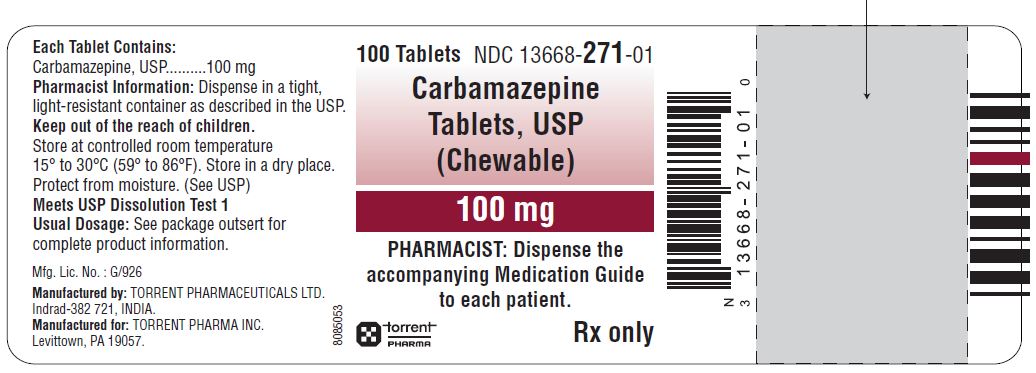
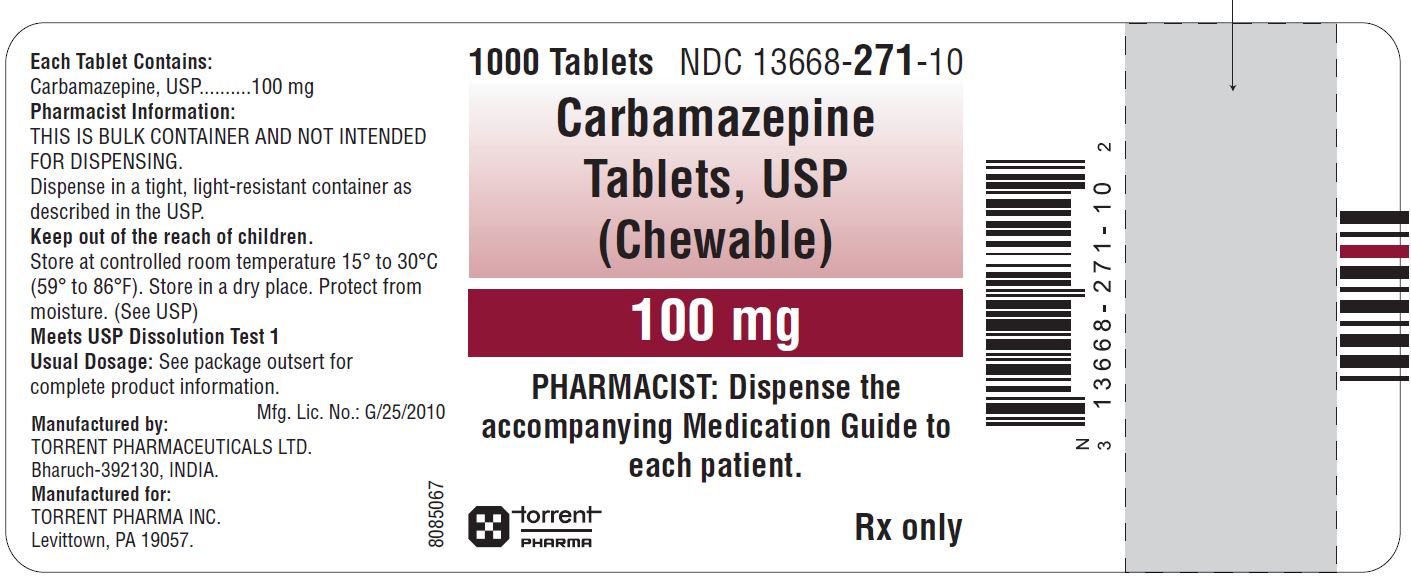
Carbamazepine Tablets, USP (chewable), 100 mg are available in the following form: pink colored, circular, strawberry/vanilla flavored, flat beveled, uncoated tablets with "271" debossed on one side and scoreline on the other.
Bottle of 100 NDC 13668-271-01
Bottle of 500 NDC 13668-271-05
Bottle of 750 NDC 13668-271-49
Bottle of 1000 NDC 13668-271-10
Carbamazepine Tablets, USP, 100 mg are available in the following form: pink colored, capsule shaped, biconvex tablets with '539' debossed on one side and plain on the other side.
Bottle of 100 NDC 13668-267-01
Bottle of 500 NDC 13668-267-05
Bottle of 1000 NDC 13668-267-10
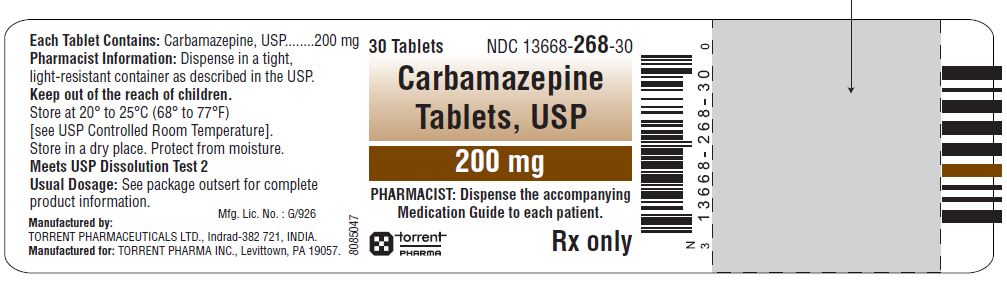
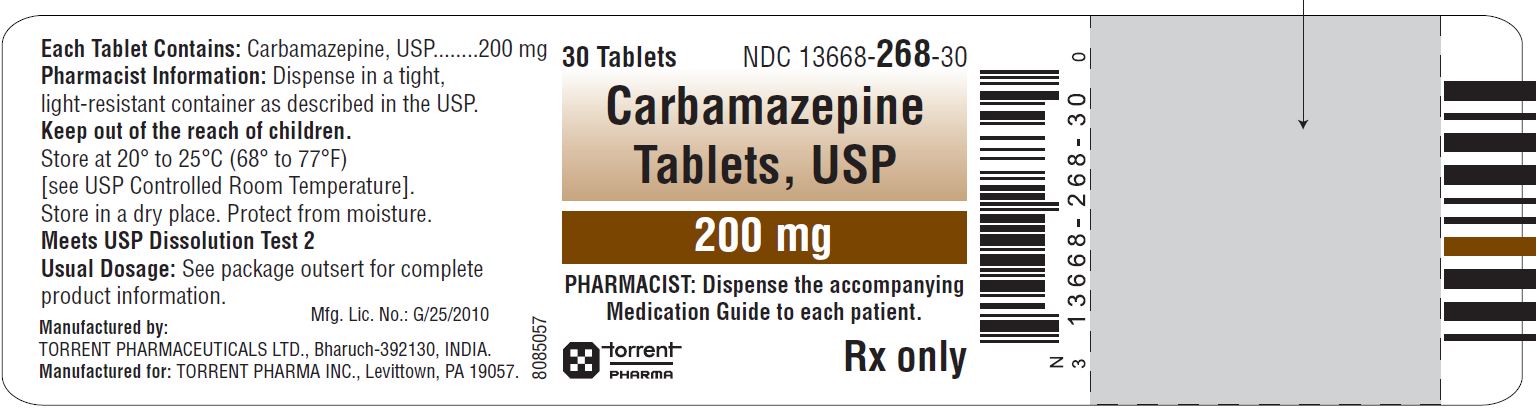
Carbamazepine Tablets, USP, 200 mg are available in the following form: pink colored, capsule shaped, biconvex tablets with '268' debossed on one side and scored on the other side.
Bottle of 30 NDC 13668-268-30
Bottle of 100 NDC 13668-268-01
Bottle of 500 NDC 13668-268-05
Bottle of 1000 NDC 13668-268-10
Bottle of 2500 NDC 13668-268-31
Carbamazepine Tablets, USP, 300 mg are available in the following form: pink colored, capsule shaped, biconvex tablets with '535' debossed on one side and scored on the other side.
Bottle of 100 NDC 13668-269-01
Bottle of 500 NDC 13668-269-05
Bottle of 1000 NDC 13668-269-10
Carbamazepine Tablets, USP, 400 mg are available in the following form: pink colored, capsule shaped, biconvex tablets with '536' debossed on one side and scored on the other side.
Bottle of 100 NDC 13668-270-01
Bottle of 500 NDC 13668-270-05
Bottle of 1000 NDC 13668-270-10
Store at 20° to 25°C (68° to 77°F) [see USP Controlled Room Temperature]. Protect from light and moisture. Dispense in a tight, light-resistant container as defined in the USP.

Company Logo (1859fbe5 4110 4511 Bfd2 63c190886c6f 02)
Manufactured by:
TORRENT PHARMACEUTICALS LTD., INDIA.
Manufactured for:
TORRENT PHARMA INC., Basking Ridge, NJ 07920.
8078198 Revised March 2020