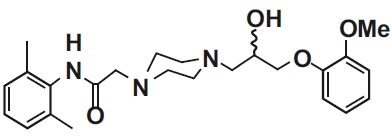
Ranolazine is extensively metabolized in the gut and liver and its absorption is highly variable. For example, at a dose of 1000 mg twice daily, the mean steady-state Cmax was 2600 ng/mL with 95% confidence limits of 400 and 6100 ng/mL. The pharmacokinetics of the (+) R- and (-) S-enantiomers of ranolazine are similar in healthy volunteers. The apparent terminal half-life of ranolazine is 7 hours. Steady state is generally achieved within 3 days of twice-daily dosing with ranolazine extended-release tablets. At steady state over the dose range of 500 to 1000 mg twice daily, Cmax and AUC0-τ increase slightly more than proportionally to dose, 2.2- and 2.4-fold, respectively. With twice-daily dosing, the trough: peak ratio of the ranolazine plasma concentration is 0.3 to 0.6. The pharmacokinetics of ranolazine is unaffected by age, gender, or food.
Absorption and Distribution
After oral administration of ranolazine extended-release tablets, peak plasma concentrations of ranolazine are reached between 2 and 5 hours. After oral administration of 14C-ranolazine as a solution, 73% of the dose is systemically available as ranolazine or metabolites. The bioavailability of ranolazine from ranolazine extended-release tablets relative to that from a solution of ranolazine is 76%. Because ranolazine is a substrate of P-gp, inhibitors of P-gp may increase the absorption of ranolazine.
Food (high-fat breakfast) has no important effect on the Cmax and AUC of ranolazine. Therefore, ranolazine extended-release tablets may be taken without regard to meals. Over the concentration range of 0.25 to 10 µg/mL, ranolazine is approximately 62% bound to human plasma proteins.
Metabolism and Excretion
Ranolazine is metabolized mainly by CYP3A and, to a lesser extent, by CYP2D6. Following a single oral dose of ranolazine solution, approximately 75% of the dose is excreted in urine and 25% in feces. Ranolazine is metabolized rapidly and extensively in the liver and intestine; less than 5% is excreted unchanged in urine and feces. The pharmacologic activity of the metabolites has not been well characterized. After dosing to steady state with 500 mg to 1500 mg twice daily, the four most abundant metabolites in plasma have AUC values ranging from about 5 to 33% that of ranolazine, and display apparent half-lives ranging from 6 to 22 hours.
Drug Interactions
Effect of Other Drugs on Ranolazine
In vitro data indicate that ranolazine is a substrate of CYP3A and, to a lesser degree, of CYP2D6. Ranolazine is also a substrate of P-glycoprotein.
Strong CYP3A Inhibitors
Plasma levels of ranolazine with ranolazine extended-release tablets 1000 mg twice daily are increased by 220% when co-administered with ketoconazole 200 mg twice daily [see Contraindications (4)].
Moderate CYP3A Inhibitors
Plasma levels of ranolazine with ranolazine extended-release tablets 1000 mg twice daily are increased by 50 to 130% by diltiazem 180 to 360 mg, respectively. Plasma levels of ranolazine with ranolazine extended-release tablets 750 mg twice daily are increased by 100% by verapamil 120 mg three times daily [see Drug Interactions (7.1)].
Weak CYP3A Inhibitors
The weak CYP3A inhibitors simvastatin (20 mg once daily) and cimetidine (400 mg three times daily) do not increase the exposure to ranolazine in healthy volunteers.
CYP3A Inducers
Rifampin 600 mg once daily decreases the plasma concentrations of ranolazine (1000 mg twice daily) by approximately 95% [see Contraindications (4)].
CYP2D6 Inhibitors
Paroxetine 20 mg once daily increased ranolazine concentrations by 20% in healthy volunteers receiving ranolazine extended-release tablets 1000 mg twice daily. No dose adjustment of ranolazine extended-release tablets is required in patients treated with CYP2D6 inhibitors.
Digoxin
Plasma concentrations of ranolazine are not significantly altered by concomitant digoxin at 0.125 mg once daily.
Effect of Ranolazine on Other Drugs
In vitro ranolazine and its O-demethylated metabolite are weak inhibitors of CYP3A and moderate inhibitors of CYP2D6 and P-gp. In vitro ranolazine is an inhibitor of OCT2.
CYP3A Substrates
The plasma levels of simvastatin, a CYP3A substrate, and its active metabolite are increased by 100% in healthy volunteers receiving 80 mg once daily and ranolazine extended-release tablets 1000 mg twice daily [see Drug Interactions (7.2)]. Mean exposure to atorvastatin (80 mg daily) is increased by 40% following co-administration with ranolazine extended-release tablets (1000 mg twice daily) in healthy volunteers. However, in one subject the exposure to atorvastatin and metabolites was increased by ~400% in the presence of ranolazine extended-release tablets.
Diltiazem
The pharmacokinetics of diltiazem is not affected by ranolazine in healthy volunteers receiving diltiazem 60 mg three times daily and ranolazine extended-release tablets 1000 mg twice daily.
P-gp Substrates
Ranolazine increases digoxin concentrations by 50% in healthy volunteers receiving ranolazine extended-release tablets 1000 mg twice daily and digoxin 0.125 mg once daily [see Drug Interactions (7.2)].
CYP2D6 Substrates
Ranolazine extended-release tablets 750 mg twice daily increases the plasma concentrations of a single dose of immediate release metoprolol (100 mg), a CYP2D6 substrate, by 80% in extensive CYP2D6 metabolizers with no need for dose adjustment of metoprolol. In extensive metabolizers of dextromethorphan, a substrate of CYP2D6, ranolazine inhibits partially the formation of the main metabolite dextrorphan.
OCT2 Substrates
In subjects with type 2 diabetes mellitus, the exposure to metformin is increased by 40% and 80% following administration of ranolazine 500 mg twice daily and 1000 mg twice daily, respectively. If co-administered with ranolazine extended-release tablets 1000 mg twice daily, do not exceed metformin doses of 1700 mg/day [see Drug Interactions (7.2)].