Because clinical trials are conducted under widely varying conditions, adverse reaction rates observed in the clinical trials of a drug cannot be directly compared to rates in the clinical trials of another drug and may not reflect the rates observed in clinical practice.
Hydromorphone hydrochloride extended-release tablets were administered to a total of 2,524 patients in 15 controlled and uncontrolled clinical studies. Of these, 423 patients were exposed to hydromorphone hydrochloride extended-release tablets for greater than 6 months and 141 exposed for greater than one year.
The most common adverse reactions leading to study discontinuation were nausea, vomiting, constipation, somnolence, and dizziness. The most common treatment-related serious adverse reactions from controlled and uncontrolled chronic pain studies were drug withdrawal syndrome, overdose, confusional state, and constipation.
The overall incidence of adverse reactions in patients greater than 65 years of age was higher, with a greater than 5% difference in rates for constipation and nausea when compared with younger patients. The overall incidence of adverse reactions in female patients was higher, with a greater than 5% difference in rates for nausea, vomiting, constipation and somnolence when compared with male patients.
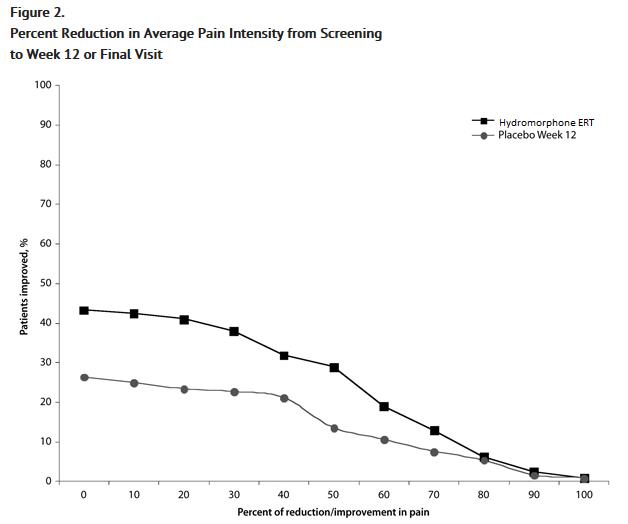
A 12-week double-blind, placebo-controlled, randomized withdrawal study was conducted in opioid tolerant patients with moderate to severe low back pain
[see Clinical Studies (14)]. A total of 447 patients were enrolled into the open-label titration phase with 268 patients randomized into the double-blind treatment phase. The adverse reactions that were reported in at least 2% of the patients are contained in
Table 2.
Table 2.
Number (%) of Patients with Adverse Reactions Reported in ≥ 2% of Patients
with Moderate to Severe Low Back Pain During the Open-Label Titration Phase or Double-Blind Treatment Phase by Preferred Term
Preferred Term | Open-Label Titration Phase | Double-Blind Treatment Phase |
| Hydromorphone Hydrochloride Extended-Release Tablets(N=447) | Hydromorphone Hydrochloride
Extended-Release Tablets (N=134)
| Placebo (N=134) |
Constipation | 69 (15) | 10 (7) | 5 (4) |
Nausea | 53 (12) | 12 (9) | 10 (7) |
Somnolence | 39 (9) | 1 (1) | 0 (0) |
Headache | 35 (8) | 7 (5) | 10 (7) |
Vomiting | 29 (6) | 8 (6) | 6 (4) |
Pruritus | 21 (5) | 1 (1) | 0 (0) |
Dizziness | 17 (4) | 3 (2) | 2 (1) |
Insomnia | 13 (3) | 7 (5) | 5 (4) |
Dry Mouth | 13 (3) | 2 (1) | 0 (0) |
Edema Peripheral | 13 (3) | 3 (2) | 1 (1) |
Hyperhidrosis | 13 (3) | 2 (1) | 2 (1) |
Anorexia/Decreased Appetite | 10 (2) | 2 (1) | 0 (0) |
Arthralgia | 9 (2) | 8 (6) | 3 (2) |
Abdominal Pain | 9 (2) | 4 (3) | 3 (2) |
Muscle Spasms | 5 (1) | 3 (2) | 1 (1) |
Weight Decreased | 3 (1) | 4 (3) | 3 (2) |
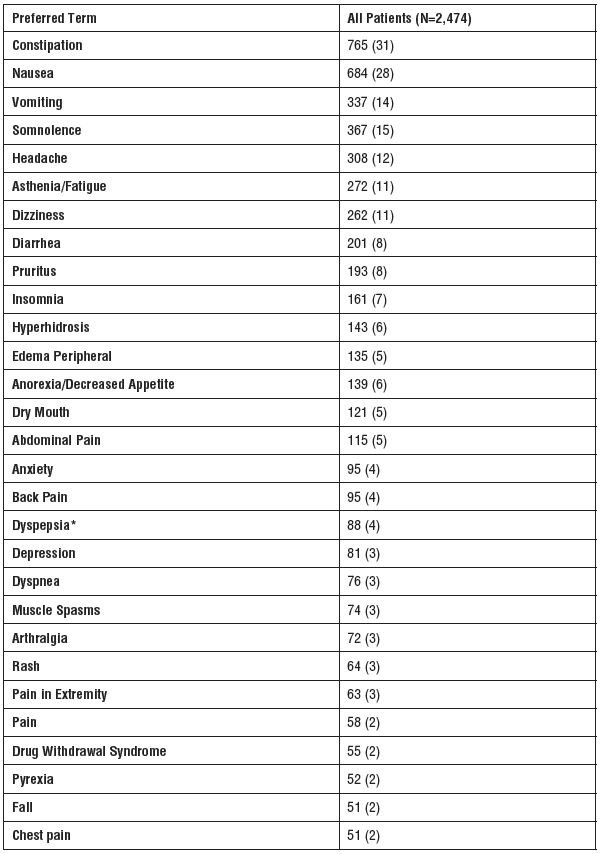
The adverse reactions that were reported in at least 2% of the total treated patients (N=2,474) in the 14 chronic clinical trials are contained in
Table 3.
Table 3.
Number (%) of Patients with Adverse Reactions Reported in ≥ 2% of Patients
with Chronic Pain Receiving Hydromorphone Hydrochloride Extended-Release Tablets in 14 Clinical Studies by Preferred Term
Preferred Term | All Patients (N=2,474) |
Constipation | 765 (31) |
Nausea | 684 (28) |
Vomiting | 337 (14) |
Somnolence | 367 (15) |
Headache | 308 (12) |
Asthenia/Fatigue | 272 (11) |
Dizziness | 262 (11) |
Diarrhea | 201 (8) |
Pruritus | 193 (8) |
Insomnia | 161 (7) |
Hyperhidrosis | 143 (6) |
Edema Peripheral | 135 (5) |
Anorexia/Decreased Appetite | 139 (6) |
Dry Mouth | 121 (5) |
Abdominal Pain | 115 (5) |
Anxiety | 95 (4) |
Back Pain | 95 (4) |
Dyspepsia* | 88 (4) |
Depression | 81 (3) |
Dyspnea | 76 (3) |
Muscle Spasms | 74 (3) |
Arthralgia | 72 (3) |
Rash | 64 (3) |
Pain in Extremity | 63 (3) |
Pain | 58 (2) |
Drug Withdrawal Syndrome | 55 (2) |
Pyrexia | 52 (2) |
Fall | 51 (2) |
Chest pain | 51 (2) |
* Reflux esophagitis, gastroesophageal reflux disease and Barrett’s esophagus were grouped and reported with dyspepsia
The following Adverse Reactions occurred in patients with an overall frequency of < 2% and are listed in descending order within each System Organ Class:
Cardiac disorders: palpitations, tachycardia, bradycardia, extrasystoles
Ear and labyrinth disorders: vertigo, tinnitus
Endocrine disorders: hypogonadism
Eye disorders: vision blurred, diplopia, dry eye, miosis
Gastrointestinal disorders: flatulence, dysphagia, hematochezia, abdominal distension, hemorrhoids, abnormal feces, intestinal obstruction, eructation, diverticulum, gastrointestinal motility disorder, large intestine perforation, anal fissure, bezoar, duodenitis, ileus, impaired gastric emptying, painful defecation
General disorders and administration site conditions: chills, malaise, feeling abnormal, feeling of body temperature change, feeling jittery, hangover, gait disturbance, feeling drunk, body temperature decreased
Infections and infestations: gastroenteritis, diverticulitis
Injury, poisoning and procedural complications: contusion, overdose
Investigations: weight decreased, hepatic enzyme increased, blood potassium decreased, blood amylase increased, blood testosterone decreased
Metabolism and nutrition disorders: dehydration, fluid retention, increased appetite, hyperuricemia
Musculoskeletal and connective tissue disorders: myalgia
Nervous system disorders: tremor, sedation, hypoesthesia, paresthesia, disturbance in attention, memory impairment, dysarthria, syncope, balance disorder, dysgeusia, depressed level of consciousness, coordination abnormal, hyperesthesia, myoclonus, dyskinesia, crying, hyperreflexia, encephalopathy, cognitive disorder, convulsion, psychomotor hyperactivity
Psychiatric disorders: confusional state, nervousness, restlessness, abnormal dreams, mood altered, hallucination, panic attack, euphoric mood, paranoia, dysphoria, listless, suicide ideation, libido decreased, aggression
Renal and urinary disorders: dysuria, urinary retention, urinary frequency, urinary hesitation, micturition disorder
Reproductive system and breast disorders: erectile dysfunction, sexual dysfunction
Respiratory, thoracic and mediastinal disorders: rhinorrhea, respiratory distress, hypoxia, bronchospasm, sneezing, hyperventilation, respiratory depression
Skin and subcutaneous tissue disorders: erythema
Vascular disorders: flushing, hypertension, hypotension