- Infuse diluted solution intravenously over 90 minutes. Do not use in-line filters. Discard unused portion.
Cholinergic Reactions: ONIVYDE can cause cholinergic reactions manifesting as rhinitis, increased salivation, flushing, bradycardia, miosis, lacrimation, diaphoresis, and intestinal hyperperistalsis with abdominal cramping and early onset diarrhea. In Study 1, Grade 1 or 2 cholinergic symptoms other than early diarrhea occurred in 12 (4.5%) ONIVYDE-treated patients. Six of these 12 patients received atropine and in 1 of the 6 patients, atropine was administered for cholinergic symptoms other than diarrhea.
Infusion Reactions: Infusion reactions, consisting of rash, urticaria, periorbital edema, or pruritus, occurring on the day of ONIVYDE administration were reported in 3% of patients receiving ONIVYDE or ONIVYDE/5-FU/LV.
Laboratory abnormalities that occurred with higher incidence in the ONIVYDE/5-FU/LV arm compared to the 5-FU/LV arm (≥5% difference) are summarized in the following table.
Table 3: Laboratory Abnormalities with Higher Incidence (≥5% Difference) in the ONIVYDE/5-FU/LV ArmNCI CTCAE v4.0, worst grade shown.
Percent based on number of patients with a baseline and at least one post-baseline measurement.
| Laboratory abnormality | ONIVYDE/5-FU/LV
N=117 | 5-FU/LV
N=134 |
|---|
Grades 1-4
(%) | Grades 3-4
(%) | Grades 1-4
(%) | Grades 3-4
(%) |
|---|
| Hematology |
| Anemia | 97 | 6 | 86 | 5 |
| Lymphopenia | 81 | 27 | 75 | 17 |
| Neutropenia | 52 | 20 | 6 | 2 |
| Thrombocytopenia | 41 | 2 | 33 | 0 |
| Hepatic |
| Increased alanine aminotransferase (ALT) | 51 | 6 | 37 | 1 |
| Hypoalbuminemia | 43 | 2 | 30 | 0 |
| Metabolic |
| Hypomagnesemia | 35 | 0 | 21 | 0 |
| Hypokalemia | 32 | 2 | 19 | 2 |
| Hypocalcemia | 32 | 1 | 20 | 0 |
| Hypophosphatemia | 29 | 4 | 18 | 1 |
| Hyponatremia | 27 | 5 | 12 | 3 |
| Renal |
| Increased creatinine | 18 | 0 | 13 | 0 |
Risk Summary
Based on animal data with irinotecan HCl and the mechanism of action of ONIVYDE, ONIVYDE can cause fetal harm when administered to a pregnant woman [see Clinical Pharmacology (12.1)]. There are no available data in pregnant women. Embryotoxicity and teratogenicity were observed following treatment with irinotecan HCl, at doses resulting in irinotecan exposures lower than those achieved with ONIVYDE 70 mg/m2 in humans, administered to pregnant rats and rabbits during organogenesis [see Data]. Advise pregnant women of the potential risk to a fetus.
In the U.S. general population, the estimated background risk of major birth defects and miscarriage in clinically recognized pregnancies is 2-4% and 15-20%, respectively.
Data
Animal Data
No animal studies have been conducted to evaluate the effect of irinotecan liposome on reproduction and fetal development; however, studies have been conducted with irinotecan HCl. Irinotecan crosses the placenta of rats following intravenous administration. Intravenous administration of irinotecan at a dose of 6 mg/kg/day to rats and rabbits during the period of organogenesis resulted in increased post-implantation loss and decreased numbers of live fetuses. In separate studies in rats, this dose resulted in an irinotecan exposure of approximately 0.002 times the exposure of irinotecan based on area under the curve (AUC) in patients administered ONIVYDE at the 70 mg/m2 dose. Administration of irinotecan HCl resulted in structural abnormalities and growth delays in rats at doses greater than 1.2 mg/kg/day (approximately 0.0002 times the clinical exposure to irinotecan in ONIVYDE based on AUC). Teratogenic effects included a variety of external, visceral, and skeletal abnormalities. Irinotecan HCl administered to rat dams for the period following organogenesis through weaning at doses of 6 mg/kg/day caused decreased learning ability and decreased female body weights in the offspring.
Risk Summary
There is no information regarding the presence of irinotecan liposome, irinotecan, or SN-38 (an active metabolite of irinotecan) in human milk, or the effects on the breastfed infant or on milk production. Irinotecan is present in rat milk [see Data].
Because of the potential for serious adverse reactions in breastfed infants from ONIVYDE, advise a nursing woman not to breastfeed during treatment with ONIVYDE and for one month after the final dose.
Data
Radioactivity appeared in rat milk within 5 minutes of intravenous administration of radiolabeled irinotecan HCl and was concentrated up to 65-fold at 4 hours after administration relative to plasma concentrations.
Contraception
Females
ONIVYDE can cause fetal harm when administered to a pregnant woman [see Use in Specific Populations (8.1)]. Advise females of reproductive potential to use effective contraception during treatment with ONIVYDE and for one month after the final dose.
Males
Because of the potential for genotoxicity, advise males with female partners of reproductive potential to use condoms during treatment with ONIVYDE and for four months after the final dose [see Nonclinical Toxicology (13.1)].
Distribution
Direct measurement of irinotecan liposome showed that 95% of irinotecan remains liposome-encapsulated, and the ratios between total and encapsulated forms did not change with time from 0 to 169.5 hours post-dose. The mean volume of distribution is summarized in Table 4.
Plasma protein binding is <0.44% of the total irinotecan in ONIVYDE.
Elimination
Metabolism
The metabolism of irinotecan liposome has not been evaluated. Irinotecan is subject to extensive metabolic conversion by various enzyme systems, including esterases to form the active metabolite SN-38, and UGT1A1 mediating glucuronidation of SN-38 to form the inactive glucuronide metabolite SN-38G. Irinotecan can also undergo CYP3A4-mediated oxidative metabolism to several inactive oxidation products, one of which can be hydrolyzed by carboxylesterase to release SN-38. In the population pharmacokinetic analysis using the results of a subset with UGT1A1*28 genotypic testing, in which the analysis adjusted for the lower dose administered to patients homozygous for the UGT1A1*28 allele, patients homozygous (N=14) and non-homozygous (N=244) for this allele had total SN-38 average steady-state concentrations of 1.06 and 0.95 ng/mL, respectively.
Excretion
The disposition of ONIVYDE has not been elucidated in humans. Following administration of irinotecan HCl , the urinary excretion of irinotecan is 11 to 20%; SN-38, <1%; and SN-38 glucuronide, 3%. The cumulative biliary and urinary excretion of irinotecan and its metabolites (SN-38 and SN-38 glucuronide), over a period of 48 hours following administration of irinotecan HCl in two patients, ranged from approximately 25% (100 mg/m2) to 50% (300 mg/m2).
Specific Populations
Age, Gender, and Renal Impairment:
The population pharmacokinetic analysis suggests that age (28 to 87 years) had no clinically meaningful effect on the exposure of irinotecan and SN-38.
The population pharmacokinetic analysis suggests that gender (196 males and 157 females) had no clinically meaningful effect on the exposure of irinotecan and SN-38 after adjusting for body surface area (BSA).
In a population pharmacokinetic analysis, mild-to-moderate renal impairment had no effect on the exposure of total SN-38 after adjusting for BSA. The analysis included 68 patients with moderate (CLcr 30 - 59 mL/min) renal impairment, 147 patients with mild (CLcr 60 - 89 mL/min) renal impairment, and 135 patients with normal renal function (CLcr > 90 mL/min). There was insufficient data in patients with severe renal impairment (CLcr < 30 mL/min) to assess its effect on pharmacokinetics.
Ethnicity: The population pharmacokinetic analysis suggests that Asians (East Asians, N=150) have 56% lower total irinotecan average steady state concentration and 8% higher total SN-38 average steady state concentration than Whites (N=182).
Hepatic Impairment: The pharmacokinetics of irinotecan liposome have not been studied in patients with hepatic impairment. In a population pharmacokinetic analysis, patients with baseline bilirubin concentrations of 1-2 mg/dL (N=19) had average steady state concentrations for total SN-38 that were increased by 37% compared to patients with baseline bilirubin concentrations of <1 mg/dL (N=329); however, there was no effect of elevated ALT/AST concentrations on total SN-38 concentrations. No data are available in patients with bilirubin >2 mg/dL.
Drug Interactions
In a population pharmacokinetic analysis, the pharmacokinetics of total irinotecan and total SN-38 were not altered by the co-administration of fluorouracil/leucovorin.
Following administration of irinotecan HCl, dexamethasone, a moderate CYP3A4 inducer, does not alter the pharmacokinetics of irinotecan.
In vitro studies indicate that irinotecan, SN-38 and another metabolite, aminopentane carboxylic acid (APC), do not inhibit cytochrome P-450 isozymes.
How Supplied
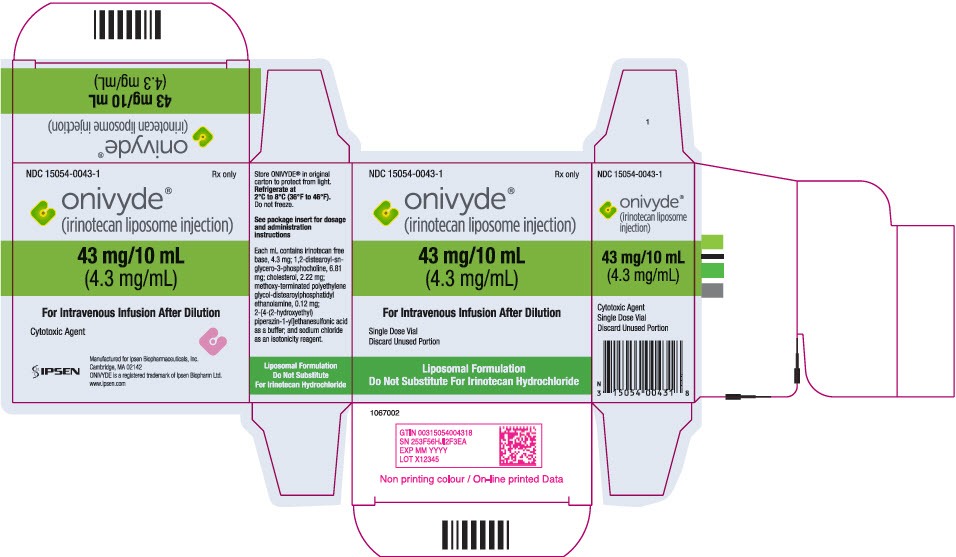
ONIVYDE is available in a single-dose vial containing 43 mg irinotecan free base at a concentration of 4.3 mg/mL
NDC: 15054-0043-1
Severe Neutropenia
Advise patients of the risk of neutropenia leading to severe and life-threatening infections and the need for monitoring of blood counts. Instruct patients to contact their healthcare provider immediately if experiencing signs of infection, such as fever, chills, dizziness, or shortness of breath [see Warnings and Precautions (5.1)].
Severe Diarrhea
Inform patients of the risk of severe diarrhea. Advise patients to contact their healthcare provider if they experience persistent vomiting or diarrhea; black or bloody stools; or symptoms of dehydration such as lightheadedness, dizziness, or faintness [see Warnings and Precautions (5.2)].
Interstitial Lung Disease
Inform patients of the potential risk of ILD. Advise patients to contact their healthcare provider as soon as possible for new onset cough or dyspnea [see Interstitial Lung Disease (5.3)].
Hypersensitivity to irinotecan HCl or ONIVYDE
Advise patients of the potential risk of severe hypersensitivity and that ONIVYDE is contraindicated in patients with a history of severe allergic reactions with irinotecan HCl or ONIVYDE. Instruct patients to seek immediate medical attention for signs of severe hypersensitivity reaction such as chest tightness; shortness of breath; wheezing; dizziness or faintness; or swelling of the face, eyelids, or lips [see Contraindications (4) and Warnings and Precautions (5.4)].
Females and males of reproductive potential
Embryo-fetal toxicity: Inform females of reproductive potential of the potential risk to a fetus, to use effective contraception during treatment and for one month after the final dose, and to inform their healthcare provider of a known or suspected pregnancy [see Warnings and Precautions (5.5), Use in Specific Populations (8.1, 8.3)].
Contraception: Advise male patients with female partners of reproductive potential to use condoms during treatment with ONIVYDE and for four months after the final dose [see Females and Males of Reproductive Potential (8.3)].
Lactation
Advise women not to breastfeed during treatment with ONIVYDE and for one month after the final dose [see Use in Special Populations (8.2)].
Manufactured for:
Ipsen Biopharmaceuticals, Inc.Basking Ridge, NJ 07920
ONIVYDE is a registered trademark of Ipsen Biopharm Ltd.