Limitations of Use
Use of IQIRVO is not recommended in patients who have or develop decompensated cirrhosis (e.g., ascites, variceal bleeding, hepatic encephalopathy) [see Use in Specific Populations (8.7), Clinical Pharmacology (12.3)].
Common Adverse Reactions
Table 1 presents common adverse reactions that occurred in Study 1.
Table 1: Common Adverse Reactions Occurring During the Double-Blind Period in Adult Patients with PBC (Study 1)Included 8 patients (5%) who were intolerant to UDCA and initiated treatment as monotherapy: 6 patients (5%) in the IQIRVO arm and 2 patients (4%) in the placebo arm.
| Adverse Reaction Occurring in greater than or equal to 5% of patients in the IQIRVO treatment arm and at an incidence greater than or equal to 1% higher than in the placebo treatment arm. | IQIRVO 80 mg Once Daily
N = 108
% (n) | Placebo
N = 53
% (n) |
|---|
| Weight gain Weight gain, abdominal pain, muscle pain, fracture, and rash include other related terms. | 23% (25) | 21% (11) |
| Diarrhea | 11% (12) | 9% (5) |
| Abdominal pain | 11% (12) | 6% (3) |
| Nausea | 11% (12) | 6% (3) |
| Vomiting | 11% (12) | 2% (1) |
| Arthralgia | 8% (9) | 4% (2) |
| Constipation | 8% (9) | 2% (1) |
| Muscle pain | 7% (8) | 2% (1) |
| Fracture | 6% (7) | 0 |
| Gastroesophageal reflux disease | 6% (7) | 2% (1) |
| Dry mouth | 5% (5) | 2% (1) |
| Weight loss | 5% (5) | 0 |
| Rash | 5% (5) | 4% (2) |
Myalgia, Myopathy, and Rhabdomyolysis
Muscle injury included rhabdomyolysis, CPK elevation with or without myalgia, and myopathy. Rhabdomyolysis and acute kidney injury (AKI) occurred in one IQIRVO-treated patient who had cirrhosis at baseline and was also on a stable dose of an HMG-CoA reductase inhibitor for a year. Median time to development of myalgia was 85.5 days (interquartile range: 29, 291). CPK elevation and/or myalgia occurred in patients on IQIRVO monotherapy as well as in patients who were concomitantly treated with an HMG-CoA reductase inhibitor.
Table 2 presents the frequency of muscle injury related adverse reactions in Study 1.
Table 2: Muscle Injury Related Adverse Reactions During the Double-Blind Period in Adult Patients with PBC in Study 1| Adverse Reaction | IQIRVO 80 mg Once Daily
N = 108
% (n) | Placebo
N = 53
% (n) |
|---|
| Creatine phosphokinase (CPK) increased (>3× ULN) | 4% (4) Two patients receiving IQIRVO 80 mg once daily were on a concomitant HMG-CoA reductase inhibitor | 0 |
| Myalgia | 4% (4) | 2% (1) |
| CPK increased and Myalgia | 1% (1) One patient receiving IQIRVO 80 mg once daily was on a concomitant HMG-CoA reductase inhibitor | 0 |
| Rhabdomyolysis and AKI AKI: Acute kidney injury | 1% (1) | 0 |
Fractures
Fractures occurred in 6% (n=7) of IQIRVO-treated patients compared to no placebo-treated patients. The median time to fracture after receiving IQIRVO was 122 days (interquartile range: 48, 258).
Less Common Adverse Reactions
Additional adverse reactions that occurred more frequently in the IQIRVO-treated patients compared to placebo, but in less 5% of patients included dizziness, gastroenteritis, increased blood creatinine, and anemia.
Cholelithiasis and Cholecystitis
New onset of cholelithiasis was detected in 3 (3%) IQIRVO-treated patients compared to no placebo-treated patients. The three IQIRVO-treated patients were taking UDCA concomitantly. An additional patient who had gallstones at baseline developed cholecystitis requiring cholecystectomy.
Risk Summary
Based on data from animal reproduction studies, IQIRVO may cause fetal harm when administered during pregnancy. Treatment of pregnant rats with elafibranor during organogenesis through lactation resulted in stillbirths, reduced survival, decrease in pup body weight, and/or blue/black discoloration of the caudal section of body, which occurred at maternal plasma drug exposures lower than or approximately equal to human exposure at the recommended dose (see Data). There are insufficient data from human pregnancies exposed to IQIRVO to allow an assessment of a drug-associated risk of major birth defects, miscarriage, or other adverse maternal or fetal outcomes.
The background risk of major birth defects and miscarriage for the indicated population is unknown. All pregnancies have a background risk of birth defect, loss, or other adverse outcomes. In the U.S. general population, the estimated background risk of major birth defects and miscarriage in clinically recognized pregnancies is 2-4% and 15-20%, respectively.
Report pregnancies to Ipsen Pharmaceuticals, Inc. Adverse Event reporting line at 1-855-463-5127 and [https://www.ipsen.com/contact-us/].
Data
Animal Data
No effects on embryo-fetal development were observed in pregnant rats treated orally with up to 300 mg/kg/day elafibranor (15-times the recommended dose based on combined AUC [area under the plasma concentration-time curve] for elafibranor and GFT1007) during the period of organogenesis.
No adverse effects on embryo-fetal development were observed in pregnant rabbits treated orally with doses up to 100 mg/kg/day elafibranor, which produced systemic exposures (combined AUC for elafibranor and GFT1007) during the period of organogenesis that were less than the human exposure. Administration of 300 mg/kg/day (3.9-times the recommended dose based on combined AUC for elafibranor and GFT1007) produced marked maternal toxicity, embryo-lethality, reduced fetal weight, and a low incidence of fetal malformations. Variations in ossification of distal limb bones occurred at 100 mg/kg/day, which was associated with strong signs of maternal toxicity (e.g., body weight loss).
A pre- and postnatal development study was performed using oral administration of 10, 30, or 100 mg/kg/day elafibranor in female rats during organogenesis through lactation. All doses produced a reduction in pup survival (during postnatal days 1-4 at 100 mg/kg/day and postnatal days 5-21 at 10 mg/kg/day and higher), a decrease in pup body weight (dose-dependent, up to -28% on postnatal day 1), blue/black discoloration of the caudal section of body, and developmental delays based on evaluation of physical landmarks and functional tests. The developmental delays were likely caused by the decrease in body weight. Adverse effects in the offspring occurred at maternal exposures at or above 0.6-times the recommended dose based on combined AUC for elafibranor and GFT1007. Stillbirths were observed in the 30 and 100 mg/kg/day groups (1.3 and 4.9-times the recommended dose, respectively, based on combined AUC for elafibranor and GFT1007). Aortic or iliac arterial thrombosis was found in decedent pups from females treated with 30 or 100 mg/kg/day. The surviving adult offspring showed no effects on learning and memory, reflex development, or reproductive capability.
Risk Summary
There are no data available on the presence of elafibranor or its metabolites in human or animal milk, or on effects of the drug on the breastfed infant or the effects on milk production. Because of the potential for serious adverse reactions in the breastfed infant, advise patients not to breastfeed during treatment with IQIRVO, and for 3 weeks after the last dose.
Pregnancy Testing
For females of reproductive potential, verify that the patient is not pregnant prior to initiating IQIRVO.
Contraception
Females
Advise females of reproductive potential to use effective contraception (non-hormonal) or add a barrier method of contraception when using hormonal contraceptives during treatment with IQIRVO and for 3 weeks after the last dose.
Cardiac Electrophysiology
At 3.75-times the recommended dose of 80 mg, IQIRVO did not cause clinically significant QTc interval prolongation.
Absorption
Following once daily dosing of 80 mg in patients with PBC, median time to peak plasma concentrations (Tmax) of elafibranor and GFT1007 was 1.25 hours (range: 0.5-2 hours).
Effect of Food
When administered with a high-fat and high-calorie meal, Tmax was delayed by 30 minutes for elafibranor and by 1-hour for GFT1007 compared to in fasted conditions. Under fed condition, mean Cmax and AUC of elafibranor decreased by 50% and 15% respectively and mean Cmax of GFT1007 decreased by 30%, but the AUC was not affected compared to fasted conditions. The difference was not clinically meaningful.
Distribution
Plasma protein binding of both elafibranor and GFT1007 was approximately 99.7% (mainly to serum albumin). The mean apparent volume of distribution (Vd/F) of elafibranor in healthy subjects was 4731 L, following a single dose of elafibranor at 80 mg in fasted conditions.
Elimination
Following a single 80 mg dose under fasted conditions, median elimination half-life was 70.2 hours (range 37.1 to 92.2 hours) for elafibranor, and 15.4 hours (range 9.39 to 21.7 hours) for major active metabolite GFT1007. Elafibranor mean apparent total clearance (CL/F) was 50.0 L/h after a single 80 mg dose under fasted conditions.
Metabolism
Elafibranor is extensively metabolized to form a major active metabolite, GFT1007. The mean systemic exposure (AUC) to GFT1007 was 3.2-fold higher than that of elafibranor at steady state. Additional major inactive metabolite, an acyl glucuronide conjugate GFT3351 that consisted of four stereoisomers was formed.
In vitro studies showed that elafibranor was metabolized by cytosolic enzyme, 15-ketoprostaglandin 13-Δ reductase (PTGR1), to form GFT1007. Elafibranor was also metabolized by CYP2J2, and uridine diphosphate (UDP)-glucuronosyltransferase (UGT) isoforms, UGT1A3, UGT1A4, and UGT2B7. GFT1007 was further metabolized by CYP2C8 and UGT1A3 and UGT2B7.
Excretion
Following a single 120 mg oral dose (1.5-times the recommended dose) of 14C-radiolabelled elafibranor in healthy subjects, approximately 77.1% of the dose was recovered in feces, primarily as elafibranor (56.7% of the administered dose) and its major metabolite GFT1007 (6.08% of the administered dose). Approximately 19.3% was recovered in urine, primarily as glucuronide conjugate GFT3351 (11.8% of the administered dose). A negligible amount of unchanged elafibranor or GFT1007 was detectable in the urine. Biliary excretion of elafibranor in humans was suggested by the excretion of 60% of orally administered elafibranor in the bile of rats.
Specific Populations
There was no evidence that sex and body mass index (BMI) (14.5 to 53.5 kg/m2) or body weight (43 kg to 120 kg) had any clinically meaningful impact on PK of elafibranor and GFT1007.
Age
Following single dose 120 mg elafibranor administration (1.5-times the recommended dose), the AUCinf of elafibranor and GFT1007 was 23% and 51% higher, respectively in healthy elderly subjects (age range 75-80 years) than in healthy young subjects (age 26-42 years) [see Use in Specific Populations (8.5)].
Patients with Renal Impairment
Following a single dose of 120 mg elafibranor administration (1.5-times the recommended dose), the systemic exposure of elafibranor was 32% lower and GFT1007 was not significantly different between patients with normal renal function and patients with severe renal impairment (eGFR < 15 mL/min/1.73 m2, Modification of Diet in Renal Disease (MDRD)) but not yet on dialysis. The unbound fraction of elafibranor was 21% lower and GFT1007 was not significantly different between patients with normal renal function and patients with severe renal impairment [see Use in Specific Populations (8.6)].
Patients with Hepatic Impairment
Following a single dose 120 mg elafibranor administration (1.5-times the recommended dose), no clinically significant differences in the pharmacokinetics of elafibranor or GFT1007 (mean change < 30%) were observed in patients with hepatic impairment (Child-Pugh A, B and C). However, the unbound fraction of elafibranor and GFT1007 was significantly increased by 2-fold and 2.6-fold, respectively, in patients with severe hepatic impairment (Child-Pugh C) [see Use in Specific Populations (8.7)].
Drug Interactions
Effect of IQIRVO on the Pharmacokinetics of Other Drugs
In vitro Studies:
Elafibranor, GFT1007 and GFT3351 did not inhibit CYP1A2, CYP2B6, CYP2C8, CYP2C9, CYP2C19, CYP2D6, and CYP3A4. No time dependent CYP inhibition is observed. Elafibranor and GFT1007 did not induce CYP1A2, CYP2B6, and CYP3A4. The CYP induction potential for GFT3351 was not assessed.
Elafibranor is not expected to inhibit UGT1A1, 1A3, 1A4, 1A6, 1A9, 2B7, 2B10, and 2B15 at the clinically relevant concentrations. GFT1007 is not expected to inhibit UGT1A1, 1A3, 1A4, 1A9, 2B7, 2B10, and 2B15 at the clinically relevant concentrations.
GFT1007 inhibited UGT1A6 but the clinical relevance of UGT1A6 inhibition is unknown.
Elafibranor is an inhibitor of bile salt export pump (BSEP) and breast cancer resistance protein (BCRP) and the clinical significance of BSEP and BCRP inhibition by elafibranor is unknown.
GFT3351 is an inhibitor of multidrug resistance associated protein 2 (MRP2) and MRP3 and the clinical significance of MRP2 and MRP3 inhibition by GFT3351 is unknown.
Elafibranor did not inhibit permeability-glycoprotein/multidrug resistance protein 1 (P-gp/MDR1), organic anion transporting polypeptides 1B1 (OATP1B1), organic cation transporter 1 (OCT1), OCT2, organic anion transporter 1 (OAT1), multidrug and toxin extrusion protein 1 (MATE1), MATE2-K and OAT3 and OATP1B3.
GFT1007 did not inhibit OAT3, OATP1B3, BSEP, P-gp/MDR1, BCRP, OATP1B1, OCT1, OCT2, OAT1, MATE1 and MATE2-K. GFT3351 did not inhibit BCRP, P-gp, OATP1B1, OATP1B3, OAT1, OAT2, OAT3, OCT1, OCT2, MATE1, MATE2-K, and BSEP.
Clinical Studies:
Warfarin (CYP2C9 Substrate):
No clinically significant differences in Cmax and AUC of S-warfarin and R-warfarin were observed when a single dose of warfarin 15 mg was administered with elafibranor 120 mg once daily at steady state compared to administered alone. No difference in international normalized ratio (INR) was observed.
Simvastatin (CYP3A4, OATP1B1 and OATP1B3 Substrates):
The active metabolite of simvastatin, simvastatin β-hydroxyacid Cmax decreased by 26% and AUCinf decreased by 32% following concomitant use of a single dose of simvastatin 20 mg and elafibranor 80 mg once daily at steady state. The change in simvastatin β-hydroxyacid exposure was not considered clinically meaningful. The results indicate that IQIRVO is a weak CYP3A4 inducer [see Drug Interaction (7.1)].
Atorvastatin (CYP3A, OATP1B1 and OATP1B3 Substrates):
Atorvastatin Cmax decreased by 28% and AUCinf decreased by 12% following concomitant use of a single dose of atorvastatin 40 mg and elafibranor 180 mg once daily at steady state. The change in atorvastatin exposure was not considered clinically meaningful.
Sitagliptin (dipeptidyl peptidase-IV (DPP-IV) Inhibitor):
In healthy subjects, no significant differences in plasma glucose and glucagon-like peptide-1 (GLP-1) were observed when elafibranor 120 mg was co-administered with sitagliptin 75 mg BID in comparison to administering sitagliptin alone. The relevance of the results to patients is unclear.
Effect of Other Drugs on the Pharmacokinetics of IQIRVO
In vitro Studies:
Elafibranor is a substrate of PTGR1 as well as CYP2J2 and UGT enzymes (e.g., UGT1A3, UGT1A4, and UGT2B7). GFT1007 is a substrate of CYP2C8 and UGT enzymes (e.g., UGT1A3 and UGT2B7).
Elafibranor is a substrate for MRP2 and BCRP. Potential impact of concomitant MRP2 or BCRP inhibitors was not studied in humans; thus, the clinical significance is unknown. GFT1007 is not a substrate for BCRP or MRP2. Neither elafibranor nor GFT1007 is a substrate of P-gp, OATP1B1, OATP1B3, OAT1, OAT3 and OCT2.
Clinical Study:
Indomethacin (PTGR1 Inhibitor):
No clinically significant differences in the pharmacokinetics (Cmax and AUC) of elafibranor and GFT1007 were observed when a single dose of elafibranor 120 mg was administered with indomethacin 75 mg after indomethacin was administered alone twice daily for 5 days.
Carcinogenesis
In a 2-year study in CD-1 mice, oral administration of elafibranor produced hepatocellular tumors (adenoma or carcinoma) in both sexes at doses of 1, 3, 10, and 30 mg/kg/day (0.007 to 0.14 times the recommended dose in males and 0.003 to 0.16 times the recommended dose in females based on combined AUC for elafibranor and GFT1007).
In a 2-year study in Sprague-Dawley rats, oral administration of elafibranor produced hepatocellular tumors (adenoma or carcinoma) at 10 mg/kg/day and higher in males (0.36 times the recommended dose based on combined AUC for elafibranor and GFT1007) and at 30 mg/kg/day in females (2.1 times the recommended dose based on combined AUC for elafibranor and GFT1007). In males, elafibranor also produced pancreatic acinar cell adenoma and testicular Leydig cell adenoma at 30 mg/kg/day (2.1 times the recommended dose based on combined AUC for elafibranor and GFT1007).
The liver tumors in mice and rats may be attributed to the expected rodent-specific PPARα-related liver toxicity and its related consequences. Therefore, the relevance to humans is uncertain.
Mutagenesis
Elafibranor was negative in the in vitro bacterial reverse mutation (Ames) assay, the in vivo rat micronucleus assay, and the in vivo rat comet assay. Elafibranor was mutagenic in L5178Y tk+/- mouse lymphoma cells in the absence or presence of metabolic activation and it induced the formation of micronuclei in this cell line in the presence of metabolic activation.
The metabolites GFT1007 and racemic GFT3351 were both negative in the in vitro bacterial reverse mutation (Ames) assay. GFT1007 tested negative in the in vitro micronucleus assay in L5178Y tk+/- mouse lymphoma cells, and GFT3351 tested negative in the in vitro micronucleus assay in human lymphocytes.
The overall data and weight-of-evidence from the comprehensive battery of in vivo and in vitro genotoxicity assays conducted for elafibranor, its principal active metabolite GFT1007, and the acyl glucuronide metabolite racemic GFT3351 indicate that the parent drug and its tested metabolites are unlikely to have genotoxic potential.
Impairment of Fertility
Elafibranor produced no adverse effects on rat fertility or early embryonic development at oral doses up to 100 mg/kg/day (5.9 times the recommended dose in females and 7.4 times the recommended dose in males based on combined AUC for elafibranor and GFT1007).
How Supplied
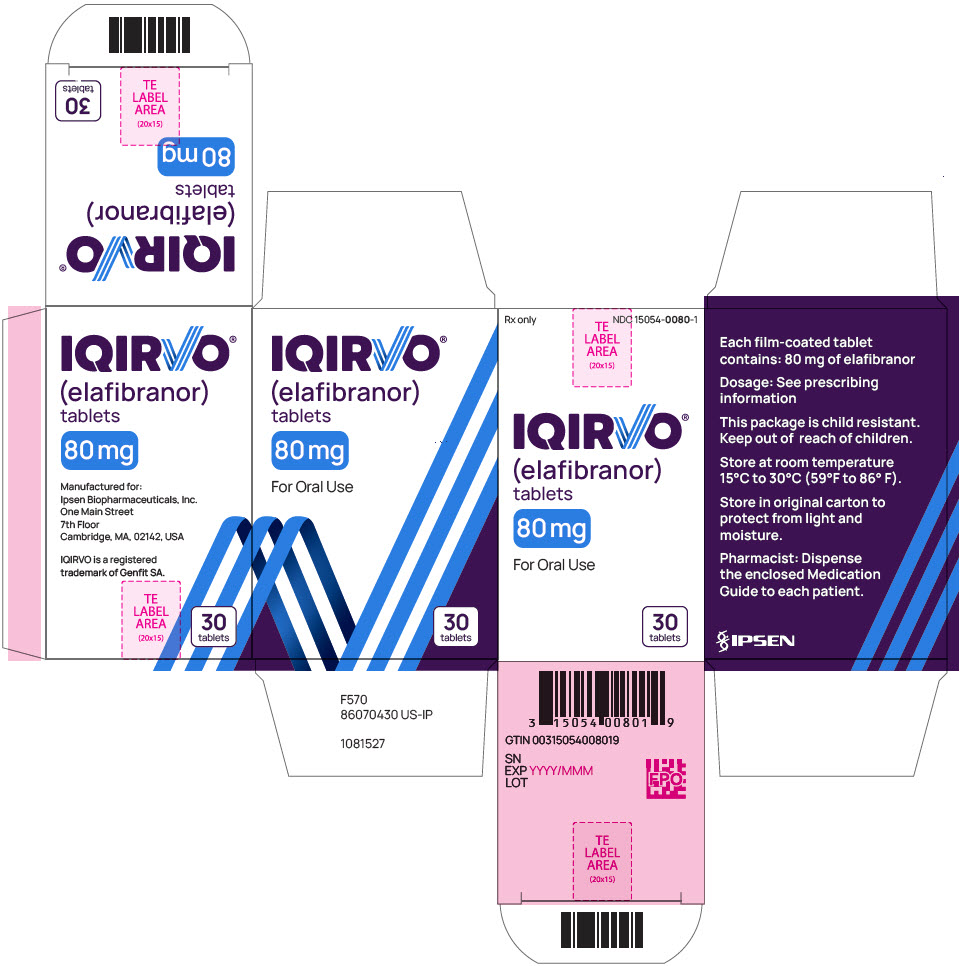
IQIRVO (elafibranor) tablets are available as 80 mg, round, orange, film-coated tablets, debossed with 'ELA 80' on one side and plain on the other side.
IQIRVO is supplied in a child-resistant 30 count bottle (NDC 15054-0080-1).
Myalgia, Myopathy, and Rhabdomyolysis
Advise patients that IQIRVO may cause rhabdomyolysis. Inform patients to report immediately to their healthcare provider any unexplained muscle symptoms such as pain, soreness, or weakness [see Warnings and Precautions (5.1)].
Fractures
Inform patients or their caregiver(s) that IQIRVO may increase the risk of bone fractures. Advise patients to call their healthcare provider to report any fractures [see Warnings and Precautions (5.2)].
Adverse Effects on Fetal and Newborn Development
Advise pregnant women and females of reproductive potential of the potential risk to the fetus and to inform their healthcare providers of a known, suspected, or planned pregnancy during treatment with IQIRVO. Inform patients to report their pregnancy to Ipsen Biopharmaceuticals, Inc. at (1-855-463-5217). Advise females of reproductive potential to use effective contraception during treatment and for 3 weeks after the last dose of IQIRVO [see Warning and Precautions (5.3), Use in Specific Population (8.1, 8.3)].
Lactation
Advise women not to breastfeed during treatment with IQIRVO and for 3 weeks after the last dose [see Use in Specific Populations (8.2)].
Drug-Induced Liver Injury
Inform patients of the risk of IQIRVO-induced liver injury. Instruct patients to report any signs or symptoms of liver injury (e.g., loss of appetite, nausea, increased fatigue, lower extremity edema, abdominal swelling, or jaundice/icterus) to their healthcare provider [see Warnings and Precautions (5.4)].
Hypersensitivity Reactions
Advise patients to contact their healthcare provider or go to the emergency department if hypersensitivity reactions, such as rash, occur [see Warnings and Precautions (5.5)].
Biliary Obstruction
Instruct patients to immediately report any signs or symptoms of biliary obstruction (e.g., right upper quadrant pain, jaundice) to their healthcare provider so that IQIRVO treatment can be interrupted while the patient is being evaluated [see Warnings and Precautions (5.6)].
Manufactured for: Ipsen Biopharmaceuticals, Inc., One Main Street, 7th Floor, Cambridge, MA, 02142, USA