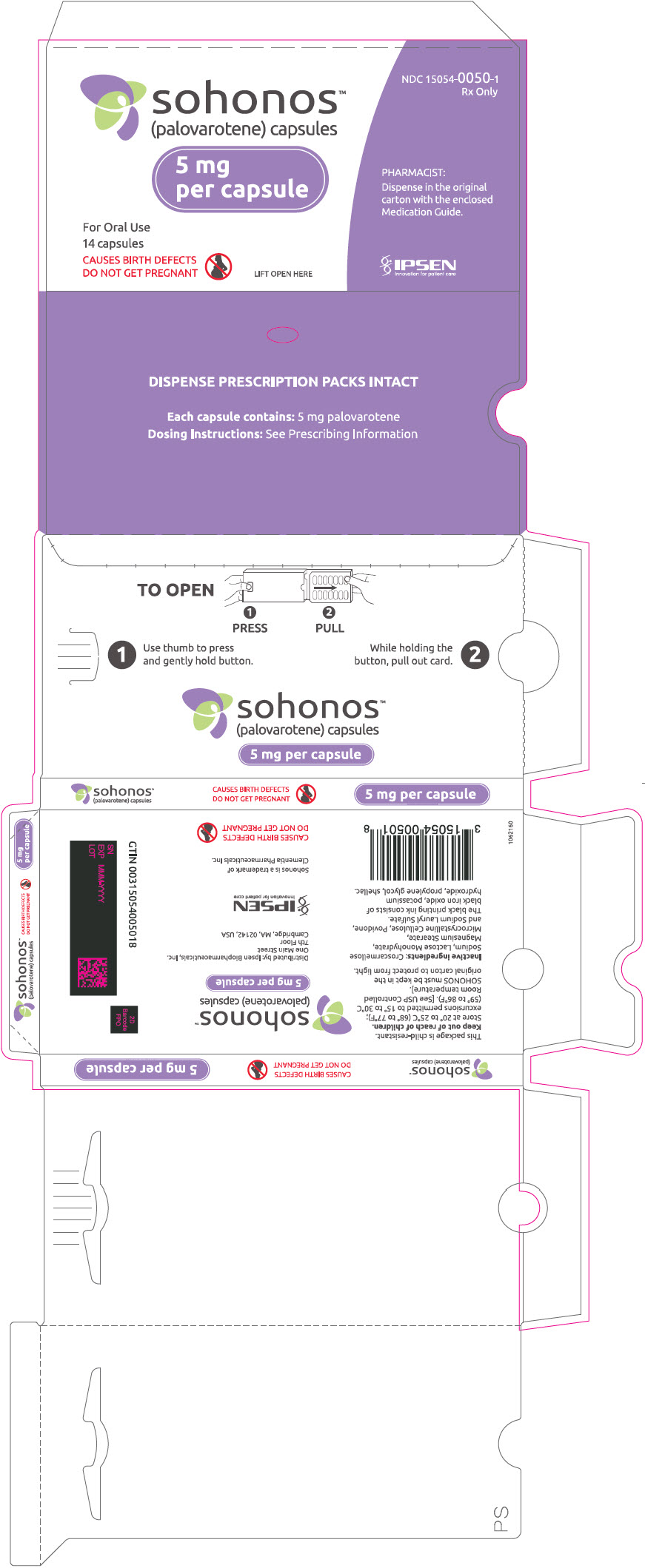
Other
Embryo-Fetal Toxicity
SOHONOS is contraindicated in pregnancy. SOHONOS may cause fetal harm. Because of the risk of teratogenicity and to minimize fetal exposure, SOHONOS is to be administered only if conditions for pregnancy prevention are met [see Warnings and Precautions (5.1) and Use in Specific Populations (8.1)].
Premature Epiphyseal Closure
Premature epiphyseal closure occurs in growing pediatric patients treated with SOHONOS, close monitoring is recommended [see Warnings and Precautions (5.2) and Use in Specific Populations (8.4)].
Dosage Overview
Take SOHONOS with food preferably at the same time each day [see Dosage and Administration (2.3)]. The recommended dosing for SOHONOS includes a chronic daily dosage (daily dose) which can then be modified/increased in the event of FOP flare-up symptoms (flare-up dose).
Initiate flare-up treatment at the onset of the first symptom indicative of a FOP flare-up or substantial high-risk traumatic event likely to lead to a flare-up (e.g., surgery, intramuscular immunization, mandibular blocks for dental procedures, muscle fatigue, blunt muscle trauma from bumps, bruises, falls, or influenza-like viral illnesses). Symptoms of a FOP flare-up typically include but are not limited to localized pain, soft tissue swelling/inflammation, redness, warmth, decreased joint range of motion, and stiffness.
Recommended Dosage for Adults and Pediatric Patients 14 Years and Older
- Daily Dose: The recommended SOHONOS daily dosage for adults and pediatric patients 14 years and older is 5 mg daily. Stop daily dosing when flare-up dosing begins.
- Flare-up Dose:
- The recommended SOHONOS flare-up dosage for adults and pediatric patients 14 years and older is 20 mg daily for 4 weeks, followed by 10 mg daily for 8 weeks (for a total of 12 weeks of flare-up treatment), even if symptoms resolve earlier, then return to daily dosing of 5 mg.
- If during the course of flare-up treatment, the patient experiences marked worsening of the original flare-up site or another flare-up at a new location, restart the 12-week flare-up dosing at 20 mg daily.
- For flare-up symptoms that have not resolved at the end of the 12-week period, the 10 mg daily dosage may be extended in 4-week intervals and continued until the flare-up symptoms resolve. If new flare-up symptoms occur after the 5 mg daily dosing is resumed, flare-up dosing may be restarted.
- Daily Dose: The recommended SOHONOS daily dosage for patients under 14 years of age is weight-based ranging from 2.5 mg to 5 mg daily (see Table 1). Stop daily dosing when flare-up dosing begins.
- Flare-up Dose:
- The recommended flare-up SOHONOS dosage for patients under 14 years of age is weight-based (see Table 1). Administer the initial flare-up dosage once daily for 4 weeks, then administer the lower flare-up dosage once daily for 8 weeks (for a total of 12 weeks of flare-up treatment), even if symptoms resolve earlier, then return to daily dosing (see Table 1).
- If during the course of flare-up treatment, the patient experiences marked worsening of the original flare-up site or another flare-up at a new location, restart the 12-week flare-up dosing with the Week 1 to 4 dose.
- For flare-up symptoms that have not resolved at the end of the 12-week period, the Week 5 to 12 flare-up dose may be extended in 4-week intervals and continued until the flare-up symptoms resolve. If new flare-up symptoms occur after daily dosing is resumed, flare-up dosing may be restarted.
- Advise females of reproductive potential that they must avoid pregnancy while taking SOHONOS and for at least one month following discontinuation of therapy.
- Advise females of childbearing potential to use at least one highly effective method of contraception (i.e. IUD) or two effective methods (i.e. combined hormonal contraception in combination with another method of contraception such as a barrier method) during treatment with SOHONOS [see Use in Specific Populations (8.3)].
- Instruct patients to immediately stop taking SOHONOS if she becomes pregnant while taking SOHONOS and to rapidly consult her healthcare provider if there is a risk of pregnancy or if she might be pregnant.
- Instruct patients to not donate blood during SOHONOS treatment and for 1 week following discontinuation to avoid blood donation to a pregnant patient and fetus.
Recommended Dosage for Pediatric Patients Aged 8 to 13 Years for Females and Aged 10 to 13 Years for Males
| Weight | Daily Dosage | Week 1 to 4 Flare-up Dosage | Week 5 to 12 Flare-up Dosage |
|---|---|---|---|
| 10 kg to 19.9 kg | 2.5 mg | 10 mg | 5 mg |
| 20 kg to 39.9 kg | 3 mg | 12.5 mg | 6 mg |
| 40 kg to 59.9 kg | 4 mg | 15 mg | 7.5 mg |
| ≥ 60 kg | 5 mg | 20 mg | 10 mg |
Missed Dose
If a dose of SOHONOS is missed, take the missed dose as soon as possible. If the dose has been missed by more than 6 hours, skip the missed dose, and continue with the next scheduled dose. Do not take two doses at the same time or in the same day.
Moderate CYP3A Inhibitors:
Avoid concomitant use of a moderate CYP3A inhibitor, if possible. If concomitant use will occur, reduce the dose of SOHONOS by half as shown in Table 3 when co-administered with moderate CYP3A inhibitors [see Drug Interactions (7.1) and Clinical Pharmacology (12.3)].
| Weight | Daily Dosage | Week 1 to 4 Flare-up Dosage | Week 5 to 12 Flare-up Dosage |
|---|---|---|---|
| 10 kg to 19.9 kg | 1 mg | 5 mg | 2.5 mg |
| 20 kg to 39.9 kg | 1.5 mg | 6 mg | 3 mg |
| 40 kg to 59.9 kg | 2 mg | 7.5 mg | 4 mg |
| ≥ 60 kg All pediatric patients ≥14 years of age and adults should receive the dose in the ≥60 kg weight category. | 2.5 mg | 10 mg | 5 mg |
Photosensitivity
Photosensitivity reactions, such as exaggerated sunburn reactions (e.g., burning, erythema, blistering) involving areas exposed to the sun have been associated with the use of retinoids and may occur with SOHONOS. Precautionary measures for phototoxicity are recommended. Excessive exposure to sun or artificial ultraviolet light should be avoided, and protection from sunlight should be used when exposure cannot be avoided (use of sunscreens, protective clothing, and use of sunglasses).
Bone mineral density and fracture
Retinoids are associated with bone toxicity, including reductions in bone mass and spontaneous reports of osteoporosis and fracture. In FOP clinical trials, SOHONOS resulted in decreased vertebral bone mineral content and bone density, and an increased risk of radiologically observed vertebral (T4 to L4) fractures in treated adult and pediatric patients compared to untreated patients. Periodic radiological assessment of the spine is recommended. [see Adverse Reactions (6.1)].]
Hyperostosis
Retinoids have been associated with hyperostotic changes (bone spurs) and calcification of tendons or ligaments and may occur with SOHONOS. These effects generally occur with long-term use, especially at high doses.
Premature epiphyseal closure
Subjects under 18 years with open epiphyses were assessed for growth during the clinical studies. Premature epiphyseal closure was identified by scheduled imaging in 27% of subjects who were less than 18 years of age at enrollment and was more common in younger compared with older subjects (31% in subjects between 8/10 years to 14 years and no subjects 14 years or older). Many of the affected subjects exhibited slowing of growth in height. [see Use in Specific Populations (8.4) and Clinical Studies (14)].
Mucocutaneous Adverse Reactions
Mucocutaneous adverse reactions observed in over 10% of subjects (N=134) were dry skin (78%), lip dry (66%), pruritus (55%), alopecia (44%), rash (42%), erythema (37%), skin exfoliation [skin peeling] (31%), and skin irritation (11%). In addition, dry eye occurred in 25% of subjects.
Bone Mineral Density and Fractures
Loss of bone mineral density and radiological vertebral fractures (PT: Spinal fracture) were identified as a risk associated with SOHONOS based on novel analyses performed on whole body CT data in FOP subjects in the Phase 3 study [see Warnings and Precautions (5.4)].
Hepatotoxicity
Retinoids have been associated with dose dependent elevations of liver enzymes and isolated cases of severe hepatitis. In SOHONOS studies of FOP, elevated ALT was observed in 7.0% of subjects during 20/10 mg flare-up dosing and 1.5% of subjects during 5 mg chronic dosing. There were no subjects who required dose reduction or treatment discontinuation due to liver enzyme elevations.
Hypertriglyceridemia
Systemic retinoids may cause marked elevations of serum triglycerides. In FOP studies, hypertriglyceridemia was reported in 2 subjects during chronic SOHONOS treatment (2%) and in 4 subjects during flare-up dosing (4%).
Pancreatitis
Pancreatitis has been reported with other systemic retinoids, both with and without elevated triglycerides, including fatal cases. In palovarotene studies, one healthy subject developed acute pancreatitis, possibly related to concomitant use of ketoconazole in a drug-drug interaction study. There were no reports of pancreatitis in the FOP clinical studies.
Night Blindness
One reaction of night blindness was observed in SOHONOS treated subjects.
Intracranial Hypertension (Pseudotumor Cerebri)
Systemic retinoid use has been associated with cases of benign intracranial hypertension (also called pseudotumor cerebri), some of which involved the concomitant use of tetracyclines. There were no reports of benign intracranial hypertension in the FOP clinical studies [see Drug Interactions (7.3)].
Risk Summary
SOHONOS is contraindicated during pregnancy. Based on the findings in animal studies and class effects of retinoids, SOHONOS can cause fetal harm when administered during pregnancy [see Warnings and Precautions (5.1) and Use in Specific Populations (8.3)]. In animal reproduction studies, oral administration of palovarotene to pregnant rats during the period of organogenesis resulted in multiple fetal malformations typical of retinoids (e.g., cleft palate, malformed skull bone, shortening of the long bones) at doses ≥0.25 mg/kg/day (less than the clinical exposure) (see Data). There are no available human data on SOHONOS use in pregnant women. If pregnancy occurs during treatment with SOHONOS, discontinue treatment immediately and refer the patient to an obstetrician/gynecologist or other specialist experienced in reproductive toxicity for further evaluation and counseling.
Data
Animal Data
Palovarotene oral administration to pregnant rats during the period of organogenesis (gestation day 6 to 17) at doses of 0.01, 0.25 and 1.25 mg/kg/day resulted in fetal malformations consistent with retinoid-mediated embryopathy. Palovarotene exposure resulted in fetal external, visceral and skeletal malformations typical of retinoids, including defects in the mouth (cleft palate, protruding tongue), eye (anophthalmia, microphthalmia), skull (dilated cerebral ventricle, misshapen brain), skeleton (shortening of the long bones), blood vessels, kidney, and ureters at doses ≥ 0.25 mg/kg/day (less than the clinical exposure). The fetal toxicity was observed at maternal rat exposures well below the range of clinically relevant exposures.
Risk Summary
There are no data available on the presence of palovarotene or its main metabolites in either animal or human milk, the effects on the breastfed infant, or on milk production. Because of the potential for serious adverse reactions in breastfed infants exposed to palovarotene through breastmilk, advise females that breastfeeding is not recommended during treatment with SOHONOS, and for at least 1 month after the final dose of SOHONOS.
Pregnancy Testing
Obtain a negative serum pregnancy test within one week prior to SOHONOS therapy. Verify that patient is not pregnant periodically, as needed, over the course of treatment with SOHONOS and one month after treatment discontinuation unless they are not at risk of pregnancy.
Contraception
Females
SOHONOS can cause embryo-fetal harm when administered during pregnancy [see Warnings and Precautions (5.1), Use in Specific Populations (8.1)]. Advise females of reproductive potential to use effective contraception at least one month prior to treatment, during treatment with SOHONOS and for 1 month after the last dose, unless continuous abstinence is chosen.
CDC Effectiveness of Contraceptive Methods Chart, https://www.cdc.gov/reproductivehealth/unintendedpregnancy/pdf/contraceptive_methods_508.pdf
Males
Palovarotene is present in semen (0.7 ng/mL) in amounts 100-fold lower than the maternal plasma exposure at the no observed adverse effect level (NOAEL) for fetal toxicity observed in animal studies. Administration of SOHONOS to a male patient is considered unlikely to affect development of an embryo or fetus carried by a pregnant female sexual partner exposed to SOHONOS via the patient's semen.
Bone Safety
In clinical studies with SOHONOS, assessments of growth and bone safety in growing children included linear and knee height, femur and tibia length measured by Whole-Body Computed Tomography (WBCT), and hand/wrist and knee radiographs. Premature epiphyseal closure has been identified as an irreversible serious risk associated with SOHONOS treatment. Premature epiphyseal closure was observed as early as 6 months after initiating therapy with the majority occurring at or after 12 months. In SOHONOS treated subjects there was a trend of declining height Z-scores in adolescent subjects, potentially due to a loss of linear height and/or increasing spinal deformity. The long-term effects on final height in subjects with FOP treated with SOHONOS have not been established. [see Adverse Reactions (6.1)].
Monitoring Recommendation
Prior to starting treatment with SOHONOS, all growing children should undergo baseline clinical and radiological assessments including but not limited to an assessment of skeletal maturity via hand/wrist and knee x-rays, standard growth curves and pubertal staging. Continued monitoring is recommended every 6-12 months until patients reach skeletal maturity (e.g., epiphyseal closure) or final adult height [see Warnings and Precautions (5.2)].
Juvenile Animal Data
A juvenile animal study was conducted in juvenile rats given daily oral doses of palovarotene at 0.1, 0.5 or 1.2 mg/kg/day from Week 3 to Week 9 of age (prior to epiphyseal fusion). Palovarotene adversely affected skeletal growth and development including, reduction in bone size, abnormal bone shape and/or geometry, diffuse bone loss, and growth in general were affected at ≥ 0.5 mg/kg/day (less than the clinical exposure). As expected, physes were either widened due to an expanded zone of cartilage hypertrophy/maturation (sometimes accompanied by chondrodysplasia), narrowed, or partially/completely closed. In the proximal femur, avascular necrosis of the femoral head was observed accompanied with malformations and microfractures of trabeculae in a few rats at 1.2 mg/kg/day (less than the clinical exposure). In vertebrae, palovarotene completely inhibited the endochondral ossification that normally occurs in the hyaline cartilage at the end of the vertebral body There also were tibial fractures in two high-dose females. The skeletal effects showed evidence of reversing after dosing discontinuation at 0.5 mg/kg/day, but not at highest dose of 1.2 mg/kg/day.
Cardiac Electrophysiology
At doses up to 2.5 times the maximum recommended dose, palovarotene does not prolong the QT interval to any clinically relevant extent.
Absorption
The median time to achieve peak concentration (Tmax) of palovarotene was 3.0 to 4.0 hours across the chronic dose of 5 mg to flare-up dose of 10 and 20 mg.
Effect of Food
Palovarotene mean AUC and mean Cmax increased by approximately 40% and 16%, respectively; Tmax was delayed by approximately 2 hours with a high-fat, high-calorie meal (800 to 1000 calories, 15% protein, 25% carbohydrate, and 50 to 60% fat).
No clinically significant differences in the AUC and Cmax of palovarotene were observed when palovarotene was administered whole compared to the contents sprinkled onto one teaspoon of applesauce following a high-fat, high-caloric breakfast.
Distribution
The mean (SD) apparent volume of distribution (Vd/F) is 237 (± 90.1) L following administration of a single 20 mg dose with food. Protein binding of palovarotene is 97.9% to 99.6% in vitro.
The mean blood-to-plasma ratio of palovarotene in humans is 0.62.
Elimination
The mean elimination half-life is 8.7 hours following administration of a 20 mg once daily dosage for 14 days with a standard breakfast (800 to 1000 calories, 15% protein, 25% carbohydrate, and 50 to 60% fat). The apparent total body clearance (CL/F) of palovarotene is estimated at 19.9 L/h.
Metabolism
Palovarotene is extensively metabolized by CYP3A4 and to a minor extent by CYP2C8 and CYP2C19.
Following administration of [14-C]-radiolabeled palovarotene, the contribution of palovarotene and its four known major metabolites (M2, M3, M4a, and M4b) represented collectively 40% of the total exposure in plasma. The pharmacological activity of M3 and M4b is approximately 1.7% and 4.2% of the activity of the parent drug.
Excretion
Following administration of a 1 mg dose of [14C]-radiolabeled palovarotene in healthy subjects, 97.1% of the dose was recovered in the feces and 3.2% in the urine.
Specific Populations
There were no clinically significant differences in the pharmacokinetics of palovarotene based on age (2 to 85 years old), sex, race (Asian, black, white and others), smoking status, mild to moderate renal impairment, or mild hepatic impairment. The effect of severe renal impairment, or moderate to severe hepatic impairment on the pharmacokinetics of palovarotene is unknown.
Body Weight
Body weight (13 to 130 kg) was found to have a significant effect on the pharmacokinetics of palovarotene resulting in increasing exposure with decreasing weight at the same dose.
Pediatric Patients
The estimated steady-state AUC0-τ and Cmax,ss following weight-based dosing for 5, 10, and 20 mg (or dose equivalent) in pediatric patients <14 years old are comparable for the equivalent doses across the different weight groups.
Drug Interaction Studies
Clinical Studies and Model-Informed Approaches
Strong CYP3A Inhibitor: Co-administration of palovarotene with ketoconazole (strong CYP3A4 inhibitor) increased the Cmax and AUC of palovarotene by 2 and 3-fold, respectively.
Moderate CYP3A Inhibitor: Co-administration of palovarotene with erythromycin (moderate CYP3A4 inhibitor) increased the Cmax and AUC of palovarotene by 1.6 and 2.5-fold, respectively.
Strong CYP3A Inducer: Co-administration of palovarotene with rifampicin (strong CYP3A4 inducer) decrease the Cmax and AUC0-t of palovarotene by 19% and 11%, respectively.
Other Drugs: No clinically significant differences in the pharmacokinetics of palovarotene were observed when co-administered with prednisone 40 mg. No clinically significant differences in the pharmacokinetics of midazolam (CYP3A4 substrate) were observed when co-administered with palovarotene.
In Vitro Studies
Cytochrome P450 (CYP) Enzymes: Palovarotene is an inducer of CYP3A4 and CYP2B6, but not CYP1A2, CYP2C8, CYP2C9 and CYP2C19. Palovarotene is not an inhibitor of CYP1A2, CYP2B6, CYP2C8, CYP2C9, CYP2C19, CYP2D6 and CYP3A4.
Uridine diphosphate (UDP)-glucuronosyl transferase (UGT) Enzymes: Palovarotene is not an inhibitor or a substrate of UGT1A1, UGT1A3, UGT1A4, UGT1A6, UGT1A9 or UGT2B7.
Transporter Systems: Palovarotene is not an inhibitor of P-gp, OAT1, OAT3, OCT2, MATE1, MATE2 K, BCRP, OATP1B1, OATP1B3, OCT1, and BSEP. Palovarotene is not a substrate of P-gp, BCRP, OATP1B1, OATP1B3, or OCT1.
Carcinogenesis and Mutagenesis
Long term studies to assess the carcinogenic potential of palovarotene have not been conducted.
Palovarotene and its metabolites were negative in the vitro bacterial reverse mutation (Ames) assay and an in vitro micronucleus assay in primary human lymphocyte. Palovarotene did not have any clastogenic effect in the in vivo mouse micronucleus study.
Impairment of Fertility
Palovarotene effects on fertility and reproductive function were assessed in male and female rats. In a female rat fertility study, palovarotene was orally administered to females for 14 days prior to mating with drug naïve males and up to GD 7 at the dose levels of 0.3, 1 and 3 mg/kg/day. Palovarotene caused prolonged periods of diestrous and reduced ovulation rate, resulting in lower numbers of implantation sites and live embryos at 3 mg/kg/day, a dose associated with maternal toxicity.
In a male rat fertility study, palovarotene was orally administered prior to mating, during mating, and up to scheduled euthanasia (approximately 11 weeks in total) at 0.3, 1 and 3 mg/kg/day. Palovarotene did not cause adverse effects on mating, fertility indices, conception rate, reproductive organ weights or sperm parameters up to 1 mg/kg/day (less than the clinical exposure). Males did not tolerate 3 mg/kg/day, as it produced severe systemic toxicity including deaths, adverse skin and hair coat clinical signs, and substantially reduced body weight.
Embryo-Fetal Toxicity:
Advise patients that SOHONOS can cause fetal harm and is contraindicated during pregnancy. Advise patients to verify that they are not pregnant prior to initiating and periodically during SOHONOS treatment as well as one month after treatment discontinuation [see Contraindications (4), Warnings and Precautions (5.1), and Use in Specific Populations (8.3)].
Lactation
Because of the potential for serious adverse reactions from SOHONOS in a breastfed child, advise females not to breastfeed during treatment with SOHONOS, and for at least 1 month after the last dose of SOHONOS.
Premature Epiphyseal Closure:
Inform patients that SOHONOS has been shown to cause premature epiphyseal closure in growing pediatric patients with FOP and discuss the proposed monitoring plan with the patient and caregiver [see Warnings and Precautions (5.2)].
Mucocutaneous Adverse Reactions:
Advise patients that they may experience dry skin, lip dry, pruritus, rash, alopecia, erythema, skin exfoliation, and dry eye. Discuss the plan to assess their symptoms and adjust the dose if needed [see Dosage and Administration (2.4) and Warning and Precautions (5.3)]. Recommend prophylactic measures to minimize risk and/or treat the mucocutaneous adverse reactions are recommended (e.g. skin emollients, sunscreen, lip moisturizers, artificial tears) [see Warnings and Precautions (5.3)].
Photosensitivity:
Advise patients of potential increased skin sensitivity to sunlight while taking SOHONOS and to minimize exposure to sunlight and artificial ultraviolet light [see Warnings and Precautions (5.3)].
Radiological Vertebral Fractures:
Inform patients that SOHONOS resulted in decreased vertebral bone mineral content, bone density and bone strength as well as an increased risk of radiologically observed vertebral fractures and that periodic radiological assessment of the spine is recommended [see Warnings and Precautions (5.4)].
Psychiatric Disorders:
Advise patients of the possibility of experiencing new or worsening psychiatric effects, including suicidal thoughts and behaviors, depression, depression aggravated, anxiety, and mood alterations. Particular care should be taken in patients with history of psychiatric illness. Patients should be monitored for signs of depression and referred for appropriate treatment if necessary [see Warnings and Precautions (5.5)].
Night Blindness:
Advise patients of the risk of experiencing night blindness [see Warnings and Precautions (5.6)].
Drug Interactions:
Advise patients to inform their healthcare providers of all concomitant medications, including prescription medicines, over-the-counter drugs, and herbal products [see Dosage and Administration (2.5) and Drug Interactions (7)].
Dosing Instructions:
Advise the patient to take SOHONOS capsules with food. If the patient is unable to swallow the capsule, the capsule contents may be emptied onto soft food [see Dosage and Administration (2.3)].
Missed dose:
If a dose is missed, it should be taken as soon as the patient remembers. If the dose has been missed by more than 6 hours, advise the patient to skip the missed dose and continue with the next scheduled dose. Advise the patient to not take two doses at the same time or in the same day.
Distributed by: Ipsen Biopharmaceuticals, Inc. Cambridge, MA; 02142.
SOHONOS is a trademark of Clementia Pharmaceuticals Inc.
©2023. Ipsen Biopharmaceuticals, Inc. All rights reserved.