Other
Severe Primary IGF-1 Deficiency (Primary IGFD)
INCRELEX is indicated for the treatment of growth failure in pediatric patients 2 years of age and older with:
- severe primary IGF-1 deficiency or
- growth hormone (GH) gene deletion who have developed neutralizing antibodies to GH.
- height standard deviation score ≤ –3.0 and
- basal IGF-1 standard deviation score ≤ –3.0 and
- normal or elevated growth hormone (GH).
- Known Hypersensitivity
- Closed Epiphyses
- Malignant Neoplasia
Severe Primary IGF-1 deficiency (IGFD) is defined by:
Limitations of use:
INCRELEX is not a substitute to GH for approved GH indications.
INCRELEX is not indicated for use in patients with secondary forms of IGF-1 deficiency, such as GH deficiency, malnutrition, hypothyroidism, or chronic treatment with pharmacologic doses of anti-inflammatory corticosteroids.
INCRELEX should not be used by patients who are allergic to mecasermin (rhIGF-1) or any of the inactive ingredients in INCRELEX, or who have experienced a severe hypersensitivity to INCRELEX [see Warnings and Precautions (5.2) and Adverse Reactions (6.3)].
INCRELEX should not be used for growth promotion in patients with closed epiphyses.
INCRELEX is contraindicated in pediatric patients with malignant neoplasia or a history of malignancy [see Warnings and Precautions (5.7) and Adverse Reactions (6.3)].
Risk Summary
There are no available data on INCRELEX use in pregnant women. Exposure to INCRELEX during pregnancy is unlikely because the drug is not indicated for use after epiphyseal closure. In animal reproduction studies, there were no observed embryo-fetal development abnormalities with intravenous administration of INCRELEX to pregnant rats and rabbits during fetal organogenesis given at exposures up to 11 and 3 times the maximum recommended human dose (MRHD) of 0.24 mg/kg/day based on body surface area (BSA), respectively (see Data).
The estimated background risk of birth defects and miscarriage for the indicated population is unknown. In the U.S. general population, the estimated background risk of major birth defects and miscarriage in clinically recognized pregnancies is 2-4% and 15-20%, respectively.
Data
Animal Data
Studies to assess embryo-fetal toxicity evaluated the effects of INCRELEX during organogenesis in Sprague Dawley rats given 1, 4, and 16 mg/kg/day and in New Zealand White rabbits given 0.125, 0.5, and 2 mg/kg/day, administered intravenously. There were no observed embryo-fetal developmental abnormalities in rats given up to 16 mg/kg/day (11 times the MRHD based on BSA comparison). In the rabbit study, the NOAEL for fetal toxicity was 0.5 mg/kg/day (approximately equivalent to the MRHD based on BSA) due to an increase in fetal death at 2 mg/kg. INCRELEX displayed no teratogenicity or maternal toxicity in rabbits given up to 2 mg/kg (3 times the MRHD based on BSA).
Risk Summary
There is no information available on the presence of mecasermin in human or animal milk, the effects of the drug on the breastfed infant, or the effects of the drug on milk production. The developmental and health benefits of breastfeeding should be considered along with the mother's clinical need for INCRELEX and any potential adverse effects on the breast-fed child from INCRELEX or from the underlying maternal condition.
Toxicity (Gasping Syndrome) with Benzyl Alcohol
Serious adverse reactions including fatal reactions and the "gasping syndrome" occurred in premature neonates and infants in the intensive care unit who received drugs containing benzyl alcohol as a preservative. In these cases, benzyl alcohol dosages of 99 mg/kg/day to 234 mg/kg/day produced high levels of benzyl alcohol and its metabolites in the blood and urine (blood levels of benzyl alcohol were 0.61 mmol/L to 1.378 mmol/L). INCRELEX contains 9 mg/mL benzyl alcohol as a preservative.
Additional adverse reactions included gradual neurological deterioration, seizures, intracranial hemorrhage, hematologic abnormalities, skin breakdown, hepatic and renal failure, hypotension, bradycardia, and cardiovascular collapse. Preterm, low-birth weight infants may be more likely to develop these reactions because they may be less able to metabolize benzyl alcohol. Use of INCRELEX in infants is not recommended [see Warnings and Precautions (5.8)].
Safety and effectiveness in pediatric patients below the age of 2 years of age have not been established.
Tissue Growth – 1) Skeletal growth occurs at the cartilage growth plates of the epiphyses of bones where stem cells divide to produce new cartilage cells or chondrocytes. The growth of chondrocytes is under the control of IGF-1 and GH. The chondrocytes become calcified so that new bone is formed allowing the length of the bones to increase. This results in skeletal growth until the cartilage growth plates fuse at the end of puberty. 2) Cell growth: IGF-1 receptors are present on most types of cells and tissues. IGF-1 has mitogenic activities that lead to an increased number of cells in the body. 3) Organ growth: Treatment of IGF-1 deficient rats with rhIGF-1 results in whole body and organ growth.
Carbohydrate Metabolism –IGF-1 suppresses hepatic glucose production and stimulates peripheral glucose utilization and therefore has a hypoglycemic potential. IGF-1 has inhibitory effects on insulin secretion.
Absorption – The absolute bioavailability of rhIGF-1 after subcutaneous administration in healthy subjects is estimated to be close to 100%. However, the absolute bioavailability of INCRELEX given subcutaneously to subjects with primary insulin-like growth factor-1 deficiency (Primary IGFD) has not been determined.
Distribution – In blood, IGF-1 is bound to six IGF binding proteins, with > 80% bound as a complex with IGFBP-3 and an acid-labile subunit. IGFBP-3 is greatly reduced in subjects with severe Primary IGFD, resulting in increased clearance of IGF-1 in these subjects relative to healthy subjects. The total IGF-1 volume of distribution after subcutaneous administration in subjects with severe Primary IGFD is estimated to be 0.257 (± 0.073) L/kg at an INCRELEX dose of 0.045 mg/kg, and is estimated to increase as the dose of INCRELEX increases.
Elimination – IGF-1 is metabolized by both liver and kidney. The mean terminal t1/2 after single subcutaneous administration of 0.12 mg/kg INCRELEX in pediatric subjects with severe Primary IGFD is estimated to be 5.8 hours. Clearance of INCRELEX is inversely proportional to IGF binding protein-3 (IGFBP-3) levels. CL/F is estimated to be 0.04 L/hr/kg at 0.5 micrograms/mL of IGFBP-3, and 0.01 L/hr/kg at 3 micrograms/mL IGFBP-3; the latter is the median IGFBP-3 in subjects with normal IGF-1 serum levels.
Gender – In children with Primary IGFD there were no apparent differences between males and females in the pharmacokinetics of INCRELEX.
Race –The effect of race on pharmacokinetics of INCRELEX has not been studied.
| Cmax (ng/mL) | Tmax (hr) | AUC0-8 (hr*ng/mL) | t1/2 (hr) | Vd/F (L/kg) | CL/F (L/hr/kg) | |
|---|---|---|---|---|---|---|
| n | 3 | 3 | 3 | 3 | 12 Data represents 3 subjects each at doses 0.015, 0.03, 0.06, and 0.12 mg/kg SC. | 12 |
| Cmax = maximum concentration; Tmax = time of maximum concentration; AUC0-8 = area under the curve; t1/2 = half-life; Vd/F = apparent volume of distribution; CL/F = apparent systemic clearance; SC = subcutaneous injection; CV% = coefficient of variation in %. Male/female data combined, ages 12 to 22 years. PK parameters based on baseline adjusted plasma concentrations. | ||||||
| Mean | 234 | 2 | 2932 | 5.8 | 0.257 | 0.0424 |
| CV% | 23 | 0 | 50 | 64 | 28 | 38 |
| Mean Total IGF-1 Concentration after a Single Subcutaneous Dose of INCRELEX in Children with Severe Primary IGFD (0.06 mg/kg and 0.12 mg/kg, n = 3 per group) |
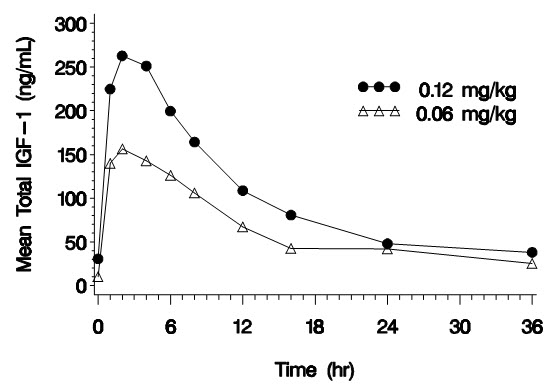 Figure (Increlex 01) |
Renal impairment– No studies have been conducted in Primary IGFD children with renal impairment.
Hepatic impairment– No studies have been conducted to determine the effect of hepatic impairment on the pharmacokinetics of rhIGF-1 in Primary IGFD children with hepatic impairment.
Carcinogenesis: INCRELEX was tumorigenic in rats in a study using doses of 0, 0.25, 1, 4, and 10 mg/kg/day by subcutaneous injection for up to 2 years. The incidence of adrenal medullary hyperplasia and pheochromocytoma increased in male rats given ≥1 mg/kg/day (below clinical exposure at the maximum recommended human dose [MRHD] based on AUC) and in female rats at all dose levels (below clinical exposure at the MRHD based on AUC). The incidence of keratoacanthoma in the skin increased in male rats given 4 and 10 mg/kg/day (approximately the clinical exposure at the MRHD based on AUC). The incidence of mammary gland carcinoma in male rats increased in animals treated with 10 mg/kg/day (3 times the MRHD based on AUC). Only doses that exceeded the maximum tolerated dose (MTD) (based on excess mortality secondary to IGF-1 induced hypoglycemia) caused skin and mammary tumors.
Mutagenesis: INCRELEX was not clastogenic in the in vitro chromosome aberration assay and the in vivo mouse micronucleus assay.
Impairment of fertility: INCRELEX had no effects on fertility in rats using intravenous doses 0.25, 1, and 4 mg/kg/day (up to 3 times the clinical exposure at the MRHD based on BSA).
Manufactured for: Ipsen Biopharmaceuticals, Inc.
Cambridge, MA 02142 USA
by: Hospira, Incorporated
McPherson, KS 67460 USA