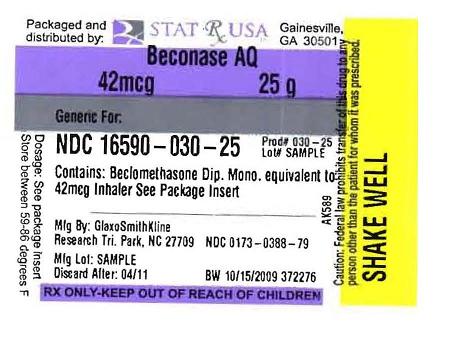
Information for Patients
Patients being treated with BECONASE AQ Nasal Spray should
receive the following information and instructions. This information is intended
to aid them in the safe and effective use of this medication. It is not a
disclosure of all possible adverse or intended effects.
Patients should use BECONASE AQ Nasal Spray at regular intervals since its
effectiveness depends on its regular use. The patient should take the medication
as directed. It is not acutely effective, and the prescribed dosage should not
be increased. Instead, nasal vasoconstrictors or oral antihistamines may be
needed until the effects of BECONASE AQ Nasal Spray are fully manifested. One to
2 weeks may pass before full relief is obtained. The patient should contact the
physician if symptoms do not improve, if the condition worsens, or if sneezing
or nasal irritation occurs.
For the proper use of BECONASE AQ Nasal Spray and to attain maximum
improvement, the patient should read and follow carefully the patient's
instructions accompanying the product.
Persons who are using immunosuppressant doses of corticosteroids should be
warned to avoid exposure to chickenpox or measles. Patients should also be
advised that if they are exposed, medical advice should be sought without
delay.
Carcinogenesis, Mutagenesis, Impairment of
Fertility
The carcinogenicity of beclomethasone dipropionate was evaluated
in rats that were exposed for a total of 95 weeks, 13 weeks at inhalation doses
up to 0.4 mg/kg and the remaining 82 weeks at combined oral and inhalation doses
up to 2.4 mg/kg. There was no evidence of carcinogenicity in this study at the
highest dose, approximately 60 times the maximum recommended daily intranasal
dose in adults on a mg/m2 basis or approximately 35 times
the maximum recommended daily intranasal dose in children on a mg/m2 basis.
Beclomethasone dipropionate did not induce gene mutation in bacterial cells
or mammalian Chinese hamster ovary (CHO) cells in vitro. No significant
clastogenic effect was seen in cultured CHO cells in vitro or in the mouse
micronucleus test in vivo.
In rats, beclomethasone dipropionate caused decreased conception rates at an
oral dose of 16 mg/kg (approximately 390 times the maximum recommended daily
intranasal dose in adults on a mg/m2 basis). There was no
significant effect of beclomethasone dipropionate on fertility in rats at oral
doses of 1.6 mg/kg (approximately 40 times the maximum recommended daily
intranasal dose in adults on a mg/m2 basis). Inhibition
of the estrous cycle in dogs was observed following oral dosing at 0.5 mg/kg
(approximately 40 times the maximum recommended daily intranasal dose in adults
on a mg/m2 basis). No inhibition of the estrous cycle in
dogs was seen following 12 months’ exposure at an estimated inhalation dose of
0.33 mg/kg (approximately 25 times the maximum recommended daily intranasal dose
in adults on a mg/m2 basis).
PregnancyTeratogenic Effects
Pregnancy Category C. Like other corticosteroids, beclomethasone
dipropionate was teratogenic and embryocidal in the mouse and rabbit at a
subcutaneous dose of 0.1 mg/kg in mice or 0.025 mg/kg in rabbits (approximately
equal to the maximum recommended daily intranasal dose in adults on a mg/m2 basis). No teratogenicity or embryocidal effects were seen in
rats when exposed to an inhalation dose of 0.1 mg/kg plus oral doses of up to
10 mg/kg per day for a combined dose of 10.1 mg/kg (approximately 240 times the
maximum recommended daily intranasal dose in adults on a mg/m2 basis).
There are no adequate and well-controlled studies in pregnant women.
Beclomethasone dipropionate should be used during pregnancy only if the
potential benefit justifies the potential risk to the fetus.
Nonteratogenic Effects
Hypoadrenalism may occur in infants born of mothers receiving
corticosteroids during pregnancy. Such infants should be carefully
observed.
Nursing Mothers
It is not known whether beclomethasone dipropionate is excreted
in human milk. Because other corticosteroids are excreted in human milk, caution
should be exercised when BECONASE AQ Nasal Spray is administered to a nursing
woman.
Pediatric Use
The safety and effectiveness of BECONASE AQ Nasal Spray have been
established in children aged 6 years and above through evidence from extensive
clinical use in adult and pediatric patients. The safety and effectiveness of
BECONASE AQ Nasal Spray in children below 6 years of age have not been
established.
Controlled clinical studies have shown that intranasal corticosteroids may
cause a reduction in growth velocity in pediatric patients. This effect has been
observed in the absence of laboratory evidence of HPA axis suppression,
suggesting that growth velocity is a more sensitive indicator of systemic
corticosteroid exposure in pediatric patients than some commonly used tests of
HPA axis function. The long-term effects of this reduction in growth velocity
associated with intranasal corticosteroids, including the impact on final adult
height, are unknown. The potential for “catch-up” growth following
discontinuation of treatment with intranasal corticosteroids has not been
adequately studied. The growth of pediatric patients receiving intranasal
corticosteroids, including BECONASE AQ Nasal Spray, should be monitored
routinely (e.g., via stadiometry). The potential growth effects of prolonged
treatment should be weighed against the clinical benefits obtained and the
risks/benefits of treatment alternatives. To minimize the systemic effects of
intranasal corticosteroids, including BECONASE AQ Nasal Spray, each patient
should be titrated to the lowest dose that effectively controls his/her
symptoms.
In a double-blind, controlled trial, 100 children between the ages of 6 and
9½ years with allergic rhinitis were randomized to receive aqueous intranasal
beclomethasone dipropionate 168 mcg twice daily or placebo for 1 year. As
measured by stadiometry, children who received beclomethasone dipropionate grew
more slowly than those who received placebo. A difference in mean change in
height was observed within 1 month of drug initiation. At the end of 12 months,
the beclomethasone dipropionate-treated group had a growth velocity on average
of 4.75 cm/year compared to 6.20 cm/year in the placebo group (p less than 0.01). While
the placebo group had an expected distribution of growth velocity, approximately
50% of the beclomethasone dipropionate-treated children grew below the 10th percentile.
In children 7.3 years of age, the mean age of children in this study, the
range for expected growth velocity is: boys − 3rd
percentile = 4.1 cm/year, 50th percentile = 5.8 cm/year,
and 97th percentile = 7.5 cm/year; girls − 3rd percentile = 4.3 cm/year, 50th
percentile = 5.9 cm/year, and 97th percentile =
7.5 cm/year. The potential reversibility of the reduction in growth velocity was
not studied. No significant differences were observed between the 2 groups for
mean basal plasma cortisol or ACTH-stimulated plasma cortisol levels.
Geriatric Use
Clinical studies of BECONASE AQ Nasal Spray did not include
sufficient numbers of subjects aged 65 and over to determine whether they
respond differently from younger subjects. Other reported clinical experience
has not identified differences in responses between the elderly and younger
patients. In general, dose selection for an elderly patient should be cautious,
starting at the low end of the dosing range, reflecting the greater frequency of
decreased hepatic, renal, or cardiac function, and of concomitant disease or
other drug therapy.