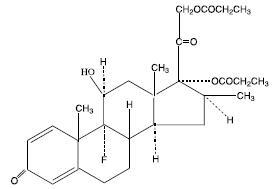
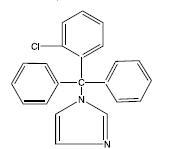
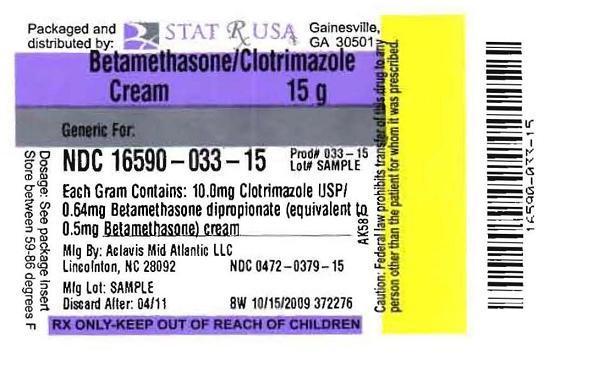
Patients using clotrimazole and betamethasone dipropionate cream
should receive the following information and instructions:
The medication is to be used as directed by the physician and is
not recommended for use longer than the prescribed time period. It is for
external use only. Avoid contact with the eyes, mouth, or intravaginally.
This medication is to be used for the full prescribed treatment
time, even though the symptoms may have improved. Notify the physician if there
is no improvement after 1 week of treatment for tinea cruris or tinea corporis,
or after 2 weeks for tinea pedis.
This medication should only be used for the disorder for which it
was prescribed.
Other corticosteroid-containing products should not be used with
clotrimazole and betamethasone dipropionate without first talking with your
physician.
The treated skin area should not be bandaged, covered, or wrapped
so as to be occluded. (See DOSAGE AND ADMINISTRATIONsection.)
Any signs of local adverse reactions should be reported to your
physician.
Patients should avoid sources of infection or reinfection.
When using clotrimazole and betamethasone dipropionate cream in
the groin area, patients should use the medication for two weeks only, and apply
the cream sparingly. Patients should wear loose-fitting clothing. Notify the
physician if the condition persists after 2 weeks.
The safety of clotrimazole and betamethasone dipropionate cream
has not been demonstrated in the treatment of diaper dermatitis. Adverse events
consistent with corticosteroid use have been observed in patients treated with
clotrimazole and betamethasone dipropionate cream for diaper dermatitis. The use
of clotrimazole and betamethasone dipropionate cream in the treatment of diaper
dermatitis is not recommended.
If there is a lack of response to clotrimazole and betamethasone
dipropionate cream, appropriate confirmation of the diagnosis, including
possible mycological studies, is indicated before instituting another course of
therapy. The following tests may be helpful in evaluating HPA-axis suppression
due to the corticosteroid components:
Urinary free cortisol test
Morning plasma cortisol test
ACTH (cosyntropin) stimulation test
Carcinogenesis, Mutagenesis, Impairment of
FertilityThere are no adequate laboratory animal studies with either the
combination of clotrimazole and betamethasone dipropionate or with either
component individually to evaluate carcinogenesis.
Betamethasone was negative in the bacterial mutagenicity assay (Salmonella typhimurium and Escherichia
coli ), and in the mammalian cell mutagenicity assay (CHO/HGPRT). It was
positive in the in vitro human lymphocyte chromosome
aberration assay, and equivocal in the in vivo mouse
bone marrow micronucleus assay. This pattern of response is similar to that of
dexamethasone and hydrocortisone.
Reproductive studies with betamethasone dipropionate carried out in rabbits
at doses of 1.0 mg/kg by the intramuscular route and in
mice up to 33 mg/kg by the intramuscular route indicated no impairment of
fertility except for dose-related increases in fetal resorption rates in both
species. These doses are approximately 5- and 38-fold the maximum human dose
based on body surface areas, respectively.
In a combined study of the effects of clotrimazole on fertility,
teratogenicity, and postnatal development, male and female rats were dosed
orally (diet admixture) with levels of 5, 10, 25, or 50 mg/kg/day (approximately
1-8 times the maximum dose in a 60 kg adult based on body surface area) from 10
weeks prior to mating until 4 weeks postpartum. No adverse effects on the
duration of estrous cycle, fertility, or duration of pregnancy were noted.
PregnancyTeratogenic EffectsPregnancy Category C:There have been
no teratogenic studies performed in animals or humans with the combination of
clotrimazole and betamethasone dipropionate. Corticosteroids are generally
teratogenic in laboratory animals when administered at relatively low dosage
levels.
Studies in pregnant rats with intravaginal doses up to 100 mg/kg (15 times
the maximum human dose) revealed no evidence of fetotoxicity due to clotrimazole
exposure.
No increase in fetal malformations was noted in pregnant rats receiving oral
(gastric tube) clotrimazole doses up to 100 mg/kg/day during gestation days
6-15. However, clotrimazole dosed at 100 mg/kg/day was embryotoxic (increased
resorptions), fetotoxic (reduced fetal weights) and maternally toxic (reduced
body weight gain) to rats. Clotrimazole dosed at 200 mg/kg/day (30 times the
maximum human dose) was maternally lethal, and therefore fetuses were not
evaluated in this group. Also in this study, doses up to 50 mg/kg/day (8 times
the maximum human dose) had no adverse effects on dams or fetuses. However, in
the combined fertility, teratogenicity, and postnatal development study
described above, 50 mg/kg clotrimazole, was associated with reduced maternal
weight gain and reduced numbers of offspring reared to 4 weeks.
Oral clotrimazole doses of 25, 50, 100, and 200 mg/kg/day (2-15 times the
maximum human dose) were not teratogenic in mice. No evidence of maternal
toxicity or embryotoxicity was seen in pregnant rabbits dosed orally with 60,
120, or 180 mg/kg/day (18-55 times the maximum human dose).
Betamethasone dipropionate has been shown to be teratogenic in rabbits when
given by the intramuscular route at doses of 0.05 mg/kg.
This dose is approximately one-fifth the maximum human dose. The abnormalities
observed included umbilical hernias, cephalocele and cleft palates.
Betamethasone dipropionate has not been tested for teratogenic potential by the
dermal route of administration. Some corticosteroids have been shown to be
teratogenic after dermal application to laboratory animals.
There are no adequate and well-controlled studies in pregnant women of the
teratogenic effects of topically applied corticosteroids. Therefore,
clotrimazole and betamethasone dipropionate cream should be used during
pregnancy only if the potential benefit justifies the potential risk to the
fetus.
Nursing MothersSystemically administered corticosteroids appear in human milk
and could suppress growth, interfere with endogenous corticosteroids production,
or cause other untoward effects. It is not known whether topical administration
of corticosteroids could result in sufficient systemic absorption to produce
detectable quantities in human milk. Because many drugs are excreted in human
milk, caution should be exercised when clotrimazole and betamethasone
dipropionate cream is administered to a nursing woman.
Pediatric UseAdverse events consistent with corticosteroid use have been
observed in patients under 12 years of age treated with clotrimazole and
betamethasone dipropionate cream. In open-label studies, 17 of 43 (39.5%) evaluable pediatric patients (aged 12 to 16 years old)
using clotrimazole and betamethasone dipropionate cream for treatment of tinea
pedis demonstrated adrenal suppression as determined by cosyntropin testing. In
another open-label study, 8 of 17 (47.1%) evaluable
pediatric patients (aged 12 to 16 years old) using clotrimazole and
betamethasone dipropionate cream for treatment of tinea cruris demonstrated
adrenal suppression as determined by cosyntropin testing. THE
USE OF CLOTRIMAZOLE AND BETAMETHASONE DIPROPIONATE CREAM IN THE TREATMENT OF
PATIENTS UNDER 17 YEARS OF AGE OR PATIENTS WITH DIAPER DERMATITIS IS NOT
RECOMMENDED.
Because of higher ratio of skin surface area to body mass, pediatric patients
under the age of 12 years are at a higher risk with clotrimazole and
betamethasone dipropionate cream. The studies described above suggest that
pediatric patients under the age of 17 years may also have this risk. They are
at increased risk of developing Cushing’s syndrome while on treatment and
adrenal insufficiency after withdrawal of treatment. Adverse effects, including
striae and growth retardation, have been reported with inappropriate use of
clotrimazole and betamethasone dipropionate cream in infants and children (see
PRECAUTIONS and ADVERSE REACTIONSsections).
Hypothalamic-pituitary-adrenal (HPA) axis suppression, Cushing’s syndrome,
linear growth retardation, delayed weight gain and intracranial hypertension
have been reported in children receiving topical corticosteroids. Manifestations
of adrenal suppression in children include low plasma cortisol levels and
absence of response to ACTH stimulation. Manifestations of intracranial
hypertension include bulging fontanelles, headaches, and bilateral
papilledema.
Geriatric UseClinical studies of clotrimazole and betamethasone dipropionate
cream did not include sufficient numbers of subjects aged 65 and over to
determine whether they respond differently from younger subjects. Post-market
adverse events reporting for clotrimazole and betamethasone dipropionate cream
in patients aged 65 and above includes reports of skin atrophy and rare reports
of skin ulceration. Caution should be exercised with the use of these
corticosteroid containing topical products on thinning skin. THE USE OF CLOTRIMAZOLE AND BETAMETHASONE DIPROPIONATE CREAM UNDER
OCCLUSION, SUCH AS IN DIAPER DERMATITIS, IS NOT RECOMMENDED.