Erythromycin
FDA Label NDC 16590-090

Full FDA labeling including Indications, Dosage, Usage, and Precautions

Structured Product Label

The following Structured Product Label (SPL) was submitted to the FDA by Stat Rx Usa for the product Erythromycin (NDC 16590-090). This document serves as the official prescribing information, containing essential scientific data and clinical materials required for healthcare providers and patients.

This specific version of the label includes detailed information regarding description:, clinical pharmacology:, indications and usage:, contraindications:, precautions:, adverse reactions:, dosage and administration:, how supplied:, and other regulatory disclosures. Use the navigation below to review specific sections of the FDA submission.

Description:


Erythromycin Ophthalmic Ointment USP belongs to the macrolide group of antibiotics. The sterile ophthalmic ointment flows freely over the conjunctiva. Erythromycin base, as crystals or powder, is slightly soluble in water, moderately soluble in ether, and readily soluble in alcohol or chloroform. Erythromycin is an antibiotic produced from a strain of Streptomyces erythraeus. It is basic and readily forms a salt when combined with an acid. It has the following structural formula:
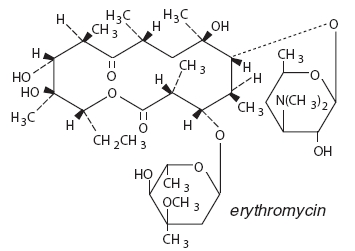

Structure Image (Erythromycin 5mg Ophthointstruct)

Structure Image (Erythromycin 5mg Ophthointstruct)


C37H67NO13

Mol. Wt. 733.94

Chemical Name: (3R•, 4S•, 5S•, 6R•, 7R•, 9R•, 11R•, 12R•, 13S•, 14R•)-4-[(2,6-Dideoxy-3-C-methyl-3-0-methyl-α-L-ribo-hexopyranosyl)oxy]-14-ethyl-7, 12, 13-trihydroxy-3, 5, 7, 9, 11, 13 hexamethyl-6-[[3,4,6-trideoxy-3-(dimethylamino)-β-D-xylo-opyranosyl]oxy]oxacyclotetradecane-2, 10-dione

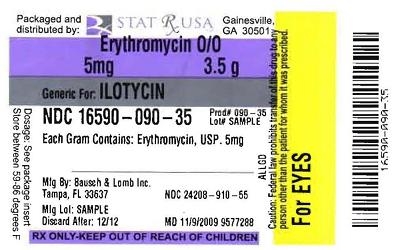
Each Gram Contains: ACTIVE: Erythromycin, USP 5 mg (0.5%); INACTIVES: White Petrolatum, Mineral Oil.                                                             


Clinical Pharmacology:

MICROBIOLOGY

Erythromycin inhibits protein synthesis without affecting nucleic acid synthesis. Erythromycin is usually active against the following organisms in vitro and in clinical infections: Streptococcus pyogenes (group A β-hemolytic), Alpha-hemolytic streptococci (viridans group); Staphylococcus aureus, including penicillinase-producing strains (methicillin-resistant staphylococci are uniformly resistant to erythromycin); Streptococcus pneumoniae; Mycoplasma pneumoniae (Eaton Agent, PPLO); Haemophilus influenzae (not all strains of this organism are susceptible at the erythromycin concentrations ordinarily achieved); Treponema pallidum; Corynebacterium diphtheriae; Neisseria gonorrhoeae; Chlamydia trachomatis.

Indications And Usage:

Contraindications:

This drug is contraindicated in patients with a history of hypersensitivity to erythromycin.

Precautions:

Adverse Reactions:

The most frequently reported adverse reactions are minor ocular irritations, redness and hypersensitivity reactions.

Dosage And Administration:

* Please review the disclaimer below.