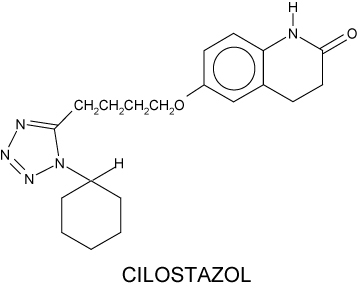
Cardiovascular Effects:
Cilostazol affects both vascular beds and cardiovascular function. It produces non-homogeneous dilation of vascular beds, with greater dilation in femoral beds than in vertebral, carotid, or superior mesenteric arteries. Renal arteries were not responsive to the effects of cilostazol.
In dogs or cynomolgous monkeys, cilostazol increased heart rate, myocardial contractile force, and coronary blood flow as well as ventricular automaticity, as would be expected for a PDE III inhibitor. Left ventricular contractility was increased at doses required to inhibit platelet aggregation. A-V conduction was accelerated. In humans, heart rate increased in a dose-proportional manner by a mean of 5.1 and 7.4 beats per minute in patients treated with 50 and 100 mg b.i.d., respectively. In 264 patients evaluated with Holter monitors, numerically more cilostazol-treated patients had increases in ventricular premature beats and non-sustained ventricular tachycardia events than did placebo-treated patients; the increases were not dose-related.
Plasma Protein and Erythrocyte Binding: Cilostazol is 95%-98% protein bound, predominantly to albumin. The mean percent binding for 3,4-dehydro-cilostazol is 97.4% and for 4´-trans-hydroxy-cilostazol is 66%. Mild hepatic impairment did not affect protein binding. The free fraction of cilostazol was 27% higher in subjects with renal impairment than in normal volunteers. The displacement of cilostazol from plasma proteins by erythromycin, quinidine, warfarin, and omeprazole was not clinically significant.
Metabolism and Excretion:
Cilostazol is eliminated predominately by metabolism and subsequent urinary excretion of metabolites. Based on in vitro studies, the primary isoenzymes involved in cilostazol's metabolism are CYP3A4 and, to a lesser extent, CYP2C19. The enzyme responsible for metabolism of 3,4-dehydro-cilostazol, the most active of the metabolites, is unknown.
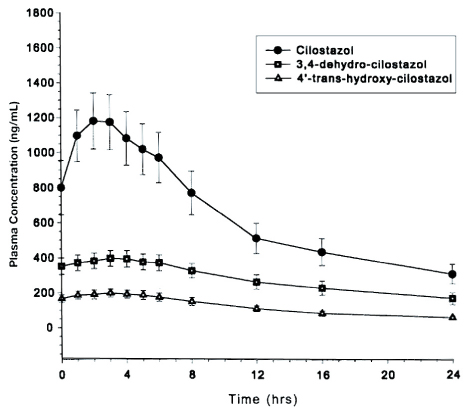
Following oral administration of 100 mg radiolabeled cilostazol, 56% of the total analytes in plasma was cilostazol, 15% was 3,4-dehydro-cilostazol (4-7 times as active as cilostazol), and 4% was 4´-trans-hydroxy-cilostazol (one fifth as active as cilostazol). The primary route of elimination was via the urine (74%), with the remainder excreted in feces (20%). No measurable amount of unchanged cilostazol was excreted in the urine, and less than 2% of the dose was excreted as 3,4-dehydro-cilostazol. About 30% of the dose was excreted in urine as 4´-trans-hydroxy-cilostazol. The remainder was excreted as other metabolites, none of which exceeded 5%. There was no evidence of induction of hepatic microenzymes.
Age and Gender: The total and unbound oral clearances, adjusted for body weight, of cilostazol and its metabolites were not significantly different with respect to age and/or gender across a 50-to-80-year-old age range.
Smokers: Population pharmacokinetic analysis suggests that smoking decreased cilostazol exposure by about 20%.
Hepatic Impairment: The pharmacokinetics of cilostazol and its metabolites were similar in subjects with mild hepatic disease as compared to healthy subjects.
Patients with moderate or severe hepatic impairment have not been studied.
Renal Impairment: The total pharmacologic activity of cilostazol and its metabolites was similar in subjects with mild to moderate renal impairment and in normal subjects. Severe renal impairment increases metabolite levels and alters protein binding of the parent and metabolites. The expected pharmacologic activity, however, based on plasma concentrations and relative PDE III inhibiting potency of parent drug and metabolites, appeared little changed. Patients on dialysis have not been studied, but, it is unlikely that cilostazol can be removed efficiently by dialysis because of its high protein binding (95%-98%).
Pharmacokinetic and Pharmacodynamic Drug-Drug Interactions:
Cilostazol could have pharmacodynamic interactions with other inhibitors of platelet function and pharmacokinetic interactions because of effects of other drugs on its metabolism by CYP3A4 or CYP2C19. A reduced dose of cilostazol should be considered when taken concomitantly with CYP3A4 or CYP2C19 inhibitors. Cilostazol does not appear to inhibit CYP3A4 (see Pharmacokinetic and Pharmacodynamic Drug-Drug Interactions, Lovastatin).
Aspirin: Short-term (≤ 4 days) coadministration of aspirin with cilostazol increased the inhibition of ADP-induced ex vivo platelet aggregation by 22% - 37% when compared to either aspirin or cilostazol alone. Short-term (≤ 4 days) coadministration of aspirin with cilostazol increased the inhibition of arachidonic acid-induced ex vivo platelet aggregation by 20% compared to cilostazol alone and by 48% compared to aspirin alone. However, short-term coadministration of aspirin with cilostazol had no clinically significant impact on PT, aPTT, or bleeding time compared to aspirin alone. Effects of long-term coadministration in the general population are unknown. In eight randomized, placebo-controlled, double-blind clinical trials, aspirin was coadministered with cilostazol to 201 patients. The most frequent doses and mean durations of aspirin therapy were 75-81 mg daily for 137 days (107 patients) and 325 mg daily for 54 days (85 patients). There was no apparent increase in incidence of hemorrhagic adverse effects in patients taking cilostazol and aspirin compared to patients taking placebo and equivalent doses of aspirin.
Warfarin: The cytochrome P-450 isoenzymes involved in the metabolism of R-warfarin are CYP3A4, CYP1A2, and CYP2C19, and in the metabolism of S-warfarin, CYP2C9. Cilostazol did not inhibit either the metabolism or the pharmacologic effects (PT, aPTT, bleeding time, or platelet aggregation) of R- and S-warfarin after a single 25-mg dose of warfarin. The effect of concomitant multiple dosing of warfarin and cilostazol on the pharmacokinetics and pharmacodynamics of both drugs is unknown.
Clopidogrel: Multiple doses of clopidogrel do not significantly increase steady state plasma concentrations of cilostazol.
Strong Inhibitors of CYP3A4: A priming dose of ketoconazole 400 mg (a strong inhibitor of CYP3A4), was given one day prior to coadministration of single doses of ketoconazole 400 mg and cilostazol 100 mg. This regimen increased cilostazol Cmax by 94% and AUC by 117%. Other strong inhibitors of CYP3A4, such as itraconazole, fluconazole, miconazole, fluvoxamine, fluoxetine, nefazodone, and sertraline, would be expected to have a similar effect (see DOSAGE AND ADMINISTRATION).
Moderate Inhibitors of CYP3A4 :
- Erythromycin and other macrolide antibiotics: Erythromycin is a moderately strong inhibitor of CYP3A4. Coadministration of erythromycin 500 mg q 8h with a single dose of cilostazol 100 mg increased cilostazol Cmax by 47% and AUC by 73%. Inhibition of cilostazol metabolism by erythromycin increased the AUC of 4´-trans-hydroxy-cilostazol by 141%. Other macrolide antibiotics (e.g., clarithromycin), but not all (e.g., azithromycin), would be expected to have a similar effect (see DOSAGE AND ADMINISTRATION).
- Diltiazem: Diltiazem 180 mg decreased the clearance of cilostazol by ∼30%. Cilostazol Cmax increased ∼30% and AUC increased ∼40% (see DOSAGE AND ADMINISTRATION).
- Grapefruit Juice: Grapefruit juice increased the Cmax of cilostazol by ∼50%, but had no effect on AUC.
Inhibitors of CYP2C19: Omeprazole: Coadministration of omeprazole did not significantly affect the metabolism of cilostazol, but the systemic exposure of 3,4-dehydro-cilostazol was increased by 69%, probably the result of omeprazole's potent inhibition of CYP2C19 (see DOSAGE AND ADMINISTRATION).
Quinidine: Concomitant administration of quinidine with a single dose of cilostazol 100 mg did not alter cilostazol pharmacokinetics.
Lovastatin: The concomitant administration of lovastatin with cilostazol decreases cilostazol Css, max and AUCτ by 15%. There is also a decrease, although nonsignificant, in cilostazol metabolite concentrations. Coadministration of cilostazol with lovastatin increases lovastatin and β-hydroxi lovastatin AUC approximately 70%. This is most likely clinically insignificant.
Hematologic adverse reactions:
Rare cases have been reported of thrombocytopenia or leucopenia progressing to agranulocytosis when cilostazol was not immediately discontinued. The agranulocytosis, however, was reversible on discontinuation of Cilostazol.
Use with Clopidogrel:
There is limited information with respect to the efficacy or safety of the concurrent use of cilostazol and clopidogrel, a platelet-aggregation inhibiting drug indicated for use in patients with peripheral arterial disease. Although it cannot be determined whether there was an additive effect on bleeding times during concomitant administration with cilostazol and clopidogrel, caution is advised for checking bleeding times during coadministration.
Hepatic Impairment:
Patients with moderate or severe hepatic impairment have not been studied in clinical trials.
Special caution is advised when cilostazol is used in such patients.
Renal Impairment:
Patients on dialysis have not been studied, but, it is unlikely that cilostazol can be removed efficiently by dialysis because of its high protein binding (95-98%).
Special caution is advised when cilostazol is used in patients with severe renal impairment; estimated creatinine clearence, <25 ml/min.
Use with other anitplatelet agents:
Cilostazol inhibits platelet aggregation but in a reversible manner. Caution is advised in patients at risk of bleeding from surgery or pathologic processes. Platelet aggregability returns to normal within 96 hours of stopping cilostazol. Caution is advised in patients receiving both cilostazol and any other antiplatelet agent, or in patients with thrombocytopenia.
Cardiovascular Toxicity:
Repeated oral administration of cilostazol to dogs (30 or more mg/kg/day for 52 weeks, 150 or more mg/kg/day for 13 weeks, and 450 mg/kg/day for 2 weeks), produced cardiovascular lesions that included endocardial hemorrhage, hemosiderin deposition and fibrosis in the left ventricle, hemorrhage in the right atrial wall, hemorrhage and necrosis of the smooth muscle in the wall of the coronary artery, intimal thickening of the coronary artery, and coronary arteritis and periarteritis. At the lowest dose associated with cardiovascular lesions in the 52-week study, systemic exposure (AUC) to unbound cilostazol was less than that seen in humans at the maximum recommended human dose (MRHD) of 100 mg b.i.d. Similar lesions have been reported in dogs following the administration of other positive inotropic agents (including PDE III inhibitors) and/or vasodilating agents. No cardiovascular lesions were seen in rats following 5 or 13 weeks of administration of cilostazol at doses up to 1500 mg/kg/day. At this dose, systemic exposures (AUCs) to unbound cilostazol were only about 1.5 and 5 times (male and female rats, respectively) the exposure seen in humans at the MRHD. Cardiovascular lesions were also not seen in rats following 52 weeks of administration of cilostazol at doses up to 150 mg/kg/day. At this dose, systemic exposures (AUCs) to unbound cilostazol were about 0.5 and 5 times (male and female rats, respectively) the exposure in humans at the MRHD. In female rats, cilostazol AUCs were similar at 150 and 1500 mg/kg/day. Cardiovascular lesions were also not observed in monkeys after oral administration of cilostazol for 13 weeks at doses up to 1800 mg/kg/day. While this dose of cilostazol produced pharmacologic effects in monkeys, plasma cilostazol levels were less than those seen in humans given the MRHD, and those seen in dogs given doses associated with cardiovascular lesions.
Body As a Whole: Chills, face edema, fever, generalized edema, malaise, neck rigidity, pelvic pain, retroperitoneal hemorrhage.
Cardiovascular: Atrial fibrillation, atrial flutter, cerebral infarct, cerebral ischemia, congestive heart failure, heart arrest, hemorrhage, hypotension, myocardial infarction, myocardial ischemia, nodal arrhythmia, postural hypotension, supraventricular tachycardia, syncope, varicose vein, vasodilation, ventricular extrasystoles, ventricular tachycardia.
Digestive: Anorexia, cholelithiasis, colitis, duodenal ulcer, duodenitis, esophageal hemorrhage, esophagitis, increased GGT, gastritis, gastroenteritis, gum hemorrhage, hematemesis, melena, peptic ulcer, periodontal abscess, rectal hemorrhage, stomach ulcer, tongue edema.
Endocrine: Diabetes mellitus.
Hemic and Lymphatic: Anemia, ecchymosis, iron deficiency anemia, polycythemia, purpura.
Metabolic and Nutritional:: Increased creatinine, gout, hyperlipemia, hyperuricemia.
Musculoskeletal: Arthralgia, bone pain, bursitis.
Nervous: Anxiety, insomnia, neuralgia.
Respiratory: Asthma, epistaxis, hemoptysis, pneumonia, sinusitis.
Skin and Appendages: Dry skin, furunculosis, skin hypertrophy, urticaria.
Special Senses: Amblyopia, blindness, conjunctivitis, diplopia, ear pain, eye hemorrhage, retinal hemorrhage, tinnitus.
Urogenital: Albuminuria, cystitis, urinary frequency, vaginal hemorrhage, vaginitis.
Post-Marketing Experience
The following adverse events have been reported spontaneously from worldwide post-marketing experience since launch of cilostazol in the US.
- Blood and lymphatic system disorders:
- -agranulocytosis, aplastic anemia, granulocytopenia, thrombocytopenia, leukopenia, bleeding tendency
- Cardiac disorders:
- -Torsades de pointes, QTc prolongation (Torsades de pointes and QTc prolongation occurred in patients with cardiac disorders, e.g. complete atrioventricular block, cardiac failure and bradyarrythmia, when treated with cilostazol. Cilostazol was used “off label” due to its positive chronotropic action.)
- Gastrointestinal disorders:
- -gastrointestinal hemorrhage
- General disorders and administration site conditions:
- -pain, chest pain, hot flushes
- Hepatobiliary disorders:
- -hepatic dysfunction/abnormal liver function tests, jaundice
- Injury, poisoning and procedural complications:
- -extradural hematoma and subdural hematoma
- Investigations :
- -blood glucose increased, blood uric acid increased, platelet count decreased, white blood cell count decreased, increase in BUN (blood urea increased), blood pressure increase
- Nervous system disorders:
- -intracranial hemorrhage, cerebral hemorrhage, cerebrovascular accident
- Respiratory, thoracic and mediastinal disorders:
- -pulmonary hemorrhage, interstitial pneumonia
- Skin and subcutaneous tissue disorders:
- -hemorrhage subcutaneous, pruritus, skin eruptions including Stevens-Johnson syndrome, skin drug eruption (dermatitis medicamentosa)
- Vascular disorders:
- -subacute thrombosis (These cases of subacute thrombosis occurred in patients treated with aspirin and “off label” use of cilostazol for prevention of thrombotic complication after coronary stenting.)
Discontinuation of Therapy: The available data suggest that the dosage of cilostazol can be reduced or discontinued without rebound (i.e., platelet hyperaggregability).
Cilostazol Tablets 50 mg and 100 mg
Patient Information about cilostazol (sil-OS-tah-zol)
Please read this leaflet before you start taking cilostazol and each time you renew it in case anything has changed. This leaflet does not replace careful discussions with your doctor. You and your doctor should discuss cilostazol when you start taking it and at regular check-ups. You should follow your doctor’s advice about when to have check-ups.
What is cilostazol for?
Cilostazol may improve the symptoms of patients with a medical condition called intermittent claudication.
What is intermittent claudication?
Intermittent claudication is pain in the legs that occurs with walking and disappears with rest. It occurs because narrowing or blockage of the arteries decreases blood flow to the legs. The decreased blood flow does not supply enough oxygen to the leg muscles during walking, resulting in these painful leg cramps.
What treatments are available for intermittent claudication?
The three main treatments available for intermittent claudication are:
- Exercise. Your doctor may advise an exercise program.
- Medication. Your doctor may prescribe a medication such as cilostazol. (See Who should not take cilostazol?)
- Surgery. Your doctor may recommend a surgical procedure to bypass the blocked segment of the artery. Another procedure is called a percutaneous transluminal angioplasty. In this procedure, a catheter (a flexible tube) is inserted into the artery to reduce the blockage and improve blood flow.
How does cilostazol work?
- The exact way that many drugs work is not well understood. Although how cilostazol works is not completely clear, its main effects are to dilate (widen) the arteries supplying blood to the legs and to decrease the ability of platelets in the blood to stick together. Platelets are particles that circulate in the blood and play a role in clotting.
- Cilostazol may reduce the leg pain that patients with intermittent claudication experience, allowing them to walk farther before their leg pain occurs.
- Improvement in symptoms may occur as soon as 2 weeks, but could take up to 12 weeks. If you have not noticed any benefit from cilostazol after 12 weeks you and your doctor may wish to discuss other forms of treatment.
- Sometimes blood vessel disease of the legs causes pain at rest or breakdown of skin in the leg. Cilostazol has not been shown to work in patients with these problems.
Who should not take cilostazol?
- Patients who have congestive heart failure (CHF) must not take cilostazol.
The most common symptoms of CHF are shortness of breath and swelling of the legs. However, other conditions may also cause these symptoms. - Patients who have bleeding problems, such as a bleeding peptic ulcer, must not take cilostazol.
Cilostazol decreases the ability of blood particles, called platelets, to stick together and this can increase the risk of bleeding.
It is important that you discuss with your doctor whether you have CHF or bleeding problems. - Over 1,300 patients took cilostazol in studies that lasted for 3 to 6 months. The mortality rate in these patients was similar to placebo (less than 1%). These studies were too small to be sure there is not some increased risk of dying with longer use or in patients sicker than those in the studies.
How should cilostazol be taken?
- Follow your doctor's advice about how to take cilostazol.
- You should take cilostazol twice a day, at least one half-hour before or two hours after breakfast and dinner. Take cilostazol at about the same times each day.
- Do not share cilostazol with anyone else. It was prescribed only for you.
- Keep cilostazol and all drugs out of the reach of children.
Can cilostazol be taken with other drugs?
Certain drugs and foods can increase the amount of cilostazol in the blood. Because of this, your doctor may adjust your dose of cilostazol or even stop it if you are taking or are going to take one of the following medications.
| Drugs Interacting With Cilostazol |
| Generic Name (Brand Name) | Type of Drug |
| erythromycin (such as E.E.S.®, Erythrocin®) | Antibiotic |
| ketoconazole (Nizoral®), itraconazole (Sporanox®) | Antifungal |
| diltiazem (Cardizem®) | Antihypertensive |
| omeprazole (Prilosec®) | Gastric acid reducer |
This list does not include every drug that may interact with cilostazol. Therefore, you should tell your doctor about all medications that you are taking, including vitamins, herbal supplements and over-the-counter drugs you can buy without a prescription. You should also check with your doctor before taking a new medication after you have begun cilostazol.
What are the possible side effects of cilostazol?
Cilostazol may cause side effects including headache, diarrhea, abnormal stools, increased heart rate, and palpitations.
You should discuss possible side effects with your doctor before taking cilostazol and any time you think you are having a side effect.
Call your doctor for medical advice about side effects. You may report side effects to FDA at 1-800-FDA-1088.
This provides only a summary of information about cilostazol. If you have any questions about cilostazol, talk to your doctor.
Rev. July 2009
MF # 334-03
Manufactured and Distributed by:
Corepharma LLC
Middlesex, NJ 08846