Other
40-9101
KADIAN® CII
(morphine sulfate extended-release) Capsules
Revised – February 2010
KADIAN® 10 mg Capsules
KADIAN® 20 mg Capsules
KADIAN® 30 mg Capsules
KADIAN® 50 mg Capsules
KADIAN® 60 mg Capsules
KADIAN® 80 mg Capsules
KADIAN® 100 mg Capsules
KADIAN® 200 mg Capsules
Rx only
AbsorptionFollowing the administration of oral morphine solution, approximately 50% of the morphine absorbed reaches the systemic circulation within 30 minutes. However, following the administration of an equal amount of KADIAN® to healthy volunteers, this occurs, on average, after 8 hours. As with most forms of oral morphine, because of pre-systemic elimination, only about 20 to 40% of the administered dose reaches the systemic circulation.
Food Effects: While concurrent administration of food slows the rate of absorption of KADIAN®, the extent of absorption is not affected and KADIAN® can be administered without regard to meals.
Steady State: When KADIAN® is given on a fixed dosing regimen to patients with chronic pain due to malignancy, steady state is achieved in about two days. At steady state, KADIAN® will have a significantly lower Cmax and a higher Cmin than equivalent doses of oral morphine solution and some other extended-release preparations (see Graph 1).
Graph 1 (Study # MOB-1/90): Mean steady state plasma morphine concentrations for KADIAN® (twice a day), extended-release morphine tablet (twice a day) and oral morphine solution (every 4 hours); plasma concentrations are normalized to 100 mg every 24 hours, (n=24).

Graph 1 (Aa369910 Figure 02)
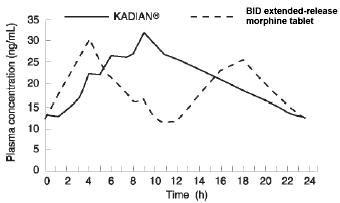
When given once-daily (every 24 hours) to 24 patients with malignancy, KADIAN® had a similar Cmax and higher Cmin at steady state in clinical usage, when compared to twice-daily (every 12 hours) extended-release morphine tablets, given at an equivalent total daily dosage (see Graph 2 and Table 1). Drug-disease interactions are frequently seen in the older and more gravely ill patients, and may result in both altered absorption and reduced clearance as compared to normal volunteers (see Geriatric, Hepatic Failure, and Renal Insufficiency sections).
Graph 2 (Study # MOR-9/92): Dose normalized mean steady state plasma morphine concentrations for KADIAN® (once a day), and an equivalent dose of a 12-hour, extended-release morphine tablet given twice a day. Plasma concentrations are normalized to 100 mg every 24 hours, (n=24).
Graph 2 (Aa369910 Figure 03)
Once absorbed, morphine is distributed to skeletal muscle, kidneys, liver, intestinal tract, lungs, spleen and brain. The volume of distribution of morphine is approximately 3 to 4 L/kg. Morphine is 30 to 35% reversibly bound to plasma proteins. Although the primary site of action of morphine is in the CNS, only small quantities pass the blood-brain barrier. Morphine also crosses the placental membranes (see PRECAUTIONS-Pregnancy) and has been found in breast milk (see PRECAUTIONS-Nursing Mothers).
Metabolism
The major pathway of the detoxification of morphine is conjugation, either with D-glucuronic acid in the liver to produce glucuronides or with sulfuric acid to give morphine-3-etheral sulfate. Although a small fraction (less than 5%) of morphine is demethylated, for all practical purposes, virtually all morphine is converted to glucuronide metabolites including morphine-3-glucuronide, M3G (about 50%) and morphine-6-glucuronide, M6G (about 5 to 15%). Studies in healthy subjects and cancer patients have shown that the glucuronide metabolite to morphine mean molar ratios (based on AUC) are similar after both single doses and at steady state for KADIAN®, 12-hour extended-release morphine sulfate tablets and morphine sulfate solution.
M3G has no significant analgesic activity. M6G has been shown to have opioid agonist and analgesic activity in humans.
Excretion
Approximately 10% of morphine dose is excreted unchanged in the urine. Most of the dose is excreted in the urine as M3G and M6G. A small amount of the glucuronide metabolites is excreted in the bile and there is some minor enterohepatic cycling. Seven to 10% of administered morphine is excreted in the feces.
The mean adult plasma clearance is about 20-30 mL/minute/kg. The effective terminal half-life of morphine after IV administration is reported to be approximately 2.0 hours. Longer plasma sampling in some studies suggests a longer terminal half-life of morphine of about 15 hours.
Special Populations Geriatric
The elderly may have increased sensitivity to morphine and may achieve higher and more variable serum levels than younger patients. In adults, the duration of analgesia increases progressively with age, though the degree of analgesia remains unchanged. KADIAN® pharmacokinetics have not been investigated in elderly patients (>65 years) although such patients were included in the clinical studies.
Nursing Mothers
Morphine is excreted in the maternal milk, and the milk to plasma morphine AUC ratio is about 2.5:1. The amount of morphine received by the infant depends on the maternal plasma concentration, amount of milk ingested by the infant, and the extent of first pass metabolism.
Pediatric
Infants under 1 month of age have a prolonged elimination half-life and decreased clearance relative to older infants and pediatric patients. The clearance of morphine and its elimination half-life begin to approach adult values by the second month of life. Pediatric patients old enough to take capsules should have pharmacokinetic parameters similar to adults, dosed on a per kilogram basis (see PRECAUTIONS-Pediatric Use).
Gender
No meaningful differences between male and female patients were demonstrated in the analysis of the pharmacokinetic data from clinical studies.
Race
Pharmacokinetic differences due to race may exist. Chinese subjects given intravenous morphine in one study had a higher clearance when compared to caucasian subjects (1852 ± 116 mL/min versus 1495 ± 80 mL/min).
Hepatic Failure
The pharmacokinetics of morphine were found to be significantly altered in individuals with alcoholic cirrhosis. The clearance was found to decrease with a corresponding increase in half-life. The M3G and M6G to morphine plasma AUC ratios also decreased in these patients indicating a decrease in metabolic activity.
Renal Insufficiency
The pharmacokinetics of morphine are altered in renal failure patients. AUC is increased and clearance is decreased. The metabolites, M3G and M6G accumulate several fold in renal failure patients compared with healthy subjects.
Drug-Drug Interactions
The known drug interactions involving morphine are pharmacodynamic, not pharmacokinetic (see PRECAUTIONS-Drug Interactions).