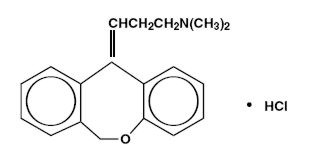
Information for PatientsPrescribers or other health professionals should inform patients,
their families, and their caregivers about the benefits and risks associated
with treatment with doxepin and should counsel them in its appropriate use. A
patient Medication Guide about "Antidepressant Medicines, Depression and other
Serious Mental Illness and Suicidal Thoughts or Actions" is available for
doxepin. The prescriber or health professional should instruct patients, their
families, and their caregivers to read the Medication Guide and should assist
them in understanding its contents. Patients should be given the opportunity to
discuss the contents of the Medication Guide and to obtain answers to any
questions they may have. The complete text of the Medication Guide is reprinted
at the end of this document.
Patients should be advised of the following issues and asked to alert their
prescriber if these occur while taking doxepin.
Clinical Worsening and Suicide RiskPatients, their families and their caregivers should be
encouraged to be alert to the emergence of anxiety, agitation, panic attacks,
insomnia, irritability, hostility, aggressiveness, impulsivity, akathisia
(psychomotor restlessness), hypomania, mania, other unusual changes in behavior,
worsening of depression, and suicidal ideation, especially early during
antidepressant treatment and when the dose is adjusted up or down. Families and
caregivers of patients should be advised to look for the emergence of such
symptoms on a day to day basis, since changes may be abrupt. Such symptoms
should be reported to the patient's prescriber or health professional,
especially if they are severe, abrupt in onset, or were not part of the
patient's presenting symptoms. Symptoms such as these may be associated with an
increased risk for suicidal thinking and behavior and indicate a need for very
close monitoring and possibly changes in the medication.
Drug Interactions
Drugs Metabolized by P450 2D6
The biochemical activity of the drug metabolizing isozyme
cytochrome P450 2D6 (debrisoquin hydroxylase) is reduced in a subset of the
Caucasian population (about 7 to 10% of Caucasians are so called "poor
metabolizers"); reliable estimates of the prevalence of reduced P450 2D6 isozyme
activity among Asian, African and other populations are not yet available. Poor
metabolizers have higher than expected plasma concentrations of tricyclic
antidepressants (TCAs) when given usual doses. Depending on the fraction of drug
metabolized by P450 2D6, the increase in plasma concentration may be small, or
quite large (8-fold increase in plasma AUC of the TCA).
In addition, certain drugs inhibit the activity of this isozyme and make
normal metabolizers resemble poor metabolizers. An individual who is stable on a
given dose of TCA may become abruptly toxic when given one of these inhibiting
drugs as concomitant therapy. The drugs that inhibit cytochrome P450 2D6 include
some that are not metabolized by the enzyme (quinidine; cimetidine) and many
that are substrates for P450 2D6 (many other antidepressants, phenothiazines,
and the Type 1C antiarrhythmics propafenone and flecainide). While all the
selective serotonin reuptake inhibitors (SSRIs), e.g., citalopram, escitalopram,
fluoxetine, sertraline, and paroxetine, inhibit P450 2D6, they may vary in the
extent of inhibition. The extent to which SSRI-TCA interactions may pose
clinical problems will depend on the degree of inhibition and the
pharmacokinetics of the SSRI involved. Nevertheless, caution is indicated in the
coadministration of TCAs with any of the SSRIs and also in switching from one
class to the other. Of particular importance, sufficient time must elapse before
initiating TCA treatment in a patient being withdrawn from fluoxetine, given the
long half-life of the parent and active metabolite (at least 5 weeks may be
necessary).
Concomitant use of tricyclic antidepressants with drugs that can inhibit
cytochrome P450 2D6 may require lower doses than usually prescribed for either
the tricyclic antidepressant or the other drug. Furthermore, whenever one of
these other drugs is withdrawn from cotherapy, an increased dose of tricyclic
antidepressant may be required. It is desirable to monitor TCA plasma levels
whenever a TCA is going to be coadministered with another drug known to be an
inhibitor of P450 2D6.
Doxepin is primarily metabolized by CYP2D6 (with CYP1A2 and CYP3A4 as minor
pathways). Inhibitors or substrates of CYP2D6 (i.e., quinidine, selective
serotonin reuptake inhibitors [SSRIs]) may increase the plasma concentration of
doxepin when administered concomitantly. The extent of interaction depends on
the variability of effect on CYP2D6. The clinical significance of this
interaction with doxepin has not been systematically evaluated.
MAO InhibitorsSerious side effects and even death have been reported following
the concomitant use of certain drugs with MAO inhibitors. Therefore, MAO
inhibitors should be discontinued at least two weeks prior to the cautious
initiation of therapy with doxepin. The exact length of time may vary and is
dependent upon the particular MAO inhibitor being used, the length of time it
has been administered, and the dosage involved.
CimetidineCimetidine has been reported to produce clinically significant
fluctuations in steady-state serum concentrations of various tricyclic
antidepressants. Serious anticholinergic symptoms (i.e., severe dry mouth,
urinary retention and blurred vision) have been associated with elevations in
the serum levels of tricyclic antidepressant when cimetidine therapy is
initiated. Additionally, higher than expected tricyclic antidepressant levels
have been observed when they are begun in patients already taking cimetidine. In
patients who have been reported to be well controlled on tricyclic
antidepressants receiving concurrent cimetidine therapy, discontinuation of
cimetidine has been reported to decrease established steady-state serum
tricyclic antidepressant levels and compromise their therapeutic effects.
AlcoholIt should be borne in mind that alcohol ingestion may increase
the danger inherent in any intentional or unintentional doxepin overdosage. This
is especially important in patients who may use alcohol excessively.
TolazamideA case of severe hypoglycemia has been reported in a type II
diabetic patient maintained on tolazamide (1 gm/day) 11 days after the addition
of doxepin (75 mg/day).
DrowsinessSince drowsiness may occur with the use of this drug, patients
should be warned of the possibility and cautioned against driving a car or
operating dangerous machinery while taking the drug. Patients should also be
cautioned that their response to alcohol may be potentiated.
Sedating drugs may cause confusion and over sedation in the elderly; elderly
patients generally should be started on low doses of doxepin and observed
closely (see PRECAUTIONS: Geriatric Use).
SuicideSince suicide is an inherent risk in any depressed patient and
may remain so until significant improvement has occurred, patients should be
closely supervised during the early course of therapy. Prescriptions should be
written for the smallest feasible amount.
PsychosisShould increased symptoms of psychosis or shift to manic
symptomatology occur, it may be necessary to reduce dosage or add a major
tranquilizer to the dosage regimen.
Pediatric UseSafety and effectiveness in the pediatric population have not
been established (see BOX WARNING and WARNINGS: Clinical Worsening and Suicide Risk).
Anyone considering the use of doxepin in a child or adolescent must balance
the potential risks with the clinical need.
Geriatric UseA determination has not been made whether controlled clinical
studies of doxepin included sufficient numbers of subjects aged 65 and over to
define a difference in response from younger subjects. Other reported clinical
experience has not identified differences in responses between the elderly and
younger patients. In general, dose selection for an elderly patient should be
cautious, usually starting at the low end of the dosing range, reflecting the
greater frequency of decreased hepatic, renal or cardiac function, and of
concomitant disease or other drug therapy.
The extent of renal excretion of doxepin has not been determined. Because
elderly patients are more likely to have decreased renal function, care should
be taken in dose selections.
Sedating drugs may cause confusion and over sedation in the elderly; elderly
patients generally should be started on low doses of doxepin and observed
closely. (See WARNINGS.)