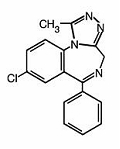
Side effects to alprazolam, if they occur, are generally observed at the beginning of therapy and usually disappear upon continued medication. In the usual patient, the most frequent side effects are likely to be an extension of the pharmacological activity of alprazolam, eg, drowsiness or lightheadedness.
The data cited in the two tables below are estimates of untoward clinical event incidence among patients who participated under the following clinical conditions: relatively short duration (ie, four weeks) placebo-controlled clinical studies with dosages up to 4 mg/day of alprazolam (for the management of anxiety disorders or for the short-term relief of the symptoms of anxiety) and short-term (up to ten weeks) placebo-controlled clinical studies with dosages up to 10 mg/day of alprazolam in patients with panic disorder, with or without agoraphobia.
These data cannot be used to predict precisely the incidence of untoward events in the course of usual medical practice where patient characteristics, and other factors often differ from those in clinical trials. These figures cannot be compared with those obtained from other clinical studies involving related drug products and placebo as each group of drug trials are conducted under a different set of conditions.
Comparison of the cited figures, however, can provide the prescriber with some basis for estimating the relative contributions of drug and non-drug factors to the untoward event incidence in the population studied. Even this use must be approached cautiously, as a drug may relieve a symptom in one patient but induce it in others. (For example, an anxiolytic drug may relieve dry mouth [a symptom of anxiety] in some subjects but induce it [an untoward event] in others.)
Additionally, for anxiety disorders the cited figures can provide the prescriber with an indication as to the frequency with which physician intervention (eg, increased surveillance, decreased dosage or discontinuation of drug therapy) may be necessary because of the untoward clinical event.
Treatment-Emergent Adverse Events Reported in Placebo-Controlled Trials of Anxiety Disorders | ANXIETY DISORDERS | |
|---|
| Treatment-Emergent
Symptom IncidenceEvents reported by 1% or more of alprazolam patients are included. | Incidence of Intervention Because of Symptom |
|---|
| ALPRAZOLAM | PLACEBO | ALPRAZOLAM |
|---|
Number of Patients % of Patients Reporting: | 565 | 505 | 565 |
| Central Nervous System | | | |
| Drowsiness | 41.0 | 21.6 | 15.1 |
| Lightheadedness | 20.8 | 19.3 | 1.2 |
| Depression | 13.9 | 18.1 | 2.4 |
| Headache | 12.9 | 19.6 | 1.1 |
| Confusion | 9.9 | 10.0 | 0.9 |
| Insomnia | 8.9 | 18.4 | 1.3 |
| Nervousness | 4.1 | 10.3 | 1.1 |
| Syncope | 3.1 | 4.0 | None reported |
| Dizziness | 1.8 | 0.8 | 2.5 |
| Akathisia | 1.6 | 1.2 | |
| Tiredness/Sleepiness | | | 1.8 |
| Gastrointestinal | | | |
| Dry Mouth | 14.7 | 13.3 | 0.7 |
| Constipation | 10.4 | 11.4 | 0.9 |
| Diarrhea | 10.1 | 10.3 | 1.2 |
| Nausea/Vomiting | 9.6 | 12.8 | 1.7 |
| Increased Salivation | 4.2 | 2.4 | |
| Cardiovascular | | | |
| Tachycardia/Palpitations | 7.7 | 15.6 | 0.4 |
| Hypotension | 4.7 | 2.2 | |
| Sensory | | | |
| Blurred Vision | 6.2 | 6.2 | 0.4 |
| Musculoskeletal | | | |
| Rigidity | 4.2 | 5.3 | |
| Tremor | 4.0 | 8.8 | 0.4 |
| Cutaneous | | | |
| Dermatitis/Allergy | 3.8 | 3.1 | 0.6 |
| Other | | | |
| Nasal Congestion | 7.3 | 9.3 | |
| Weight Gain | 2.7 | 2.7 | |
| Weight Loss | 2.3 | 3.0 | |
In addition to the relatively common (ie, greater than 1%) untoward events enumerated in the table above, the following adverse events have been reported in association with the use of benzodiazepines: dystonia, irritability, concentration difficulties, anorexia, transient amnesia or memory impairment, loss of coordination, fatigue, seizures, sedation, slurred speech, jaundice, musculoskeletal weakness, pruritus, diplopia, dysarthria, changes in libido, menstrual irregularities, incontinence and urinary retention.
Treatment-Emergent Adverse Events Reported in Placebo-Controlled Trials of Panic Disorder| PANIC DISORDER |
|---|
| Treatment-Emergent
Symptom Incidence
|
|---|
| ALPRAZOLAM | PLACEBO |
|---|
Number of Patients % of Patients Reporting: | 1388 | 1231 |
| | |
| Central Nervous System | | |
| Drowsiness | 76.8 | 42.7 |
| Fatigue and Tiredness | 48.6 | 42.3 |
| Impaired Coordination | 40.1 | 17.9 |
| Irritability | 33.1 | 30.1 |
| Memory Impairment | 33.1 | 22.1 |
| Lightheadedness/Dizziness | 29.8 | 36.9 |
| Insomnia | 29.4 | 41.8 |
| Headache | 29.2 | 35.6 |
| Cognitive Disorder | 28.8 | 20.5 |
| Dysarthria | 23.3 | 6.3 |
| Anxiety | 16.6 | 24.9 |
| Abnormal Involuntary Movement | 14.8 | 21.0 |
| Decreased Libido | 14.4 | 8.0 |
| Depression | 13.8 | 14.0 |
| Confusional State | 10.4 | 8.2 |
| Muscular Twitching | 7.9 | 11.8 |
| Increased Libido | 7.7 | 4.1 |
| Change in Libido (Not Specified) | 7.1 | 5.6 |
| Weakness | 7.1 | 8.4 |
| Muscle Tone Disorders | 6.3 | 7.5 |
| Syncope | 3.8 | 4.8 |
| Akathisia | 3.0 | 4.3 |
| Agitation | 2.9 | 2.6 |
| Disinhibition | 2.7 | 1.5 |
| Paresthesia | 2.4 | 3.2 |
| Talkativeness | 2.2 | 1.0 |
| Vasomotor Disturbances | 2.0 | 2.6 |
| Derealization | 1.9 | 1.2 |
| Dream Abnormalities | 1.8 | 1.5 |
| Fear | 1.4 | 1.0 |
| Feeling Warm | 1.3 | 0.5 |
| Gastrointestinal | | |
| Decreased Salivation | 32.8 | 34.2 |
| Constipation | 26.2 | 15.4 |
| Nausea/Vomiting | 22.0 | 31.8 |
| Diarrhea | 20.6 | 22.8 |
| Abdominal Distress | 18.3 | 21.5 |
| Increased Salivation | 5.6 | 4.4 |
| Cardio-Respiratory | | |
| Nasal Congestion | 17.4 | 16.5 |
| Tachycardia | 15.4 | 26.8 |
| Chest Pain | 10.6 | 18.1 |
| Hyperventilation | 9.7 | 14.5 |
| Upper Respiratory Infection | 4.3 | 3.7 |
| Sensory | | |
| Blurred Vision | 21.0 | 21.4 |
| Tinnitus | 6.6 | 10.4 |
| Musculoskeletal | | |
| Muscular Cramps | 2.4 | 2.4 |
| Muscle Stiffness | 2.2 | 3.3 |
| Cutaneous | | |
| Sweating | 15.1 | 23.5 |
| Rash | 10.8 | 8.1 |
| Other | | |
| Increased Appetite | 32.7 | 22.8 |
| Decreased Appetite | 27.8 | 24.1 |
| Weight Gain | 27.2 | 17.9 |
| Weight Loss | 22.6 | 16.5 |
| Micturition Difficulties | 12.2 | 8.6 |
| Menstrual Disorders | 10.4 | 8.7 |
| Sexual Dysfunction | 7.4 | 3.7 |
| Edema | 4.9 | 5.6 |
| Incontinence | 1.5 | 0.6 |
| Infection | 1.3 | 1.7 |
In addition to the relatively common (ie, greater than 1%) untoward events enumerated in the table above, the following adverse events have been reported in association with the use of alprazolam: seizures, hallucinations, depersonalization, taste alterations, diplopia, elevated bilirubin, elevated hepatic enzymes, and jaundice.
Panic disorder has been associated with primary and secondary major depressive disorders and increased reports of suicide among untreated patients (see PRECAUTIONS, General).