Absorption
Naproxen
At steady state following administration of VIMOVO twice daily, peak plasma concentrations of naproxen are reached on average 3 hours following both the morning and the evening dose.
Bioequivalence between VIMOVO and enteric-coated naproxen, based on both area under the plasma concentration-time curve (AUC) and maximum plasma concentration (Cmax) of naproxen, has been demonstrated for both the 375 mg and 500 mg doses.
Naproxen is absorbed from the gastrointestinal tract with an in vivo bioavailability of 95%.
Steady-state levels of naproxen are reached in 4 to 5 days.
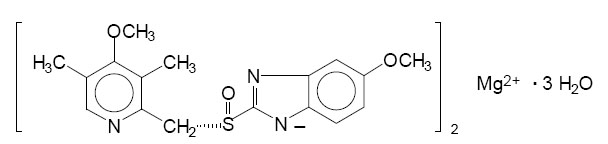
Esomeprazole
Following administration of VIMOVO twice daily, esomeprazole is rapidly absorbed with peak plasma concentration reached within on average, 0.43 to 1.2 hours, following the morning and evening dose on both the first day of administration and at steady state. The peak plasma concentrations of esomeprazole are higher at steady state compared to on first day of dosing of VIMOVO.
Figure 1 represents the pharmacokinetics of naproxen and esomeprazole following administration of VIMOVO 500 mg/20 mg.
Figure 1: Mean plasma concentrations of naproxen and esomeprazole following single dose administration of VIMOVO (500mg/20 mg)

Figure 1 (Vimovo Figureone)
Food effect
Administration of VIMOVO together with high-fat food in healthy volunteers does not affect the extent of absorption of naproxen but significantly prolongs tmax by 10 hours and decreases peak plasma concentration (Cmax) by about 12%.
Administration of VIMOVO together with high-fat food in healthy volunteers delays tmax of esomeprazole by 1 hour and significantly reduces the extent of absorption, resulting in 52% and 75% reductions of area under the plasma concentration versus time curve (AUC) and peak plasma concentration (Cmax), respectively.
Administration of VIMOVO 30 minutes before high-fat food intake in healthy volunteers does not affect the extent of absorption of naproxen but delays the absorption by about 4 hours and decreases peak plasma concentration (Cmax) by about 17%, but has no significant effect on the rate or extent of esomeprazole absorption compared to administration under fasted conditions [see Dosage and Administration (2)].
Administration of VIMOVO 60 minutes before high-fat food intake in healthy volunteers has no effect on the rate and extent of naproxen absorption; however, increases the esomeprazole AUC by 25% and Cmax by 50% compared to administration under fasted conditions. This increase in esomeprazole Cmax does not raise a safety issue since the approved dosing regimen of esomeprazole at 40 mg QD would result in higher Cmax [see Dosage and Administration (2)].
Therefore, VIMOVO should be taken at least 30 minutes before the meal.
Distribution
Naproxen
Naproxen has a volume of distribution of 0.16 L/kg. At therapeutic levels naproxen is greater than 99% albumin-bound. At doses of naproxen greater than 500 mg/day there is less than proportional increase in plasma levels due to an increase in clearance caused by saturation of plasma protein binding at higher doses (average trough Css 36.5, 49.2 and 56.4 mg/L with 500, 1000 and 1500 mg daily doses of naproxen, respectively). The naproxen anion has been found in the milk of lactating women at a concentration equivalent to approximately 1% of maximum naproxen concentration in plasma [see Use in Specific Populations (8.3)].
Esomeprazole
The apparent volume of distribution at steady state in healthy subjects is approximately 16L. Esomeprazole is 97% plasma protein bound.
Metabolism
Naproxen
Naproxen is extensively metabolized in the liver by the cytochrome P450 system (CYP), CYP2C9 and CYP1A2, to 6-0-desmethyl naproxen. Neither the parent drug nor the metabolites induce metabolizing enzymes. Both naproxen and 6-0-desmethyl naproxen are further metabolized to their respective acylglucuronide conjugated metabolites. Consistent with the half-life of naproxen, the area under the plasma concentration time curve increases with repeated dosing of VIMOVO twice daily.
Esomeprazole
Esomeprazole is extensively metabolized in the liver by the CYP enzyme system. The major part of the metabolism of esomeprazole is dependent on the polymorphic CYP2C19, responsible for the formation of the hydroxyl- and desmethyl metabolites of esomeprazole. The remaining part is dependent on another specific isoform CYP3A4, responsible for the formation of esomeprazole sulphone, the main metabolite in plasma. The major metabolites of esomeprazole have no effect on gastric acid secretion.
The area under the plasma esomeprazole concentration-time curve increases with repeated administration of VIMOVO. This increase is dose-dependent and results in a non-linear dose-AUC relationship after repeated administration. An increased absorption of esomeprazole with repeated administration of VIMOVO probably also contributes to the time-and dose-dependency.
Excretion
Naproxen
Following administration of VIMOVO twice daily, the mean elimination half-life for naproxen is approximately 15 hours following the evening dose, with no change with repeated dosing.
The clearance of naproxen is 0.13 mL/min/kg. Approximately 95% of the naproxen from any dose is excreted in the urine, primarily as naproxen (<1%), 6-0-desmethyl naproxen (<1%) or their conjugates (66% to 92%). Small amounts, 3% or less of the administered dose, are excreted in the feces. In patients with renal failure, metabolites may accumulate [see Warnings and Precautions (5.6, 5.7)].
Esomeprazole
Following administration of VIMOVO twice daily, the mean elimination half-life of esomeprazole is approximately 1 hour following both the morning and evening dose on day 1, with a slightly longer elimination half-life at steady state (1.2-1.5 hours).
Almost 80% of an oral dose of esomeprazole is excreted as metabolites in the urine, the remainder in the feces. Less than 1% of the parent drug is found in the urine.
Special Populations
Geriatric Patients
There is no specific data on the pharmacokinetics of VIMOVO in patients over age 65.
Studies indicate that although total plasma concentration of naproxen is unchanged, the unbound plasma fraction of naproxen is increased in the elderly, although the unbound fraction is <1% of the total naproxen concentration. Unbound trough naproxen concentrations in elderly subjects have been reported to range from 0.12% to 0.19% of total naproxen concentration, compared with 0.05% to 0.075% in younger subjects. The clinical significance of this finding is unclear, although it is possible that the increase in free naproxen concentration could be associated with an increase in the rate of adverse events per a given dosage in some elderly patients [see Adverse Reactions (6) and Use in Specific Populations (8.5)].
The AUC and Cmax values of esomeprazole were slightly higher (25% and 18%, respectively) in the elderly as compared to younger subjects at steady state. Dosage adjustment for the esomeprazole component based on age is not necessary.
Race
Pharmacokinetic differences due to race have not been studied for naproxen.
Approximately 3% of Caucasians and 15 to 20% of Asians lack a functional CYP2C19 enzyme and are called poor metabolizers. In these individuals the metabolism of esomeprazole is probably mainly catalyzed by CYP3A4. After repeated once-daily administration of 40 mg esomeprazole, the mean area under the plasma concentration-time curve was approximately 100% higher in poor metabolizers than in subjects having a functional CYP2C19 enzyme (extensive metabolizers).
Hepatic Insufficiency
The pharmacokinetics of VIMOVO or naproxen have not been determined in subjects with hepatic impairment.
In patients with severe hepatic impairment, VIMOVO should be avoided due to increase of risk of NSAID associated bleeding and/or renal failure associated with naproxen.
Chronic alcoholic liver disease and probably also other forms of cirrhosis reduce the total plasma concentration of naproxen, but the plasma concentration of unbound naproxen is increased. The implication of this finding for the naproxen component of VIMOVO dosing is unknown but it is prudent to use the lowest effective dose.
The AUCs of esomeprazole in patients with severe hepatic insufficiency (Child Pugh Class C) have been shown to be 2-3 times higher than in patients with normal liver function. For this reason, it has been recommended that esomeprazole doses not exceed 20 mg daily in patients with severe hepatic impairment. However, there is no dose adjustment necessary for patients with Child Pugh Class A and B for the esomeprazole component of VIMOVO. There is no VIMOVO dosage form that contains less than 20 mg esomeprazole for twice daily dosing [see Dosage and Administration (2), Warnings and Precautions (5.11), and Use in Specific Populations (8.6)].
Renal Insufficiency
The pharmacokinetics of VIMOVO or naproxen have not been determined in subjects with renal impairment.
Given that naproxen, its metabolites and conjugates are primarily excreted by the kidney, the potential exists for naproxen metabolites to accumulate in the presence of renal insufficiency. Elimination of naproxen is decreased in patients with severe renal impairment. Naproxen-containing products, including VIMOVO, is not recommended for use in patients with moderate to severe and severe renal impairment (creatinine clearance <30 ml/min) [see Dosage and Administration (2), Warnings and Precautions (5.6, 5.7), and Use in Specific Populations (8.7)].
No studies have been performed with esomeprazole in patients with decreased renal function. Since the kidney is responsible for the excretion of the metabolites of esomeprazole but not for the elimination of the parent compound, the metabolism of esomeprazole is not expected to be changed in patients with impaired renal function.
Gender
The AUC and Cmax values of esomeprazole were slightly higher (13%) in females than in males at steady state. Dosage adjustment for the esomeprazole component based on gender is not necessary.