Other
Adenosine injection, USP is indicated as an adjunct to thallium-201 myocardial perfusion scintigraphy in patients unable to exercise adequately.
The recommended adenosine injection dose is 0.14 mg/kg/min infused over six minutes (total dose of 0.84 mg/kg) (Table 1).
- Administer adenosine injection only as a continuous peripheral intravenous infusion
- Inject Thallium-201 at the midpoint of the adenosine injection infusion (i.e., after the first three minutes of adenosine injection)
- Thallium-201 is physically compatible with adenosine injection and may be injected directly into the adenosine injection infusion set
- Inject Thallium-201 as close to the venous access as possible to prevent an inadvertent increase in the dose of adenosine injection (the contents of the intravenous tubing) being administered
- Second- or third-degree AV block (except in patients with a functioning artificial pacemaker) [see Warnings and Precautions (5.2)]
- Sinus node disease, such as sick sinus syndrome or symptomatic bradycardia (except in patients with a functioning artificial pacemaker) [see Warnings and Precautions (5.2)]
- Known or suspected bronchoconstrictive or bronchospastic lung disease (e.g., asthma) [see Warnings and Precautions (5.3)]
- Known hypersensitivity to adenosine [see Warnings and Precautions (5.7)]
- Fatal Cardiac Arrest, Ventricular Arrhythmias, and Myocardial Infarction [see Warnings and Precautions (5.1)]
- Sinoatrial and Atrioventricular Nodal Block [seeWarnings and Precautions (5.2)]
- Bronchoconstriction [see Warnings and Precautions (5.3)]
- Hypotension [see Warnings and Precautions (5.4)]
- Cerebrovascular Accident [see Warnings and Precautions (5.5)]
- Seizures [see Warnings and Precautions (5.6)]
- Hypersensitivity [see Warnings and Precautions (5.7)]
- Atrial fibrillation [see Warnings and Precautions (5.8)]
- Hypertension [see Warnings and Precautions (5.9)]
Visually inspect adenosine injection for particulate matter and discoloration prior to administration. Do not administer adenosine injection if it contains particulate matter or is discolored.
There are no data on the safety or efficacy of alternative adenosine injection infusion protocols. The safety and efficacy of adenosine injection administered by the intracoronary route have not been established.
| Patient Weight (kilograms) | Infusion Rate (mL per minute over 6 minutes for total dose of 0.84 mg/kg) |
| 45 | 2.1 |
| 50 | 2.3 |
| 55 | 2.6 |
| 60 | 2.8 |
| 65 | 3 |
| 70 | 3.3 |
| 75 | 3.5 |
| 80 | 3.8 |
| 85 | 4 |
| 90 | 4.2 |
The nomogram displayed in Table 1 was derived from the following general formula:

Formula (68f66df7 6aa0 481c 99b9 4314a3736ed1 01)
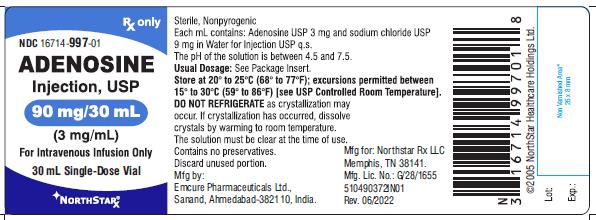
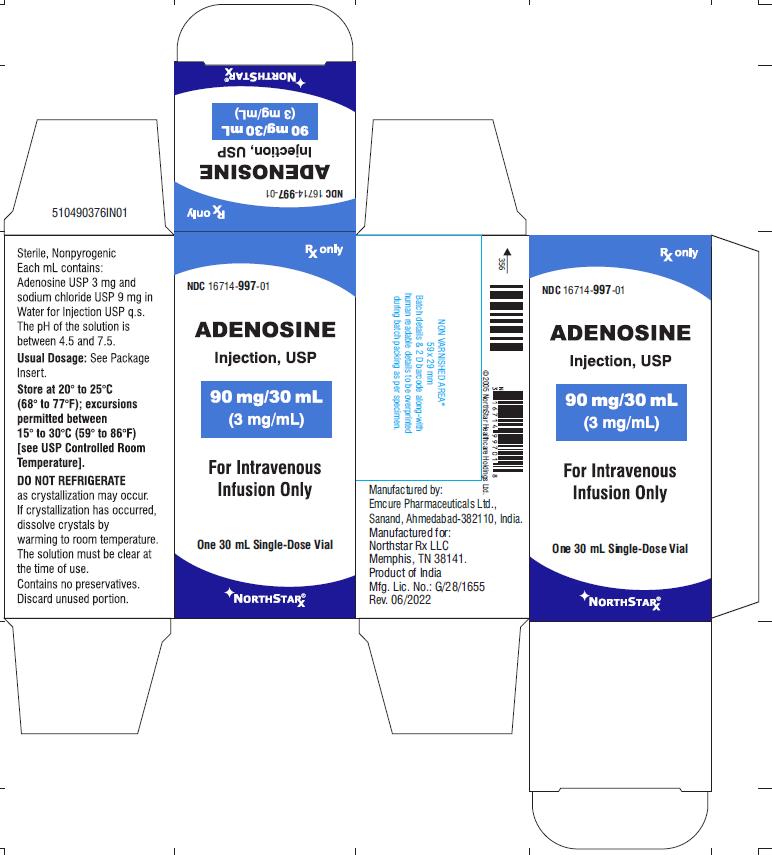
Adenosine injection, USP is supplied as 20 mL and 30 mL single-dose vials containing a sterile, nonpyrogenic, clear solution of adenosine 3 mg/mL.
Adenosine injection is contraindicated in patients with:
The following adverse reactions are discussed in more detail in other sections of the prescribing information: