Other
Suicidality and Antidepressant Drugs
Antidepressants increased the risk compared to placebo of suicidal thinking and behavior (suicidality) in children, adolescents, and young adults in short-term studies of major depressive disorder (MDD) and other psychiatric disorders. Anyone considering the use of clomipramine hydrochloride or any other antidepressant in a child, adolescent, or young adult must balance this risk with the clinical need. Short-term studies did not show an increase in the risk of suicidality with antidepressants compared to placebo in adults beyond age 24; there was a reduction in risk with antidepressants compared to placebo in adults aged 65 and older. Depression and certain other psychiatric disorders are themselves associated with increases in the risk of suicide. Patients of all ages who are started on antidepressant therapy should be monitored appropriately and observed closely for clinical worsening, suicidality, or unusual changes in behavior. Families and caregivers should be advised of the need for close observation and communication with the prescriber. Clomipramine hydrochloride is not approved for use in pediatric patients except for patients with obsessive compulsive disorder (OCD) (see WARNINGS, Clinical Worsening and Suicide Risk; PRECAUTIONS, Information for Patients; and PRECAUTIONS, Pediatric Use).
Clomipramine hydrochloride capsules, USP are an antiobsessional drug that belongs to the class (dibenzazepine) of pharmacologic agents known as tricyclic antidepressants. Clomipramine hydrochloride is available as capsules of 25, 50, and 75 mg for oral administration.
Clomipramine hydrochloride, USP is 3-chloro-5-[3-(dimethylamino) propyl]-10, 11-dihydro 5H-dibenz[b,f ] azepine monohydrochloride, and its structural formula is:

Clomipramine HCl Capsule (993bcac0 Bb8f 4593 B89a B78f0f6fbebd 01)
Molecular Formula = C19H23ClN2.HCl
Molecular Weight = 351.31
Clomipramine hydrochloride, USP is a white or slightly yellow, crystalline powder, slightly hygroscopic. It is very soluble in water.
Each capsule contains clomipramine hydrochloride USP, 25 mg or 50 mg or 75 mg and inactive ingredients: colloidal silicon dioxide, microcrystalline cellulose, magnesium stearate and pregelatinized starch. Additionally, hard gelatin capsule shell contains: D&C red 33, D&C yellow 10 (25 mg), D&C red 28 (25 mg and 75 mg), FD&C red 40, FD&C blue 1(25.mg and 75 mg), gelatin, iron oxide yellow (50 mg), sodium lauryl sulfate, titanium dioxide and water. Each capsule is imprinted with black pharmaceutical ink which contains ammonia solution, butyl alcohol, dehydrated alcohol, ferrosoferric oxide, isopropyl alcohol, potassium hydroxide, propylene glycol, purified water and shellac.
The Product meets USP Dissolution Test # 2.
Clomipramine hydrochloride capsules, USP are indicated for the treatment of obsessions and compulsions in patients with Obsessive-Compulsive Disorder (OCD). The obsessions or compulsions must cause marked distress, be time-consuming, or significantly interfere with social or occupational functioning, in order to meet the DSM-III-R (circa 1,989) diagnosis of OCD.
Obsessions are recurrent, persistent ideas, thoughts, images, or impulses that are ego dystonic. Compulsions are repetitive, purposeful, and intentional behaviors performed in response to an obsession or in a stereotyped fashion, and are recognized by the person as excessive or unreasonable.
The effectiveness of clomipramine hydrochloride for the treatment of OCD was demonstrated in multicenter, placebo-controlled, parallel-group studies, including two 10-week studies in adults and one 8-week study in children and adolescents 10 to 17 years of age. Patients in all studies had moderate-to-severe OCD (DSM-III), with mean baseline ratings on the Yale-Brown Obsessive Compulsive Scale (YBOCS) ranging from 26 to 28 and a mean baseline rating of 10 on the NIMH Clinical Global Obsessive Compulsive Scale (NIMH-OC). Patients taking CMI experienced a mean reduction of approximately 10 on the YBOCS, representing an average improvement on this scale of 35% to 42% among adults and 37% among children and adolescents. CMI-treated patients experienced a 3.5 unit decrement on the NIMH-OC. Patients on placebo showed no important clinical response on either scale. The maximum dose was 250 mg/day for most adults and 3 mg/kg/day (up to 200 mg) for all children and adolescents.
The effectiveness of clomipramine hydrochloride for long-term use (i.e., for more than 10 weeks) has not been systematically evaluated in placebo-controlled trials. The physician who elects to use clomipramine hydrochloride for extended periods should periodically reevaluate the long-term usefulness of the drug for the individual patient (see DOSAGE AND ADMINISTRATION).
Clomipramine hydrochloride is contraindicated in patients with a history of hypersensitivity to clomipramine hydrochloride or other tricyclic antidepressants.
Monoamine Oxidase Inhibitors (MAOIs)
The use of MAOIs intended to treat psychiatric disorders with clomipramine hydrochloride or within 14 days of stopping treatment with clomipramine hydrochloride is contraindicated because of an increased risk of serotonin syndrome. The use of clomipramine hydrochloride within 14 days of stopping an MAOI intended to treat psychiatric disorders is also contraindicated (see WARNINGS and DOSAGE AND ADMINISTRATION).
Starting clomipramine hydrochloride in a patient who is being treated with linezolid or intravenous methylene blue is also contraindicated because of an increased risk of serotonin syndrome (see WARNINGS and DOSAGE AND ADMINISTRATION).
Myocardial Infarction
Clomipramine hydrochloride is contraindicated during the acute recovery period after a myocardial infarction.
Clomipramine hydrochloride has not been systematically studied in animals or humans for its potential for abuse, tolerance, or physical dependence. While a variety of withdrawal symptoms have been described in association with clomipramine hydrochloride discontinuation (see PRECAUTIONS, Withdrawal Symptoms), there is no evidence for drug-seeking behavior, except for a single report of potential clomipramine hydrochloride abuse by a patient with a history of dependence on codeine, benzodiazepines, and multiple psychoactive drugs. The patient received clomipramine hydrochloride for depression and panic attacks and appeared to become dependent after hospital discharge.
Despite the lack of evidence suggesting an abuse liability for clomipramine hydrochloride in foreign marketing, it is not possible to predict the extent to which clomipramine hydrochloride might be misused or abused once marketed in the U.S. Consequently, physicians should carefully evaluate patients for a history of drug abuse and follow such patients closely.
Deaths may occur from overdosage with this class of drugs. Multiple drug ingestion (including alcohol) is common in deliberate tricyclic overdose. As the management is complex and changing, it is recommended that the physician contact a poison control center for current information on treatment. Signs and symptoms of toxicity develop rapidly after tricyclic overdose. Therefore, hospital monitoring is required as soon as possible.
Human Experience
In U.S. clinical trials, 2 deaths occurred in 12 reported cases of acute overdosage with clomipramine hydrochloride either alone or in combination with other drugs. One death involved a patient suspected of ingesting a dose of 7,000 mg. The second death involved a patient suspected of ingesting a dose of 5,750 mg. The 10 nonfatal cases involved doses of up to 5,000 mg, accompanied by plasma levels of up to 1,010 ng/mL. All 10 patients completely recovered. Among reports from other countries of clomipramine hydrochloride overdose, the lowest dose associated with a fatality was 750 mg. Based upon postmarketing reports in the United Kingdom, CMI's lethality in overdose is considered to be similar to that reported for closely related tricyclic compounds marketed as antidepressants.
Manifestations
Signs and symptoms vary in severity depending upon factors such as the amount of drug absorbed, the age of the patient, and the time elapsed since drug ingestion. Critical manifestations of overdose include cardiac dysrhythmias, severe hypotension, convulsions, and CNS depression including coma. Changes in the electrocardiogram, particularly in QRS axis or width, are clinically significant indicators of tricyclic toxicity. Other CNS manifestations may include drowsiness, stupor, ataxia, restlessness, agitation, delirium, severe perspiration, hyperactive reflexes, muscle rigidity, and athetoid and choreiform movements. Cardiac abnormalities may include tachycardia, signs of congestive heart failure, and in very rare cases, cardiac arrest. Respiratory depression, cyanosis, shock, vomiting, hyperpyrexia, mydriasis, and oliguria or anuria may also be present.
Management
Obtain an ECG and immediately initiate cardiac monitoring. Protect the patient's airway, establish an intravenous line, and initiate gastric decontamination. A minimum of 6 hours of observation with cardiac monitoring and observation for signs of CNS or respiratory depression, hypotension, cardiac dysrhythmias and/or conduction blocks, and seizures is necessary.
If signs of toxicity occur at any time during this period, extended monitoring is required. There are case reports of patients succumbing to fatal dysrhythmias late after overdose; these patients had clinical evidence of significant poisoning prior to death and most received inadequate gastrointestinal decontamination. Monitoring of plasma drug levels should not guide management of the patient.
Gastrointestinal Decontamination
All patients suspected of tricyclic overdose should receive gastrointestinal decontamination. This should include large volume gastric lavage followed by activated charcoal. If consciousness is impaired, the airway should be secured prior to lavage. Emesis is contraindicated.
Cardiovascular
A maximal limb-lead QRS duration of ≥ 0.10 seconds may be the best indication of the severity of the overdose. Intravenous sodium bicarbonate should be used to maintain the serum pH in the range of 7.45 to 7.55. If the pH response is inadequate, hyperventilation may also be used. Concomitant use of hyperventilation and sodium bicarbonate should be done with extreme caution, with frequent pH monitoring. A pH >7.60 or a pCO2 <20 mmHg is undesirable. Dysrhythmias unresponsive to sodium bicarbonate therapy/hyperventilation may respond to lidocaine, bretylium, or phenytoin. Type 1A and 1C antiarrhythmics are generally contraindicated (e.g., quinidine, disopyramide, and procainamide).
In rare instances, hemoperfusion may be beneficial in acute refractory cardiovascular instability in patients with acute toxicity. However, hemodialysis, peritoneal dialysis, exchange transfusions, and forced diuresis generally have been reported as ineffective in tricyclic poisoning.
CNS
In patients with CNS depression, early intubation is advised because of the potential for abrupt deterioration. Seizures should be controlled with benzodiazepines, or if these are ineffective, other anticonvulsants (e.g., phenobarbital, phenytoin). Physostigmine is not recommended except to treat life-threatening symptoms that have been unresponsive to other therapies, and then only in consultation with a poison control center.
Psychiatric Follow-up
Since overdosage is often deliberate, patients may attempt suicide by other means during the recovery phase. Psychiatric referral may be appropriate.
Pediatric Management
The principles of management of child and adult overdosages are similar. It is strongly recommended that the physician contact the local poison control center for specific pediatric treatment.
The treatment regimens described below are based on those used in controlled clinical trials of clomipramine hydrochloride in 520 adults, and 91 children and adolescents with OCD. During initial titration, clomipramine hydrochloride should be given in divided doses with meals to reduce gastrointestinal side effects. The goal of this initial titration phase is to minimize side effects by permitting tolerance to side effects to develop or allowing the patient time to adapt if tolerance does not develop.
Because both CMI and its active metabolite, DMI, have long elimination half-lives, the prescriber should take into consideration the fact that steady-state plasma levels may not be achieved until 2 to 3 weeks after dosage change (see CLINICAL PHARMACOLOGY). Therefore, after initial titration, it may be appropriate to wait 2 to 3 weeks between further dosage adjustments.
Initial Treatment/Dose Adjustment (Adults)
Treatment with clomipramine hydrochloride should be initiated at a dosage of 25 mg daily and gradually increased, as tolerated, to approximately 100 mg during the first 2 weeks. During initial titration, clomipramine hydrochloride should be given in divided doses with meals to reduce gastrointestinal side effects. Thereafter, the dosage may be increased gradually over the next several weeks, up to a maximum of 250 mg daily. After titration, the total daily dose may be given once daily at bedtime to minimize daytime sedation.
Initial Treatment/Dose Adjustment (Children and Adolescents)
As with adults, the starting dose is 25 mg daily and should be gradually increased (also given in divided doses with meals to reduce gastrointestinal side effects) during the first 2 weeks, as tolerated, up to a daily maximum of 3 mg/kg or 100 mg, whichever is smaller. Thereafter, the dosage may be increased gradually over the next several weeks up to a daily maximum of 3 mg/kg or 200 mg, whichever is smaller (see PRECAUTIONS, Pediatric Use). As with adults, after titration, the total daily dose may be given once daily at bedtime to minimize daytime sedation.
Maintenance/Continuation Treatment (Adults, Children, and Adolescents)
While there are no systematic studies that answer the question of how long to continue clomipramine hydrochloride, OCD is a chronic condition and it is reasonable to consider continuation for a responding patient. Although the efficacy of clomipramine hydrochloride after 10 weeks has not been documented in controlled trials, patients have been continued in therapy under double- blind conditions for up to 1 year without loss of benefit. However, dosage adjustments should be made to maintain the patient on the lowest effective dosage, and patients should be periodically reassessed to determine the need for treatment. During maintenance, the total daily dose may be given once daily at bedtime.
Switching a Patient To or From a Monoamine Oxidase Inhibitor (MAOI) Intended to Treat Psychiatric Disorders
At least 14 days should elapse between discontinuation of an MAOI intended to treat psychiatric disorders and initiation of therapy with clomipramine hydrochloride. Conversely, at least 14 days should be allowed after stopping clomipramine hydrochloride before starting an MAOI intended to treat psychiatric disorders (see CONTRAINDICATIONS).
Use of Clomipramine Hydrochloride With Other MAOIs, Such as Linezolid or Methylene Blue
Do not start clomipramine hydrochloride in a patient who is being treated with linezolid or intravenous methylene blue because there is increased risk of serotonin syndrome. In a patient who requires more urgent treatment of a psychiatric condition, other interventions, including hospitalization, should be considered (see CONTRAINDICATIONS).
In some cases, a patient already receiving clomipramine hydrochloride therapy may require urgent treatment with linezolid or intravenous methylene blue. If acceptable alternatives to linezolid or intravenous methylene blue treatment are not available and the potential benefits of linezolid or intravenous methylene blue treatment are judged to outweigh the risks of serotonin syndrome in a particular patient, clomipramine hydrochloride should be stopped promptly, and linezolid or intravenous methylene blue can be administered. The patient should be monitored for symptoms of serotonin syndrome for two weeks or until 24 hours after the last dose of linezolid or intravenous methylene blue, whichever comes first. Therapy with clomipramine hydrochloride may be resumed 24 hours after the last dose of linezolid or intravenous methylene blue (see WARNINGS).
The risk of administering methylene blue by non-intravenous routes (such as oral tablets or by local injection) or in intravenous doses much lower than 1 mg/kg with clomipramine hydrochloride is unclear. The clinician should, nevertheless, be aware of the possibility of emergent symptoms of serotonin syndrome with such use (see WARNINGS).
Clomipramine Hydrochloride Capsules USP, 25 mg are white to off white powder filled in size "2" capsule with opaque pink cap printed with '1065' in black ink and opaque light pink body and are supplied as:
NDC 16714-849-01 in bottle of 30 capsules
NDC 16714-849-02 in bottle of 90 capsules
NDC 16714-849-03 in bottle of 100 capsules
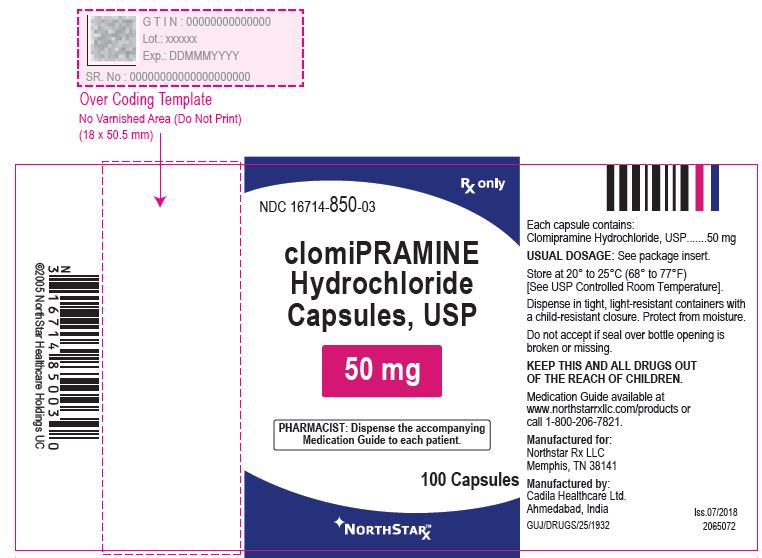
Clomipramine Hydrochloride Capsules USP, 50 mg are white to off white powder filled in size "1" capsule with opaque yellow cap printed with '1066' in black ink and opaque light pink body and are supplied as:
NDC 16714-850-01 in bottle of 30 capsules
NDC 16714-850-02 in bottle of 90 capsules
NDC 16714-850-02 in bottle of 100 capsules
Clomipramine Hydrochloride Capsules USP, 75 mg are white to off white powder filled in size "1" capsule with opaque dark pink cap printed with '1067' in black ink and opaque light pink body and are supplied as:
NDC 16714-851-01 in bottle of 30 capsules
NDC 16714-851-02 in bottle of 90 capsules
NDC 16714-851-03 in bottle of 100 capsules
Storage
Store at 20° to 25°C (68° to 77°F) [see USP Controlled Room Temperature].
Dispense in tight, light-resistant containers with a child-resistant closure. Protect from moisture.
ANIMAL TOXICOLOGY
Phospholipidosis and testicular changes, commonly associated with tricyclic compounds, have been observed with clomipramine hydrochloride. In chronic rat studies, changes related to clomipramine hydrochloride consisted of systemic phospholipidosis, alterations in the testes (atrophy, mineralization) and secondary changes in other tissues. In addition cardiac thrombosis and dermatitis/keratitis were observed in rats treated for 2 years at doses which were 24 and 10 times the maximum recommended human daily dose (MRHD), respectively, on a mg/kg basis, and 4 and 1.5 times the MRHD, respectively, on a mg/m2 basis.
Medication Guide available at www.northstarrxllc.com/products or call 1-800-206-7821.
Manufactured for:
Northstar Rx LLC
Memphis, TN 38141
Manufactured by:
Cadila Healthcare Ltd.
Ahmedabad, India.
Iss.07/2018
Manufactured for:
Northstar Rx LLC
Memphis, TN 38141
Manufactured by:
Cadila Healthcare Ltd.
Ahmedabad, India.
Iss.07/2018