Because clinical trials are conducted under widely varying conditions, adverse reaction rates observed in the clinical trials of a drug cannot be directly compared to rates in the clinical trials of another drug and may not reflect the rates observed in practice.
Small Cell Lung Cancer
Data in the following section are based on the combined experiences of the 879 patients studied, including 426 patients with small cell lung cancer treated with topotecan.
Table 1 lists the principle hematologic adverse reactions and
Table 2 lists non-hematologic adverse reactions occurring in at least 15% of patients.
Table 1. Hematologic Adverse Reactions Experienced in ≥15% of Patients, Including 426 Patients With Small Cell Lung Cancer, Receiving Topotecan| Hematologic Adverse Reaction | Patients (n=879) % Incidence
|
Neutropenia <1,500 cells/mm
3 <500 cells/mm
3 | 97 78
|
Leukopenia <3,000 cells/mm
3 <1,000 cells/mm
3 | 97 32
|
Thrombocytopenia <75,000/mm
3 <25,000/mm
3 | 69 27
|
Anemia <10 g/dL <8 g/dL
| 89 37
|
Table 2. Non-hematologic Adverse Reactions Experienced by ≥15% of 879 Patients, Including 426 Patients With Small Cell Lung Cancer, Receiving TopotecanNon-hematologic Adverse Reaction | Percentage of Patients with Adverse Reaction (879 Patients) |
| All Grades | Grade 3 | Grade 4 |
| | |
| Infections and infestations | | | |
| Sepsis or pyrexia/infection with neutropenia
a | 43 | NR | 23 |
| Metabolism and nutrition disorders | | | |
| Anorexia | 19 | 2 | <1 |
| Nervous system disorders | | | |
| Headache | 18 | 1 | <1 |
| Respiratory, thoracic, and mediastinal disorders | | | |
| Dyspnea | 22 | 5 | 3 |
| Coughing | 15 | 1 | 0 |
| Gastrointestinal disorders | | | |
| Nausea | 64 | 7 | 1 |
| Vomiting | 45 | 4 | 1 |
| Diarrhea | 32 | 3 | 1 |
| Constipation | 29 | 2 | 1 |
| Abdominal pain | 22 | 2 | 2 |
| Stomatitis | 18 | 1 | <1 |
| Skin and subcutaneous tissue disorders | | | |
| Alopecia | 49 | NA | NA |
| Rash
b | 16 | 1 | 0 |
| General disorders and administrative site conditions | | | |
| Fatigue | 29 | 5 | 0 |
| Pyrexia | 28 | 1 | <1 |
| Pain
c | 23 | 2 | 1 |
| Asthenia | 25 | 4 | 2 |
NA = Not applicable
NR = Not reported separately
a Does not include Grade 1 sepsis or pyrexia
b Rash also includes pruritus, rash erythematous, urticaria, dermatitis, bullous eruption, and maculopapular rash.
c Pain includes body pain, back pain, and skeletal pain.
Nervous System Disorders
Paresthesia occurred in 7% of patients but was generally grade 1.
Hepatobiliary Disorders
Grade 1 transient elevations in hepatic enzymes occurred in 8% of patients. Greater elevations, grade 3/4, occurred in 4%. Grade 3/4 elevated bilirubin occurred in <2% of patients.
Table 3 shows the grade 3/4 hematologic and major non-hematologic adverse reactions in the topotecan/CAV comparator trial in small cell lung cancer.
Table 3. Adverse Reactions Experienced by ≥5% of Small Cell Lung Cancer Patients Randomized to Receive Topotecan or CAV
Adverse Reaction | Topotecan (n=107)
| CAV (n=104)
|
| Hematologic Grade 3/4 | % | % |
Grade 4 neutropenia (<500 cells/mm
3)
| 70 | 72 |
Grade 3/4 anemia (Hgb <8 g dL)
| 42 | 20 |
Grade 4 thrombocytopenia (<25,000 plts/mm
3)
| 29 | 5 |
| Pyrexia/Grade 4 neutropenia | 28 | 26 |
| Non-hematologic Grade 3/4 | % | % |
Infections and infestations Documented sepsis
a | 5 | 5 |
Respiratory, thoracic, and mediastinal disorders Dyspnea | 9 | 14 |
| Pneumonia | 8 | 6 |
Gastrointestinal disorders Abdominal pain | 6 | 4 |
| Nausea | 8 | 6 |
General disorders and administrative site conditions Fatigue | 6 | 10 |
| Asthenia | 9 | 7 |
| Pain
b | 5 | 7 |
a Death related to sepsis occurred in 3% of patients receiving topotecan, and in 1% of patients receiving CAV
b Pain includes body pain, skeletal pain, and back pain.
Cervical Cancer
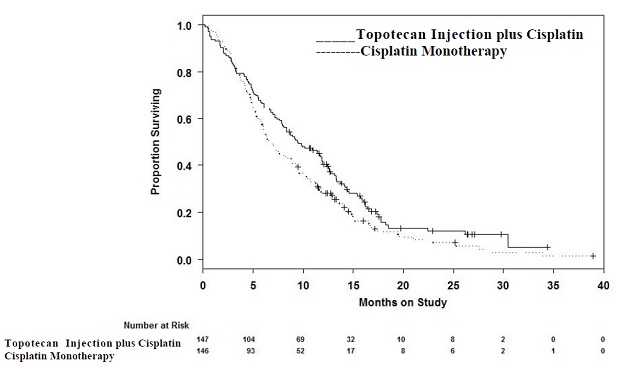
In the comparative trial with Topotecan Injection plus cisplatin versus cisplatin in patients with cervical cancer, the most common dose-limiting adverse reaction was myelosuppression.
Table 4 shows the hematologic adverse reactions and
Table 5 shows the non-hematologic adverse reactions in patients with cervical cancer.
Table 4. Hematologic Adverse Reactions in Patients with Cervical Cancer Treated with Topotecan Injection Plus Cisplatin or Cisplatin Monotherapy
a| Hematologic Adverse Reaction | Topotecan Injection
Plus Cisplatin (n = 140) | Cisplatin (n = 144) |
| Anemia | | |
| All grades (Hgb <12 g/dL) | 131 (94%) | 130 (90%) |
| Grade 3 (Hgb <8 to 6.5 g/dL) | 47 (34%) | 28 (19%) |
| Grade 4 (Hgb <6.5 g/dL) | 9 (6%) | 5 (3%) |
| Leukopenia | | |
| All grades (<3,800 cells/mm
3)
| 128 (91%) | 43 (30%) |
| Grade 3 (<2,000 to 1,000 cells/mm
3)
| 58 (41%) | 1 (1%) |
| Grade 4 (<1,000 cells/mm
3)
| 35 (25%) | 0 (0%) |
| Neutropenia | | |
| All grades (<2,000 cells/mm
3)
| 125 (89%) | 28 (19%) |
| Grade 3 (<1,000 to 500 cells/mm
3)
| 36 (26%) | 1 (1%) |
| Grade 4 (<500 cells/mm
3)
| 67 (48%) | 1 (1%) |
| Thrombocytopenia | | |
| All grades (<130,000 cells/mm
3)
| 104 (74%) | 21 (15%) |
| Grade 3 (<50,000 to 10,000 cells/mm
3)
| 36 (26%) | 5 (3%) |
| Grade 4 (<10,000 cells/mm
3)
| 10 (7%) | 0 (0%) |
a Includes patients who were eligible and treated.
Table 5. Non-hematologic Adverse Reactions Experienced by ≥ 5% of Patients with Cervical Cancer Treated with Topotecan Injection Plus Cisplatin or Cisplatin Monotherapy
a | Topotecan Injection Plus Cisplatin | Cisplatin |
| (n = 140) | (n = 144) |
| Adverse Reaction | All Grades
b | Grade 3 | Grade 4 | All Grades
b | Grade 3 | Grade 4 |
| General disorders and administrative site conditions | | | | | | |
| Constitutional
c | 96 (69%) | 11 (8%) | 0 | 89 (62%) | 17 (12%) | 0 |
| Pain
d | 82 (59%) | 28 (20%) | 3 (2%) | 72 (50%) | 18 (13%) | 5 (3%) |
| Gastrointestinal disorders | | | | | | |
| Vomiting | 56 (40%) | 20 (14%) | 2 (1%) | 53 (37%) | 13 (9%) | 0 |
| Nausea | 77 (55%) | 18 (13%) | 2 (1%) | 79 (55%) | 13 (9%) | 0 |
| Stomatitis-pharyngitis | 8 (6%) | 1 (<1%) | 0 | 0 | 0 | 0 |
| Other | 88 (63%) | 16 (11%) | 4 (3%) | 80 (56%) | 12 (8%) | 3 (2%) |
| Dermatology | 67 (48%) | 1 (<1%) | 0 | 29 (20%) | 0 | 0 |
| Metabolic-Laboratory | 55 (39%) | 13 (9%) | 7 (5%) | 44 (31%) | 14 (10%) | 1 (<1%) |
| Genitourinary | 51 (36%) | 9 (6%) | 9 (6%) | 49 (34%) | 7 (5%) | 7 (5%) |
| Nervous system disorders | | | | | | |
| Neuropathy | 4 (3%) | 1 (<1%) | 0 | 3 (2%) | 1 (<1%) | 0 |
| Other | 49 (35%) | 3 (2%) | 1 (<1%) | 43 (30%) | 7 (5%) | 2 (1%) |
| Infection-febrile neutropenia | 39 (28%) | 21 (15%) | 5 (4%) | 26 (18%) | 11 (8%) | 0 |
| Cardiovascular | 35 (25%) | 7 (5%) | 6 (4%) | 22 (15%) | 8 (6%) | 3 (2%) |
| Hepatic | 34 (24%) | 5 (4%) | 2 (1%) | 23 (16%) | 2 (1%) | 0 |
| Pulmonary | 24 (17%) | 4 (3%) | 0 | 23 (16%) | 5 (3%) | 3 (2%) |
| Vascular disorders | | | | | | |
| Hemorrhage | 21 (15%) | 8 (6%) | 1 (<1%) | 20 (14%) | 3 (2%) | 1 (<1%) |
| Coagulation | 8 (6%) | 4 (3%) | 3 (2%) | 10 (7%) | 7 (5%) | 0 |
| Musculoskeletal | 19 (14%) | 3 (2%) | 0 | 7 (5%) | 1 (<1%) | 1 (<1%) |
| Allergy-Immunology | 8 (6%) | 2 (1%) | 1 (<1%) | 4 (3%) | 0 | 1 (<1%) |
| Endocrine | 8 (6%) | 0 | 0 | 4 (3%) | 2 (1%) | 0 |
| Sexual reproduction function | 7 (5%) | 0 | 0 | 10 (7%) | 1 (<1%) | 0 |
| Ocular-visual | 7 (5%) | 0 | 0 | 7 (5%) | 1 (<1%) | 0 |
Data were collected using NCI Common Toxicity Criteria, v. 2.0.
a Includes patients who were eligible and treated.
b Grades 1 through 4 only. There were 3 patients who experienced grade 5 deaths with investigator-designated attribution. One was a grade 5 hemorrhage in which the drug-related thrombocytopenia aggravated the event. A second patient experienced bowel obstruction, cardiac arrest, pleural effusion and respiratory failure which were not treatment related but probably aggravated by treatment. A third patient experienced a pulmonary embolism and adult respiratory distress syndrome, the latter was indirectly treatment-related.
c Constitutional includes fatigue (lethargy, malaise, asthenia), fever (in the absence of neutropenia), rigors, chills, sweating, and weight gain or loss.
d Pain includes abdominal pain or cramping, arthralgia, bone pain, chest pain (non-cardiac and non-pleuritic), dysmenorrhea, dyspareunia, earache, headache, hepatic pain, myalgia, neuropathic pain, pain due to radiation, pelvic pain, pleuritic pain, rectal or perirectal pain, and tumor pain.